

What Playing With Dogs Teaches Kids: 9 Real Benefits
TL;DR:
- Playing with dogs helps children develop empathy, social skills, and confidence while reducing anxiety. Active dog interactions also promote physical activity and improve reading motivation in young kids. These benefits are supported by research on emotional, social, cognitive, and physical growth.
Dogs are one of the most effective teachers children will ever have, and they never grade on a curve. Research consistently shows that kids who play regularly with dogs develop stronger empathy, better social skills, lower anxiety, and even improved reading confidence compared to children without that canine connection. The benefits of dogs for children go well beyond simple companionship.
Table of Contents
- Quick Summary
- TL;DR
- 1. What playing with dogs teaches kids: core benefits at a glance
- 2. How dogs build empathy and emotional intelligence in children
- 3. Dogs as social catalysts: reducing anxiety and improving peer skills
- 4. Educational benefits: reading confidence and cognitive growth
- 5. Toys and activities that extend dog-play benefits
- 6. Key takeaways on what playing with dogs teaches kids
- 7. How dogs teach kids to read non-verbal communication
- Key Takeaways
- FAQ
- Recommended Reads
Quick Summary
Playing with dogs gives children a natural classroom for emotional and social growth. Key gains include empathy, responsibility, confidence, physical fitness, and stress relief, all backed by peer-reviewed research.
TL;DR
- Dogs trigger oxytocin release in kids, lifting mood for hours after play
- Preschoolers in dog-owning families show fewer peer problems and more prosocial behavior
- Reading aloud to dogs reduces anxiety and builds academic confidence
- Active dog play and walking increase physical activity, especially in girls
- Kids learn fairness, honesty, and non-verbal communication through dog interaction
Table of Contents
- What playing with dogs teaches kids: core benefits at a glance
- How dogs build empathy and emotional intelligence
- Dogs as social catalysts: reducing anxiety and improving peer skills
- Educational benefits: reading confidence and cognitive growth
- Toys and activities that extend dog-play benefits
- Key takeaways
- Understanding non-verbal communication and body language
- FAQ
1. What playing with dogs teaches kids: core benefits at a glance
Children gain a surprising range of developmental skills simply by spending time with a dog. A study of 1,646 preschool children found that kids from dog-owning families had fewer conduct problems, fewer peer problems, and higher prosocial behaviors than children who did not have a dog at home.
- Empathy and emotional sensitivity through recognizing a dog’s moods and needs
- Responsibility and routine by participating in feeding, brushing, and walks
- Social confidence as dogs act as natural conversation starters with peers
- Physical health through active play, yard games, and daily walks
- Stress relief and mood regulation via oxytocin release during play
- Reading and academic confidence in low-pressure, non-judgmental settings
- Fairness and communication learned through the social rules of animal play
2. How dogs build empathy and emotional intelligence in children
Children develop empathy fastest when they can observe and respond to another being’s emotional state in real time. Dogs make that easy. A dog’s body language is immediate and honest: a wagging tail, flattened ears, or a tucked tail all signal something specific, and kids learn to read those signals quickly.
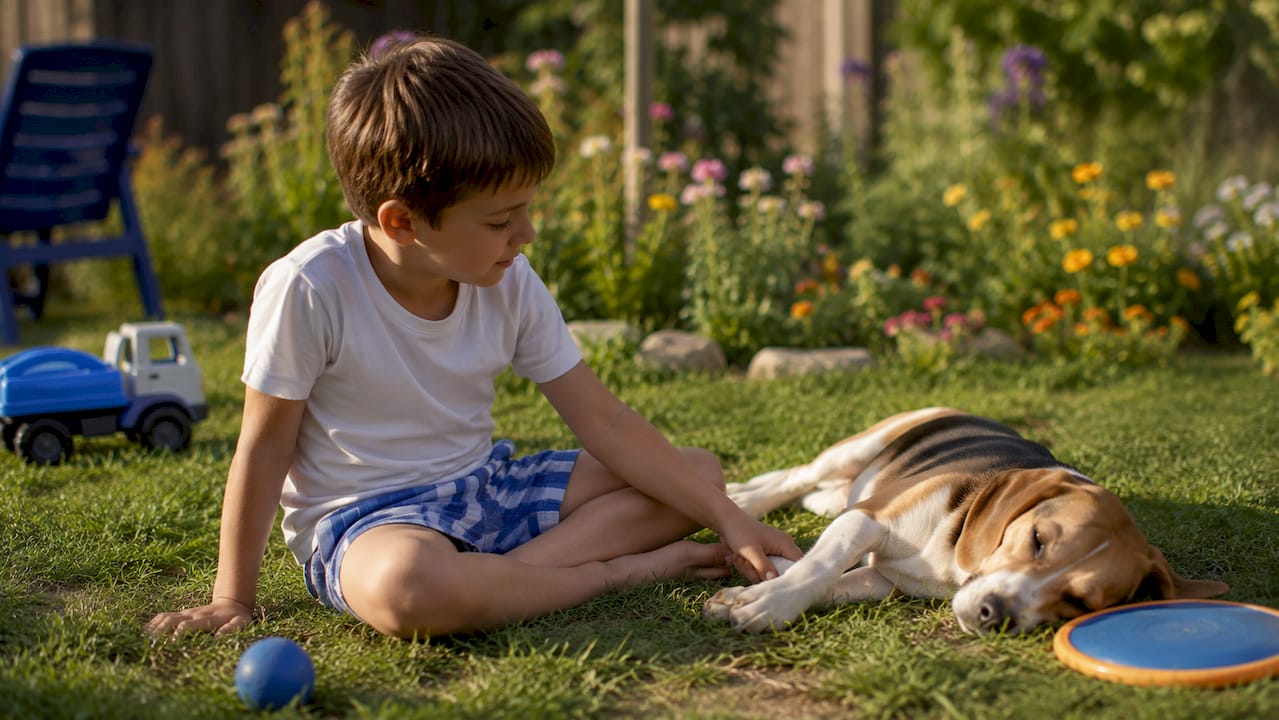
John Bradshaw, former reader in companion animal behavior at the University of Bristol and author of multiple books on dogs, puts it plainly:
That responsiveness transfers. Children who learn to notice when a dog is uncomfortable or excited carry that attentiveness into their human relationships. Bradshaw also notes that a dog teaches children something no storybook can: what it actually feels like to be an animal, with its own perspective and needs separate from ours.
The biology backs this up. Research at the University of Arizona found that play with a familiar or even an unfamiliar friendly dog raised salivary oxytocin levels in children aged 8–10. Oxytocin is the same hormone linked to bonding and trust, and its positive feedback loop means 20–30 minutes of play can sustain elevated mood for several hours afterward.
Pro Tip: Let your child be the “good cop” with the family dog. Parents handle less pleasant tasks like nail clipping, while kids give treats, play games, and offer affection. This builds lasting trust between child and dog and reinforces the child’s sense of kindness and care.
3. Dogs as social catalysts: reducing anxiety and improving peer skills
A shy child at a playground often stays on the sidelines. Put a dog in that same space, and the dynamic shifts almost immediately. The CDC reports that children with dogs experience less social anxiety partly because the dog acts as an ice-breaker, giving other kids an immediate, low-stakes reason to approach and talk.
This is not just anecdotal. The preschool study mentioned earlier found that children who played actively with their dog at least three times per week were significantly more likely to show prosocial behaviors than dog-owning children who played less often. Frequency matters. A dog in the house helps, but a dog that a child actually engages with regularly is where the social development really accelerates.
For children who struggle with peer interactions, the dog offers something rare: a relationship with zero judgment and consistent positive feedback. That experience of being accepted unconditionally gives kids a kind of social confidence they can carry into harder human interactions.
4. Educational benefits: reading confidence and cognitive growth
Dogs have found their way into classrooms and reading programs for a reason. Children who struggle with reading often associate it with embarrassment, especially when reading aloud. A dog changes that equation entirely.
Studies on canine-assisted reading programs show that children are more willing to practice reading aloud to a dog because the dog provides a warm, non-judgmental presence. There is no correction, no impatience, and no visible disappointment when a word gets mispronounced. That safety lowers anxiety and increases the time children spend actually reading.
| Benefit | What the research shows |
|---|---|
| Reading motivation | Children read longer and more willingly with a dog present |
| Anxiety reduction | Physiological measures show greater relaxation during dog-assisted reading |
| On-task behavior | Students in dog-assisted groups showed longer focus during sessions |
| Prosocial behavior | Dog-owning preschoolers scored higher on prosocial behavior measures |
| Physical activity | Adding a dog increased girls’ light-intensity activity by 52 minutes per day |
Beyond reading, dogs improve children’s cognitive performance more broadly. Research cited in peer-reviewed literature found that children made fewer errors on object categorization tasks and needed fewer prompts in memory tasks when a dog was present in the room. The dog’s calm presence appears to reduce cognitive load, freeing up attention for the task at hand. Pair that with interactive books for kids and you have a genuinely powerful combination for building early literacy.
5. Toys and activities that extend dog-play benefits
Not every child has a dog at home, and even those who do benefit from toys that reinforce the same developmental skills. The empathy, patience, problem-solving, and active play that dogs naturally encourage can all be channeled through the right activities.
Toylandeu™ carries a range of products that align directly with what kids learn from pets:
- Creative art kits like the Montessori Drawing Kit build focus and self-expression, skills that mirror the patience children practice when communicating with a dog
- RC cars and stunt vehicles such as the Gesture-Controlled Stunt Car keep kids physically active and engaged outdoors, echoing the movement benefits of dog walks
- Ball-jointed dolls encourage nurturing play and imaginative caregiving, reinforcing the responsibility and empathy children develop through pet care
- Board games and interactive sets build turn-taking, fairness, and communication, the same social rules children absorb through dog play
Pro Tip: Pair a creative toy with a conversation about your child’s dog. Ask what the dog might be feeling today, or what the dog would think of the toy. This simple habit keeps the empathy muscle active even during solo play.
Toylandeu™ ships over 30,000 toy options worldwide, so finding something that matches your child’s current developmental stage is straightforward. Browse the full selection at toylandeu.com.
6. Key takeaways on what playing with dogs teaches kids
Playing with dogs delivers measurable, research-backed developmental benefits across emotional, social, cognitive, and physical domains.
- Dogs trigger oxytocin release, improving mood for hours after a play session
- Preschoolers from dog-owning families show higher prosocial behavior and fewer peer problems
- Reading aloud to dogs reduces anxiety and increases time on task
- Girls who gained a family dog increased their daily light-intensity physical activity significantly
- Children learn fairness, honesty, and rule-following through the social structure of animal play
- Consistent, active engagement with a dog matters more than simply having one in the home
7. How dogs teach kids to read non-verbal communication
Dogs communicate almost entirely without words, and children who spend time with them become surprisingly fluent in that language. A dog that turns away, yawns, or licks its lips is signaling stress. A dog with a loose, wiggly body and soft eyes is relaxed and playful. Kids pick up on these distinctions faster than most adults expect.
This skill transfers directly to human interaction. Reading facial expressions, posture, and tone of voice are the same cognitive processes children practice when they learn to read a dog’s body language. Animal behaviorists note that dogs follow human communicative cues closely, making them particularly effective partners for this kind of learning. A child who has learned to pause and observe before approaching a dog carries that same thoughtfulness into conversations with classmates and adults.
The social rules of animal play reinforce this further. Dogs signal their intentions constantly during play: a play bow means “I want to play, not fight.” When a dog stops playing and walks away, it is communicating clearly. Children who learn to respect those signals develop a genuine sensitivity to boundaries, both given and received.
Key Takeaways
Playing with dogs consistently builds empathy, social confidence, physical fitness, and reading motivation in children, with benefits that begin as early as age two.
| Point | Details |
|---|---|
| Oxytocin and mood | Play with a dog raises children’s oxytocin levels, sustaining mood benefits for several hours. |
| Prosocial behavior | Preschoolers in dog-owning families showed higher prosocial behavior in a study of 1,646 children. |
| Reading confidence | Dogs provide a non-judgmental presence that lowers reading anxiety and increases time on task. |
| Physical activity | Girls who gained a family dog increased daily light-intensity activity by 52 minutes. |
| Non-verbal skills | Reading dog body language builds the same emotional attentiveness children use with peers. |
FAQ
What do kids learn from playing with dogs?
Children learn empathy, responsibility, social confidence, fairness, and non-verbal communication through regular dog play. Research also shows improvements in physical activity levels and reading motivation.
How do dogs help reduce social anxiety in children?
Dogs act as social catalysts, giving children a natural conversation starter that lowers the pressure of peer interaction. The CDC notes this “ice-breaker effect” reduces social anxiety by encouraging peer engagement.
Can playing with a dog improve a child’s reading skills?
Yes. Canine-assisted reading programs show that children read longer and with less anxiety when a dog is present, because the dog offers a non-judgmental audience with no risk of embarrassment.
At what age do children start benefiting from dog interaction?
Benefits appear as early as ages 2–5. The preschool study of 1,646 children found that even toddlers in dog-owning families showed better social-emotional outcomes than those without a dog.
Do children need to own a dog to get these benefits?
Ownership helps, but the quality and frequency of interaction matter most. Children who actively play with and walk a dog gain more developmental benefits than those who simply live in the same house as one.
Recommended Reads
- Why Interactive Toys Matter for Child Development
- Interactive Dolls: Foster Imagination, Empathy & Learning
- Top Fun Brain Development Toys That Boost Playful Learning
- How 2026’s Interactive Toys Boost Child Learning & Safety