

Why Interactive Toys Matter for Child Development
- Interactive toys respond to children’s actions, fostering cognitive, physical, and language development.
- Open-ended toys encourage creativity and sustained engagement, unlike fixed-function battery-operated toys.
- Inclusive, adaptable interactive toys support children with diverse abilities and developmental needs.
Not every toy is created equal, and that’s a fact many parents discover too late. Walk through any toy store and you’ll see shelves packed with plush animals, battery-powered gadgets, and flashy screen-based devices, all marketed as “educational.” But research tells a different story. Interactive toys, the kind that respond to your child’s actions and invite them to explore, solve, and create, deliver developmental benefits that passive toys simply cannot match. This article breaks down what interactive toys actually are, how they work in your child’s brain, and how you can make smarter choices that support real, lasting growth.
Table of Contents
- What are interactive toys and how do they work?
- Cognitive, physical, and language development: The major benefits
- Why open-ended beats battery: Imagination, creativity, and long-term engagement
- Interactive toys for every child: Inclusivity and adaptability
- A fresh perspective: The hidden costs of ‘passive’ play and what parents often miss
- Find the perfect interactive toy for your child’s growth
- Frequently asked questions
Key Takeaways
| Point | Details |
|---|---|
| Hands-on learning matters | Interactive toys provide action-based experiences that boost cognitive development more than passive options. |
| Open-ended toys win | Simple, open-ended toys foster creativity and longer engagement compared to battery-operated or screen-based toys. |
| Inclusive benefits for all | Interactive play supports children across the ability spectrum, with adaptive toys offering extra value. |
| Science supports smart choices | Research consistently links interactive play with gains in problem-solving, language, and physical coordination. |
What are interactive toys and how do they work?
An interactive toy is any plaything that responds directly to a child’s actions. Press a button, hear a sound. Stack a block, see it fall. Solve a puzzle, feel the satisfaction of a perfect fit. That immediate feedback loop is what separates interactive toys from passive ones. A plush stuffed animal is adorable, but it doesn’t change based on what your child does. An interactive toy does, and that difference matters more than most parents realize.
The science behind this is rooted in how young brains develop. When a child acts on a toy and receives a response, their brain forms new neural connections through a process called neuroplasticity (the brain’s ability to reorganize and grow based on experience). This action-response-reinforcement cycle is exactly what how interactive toys boost learning research continues to confirm: repeated, hands-on engagement shapes cognitive pathways in ways passive entertainment cannot.
Interactive toys promote cognitive development by teaching cause-and-effect, stimulating curiosity, problem-solving, and logical reasoning through immediate feedback and hands-on exploration, aligning with Piaget and Vygotsky’s theories on active learning.
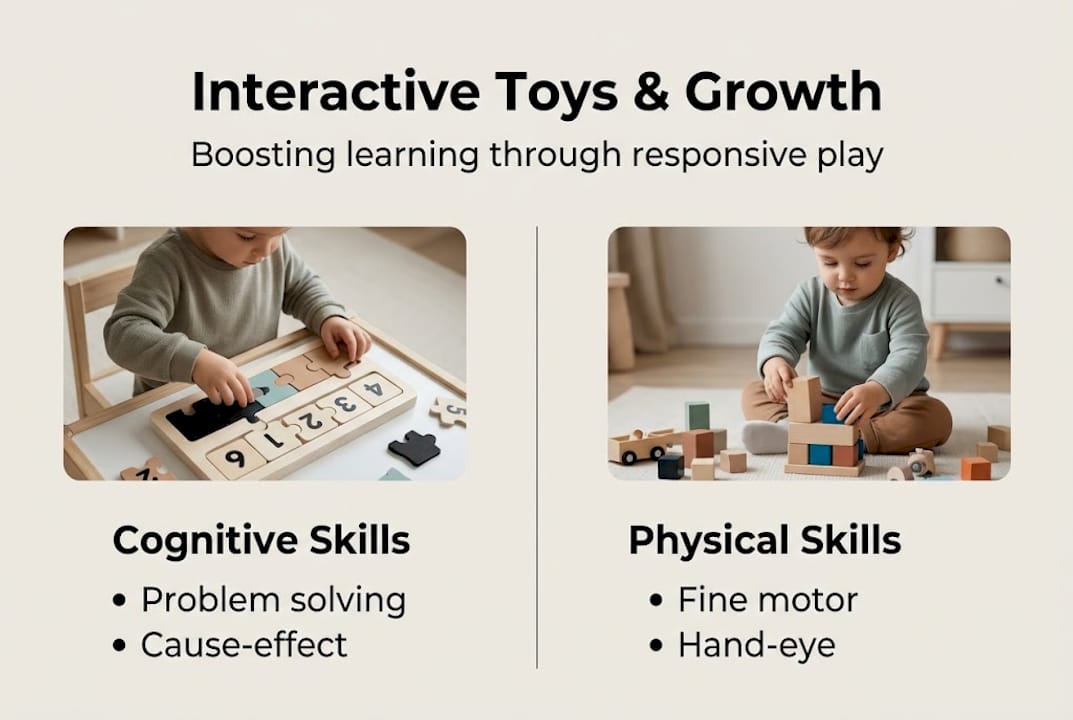
Here’s a quick comparison to make this concrete:
| Feature | Interactive toys | Passive toys |
|---|---|---|
| Responds to child’s actions | Yes | No |
| Encourages problem-solving | Yes | Rarely |
| Promotes sustained engagement | High | Low |
| Supports neuroplasticity | Strongly | Minimally |
| Examples | Blocks, puzzles, LEGO | Plush animals, decorative figures |
Some key types of interactive toys worth knowing:
- Cause-and-effect toys: Buttons, levers, and switches that produce sounds or movement
- Construction toys: Blocks, LEGO, and building kits that reward spatial thinking
- Puzzle toys: Shape sorters and jigsaws that build logical reasoning
- Role-play toys: Interactive dolls for learning that encourage empathy and storytelling
- STEM kits: Science and engineering sets that introduce real-world concepts
The bottom line is simple. If a toy changes based on what your child does, it’s working with their brain, not just sitting in front of it.
Cognitive, physical, and language development: The major benefits
With an understanding of how interactive toys work, let’s explore the tangible developmental rewards you can expect. The benefits fall into three major categories, and each one has real research behind it.
Cognitive gains are the most widely studied. Interactive toys build executive functions, the mental skills that include attention, working memory, and flexible thinking. When a child figures out how to complete a puzzle or build a structure that doesn’t fall, they’re practicing planning, trial-and-error reasoning, and persistence. These are the same skills that predict academic success years later.
Physical development is equally important. Fine and gross motor skills develop through actions like pressing buttons, stacking objects, turning knobs, and physically manipulating toys. Fine motor skills (small, precise movements like pinching or threading) are especially critical for writing and self-care tasks. Interactive toys that require grip, coordination, and hand-eye precision give these muscles and neural pathways a genuine workout.
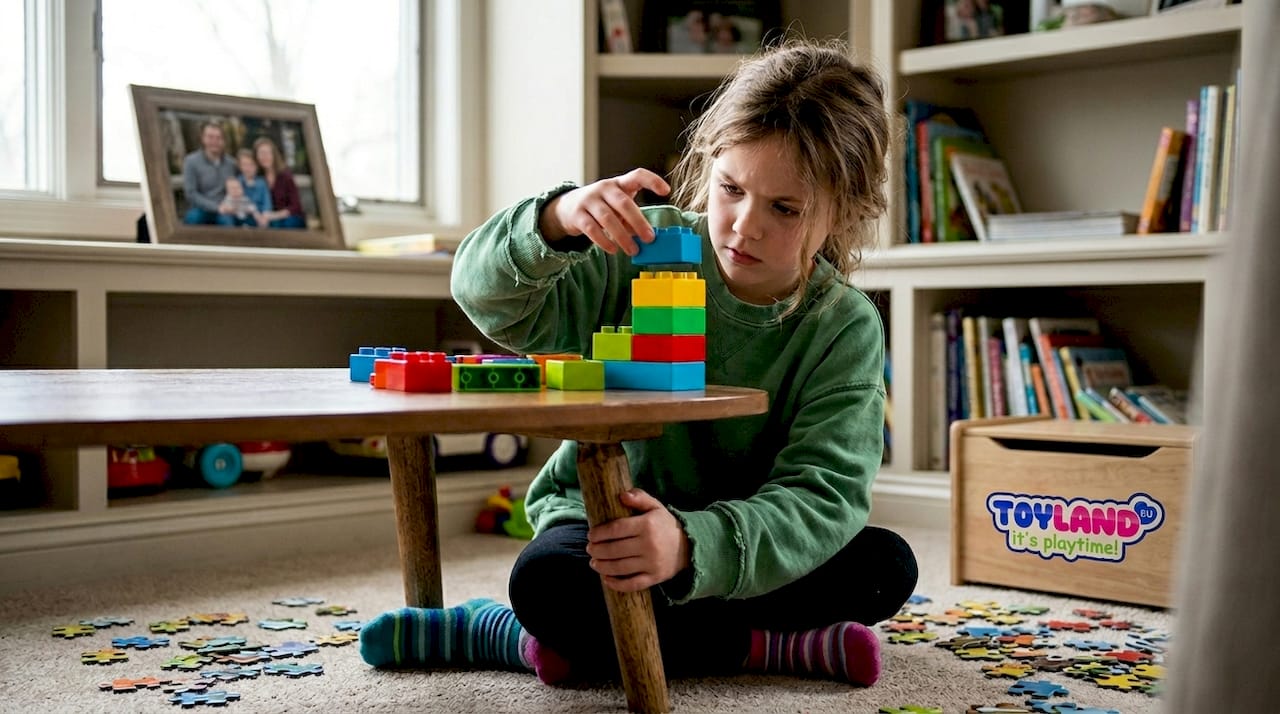
Language and literacy round out the picture. Auditory feedback and interactive storytelling in toys boost vocabulary, comprehension, and communication. Toys that name colors, count objects, or narrate stories expose children to language in a context that feels playful, not instructional. That’s a powerful combination.
Here’s a breakdown by developmental domain:
| Developmental domain | Toy feature that supports it |
|---|---|
| Logical reasoning | Puzzles, shape sorters |
| Fine motor skills | Stacking, threading, knob-turning |
| Gross motor skills | Push-pull toys, physical play sets |
| Vocabulary growth | Sound-producing, storytelling toys |
| Attention and focus | Open-ended construction toys |
For a deeper look at age-specific options, best early learning toys offers expert-backed recommendations sorted by developmental stage. And if you want the broader research picture, evidence for open-ended play confirms that hands-on, child-directed play consistently outperforms passive entertainment for developmental outcomes.
Pro Tip: Choose toys that engage at least two senses simultaneously, like touch and sound. Multi-sensory play strengthens more neural connections at once and tends to hold a child’s attention longer than single-sense toys.
Why open-ended beats battery: Imagination, creativity, and long-term engagement
Building on the benefits of developmental play, it’s vital to understand that not all interactive toys are created equal. There’s a meaningful difference between open-ended toys and closed-ended, battery-operated ones, and that difference shapes how long your child stays engaged and how creatively they think.
Open-ended toys have no single correct outcome. A set of blocks can become a castle, a road, a spaceship, or a zoo. A box of art supplies can produce anything a child imagines. These toys grow with your child because the play possibilities expand as their thinking does. Closed-ended toys, by contrast, have a fixed goal. Once a child figures out how to make the toy do its one trick, interest fades fast.
Open-ended toys like blocks and LEGO are preferred for imagination and sustained engagement over closed-ended battery toys, which may limit creativity. This isn’t just opinion. It’s a pattern researchers observe repeatedly: children return to open-ended toys longer, invent more complex scenarios, and demonstrate higher levels of creative thinking.
Here’s how the two types compare:
| Category | Open-ended toys | Battery/electronic toys |
|---|---|---|
| Engagement duration | Long-term | Short-term |
| Creativity support | High | Low to moderate |
| Skill outcomes | Broad and transferable | Narrow and specific |
| Reusability | Unlimited | Limited |
| Cost over time | Low (versatile) | High (novelty fades) |
A pediatric expert from UAB put it plainly: simple toys support healthier development than high-tech alternatives because they require children to do the imaginative heavy lifting themselves.
How to tell if a toy is truly open-ended:
- Can it be used in more than three different ways?
- Does it require the child’s imagination to “work”?
- Will it still be interesting six months from now?
- Does it invite collaboration with other children or adults?
If you answer yes to most of these, you’ve found a keeper. For more on this topic, benefits of open-ended toys covers why simplicity in toy design is often a sign of developmental strength, not a lack of features.
Pro Tip: If your child seems “bored” with an open-ended toy quickly, resist the urge to replace it. Try playing alongside them and introducing a new way to use it. That modeling often reignites curiosity and extends the toy’s life by months.
Interactive toys for every child: Inclusivity and adaptability
As we consider all children, inclusivity and adaptability should not be overlooked, ensuring every child can benefit from interactive play. The good news is that interactive toys are among the most adaptable tools available for children with diverse abilities.
For children with motor disabilities, powered mobility toys have shown real promise. Powered mobility toys improve cognition and language in children with physical limitations by giving them control over their environment, something that builds both confidence and cognitive engagement. That sense of agency, being able to make something happen, is foundational for all learning.
For children with autism spectrum disorder (ASD) or ADHD, predictable sensory toys are especially valuable. These children often thrive with toys that offer consistent, reliable responses. A toy that always makes the same sound when pressed, or always lights up in the same pattern, reduces anxiety and helps children focus on the interaction itself rather than managing unexpected stimuli.
Here are some interactive toy types that work well across a range of abilities:
- Switch-activated toys: Operated with a single button press, ideal for children with limited mobility
- Sensory bins and tactile kits: Provide rich sensory input without overwhelming visual complexity
- Cause-and-effect light toys: Simple, predictable, and rewarding for children building early cognitive connections
- Soft construction toys: Large, easy-to-grip blocks for children still developing fine motor control
- Cooperative board games: Encourage social interaction and turn-taking for children working on communication
As one research team noted, predictable sensory feedback in interactive toys aids focus and empathy development in neurodiverse children, outcomes that matter far beyond the playroom. For ideas on how toys can support shared experiences, group learning with toys offers practical guidance on choosing toys that work well in social settings.
A fresh perspective: The hidden costs of ‘passive’ play and what parents often miss
Here’s something the toy industry rarely tells you: a toy can be labeled “educational” and still deliver almost no developmental value. Passive toys, even well-designed ones, focus on entertaining your child rather than engaging them. And there’s a real cost to that distinction.
When children spend most of their play time with passive or highly scripted toys, they miss the chance to practice the cognitive and creative muscles that open-ended, interactive play builds. High-tech toys with lots of lights and sounds can actually distract more than develop, pulling attention toward novelty rather than toward genuine problem-solving.
Here’s the counterintuitive truth: a child who seems “bored” with a simple set of blocks is often on the edge of a creative breakthrough. That moment of boredom is where imagination kicks in. It’s not a flaw in the toy. It’s the toy doing exactly what it should.
The shift we’d encourage every parent to make is this: stop evaluating toys by their feature list and start watching how your child interacts with them. Are they asking questions? Inventing stories? Coming back to it tomorrow? Those behaviors matter far more than whether a toy sings or lights up. For parents curious about how technology can still play a positive role, tech toys for emotional growth offers a balanced look at when and how tech-based toys can genuinely support development.
Find the perfect interactive toy for your child’s growth
Choosing the right interactive toy doesn’t have to feel overwhelming. At ToylandEU, we’ve done the curation work for you, bringing together developmental, open-ended, and interactive toys that are chosen for their genuine educational value, not just their packaging.
Whether you’re looking for a hands-on creative outlet or a structured learning experience, our catalog has options designed for every age and developmental stage. The Montessori art workbook is a beautiful example of open-ended, imagination-first play. For something colorful and hands-on, the DIY art and learning kit gives children a creative canvas they’ll return to again and again. Ready to explore? Discover more interactive toys and find the perfect match for your child’s next stage of growth.
Frequently asked questions
Are interactive toys better than traditional toys for learning?
Interactive toys promote cognitive development through active, responsive play, giving them a clear developmental edge over passive traditional toys that don’t adapt to a child’s actions.
What age is best to introduce interactive toys?
Infants as young as 6 months benefit from simple cause-and-effect toys, and as children grow, interactive feedback supports neural pathway formation at every stage, so complexity can increase with age.
How do interactive toys help children with special needs?
Interactive toys benefit children with motor disabilities or sensory needs by offering predictable feedback and adaptable formats that build focus, empathy, and motor coordination.
Do electronic or screen-based toys count as interactive toys?
Not automatically. Experts recommend hands-on interactive toys over screen-based options for optimal development, since screens often promote passive viewing rather than genuine two-way engagement.
Recommended
- Interactive dolls: foster imagination, empathy & learning – ToylandEU
- How 2026’s Interactive Toys Boost Child Learning & Safety – ToylandEU
- Future of Interactive Toys 2025: Tech-Driven Child Development & Safety – ToylandEU
- AI-Powered Interactive Toys in 2025: Impact on Child Development – ToylandEU
- Why quality child care is vital for your preschooler
Last updated: April 2026