

Interactive dolls: foster imagination, empathy & learning
- Interactive dolls enhance social, emotional, and empathy skills better than tablets.
- They respond to children through voice, expressions, and movement, promoting imaginative play.
- Parental involvement and careful selection by age are key to maximizing development and toy longevity.
Most parents assume tablets and high-tech gadgets are the gold standard for educational play. But doll play outperforms tablets in building the social and emotional skills children need most. Interactive dolls occupy a unique space in child development, one that screens simply cannot replicate. They encourage children to nurture, imagine, and connect in ways that feel natural and deeply engaging. This article breaks down exactly what interactive dolls are, what the science says about their benefits, how they stack up against other toy types, and how to choose the right one for your child.
Table of Contents
- Understanding interactive dolls: What makes them unique?
- Proven developmental benefits: Social and emotional skills
- Interactive dolls vs. screens and traditional toys: What’s better for your child?
- Real-world considerations: Age, care, and common pitfalls
- A balanced approach: What parents should really focus on
- Bring learning to life with ToylandEU’s unique interactive toys
- Frequently asked questions
Key Takeaways
| Point | Details |
|---|---|
| Boosts empathy | Interactive dolls foster empathy and theory of mind more than screen-based toys. |
| Encourages creativity | Open-ended play with dolls stimulates imagination and social skills in young children. |
| Choose age-appropriate | Select simple, durable interactive dolls for preschoolers to match their development. |
| Maintenance matters | Keep dolls clean and functioning by regular checks for batteries, grime, and noise issues. |
Understanding interactive dolls: What makes them unique?
Not all dolls are created equal. A traditional cloth doll sits quietly on a shelf, waiting for your child’s imagination to bring it to life. An interactive doll, by contrast, meets your child halfway. These are toys designed with sensors, microphones, speakers, motors, or even basic AI to respond to what a child says or does. Squeeze the doll’s hand and it giggles. Feed it a pretend bottle and it makes swallowing sounds. Ask it a question and it answers back.
This responsiveness is what sets interactive dolls apart from both simple plush toys and purely screen-based entertainment. Interactive dolls nurture empathy and imaginative play by giving children a social partner that reacts, which reinforces the idea that actions have consequences and that others have feelings worth considering.
Here’s a quick breakdown of the features you’ll commonly find across interactive doll models:
- Voice response: The doll speaks, sings, or reacts to phrases your child says
- Facial expressions: Some models use LED eyes or movable features to show emotion
- Physical movement: Arm lifting, head turning, or crawling motions triggered by touch
- Programmable routines: Bedtime stories, feeding schedules, or mood-based responses
- Sensory input: Touch sensors on the hands, belly, or face that trigger different reactions
The range goes from very simple (a doll that coos when hugged) to quite sophisticated (a doll that tracks your child’s voice and adapts its responses). You can explore how imaginative play benefits children’s overall development to understand why this responsiveness matters so much.
Pro Tip: For children ages 3 to 5, simpler interactive features work best. Too many buttons, modes, or voice commands can overwhelm young kids and turn excitement into frustration fast.
The goal of an interactive doll is not to replace human connection. It is to give children a safe, low-stakes environment to practice caregiving, conversation, and emotional expression. That is a surprisingly powerful thing for a toy to do.
Proven developmental benefits: Social and emotional skills
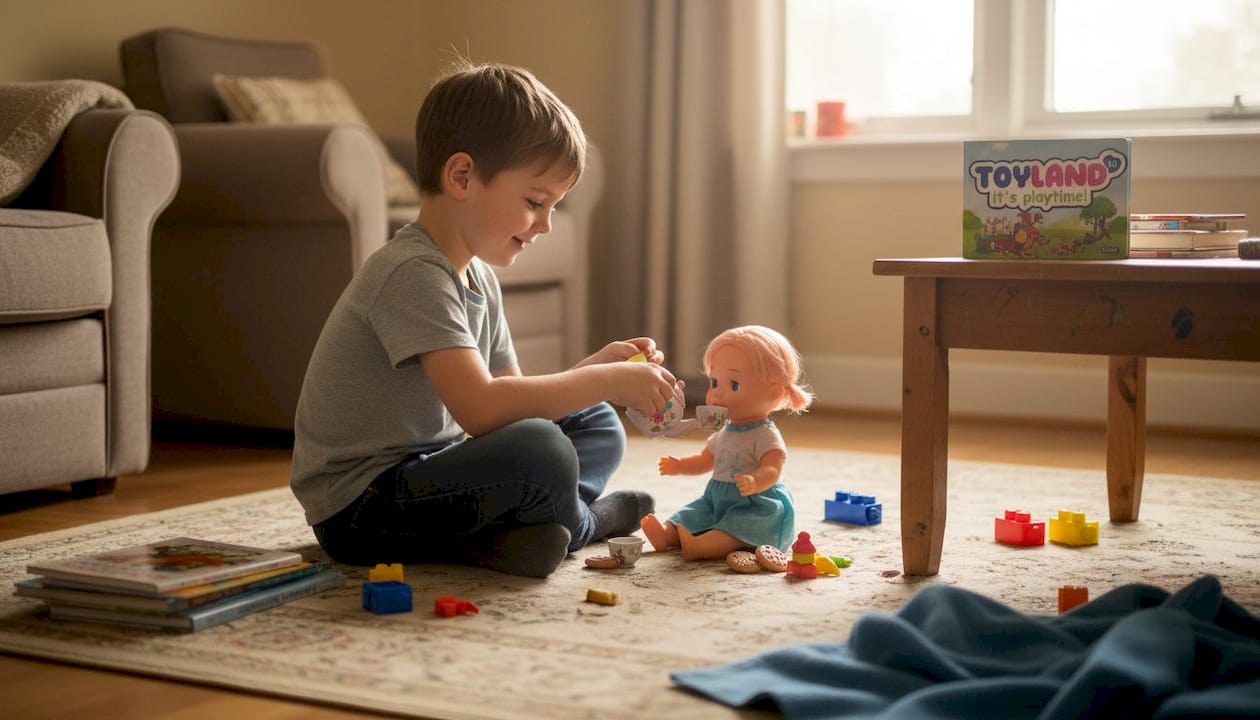
The science behind interactive doll play is more compelling than most parents realize. A randomized controlled trial involving Cardiff University found that doll play improved theory of mind more effectively than tablet-based play. Theory of mind is the ability to understand that other people have thoughts, feelings, and perspectives different from your own. It is a foundational social skill, and it develops most strongly during the preschool years.
Children who played with dolls showed stronger false-belief understanding, meaning they could recognize when another person believed something that was not true. That kind of cognitive flexibility is essential for navigating friendships, resolving conflicts, and showing compassion.
“Doll play activated brain regions associated with social processing and empathy, even when children played alone.” — Cardiff University and Arizona State University researchers
Here is what the research consistently shows about the developmental gains from doll play:
- Empathy building: Children practice recognizing and responding to emotional cues
- Nurturing behavior: Feeding, dressing, and comforting a doll reinforces caregiving instincts
- Perspective-taking: Role-play scenarios help children consider how others might feel
- Responsibility: Caring for a doll that “needs” attention teaches follow-through
- Language development: Narrating play scenarios builds vocabulary and storytelling skills
One important nuance: electronic toys reduce parent-child language compared to traditional toys when parents step back entirely. The doll’s built-in responses can sometimes fill the conversational space that a parent would otherwise occupy. This is why parent involvement matters so much. When you sit beside your child and ask questions like “Why is your doll sad today?” you amplify every developmental benefit the toy offers.
For children who are neurodiverse, including those with autism or ADHD, interactive dolls offer a particularly valuable tool. The predictable, repeatable responses of a doll create a low-pressure environment to practice social scripts. You can read more about how tech toys support emotional development for a broader look at this area.
The imaginative play advantages extend well beyond social skills too, touching on creativity, problem-solving, and even early narrative thinking.
Interactive dolls vs. screens and traditional toys: What’s better for your child?
This is the question most parents are really asking. You have limited time, limited budget, and a child who wants everything. So where does an interactive doll fit relative to a tablet app or a classic wooden toy?
| Toy type | Social skills | Language development | Empathy building | Frustration risk | Parent interaction needed |
|---|---|---|---|---|---|
| Interactive doll | High | Medium to high | High | Low to medium | Medium |
| Tablet or screen toy | Low | Low | Low | Low | Low |
| Traditional plush or wooden toy | Medium | High (with parent) | Medium | Very low | High |
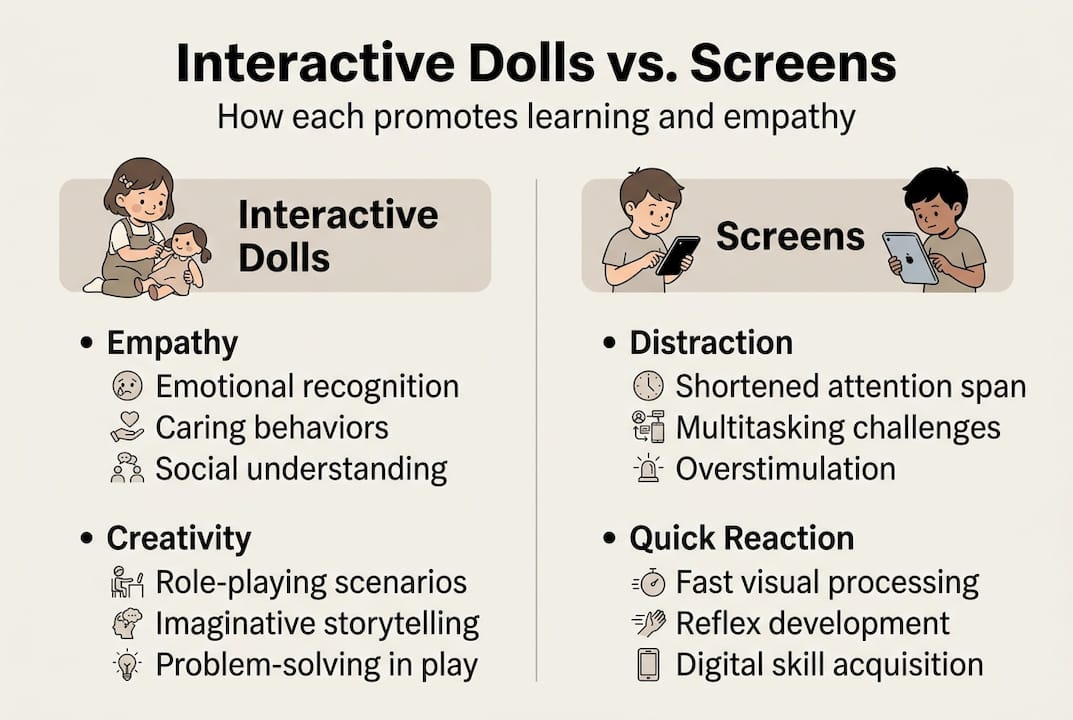
Cardiff and NAU studies show that social skill improvement is strongest with dolls, while electronic toys tend to reduce verbal interaction between parent and child. That does not mean tablets have no value. But it does mean they serve a different purpose.
Here is a practical numbered guide to matching toy type to your child’s developmental needs:
- For empathy and social skills: Choose an interactive doll with nurturing features like feeding or comforting responses
- For language and storytelling: Traditional toys with open-ended play work best, especially with parent narration
- For cognitive and STEM skills: Tablets and AI-powered toys offer structured problem-solving experiences
- For mixed development: Rotate between toy types across the week to build a full range of skills
- For neurodiverse children: Interactive dolls with predictable responses provide a safe practice environment
The takeaway is not that one toy type wins. It is that interactive dolls fill a gap that screens and traditional toys leave open, specifically the space where children learn to care for, respond to, and emotionally engage with another being.
Real-world considerations: Age, care, and common pitfalls
Choosing an interactive doll is exciting, but keeping it working and age-appropriate takes a little planning. Here is what parents need to know before buying and after the box is opened.
Choosing the right model by age:
| Age range | Recommended features | What to avoid |
|---|---|---|
| 18 months to 3 years | Simple sounds, soft body, basic touch response | Complex voice commands, small parts |
| 3 to 5 years | Feeding, cooing, basic expressions | Multi-step programming, fragile mechanisms |
| 5 to 8 years | Voice interaction, mood responses, routines | Overly babyish features that lose appeal fast |
For children in the 3 to 6 range, simpler and more durable models consistently outperform flashy ones. A doll that survives a drop, a bath-time accident, and a toddler’s grip is worth far more than one with ten features that breaks in a month.
Battery drain, noisy environments, and mechanism jamming are the most common complaints parents report. Cleaning is also critical, especially for dolls with fabric bodies and internal electronics.
Here are the most common pitfalls and how to handle them:
- Battery drain: Use rechargeable batteries and keep spares on hand; some dolls are power-hungry
- Mechanism jamming: Avoid letting small children force limbs or buttons; gentle use extends lifespan
- Noise sensitivity: Many interactive dolls are loud. Check volume controls before buying
- Mold risk: Fabric-bodied dolls with internal electronics need careful, dry cleaning. Check out plush doll cleaning tips to protect your investment
- Safety concerns: Always verify age ratings and check for 2026 interactive toy safety standards before purchasing
Pro Tip: Every few weeks, open the battery compartment and check for moisture or corrosion. A small amount of grime in the wrong place can permanently damage the doll’s electronics and end the fun entirely.
Buying a doll that matches your child’s current developmental stage, not the one they will grow into, is almost always the smarter move.
A balanced approach: What parents should really focus on
Here is an honest take that most toy reviews skip over. Interactive dolls are not magic. A doll sitting in the corner while your child watches a screen offers almost no developmental benefit. The research is clear that combined play with parents maximizes gains versus technology alone.
The temptation is to let the doll’s built-in features do all the work. It talks, it responds, it entertains. But the real developmental lift happens when you are in the room asking questions, building on the story your child is creating, and treating the doll as a shared character in your child’s imaginative world.
What we have seen consistently is that parents who treat interactive dolls as conversation starters rather than babysitters get dramatically better results. Ask your child why the doll is crying. Wonder aloud what the doll might need. Let your child teach you how the doll works. These small moments of interactive toy emotional support are where the real growth happens.
Keep screen time separate when you can. The social benefits of doll play are most pronounced when children are not splitting attention between a doll and a tablet. Quality of interaction, not the sophistication of the gadget, is what moves the needle.
Bring learning to life with ToylandEU’s unique interactive toys
If this article has sparked ideas about how play can shape your child’s development, the next step is finding the right toys to make it happen.

At ToylandEU, we carry a wide selection of interactive and imaginative toys designed to grow with your child. From nurturing dolls that respond to touch and voice to creative play sets that build social and cognitive skills, our catalog covers every developmental stage. If you want something that blends physical play with excitement, check out the gesture-controlled stunt car for older kids who love hands-on challenges. With free worldwide shipping and over 30,000 products, ToylandEU makes it easy to find toys that are both genuinely fun and genuinely good for your child.
Frequently asked questions
What ages are interactive dolls best for?
Interactive dolls are most suitable for children ages 3 to 6, since simpler models match the developmental stage of preschoolers and avoid the frustration that overly complex features can cause.
Do interactive dolls help children with autism or ADHD?
Yes. Doll play benefits neurodiverse children by supporting theory of mind development and providing a predictable, low-pressure environment to practice social interaction and emotional responses.
How do I clean and maintain interactive dolls?
Remove batteries before any cleaning, use a lightly damp cloth on fabric surfaces, and check for moisture in joints and compartments regularly. Refer to manufacturer instructions and see maintenance and cleaning tips for electronic and plush models.
Can interactive dolls replace tablets for learning?
Doll play improves social processing more effectively than tablets, but the best approach combines doll play with active parent involvement, since combined play maximizes language and emotional development gains.
What are common problems to watch for with interactive dolls?
Common pitfalls include battery and cleaning issues, along with mechanical jams and noise sensitivity. Regular maintenance and age-appropriate use keep most problems from becoming serious.
Recommended
- AI-Powered Interactive Toys in 2025: Impact on Child Development – ToylandEU
- Interactive Tech Toys Boost Kids’ Emotional Development in 2026 – ToylandEU
- AI-Powered Toys for Kids: Boost Learning Without More Screen Time – ToylandEU
- Future of Interactive Toys 2025: Tech-Driven Child Development & Safety – ToylandEU
- E-Learning and Education | AD VERBUM