

Top fun brain development toys that boost playful learning
TL;DR:
- Open-ended, hands-on toys aligned with developmental stages best support cognitive growth.
- Construction toys and puzzles enhance spatial reasoning, problem-solving, and fine motor skills.
- Simple, physical toys outperform digital apps in fostering curiosity, persistence, and flexible thinking.
Every parent has stood in a toy aisle, or scrolled through hundreds of listings online, wondering whether a toy labeled “educational” actually does anything beyond drain your wallet. The reality is that not all brain-boosting toys deliver on their promises, and choosing the wrong one means your child ends up bored while the toy collects dust. This guide cuts through the marketing noise and gives you a research-backed, parent-friendly breakdown of which toy types genuinely support cognitive growth, how to spot quality options at a glance, and exactly what to look for based on your child’s age and developmental stage.
Table of Contents
- How to choose brain development toys that spark fun and learning
- Building blocks and construction toys: Foundations for cognitive growth
- Puzzles and shape sorters: Boosting logic, patience, and hand-eye coordination
- Tech toys and STEM kits: Making robotics and coding accessible through play
- Open-ended and loose parts play: Unleashing imagination and STEM thinking
- Our take: Why ‘simple’ toys outperform apps and screens for brain growth
- Where to find brilliant brain-boosting toys for your child
- Frequently asked questions
Key Takeaways
| Point | Details |
|---|---|
| Hands-on play matters most | Toys that allow kids to experiment and build offer the greatest brain benefits. |
| Open-ended toys foster creativity | Blocks, loose parts, and puzzles inspire imagination and flexible thinking. |
| Screen time should be limited | Focus on physical, interactive toys for young children to maximize learning and development. |
| STEM kits teach real skills | Programming and robotics toys boost logic, problem-solving, and teamwork through play. |
| Parent involvement boosts value | Joining your child in play deepens learning and makes toys more engaging. |
How to choose brain development toys that spark fun and learning
Not every toy with a STEM sticker earns it. The most effective brain development toys share a handful of qualities that go beyond flashy packaging or battery-powered lights.
What to look for:
- Open-ended design: Toys that can be used in multiple ways keep children engaged longer and stimulate creative thinking. As research on open-ended toys benefits shows, these play materials consistently outperform single-function toys in creativity and problem-solving measures.
- Age-appropriate challenge: A toy that is too easy bores a child quickly. One that is too hard leads to frustration. Look for products labeled with developmental stages, not just age ranges.
- Physical interaction: Toys that require hands-on manipulation, whether stacking, assembling, or sorting, activate motor skills alongside cognitive development.
- Adaptability: The best toys grow with your child. Magnetic tiles, for example, work for a 3-year-old stacking simple towers and a 9-year-old building complex geometric structures.
- Low screen dependency: The CDC and AAP recommend limiting screens to one hour per day of high-quality content with a parent present for children aged 2 to 5, prioritizing interactive physical play instead.
“Prioritize open-ended, screen-free toys that match your child’s developmental stage,” advises Zero to Three. “These consistently show the strongest benefits for early cognitive development.”
Pro Tip: Play alongside your child for at least 10 minutes when introducing a new toy. Adult-child interaction during play significantly boosts learning outcomes, turning a good toy into a great learning experience.
One factor parents often overlook is trial-and-error opportunity. When a child tries something, fails, adjusts, and tries again, they’re building neural pathways linked to persistence and motivation. Toys that reward only a single “correct” answer short-circuit that process. Check out innovative toys for brain development to see how newer designs are building in this kind of productive challenge.
Building blocks and construction toys: Foundations for cognitive growth
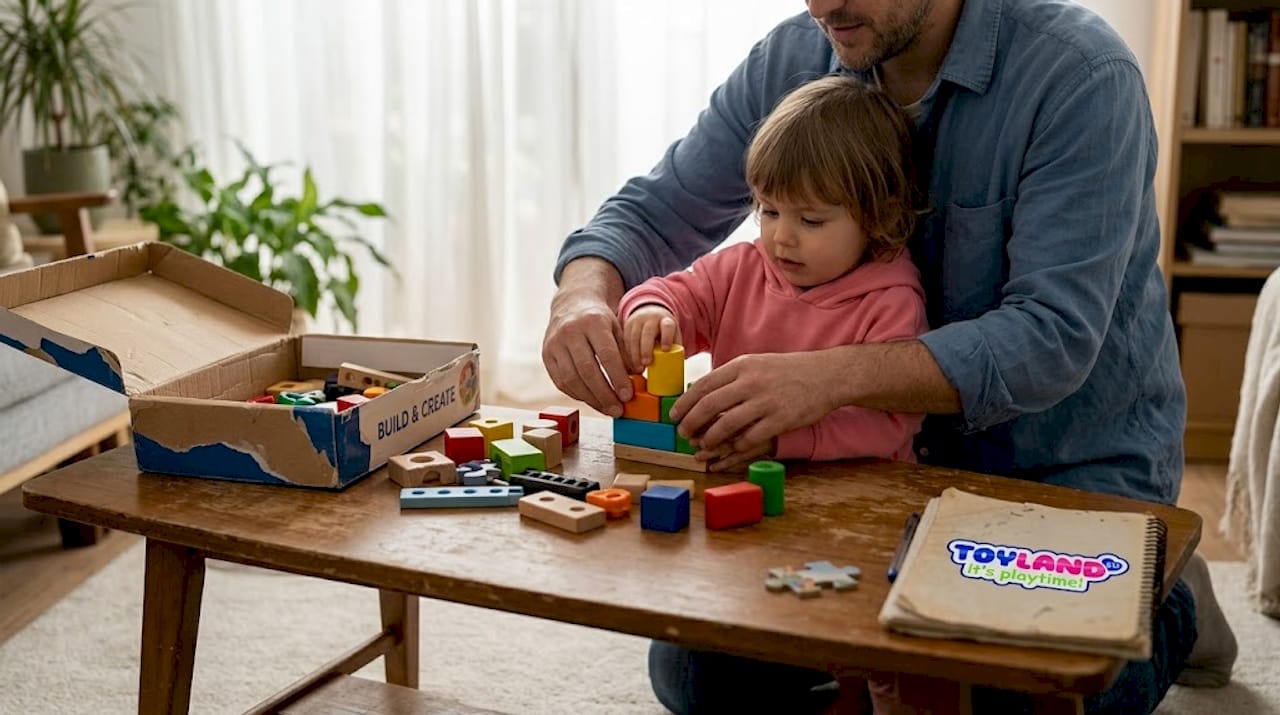
Few toys have as much research behind them as simple building blocks. Whether it’s classic wooden unit blocks, LEGO bricks, or magnetic tiles, construction play hits multiple developmental targets at once.
Why construction toys work so well:
- They build spatial reasoning, the ability to mentally rotate, visualize, and manipulate objects in space.
- They strengthen fine motor skills through gripping, pressing, and connecting pieces.
- They introduce early math concepts like symmetry, counting, and proportional thinking.
- They encourage self-directed problem-solving because there is rarely one right answer.
Research confirms that building blocks promote spatial reasoning, problem-solving, and math skills through hands-on construction and mental rotation exercises. A systematic review found that LEGO WeDo produces medium to large effects on computational thinking and problem-solving, while showing positive links to creativity in the majority of studies reviewed.
“Construction play is one of the few toy categories where the research consistently points in the same direction: children who build more, think better spatially.”
Age-by-age building toy guide:
- Ages 2 to 3: Large, chunky Montessori stacking blocks are perfect. The bigger size reduces frustration and builds early stacking and balancing skills.
- Ages 4 to 6: Duplo-sized bricks and magnetic tiles let children create recognizable structures, cars, houses, and animals, with more control.
- Ages 7 to 10: Smaller LEGO sets, Snap Circuits, and themed engineering kits introduce guided construction with a challenge goal, which boosts both focus and satisfaction.
For a broader overview of products that fit this developmental range, early learning toy examples offer a practical starting point sorted by age.
Puzzles and shape sorters: Boosting logic, patience, and hand-eye coordination
Puzzles are one of those toys that look deceptively simple from the outside. Inside, they’re a workout for the brain that few other toys match for focused, logical thinking.
Key developmental benefits:
- Logical sequencing: Children must evaluate pieces by shape, color, and orientation before placing them, practicing the same logic they will later use in reading and math.
- Hand-eye coordination: Guiding a piece into the exact right spot refines fine motor control and visual precision.
- Persistence: Puzzles teach children to sit with discomfort and push through frustration, a skill tied to long-term academic success.
- Early math foundations: Recognizing shapes, edges, and patterns primes the brain for geometry concepts years before they appear in school.
According to consumer research on top toys for young children, puzzles and shape sorters consistently rank among the best tools for building logical reasoning, hand-eye coordination, spatial intelligence, and early math foundations for ages 2 to 8.
A simple age guide for puzzle difficulty:
- Ages 2 to 3: 6 to 12 large-piece puzzles with knob handles for easy gripping.
- Ages 3 to 5: 12 to 24 pieces, themed images like animals or vehicles to hold interest.
- Ages 5 to 8: 48 to 100 pieces, introducing edge-and-corner strategy.
Pro Tip: Rotate your child’s puzzles every two weeks. Familiarity reduces challenge, and a fresh puzzle keeps the brain actively searching for solutions rather than working from memory. Browse expert early learning toys for curated puzzle picks across age groups.
Shape sorters, while simpler, are powerfully effective for toddlers aged 18 months to 3 years. The act of testing a shape, finding it doesn’t fit, rotating it, and trying again is exactly the kind of productive trial-and-error loop that builds cognitive flexibility early.
Tech toys and STEM kits: Making robotics and coding accessible through play
Many parents assume coding and robotics are for older kids or school settings. The research tells a different story.
What STEM and tech toys build:
- Sequencing and logic: Programming a robot to move forward, turn left, and stop teaches the same sequencing skills used in reading and math.
- Computational thinking: Breaking a problem into smaller steps, predicting outcomes, and debugging errors.
- Collaboration: Many STEM kits are designed for two or more children, building communication and shared problem-solving.
- Growth mindset: When a robot doesn’t behave as expected, children learn to troubleshoot rather than give up.
Research on Bee-Bot robots shows they foster computational thinking, sequencing, problem-solving, and collaboration in children as young as 3 to 4 years through programming and trial-and-error play. And as noted earlier, LEGO WeDo shows medium to large effect sizes on computational thinking, making it one of the best-documented STEM toys available.
STEM toy comparison by age and focus:
| Toy type | Best age range | Primary skill | Screen-free? |
|---|---|---|---|
| Bee-Bot floor robot | 3 to 6 | Sequencing, directions | Yes |
| LEGO WeDo kit | 6 to 10 | Engineering, coding basics | No |
| Snap Circuits | 6 to 10 | Circuits, logic | Yes |
| Magnetic tiles | 2 to 9 | Spatial reasoning, math | Yes |
| Programmable RC car | 7 to 10 | Coding, problem-solving | No |
For screen-free options specifically, coding without screens covers tactile robots and analog STEM tools that teach real logic without a tablet in sight. If you’re newer to this category, the must-have STEM toys guide is a great place to start.
Pro Tip: When setting up a new STEM kit, let your child read the instructions first without your help. The act of interpreting directions independently is itself a powerful cognitive exercise. If you need help getting started, how to set up STEM toys walks through the process clearly.
Open-ended and loose parts play: Unleashing imagination and STEM thinking
Here is where many parents raise an eyebrow. Cardboard boxes and fabric scraps as brain development tools? The research says yes, absolutely.
Comparison: Structured toys vs. open-ended loose parts
| Feature | Structured toy | Open-ended loose parts |
|---|---|---|
| Number of “correct” outcomes | One | Unlimited |
| Creativity encouraged | Low to moderate | Very high |
| Divergent thinking | Limited | Strong |
| Reusability | Fixed | Infinite |
| Cost | Moderate to high | Very low |
Studies on open-ended loose parts including cardboard, fabric, and magnetic building materials show they encourage STEM behaviors, creativity, and divergent thinking at significantly higher rates than fixed-outcome toys. Divergent thinking is the ability to generate many possible solutions to a problem, and it is a core skill for innovation, social problem-solving, and academic success.
What makes loose parts so powerful:
- They have no wrong answer, which removes the fear of failure.
- Children set their own challenge level, keeping engagement high.
- They support pretend play, which builds language, empathy, and narrative thinking simultaneously.
- They can represent anything: a block becomes a car, a phone, a piece of bread.
Research also highlights an equity angle worth knowing. Spatial and open-ended play delivers larger cognitive gains for disadvantaged children and those with special educational needs, suggesting these materials are especially valuable for families where access to expensive toys is limited. A cardboard box can outperform a $60 toy when used with intention. For families interested in going deeper, benefits of open-ended toys covers the research and practical ideas in detail.
“The most creative children aren’t always playing with the most expensive toys. They’re playing with the toys that ask the most of their imagination.”
Our take: Why ‘simple’ toys outperform apps and screens for brain growth
We’ve looked at a lot of research in writing this guide, and one pattern stands out clearly: the simpler and more hands-on a toy is, the more consistently it supports real brain development in early childhood.
Digital learning apps and screen-based toys are everywhere, and they’re convincingly marketed. But the evidence for classic, physical toys is substantially stronger and more consistent. Research on digital play displacing free play shows that rising screen time is linked to poorer sleep and attention outcomes, while unstructured physical play remains essential for self-regulation and creativity.
This doesn’t mean every digital toy is useless. Screen-free robots and hybrid STEM kits that use physical components alongside limited digital feedback can work well. But a $200 “learning tablet” rarely beats a $15 set of wooden blocks for a 4-year-old’s cognitive development.
What we consistently see is that quality of interaction beats toy price every time. A parent stacking blocks with a toddler and asking “what happens if we put the big one on top?” creates more neural activity than the most sophisticated app running solo on a tablet.
The toys that shape your child’s cognitive development most powerfully are the ones that demand something from your child’s brain, not the ones that provide instant rewards and flashing lights for minimal effort. Curiosity, persistence, and flexible thinking grow through challenge, not comfort. That’s the honest case for keeping it simple.
Where to find brilliant brain-boosting toys for your child
You now have the research, the age guides, and the categories. The next step is finding the right toys without spending hours searching through thousands of options.
At ToylandEU, we’ve brought together over 30,000 toys with free worldwide shipping, and our catalog includes the full range of brain development options covered in this guide. Whether you’re looking for a STEM robotics car kit that introduces real Python coding for older kids, or a tactile, engaging Montessori carrot game that builds logic and fine motor skills for toddlers, you’ll find options to match every age, interest, and budget. Our team is also available to help you narrow down the perfect choice if you’re not sure where to start.
Frequently asked questions
What age should my child start using brain development toys?
Children as young as two benefit from simple brain development toys like blocks and shape sorters, with more complex STEM kits becoming suitable from around age six. Research confirms that blocks and magnetic tiles promote spatial reasoning and math skills starting in toddlerhood.
How much screen time is appropriate for young children using tech toys?
Experts recommend limiting screens to one hour per day of high-quality content with a parent present for children aged 2 to 5. The CDC and AAP prioritize interactive physical play over screen-based learning for this age group.
Are digital learning toys as effective as classic toys?
Classic toys like blocks and puzzles have stronger and more consistent evidence for brain development than most digital toys. Systematic reviews show positive links for construction play across the board, while digital toy results are more mixed.
How can I encourage my child to use brain development toys more often?
Keep toys accessible at child height, rotate them every few weeks to maintain novelty, and play alongside your child regularly to model curiosity and persistence. Children engage longer when a trusted adult shows genuine interest.
Do brain development toys help children with learning differences?
Yes, particularly open-ended and spatial play. Research indicates that spatial and open-ended play delivers larger cognitive gains for children with special educational needs and those from disadvantaged backgrounds compared to their peers.