

How toys can supercharge learning: 10 evidence-based tips
TL;DR:
- Research shows that how toys are selected and used has a greater educational impact than packaging claims. Open-ended toys foster creativity and problem-solving through adult interaction and appropriate pairing with developmental stages. Responsible adult engagement, routines, and a blended approach maximize a toy’s role in children’s development.
Walk into any toy store and you’ll see the word “educational” stamped on roughly half the shelves. But a colorful box with a brain icon doesn’t automatically make a toy effective for learning. Research consistently shows that how a toy is selected, introduced, and used matters far more than what the packaging promises. Whether you’re a parent setting up a playroom or an educator designing a learning center, these evidence-based strategies will help you cut through the marketing noise and make toys a genuinely powerful part of children’s development.
Table of Contents
- Choose open-ended toys for maximum creativity
- Match toys to children’s developmental milestones
- Bring multisensory manipulatives into literacy and math
- Loose parts and play materials for problem-solving and creativity
- Technology-enhanced toys: context matters
- Build routines and model responsible toy use in classrooms
- Montessori toys: strengths and limitations
- Our perspective: what works, what doesn’t, and how to rethink ‘educational’ toys
- Explore ToylandEU’s innovative educational kits and toys
- Frequently asked questions
Key Takeaways
| Point | Details |
|---|---|
| Open-ended play matters | Toys that allow for creativity and flexible use support deeper learning than scripted products. |
| Match toys to milestones | Selecting toys based on your child’s developmental stage ensures stronger growth across skill areas. |
| Active involvement is key | Adult interaction and guided play drastically multiply a toy’s educational impact. |
| Tech toys need context | Technology-enhanced toys work best when thoughtfully integrated and supervised, not left to chance. |
| Routine and structure win | Establish clear routines and models for using toys to turn high-interest items into sustained learning tools. |
Choose open-ended toys for maximum creativity
Open-ended toys are exactly what the name suggests: toys with no single correct use. A wooden block can be a car, a building, a bridge, or a pretend sandwich. That flexibility is the entire point. According to Zero to Three, you should choose open-ended toys like blocks that children can use in many different ways, because children learn through doing.
Here’s what typically qualifies as a strong open-ended toy:
- Blocks and building sets (wooden, foam, magnetic)
- Art and craft materials (paint, clay, collage supplies)
- Sand and water play tools
- Fabric scraps, cardboard tubes, and loose containers
- Puppets and simple figurines
These items spark imagination precisely because they offer no instructions. A child holding a puppet decides the story. A child with a pile of blocks decides the architecture. That decision-making process is where problem-solving, language, and creativity develop together.
“The value of open-ended play is not in the toy itself, but in the thinking the toy demands from the child.”
The adult role here is critical. Simply placing blocks on a table and walking away is a missed opportunity. Sitting nearby, asking questions like “What are you building?” or “What happens if you try the bigger piece?”, and narrating observations doubles the educational value. This is especially relevant for understanding Montessori toy benefits, where adult interaction is baked into the methodology.
Pro Tip: Rotate toy selections every two to three weeks. Familiarity breeds boredom, and reintroducing a toy after a break often generates more creative play than a brand new item would.
Match toys to children’s developmental milestones
Even the best toy fails if it’s mismatched to a child’s developmental stage. A puzzle too complex causes frustration. One too simple causes boredom. The sweet spot is just slightly beyond current ability, a concept educators call the “zone of proximal development.”
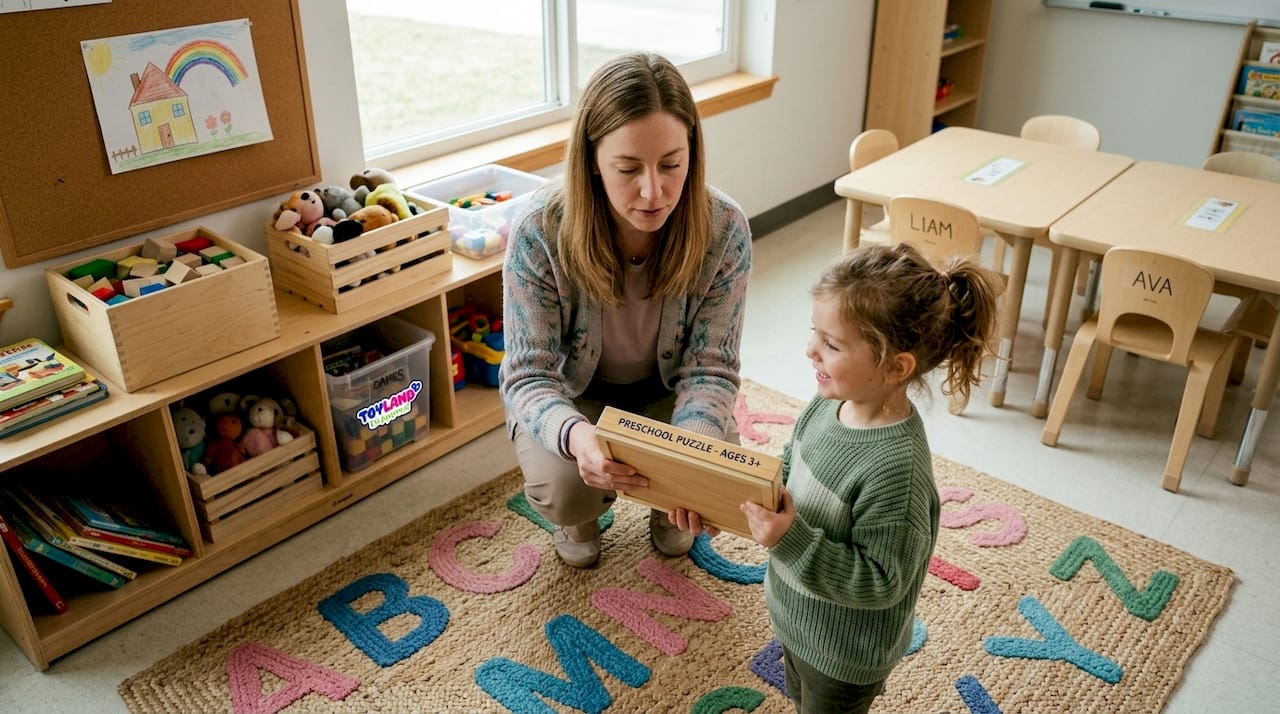
The American Red Cross emphasizes the need to match toys to developmental milestones, not just trust “educational” labels when selecting activities for children.
Here is a practical breakdown by age and developmental category:
| Age range | Physical | Cognitive | Social/emotional |
|---|---|---|---|
| 0 to 12 months | Soft rattles, teethers | High contrast mobiles, mirrors | Face-to-face play |
| 1 to 3 years | Push and pull toys, stacking rings | Shape sorters, simple puzzles | Parallel play with dolls |
| 3 to 5 years | Tricycles, balance boards | Matching games, building sets | Cooperative games |
| 6 to 10 years | Jump ropes, sports equipment | Strategy games, STEM kits | Role-play and group projects |
Notice how each category addresses different developmental streams simultaneously. A good toy choice supports physical coordination, challenges thinking, and builds social skills all at once.
- Avoid one-size-fits-all “educational” toys that claim to suit ages 1 to 6; the actual skill gap between a 12-month-old and a 6-year-old is enormous.
- Adapt activities for children with different learning needs, sensory sensitivities, or language development timelines.
Thanks to educational toy advances, many modern products now include developmental stage guides that go beyond simple age labeling, which is a genuinely useful shift.
Pro Tip: When in doubt, choose a toy slightly below the child’s current skill level. Confidence and mastery build intrinsic motivation, which fuels more ambitious play over time.
Bring multisensory manipulatives into literacy and math
When children touch, move, sort, and build, abstract concepts become concrete. This is especially powerful for early literacy and mathematics, two areas where many children struggle because the ideas are presented too symbolically too soon.
Research published by Edutopia shows that using multisensory hands-on materials in literacy instruction builds letter-sound connections and phonemic awareness far more effectively than worksheets alone.
Here is a simple phonemic awareness activity you can run with everyday objects:
- Place three small objects on a table (a cup, a coin, a stone).
- Ask the child to say a word slowly, pushing one object forward for each sound. For example, “cat” becomes three pushes: /k/, /ae/, /t/.
- After mastering this with objects, swap the objects for letter cards to bridge from sound to symbol.
- Celebrate when the child connects the physical movement to the written letter.
For math manipulatives, consider these proven tools:
- Counting blocks or cubes for addition and subtraction
- Linking chains for skip counting and multiplication patterns
- Pattern blocks for geometry and fractions
- Number lines drawn on the floor for kinesthetic number sense
The key habit to build is asking children to explain their reasoning aloud. When a child says “I put three blocks here and two blocks there and now I have five,” they are cementing the concept in long-term memory far more effectively than circling an answer on a worksheet.
Pro Tip: Use the same physical manipulative for multiple concepts over time. A set of 100 counting cubes can teach sorting, addition, place value, area, and fractions across multiple grade levels. That’s remarkable value per dollar spent.
Loose parts and play materials for problem-solving and creativity
Loose parts are simple, open-ended materials with no fixed purpose: bottle caps, wooden spools, stones, shells, pinecones, recycled containers, and fabric pieces. The idea, first proposed by architect Simon Nicholson in the 1970s, is that environments with many movable, modifiable materials invite more inventive thinking than environments with finished, single-purpose toys.
The research interest in loose parts has grown significantly, though it’s important to be honest about what the data shows. A systematic review found that loose parts play outcomes are often associated with cognitive benefits like problem-solving and creativity, but the evidence is mixed and research quality varies considerably.
“Loose parts benefit most when children have extended time, minimal interruption, and adults who value the process rather than the product.”
| Feature | Loose parts | Scripted toys |
|---|---|---|
| Child direction | High | Low |
| Creativity potential | High | Moderate to low |
| Cost | Very low | Moderate to high |
| Learning predictability | Variable | More consistent |
| Mess factor | High | Low |
Practical strategies for using loose parts at home or in classrooms:
- Start with a small, curated collection rather than overwhelming children with variety
- Offer storage that makes selection visible (open trays, clear containers)
- Set aside at least 20 minutes for uninterrupted exploration
- Document what children create with photos to generate reflection conversations afterward
The honest takeaway is this: loose parts are not a magic solution, but when conditions are right, they offer an inexpensive way to spark extended, creative play that commercial toys rarely match.
Technology-enhanced toys: context matters
Tech-integrated toys range from simple electronic musical mats to AI voice companions that hold conversations with children. The range is enormous, and so is the variance in educational value.
Research consistently shows that the educational benefit of tech toys depends heavily on pedagogy and context. Open-ended exploration with technology produces better outcomes than overly scripted, passive interactions.
A few practical guidelines for navigating this space:
- Prioritize interactivity over passivity. A toy that responds to a child’s input teaches more than one that runs a pre-set sequence.
- Limit solo screen-based use. Co-viewing and co-playing dramatically increase the learning value of most tech toys.
- Be cautious with AI companions. Research from the Brookings Institution highlights that AI toy companions may not provide genuine human feedback and raise real safety and privacy concerns, especially for young children.
- Check for data collection practices before connecting any toy to a home or school network.
| Tech toy type | Educational potential | Key concern |
|---|---|---|
| Coding robots | High (STEM, logic) | Requires adult facilitation |
| AI voice companions | Moderate | Privacy, dependency risk |
| Electronic flashcards | Low to moderate | Passive, rote learning |
| Interactive STEM kits | High | Setup complexity |
For a thorough look at what to watch for, the discussion around AI toy safety and impact covers both the promise and the real cautions parents and educators should carry into every purchase decision. When comparing newer products, innovative educational toys reviews provide useful context for evaluating claims made by manufacturers.
Pro Tip: Before purchasing a tech toy, ask one question: “Does this toy respond to the child, or does the child respond to the toy?” The first builds thinking; the second builds compliance.
Build routines and model responsible toy use in classrooms
A fantastic toy introduced without structure often becomes a distraction. In classroom settings especially, the way a toy is introduced and managed determines whether it advances learning or derails it.
Edutopia’s work on playful learning in early grades emphasizes that modeling responsible use and creating consistent routines helps high-interest items become part of learning structures rather than triggers for off-task behavior.
Concrete steps for building a toy-integrated routine:
- Introduce one new toy at a time. Demonstrate how to use it, what learning it supports, and how to care for it.
- Create a choice board where children select from a limited set of approved activities during designated play periods.
- Model expected behaviors explicitly. Show children how to set up, use, and clean up the material before allowing independent use.
- Co-create rules with students. Children who help design the guidelines are far more likely to follow them.
- Use anchor charts to remind children of the learning purpose behind each material in the classroom.
At home, the same principle applies. A consistent “building time” after school, or a designated art corner with clear expectations, turns toys from random objects into purposeful tools.
Pro Tip: Assign brief “expert” roles to children who have mastered a toy or game. Peer teaching reinforces their own learning and builds a classroom culture where toys are taken seriously as learning tools.
Montessori toys: strengths and limitations
Montessori-inspired toys, typically simple, natural-material, single-skill items, have earned enormous popularity in recent years. The philosophy is sound: isolate one concept per material, allow the child to self-correct, and build independence through hands-on repetition.
But do they deliver measurable academic results? A longitudinal study published in Nature found that Montessori academic benefits may appear for certain skills but can fade over time depending on study design and time horizon. In other words, the benefits are real but not unconditional.
| Dimension | Montessori approach | Traditional toys |
|---|---|---|
| Independence | High | Varies |
| Adult instruction needed | Low | Varies |
| Skill isolation | Deliberate | Rarely structured |
| Academic evidence | Moderate, time-dependent | Mixed |
| Cost | Often higher | Wide range |
Practical recommendations for parents and educators:
- Use Montessori materials for math and sensory skills, where the self-correcting design shines brightest
- Pair Montessori toys with rich language interaction because the materials alone rarely develop vocabulary or narrative thinking
- Don’t dismiss traditional toys in favor of an all-Montessori approach; the evidence supports a blended strategy
- Set realistic expectations since even the best research suggests effects are moderate, not transformative
For a balanced look at this question, the ongoing debate around the Montessori gold standard is worth reading before making significant investments in any single methodology.
Our perspective: what works, what doesn’t, and how to rethink ‘educational’ toys
Here’s what years of watching children play with every category of toy reveals: the toy is almost never the deciding factor. The adult is.
A $5 set of wooden blocks in the hands of an engaged parent who asks great questions will outperform a $200 “educational” robot used passively every time. This is the uncomfortable truth the toy industry has little interest in advertising. Marketing budgets go toward product features, not parenting behaviors. But the research, consistently and across categories, points back to the same variable: adult interaction, context, and intentional structure.
We’ve also seen parents and schools over-invest in a single toy type or methodology, whether that’s all Montessori, all tech, or all loose parts, and then feel frustrated when outcomes plateau. The future of educational toys lies in integration, not purity. Mix open-ended creative materials with some structured STEM activities. Pair sensory play with explicit language development. Use tech where it genuinely responds to the child, and keep it away from passive consumption.
The most powerful thing you can do with any toy is sit beside the child and be genuinely curious about what they’re discovering. That costs nothing and changes everything.
Explore ToylandEU’s innovative educational kits and toys
If the strategies above have inspired you to refresh your home or classroom toy collection, ToylandEU has a range of hands-on, multisensory products designed with exactly these principles in mind.
The Montessori drawing kit supports open-ended creative exploration with structured guidance that builds fine motor skills and visual reasoning. For tactile, sensory-rich learning, the clay modeling kit gives children a genuinely hands-on medium that supports both creativity and early math concepts. The creative learning set bridges art and math in a format that works well for children ages 3 to 12, making it a practical choice for mixed-age households and classrooms. With free worldwide shipping and over 30,000 products, ToylandEU makes it easy to find toys that align with evidence-based learning goals.
Frequently asked questions
What are the best toys for early literacy development?
Hands-on manipulatives and multisensory materials that connect sounds to symbols are highly effective; moving physical objects for each sound in a word, then replacing them with letter cards, is a proven literacy strategy backed by classroom research.
How do you decide if a toy is truly ‘educational’?
A toy earns that label when it matches the child’s developmental stage, supports specific skills, and invites active and creative engagement; developmental milestone matching matters far more than packaging claims.
Are AI-powered toys safe in classroom or home settings?
AI-powered toys require close adult supervision because they raise real safety and privacy concerns, and they cannot replicate the authentic feedback that human interaction provides.
Do Montessori toys guarantee better academic results?
No toy guarantees results; Montessori longitudinal research shows potential benefits for specific skills that can diminish over time, so realistic expectations and a blended approach are recommended.
How can toys be used responsibly in classrooms?
Modeling correct use explicitly and establishing clear routines ensures that high-interest toys support playful structured learning rather than becoming a source of distraction or off-task behavior.