

Why Gift Toys for Kids: Developmental Benefits That Matter
TL;DR:
- Gifting toys is a deliberate developmental decision that enhances problem-solving, emotional resilience, and social skills in children. Well-chosen, open-ended toys foster long-term cognitive growth, emotional regulation, and future-ready skills through active, imaginative, and challenging play. Prioritizing quality over quantity and matching toys to a child’s developmental level maximizes their lasting impact.
Most parents think of toys as a way to keep kids busy. That’s a serious underestimation. Choosing to gift toys for kids is one of the most deliberate developmental decisions you can make as a parent or guardian. Research now shows that the right toy doesn’t just entertain. It builds problem-solving skills, emotional resilience, and social intelligence in ways that structured instruction rarely can. This article breaks down the science behind why toys matter, what makes one toy more valuable than another, and how to choose gifts that genuinely support your child’s growth.
Table of Contents
- Key Takeaways
- Why gift toys for kids: the science explained
- Emotional growth: resilience, pride, and self-trust
- Pretend play and mental health
- Active playful learning and future-ready skills
- My take: toys are an investment, not just a treat
- Explore toys that actually develop your child
- FAQ
Key Takeaways
| Point | Details |
|---|---|
| Toys drive real development | The right toy supports cognitive, emotional, and social growth — not just entertainment. |
| Emotional friction is healthy | Frustration and pride during play build resilience and persistence in young children. |
| Pretend play protects mental health | Pretend play ability at ages 2–3 links to fewer behavioral problems by ages 4–7. |
| Active play beats passive consumption | Child-led, open-ended play activates more brain networks than screen-based passive activities. |
| Age-fit matters more than price | A cognitively appropriate toy with parental involvement produces the strongest developmental gains. |
Why gift toys for kids: the science explained
The term “developmental play” is what child psychologists use when describing the kind of toy-based activity that actually changes how a child’s brain works. It’s the recognized framework behind what most parents casually call “just playing.” When you understand this distinction, the question of why gift toys for kids shifts from “what will they enjoy?” to “what will help them grow?”
Here’s what the research shows toys genuinely build:
- Problem-solving and persistence. Hands-on play with toys teaches children to analyze, attempt, fail, and try again. This iterative cycle is the foundation of engineering thinking and academic grit.
- Spatial awareness and math readiness. Building toys, stacking sets, and geometry-based puzzles develop the spatial reasoning skills that predict later math performance. Explore how STEM toys build these skills from age 3 onward.
- Executive function. Parental interaction during play enhances executive function, creativity, and emotional bonding. Simply sitting beside your child and asking open questions while they play amplifies every developmental benefit.
- Design thinking. When a toy breaks or doesn’t work as expected, children naturally begin redesigning their approach. That’s iterative learning in its purest form.
Pro Tip: When selecting a toy, look for something just slightly beyond your child’s current ability. Not so hard it produces shutdown frustration, but hard enough to require real effort. That sweet spot is where the most growth happens.
Emotional growth: resilience, pride, and self-trust
Toys do more than engage the intellect. They create an emotional laboratory where children practice their most important inner skills. Frustration, pride, confusion, and breakthrough are not just side effects of play. They are the point.
Research on toy repair activities found that emotions during toy repair actively keep children engaged and help them adjust strategies through what researchers call “productive failure.” When a child cannot get a gear to turn or a block tower to stand, they experience real frustration. When they figure it out, the pride they feel is not trivial. It becomes a stored belief: “I can solve hard things.”
“Toys that allow for repair or re-storied play deepen emotional attachment and learning through persistence, creating self-efficacy and meaning in play beyond immediate entertainment.” — Research on toy repair and early childhood engineering learning
The Control-Value theory of achievement emotions, used in educational psychology, explains this well. When a child feels some control over an outcome and values the activity, positive emotions like pride become powerful motivators. Toys that give children agency, where they can change, fix, or extend the play, are the ones that generate this emotional cycle most effectively.
Pro Tip: Choose toys that can be taken apart, reassembled, or used in multiple ways. Building kits, modular sets, and fixable mechanical toys give children more emotional engagement than single-use novelty items.
Pretend play and mental health
One of the most underappreciated benefits of gifting toys for kids is the connection between imaginative play and long-term mental health. This is not soft science. A longitudinal study found that pretend play at ages 2–3 correlates with significantly fewer internalizing and externalizing mental health problems at ages 4–7, independent of emotional regulation. That last part matters. The benefits of pretend play go beyond simply helping kids manage their emotions in the moment.
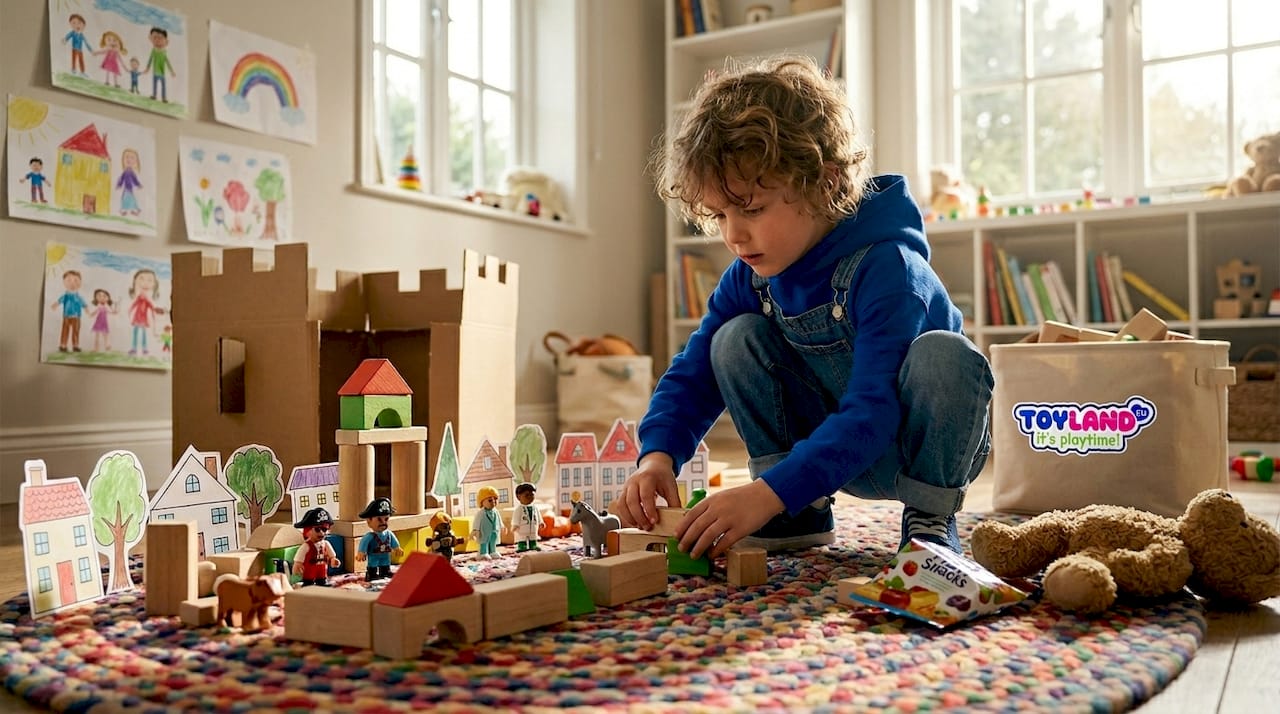
Dramatic play also provides cognitive, social, and emotional benefits that help children process real experiences through the safe distance of fantasy. Here is what open-ended pretend play builds:
- Symbolic thinking. When a cardboard box becomes a rocket ship, the child is practicing abstract reasoning, the same skill needed for reading and mathematics.
- Social negotiation. Role-play with other children requires taking turns, assigning roles, resolving disagreements, and reading social cues in real time.
- Emotional expression. Pretend play gives children a language for feelings they may not yet have words for. Acting out a fear through a toy character is a natural form of self-therapy.
- Narrative intelligence. Children who play-pretend are rehearsing storytelling and cause-and-effect logic simultaneously.
The toy type matters here. Open-ended toys that support multiple scenarios produce far greater developmental benefits than scripted or single-use toys. A doll set with interchangeable accessories beats a battery-powered toy that performs one trick repeatedly.
Learn more about how imaginative play shapes children across all major developmental domains.
Active playful learning and future-ready skills
There is a critical difference between active playful learning and passive consumption. Watching a screen is stimulating but largely receptive. Playing with a physical toy, especially one that resists the child’s first attempt, is generative. It requires the child to produce something: a solution, a story, a structure.
Play activates brain networks integrating imagination, focus, and executive functions needed for learning. These are not separate skills that children “also develop.” They are the neural foundation on which every academic skill is later built.
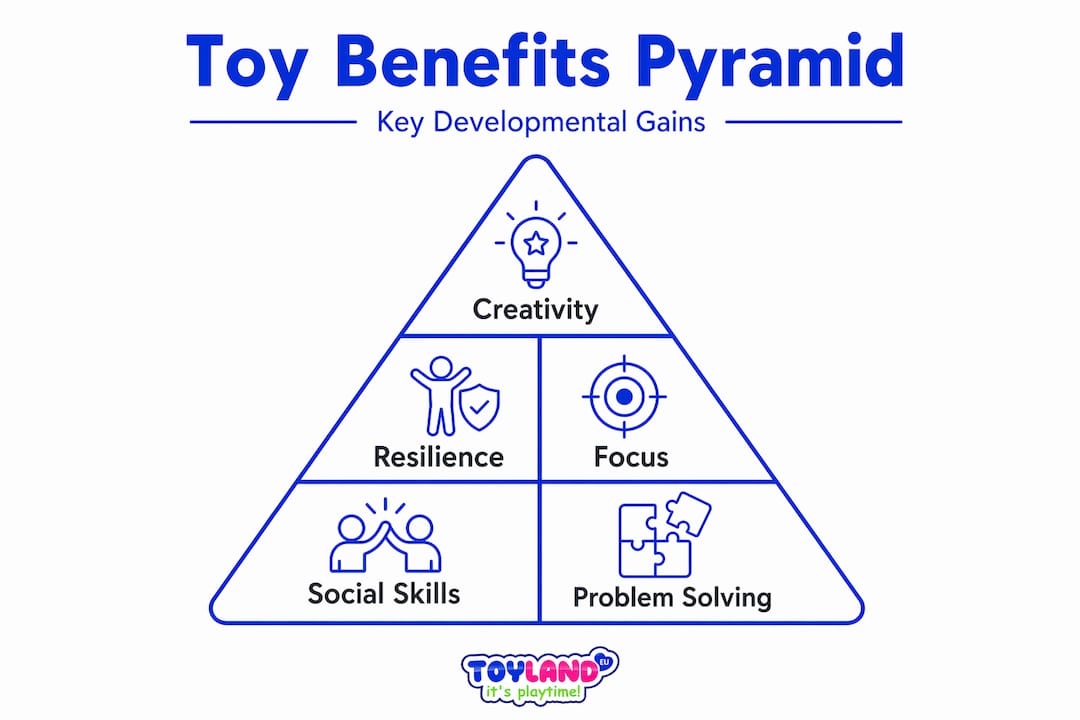
Here is how different toy types compare on this dimension:
| Toy type | How it supports active learning | Passive consumption risk |
|---|---|---|
| Building and construction sets | Spatial reasoning, problem-solving, iterative thinking | Low |
| Role-play and pretend play sets | Social skills, narrative logic, emotional expression | Low |
| STEM and robotics kits | Coding logic, cause-and-effect, persistence | Low |
| Single-button novelty toys | Brief sensory engagement | High |
| Passive screen-based “educational” apps | Recall of facts | High |
Active, child-led play with real control over outcomes is the version that builds collaboration, creativity, and the confidence to learn from failure. These are precisely the skills that schools and employers consistently identify as underdeveloped in young people. You can start building them before kindergarten with the right gifts.
My take: toys are an investment, not just a treat
I’ve watched children interact with hundreds of different types of toys, and the pattern is consistent. The ones that get played with repeatedly are almost never the most expensive or the flashiest. They are the ones that give the child something to figure out, something to revisit, and something to make their own.
What I’ve learned is that most parents undervalue toys because they’ve been told toys are “just fun.” That framing does real damage. When you see a toy as entertainment, you optimize for immediate excitement. When you see it as a developmental tool, you optimize for what it builds over time. The second frame leads to dramatically better gift choices.
I’ve also seen the mistake of quantity over fit. Fifteen toys that are too easy or too scripted produce less development than two toys that genuinely challenge and invite open-ended engagement. My honest advice: buy fewer toys and spend more time thinking about how toys shape cognitive development before you buy. One great toy, chosen with care, does more than a pile of forgettable ones.
— Thane
Explore toys that actually develop your child
If this article has shifted how you think about gifting, Toylandeu makes it easy to act on that shift. The catalog at Toylandeu includes STEM robotics kits that teach Python and real coding logic through play, as well as gesture-controlled RC cars and engineering toy sets that build spatial thinking and problem-solving in a hands-on way.
Every product ships worldwide for free, and the catalog spans over 30,000 items organized by age group and play type. Whether you are shopping for a toddler who needs open-ended pretend play tools or a school-age child ready for a real engineering challenge, Toylandeu has options chosen for developmental depth, not just shelf appeal. Browse the full selection and find a gift that does something lasting.
FAQ
Why do children benefit more from toys than screen time?
Toys require children to generate responses, make decisions, and persist through challenges. Screens are mostly receptive. Active, child-led play activates more brain networks and builds executive function in ways passive digital content does not.
What makes a toy genuinely educational?
Educational toys challenge children just beyond their current skill level and reward persistence. Parental involvement during play multiplies the developmental gains of any toy, educational or otherwise.
How does pretend play affect mental health?
Pretend play ability at ages 2–3 predicts fewer internalizing and externalizing problems at ages 4–7. The benefits run through cognitive and social channels, not just emotional regulation.
Should I buy fewer, better toys or more variety?
Fewer, well-chosen toys consistently outperform large collections of single-use items. Open-ended toys that support multiple roles and scenarios keep children engaged longer and produce stronger developmental outcomes.
At what age should I start gifting developmental toys?
From birth. Even infants benefit from age-appropriate sensory toys that stimulate visual tracking and motor development. The key is matching the toy’s challenge level to the child’s current stage.