

The ultimate toy gift checklist: safe, fun, age-right picks
TL;DR:
- Choosing the right toy requires matching age labels to a child’s developmental stage and interests while prioritizing safety. Conduct quick hazard checks for small parts, sharp edges, loud sounds, and unsafe batteries before purchasing. Focus on open-ended, active, and creative toys that provide long-term engagement and developmental benefits.
Picking the perfect toy gift sounds simple until you’re standing in the toy aisle staring at 200 options, second-guessing every single one. Too advanced? Too babyish? Could that small piece become a choking hazard? Parents and gift buyers face these questions every time a birthday or holiday rolls around, and the stakes feel surprisingly high. A great toy sparks joy, builds skills, and survives more than one afternoon of play. A poor choice collects dust or, worse, creates a safety risk. This checklist cuts through the noise with a practical, expert-backed framework so you can pick with confidence every time.
Table of Contents
- Use age guidelines as a starting point—not the only rule
- Safety first: Screen for potential risks
- Look for open-ended, active, and creative play value
- Checklist: Final checks before you buy
- The hidden pitfalls most gift buyers overlook
- Find gifts kids love (and parents approve)
- Frequently asked questions
Key Takeaways
| Point | Details |
|---|---|
| Always confirm safety | Check for small parts, choking hazards, and follow all age recommendations on packaging. |
| Match toy to the child | Look beyond age—consider the child’s unique interests and developmental stage. |
| Prioritize engagement | Seek toys that support active, open-ended, and creative play for longer-lasting fun. |
| Double-check gift readiness | Before buying, review your checklist for durability, play value, and hazard concerns. |
Use age guidelines as a starting point—not the only rule
Now that you understand the overall challenge, the first checkpoint on your list is age, but with some important nuances worth understanding before you shop.
Every toy box carries an age label. Most people treat it as the definitive answer. In reality, that label is only a safety minimum, not a skill guide, an interest guide, or a ceiling on how much fun a child can have with the toy. Manufacturers set age ranges based on hazard testing: small parts, structural integrity, and materials safety at the developmental stage described. A toy labeled “3+” contains no parts small enough to be a choking hazard for most three-year-olds. That’s it. The label says nothing about whether a particular five-year-old will enjoy it or a particularly coordinated two-year-old can use it safely.
Zero to Three, one of the leading early childhood organizations in the U.S., puts it clearly: match the toy to the child’s developmental stage, skills, and interests, not just the birthday age. Think about what the child is actually into right now. Does she spend every afternoon arranging figurines into elaborate scenes? A theater puppet set or a detailed dollhouse will land better than a puzzle technically rated for her age group.
Before you buy, ask yourself:
- What does this child love to do most with their free time?
- Are they physically ready for the coordination this toy needs?
- Will they mentally engage with the theme, or is it a “grown-up” interest they haven’t developed yet?
- Is the child pushing boundaries? Consider a toy one age step up, but re-screen the hazards carefully.
Choosing a toy aimed at an older age range is not automatically dangerous, but it does require a closer look at the hazard profile. A nine-year-old’s craft kit may include small beads or sharp tools that make it completely unsuitable for a curious four-year-old sibling who might also get their hands on it. Our toy gifting guide walks through age-range matching in more detail, and if you want a broader overview of what to prioritize, check out these tips for choosing the best toys as a useful complement to this checklist.
Remember: Age labels protect children from physical hazards. Your job as a gift buyer is to go one step further and match the toy to who the child actually is right now.
Safety first: Screen for potential risks
Even a toy that fits the child’s interests must still pass a basic safety screening. Here is how to do it efficiently without needing a laboratory or an engineering degree.
Safety screening does not have to be complicated. A quick, structured check covers the vast majority of real-world risks. The American Academy of Pediatrics highlights that choking hazards remain the top priority for infants and toddlers, and age guidance on packages exists largely because of this risk. For children under three, if any part of the toy fits inside a standard toilet paper roll, it is a potential choking hazard.
Once you have a toy in hand or are reviewing it online, run through these steps:
- Check for small parts. Shake the box. Read the warning label. Look for detachable pieces, removable stickers, or tiny accessories that could break off.
- Inspect material and finish. Hard plastic edges should be smooth. Paint should be non-toxic and lead-free. Look for ASTM F963 certification on the packaging, which is the U.S. toy safety standard. Many reputable international retailers also carry CE-marked products.
- Evaluate noise levels. Some electronic toys produce sounds louder than 85 decibels, which is loud enough to cause hearing damage with repeated exposure. Hold the toy at arm’s length and test any sound function before gifting.
- Assess battery safety. Button cell batteries are a serious hazard for young children. A toy with an accessible battery compartment (especially one that does not require a screwdriver to open) is not suitable for toddlers.
- Look for strings, cords, or ribbons. Anything longer than 12 inches poses a strangulation risk for children under three.
- Check for sharp edges or points. Especially relevant for wooden toys, metal vehicles, or poorly finished plastic. Run your hand around all edges before wrapping.
UMass Memorial Health provides a detailed breakdown of toy labeling and hazard categories, confirming that sharp edges, loudness, loose parts, and battery safety are the four categories most commonly overlooked by well-meaning gift buyers. You can find more safety tips for toy shoppers if you want to go deeper on any specific hazard type. And if you’re gifting in the context of a birthday party, a solid party gift planning guide can help you coordinate multiple gifts with age-range consistency.
Pro Tip: When shopping online, zoom into product photos to check for exposed battery compartments, visible small accessories, and cord lengths. Customer review sections are also a surprisingly useful hazard detector: parents often flag safety concerns within the first few reviews.
Look for open-ended, active, and creative play value
With safety and age right-sized, now focus on how much a toy actually keeps the child engaged, learning, and happy over the long term.
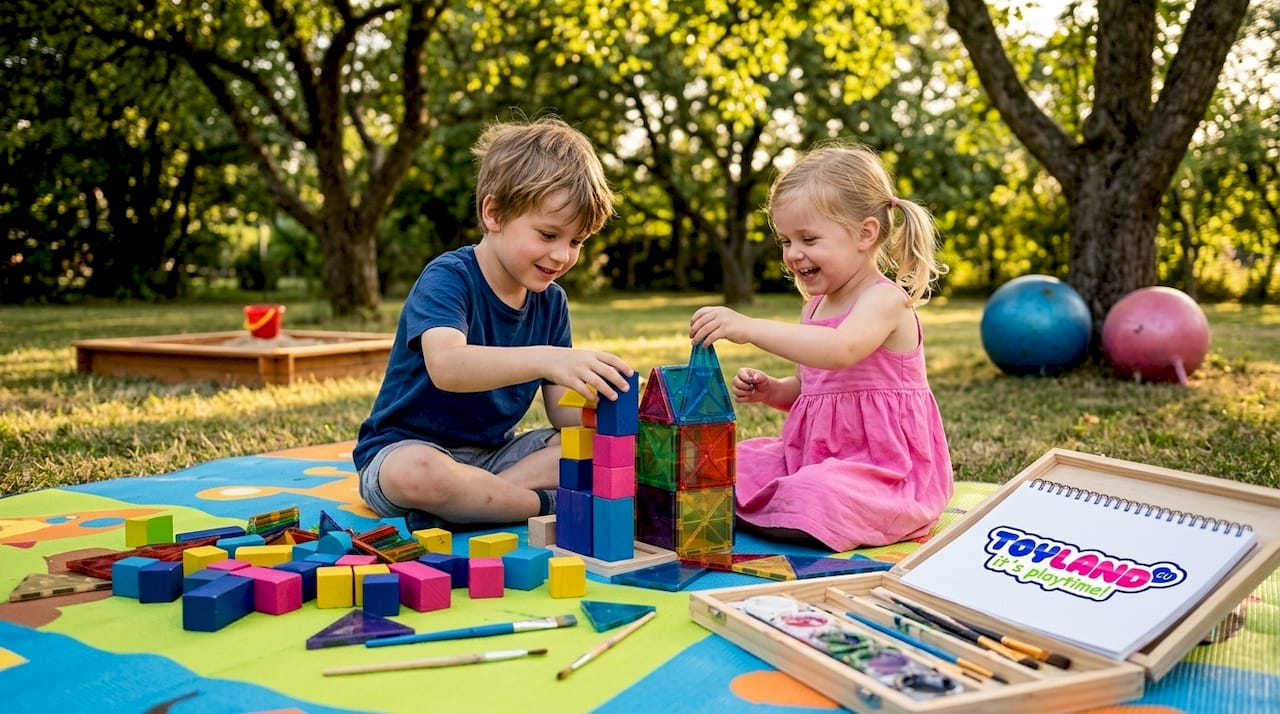
The most common gifting regret is not buying something dangerous. It is buying something the child plays with once and never touches again. The antidote is understanding play types and choosing toys that deliver more than one of them.
Zero to Three’s research consistently shows that open-ended, active play and social interaction deliver the deepest developmental benefits, and toys that combine multiple play types outperform single-function gadgets by a wide margin in terms of total play hours. Here is a quick breakdown:
- Open-ended toys (building blocks, magnetic tiles, art kits, sand and water tables) have no fixed right answer. A child can use them in dozens of ways, meaning they stay interesting for months or even years. They also grow with the child because a five-year-old builds very different structures than a nine-year-old using the same set of blocks.
- Active play toys (balls, balance boards, jump ropes, outdoor obstacle sets) get kids moving. Physical play is critical for motor development and emotional regulation, and research consistently links outdoor or active play to better focus and sleep.
- Interactive and role-play toys (puppets, dress-up kits, kitchen sets, collaborative board games) build empathy, language, and imagination. These are also strong choices for families who want to play alongside their children.
Explore our full guide on open-ended toys for creativity for specific product examples. For a science-backed angle, learning supercharged by toys breaks down exactly what skills different toy categories develop. And if you are considering something with buttons and screens, interactive toys for development explains how to tell the high-quality interactive options from the one-trick gadgets.
| Toy type | Engagement lifespan | Skill areas | Best age range |
|---|---|---|---|
| Open-ended (blocks, art kits) | Very long (months to years) | Creativity, problem-solving, fine motor | 18 months and up |
| Active/outdoor toys | Long (seasonal reuse) | Gross motor, coordination, fitness | 2 years and up |
| Role-play/interactive | Medium to long | Language, empathy, social skills | 3 years and up |
| Single-function gadgets | Short (days to weeks) | Specific skill, limited transfer | Varies |
Pro Tip: When evaluating a toy in a store, ask yourself: “Can this be used in at least three different ways?” If the answer is no, that toy has a high risk of becoming shelf decoration within a month.
Checklist: Final checks before you buy
You have narrowed your options. Now use this checklist to make sure your choice is truly ready for gifting.
Busy Toddler’s comprehensive toy research confirms that repeated, appropriate play for a child’s specific play style, combined with verified durability and hazard inspection, predicts gifting success far better than brand name or price tag. Use the table below as your quick-reference guide.
| Check | What to verify | Pass or revisit |
|---|---|---|
| Age appropriateness | Matches both safety label and child’s developmental level | Pass if both align |
| Interest match | Connects to child’s current passions or interests | Pass if yes |
| Safety screening | No small parts, sharp edges, unsafe batteries, or loud sounds | Pass only if all clear |
| Play value | Supports open-ended, active, or interactive play | Pass if at least one type |
| Durability | Well-constructed, not likely to break within weeks | Pass if sturdy build |
| Packaging | Easy to open and gift-ready, minimal plastic waste | Pass if manageable |
Here is your five-step in-store or online decision process:
- Read the full age label and confirm it fits the child’s actual developmental stage, not just their birthday.
- Run the six-point safety screening (small parts, materials, noise, batteries, cords, edges).
- Identify which play types the toy supports and make sure at least one of them matches the child’s style.
- Check durability by looking at construction quality, hinges, and connection points.
- Confirm the gift is appropriate for the setting: a loud toy is a bad idea for a small apartment, and a messy craft kit needs a parent ready to supervise.
Our article on criteria for truly giftable toys expands on the durability and fit dimensions in useful detail. For younger children specifically, early learning toy examples provides specific product ideas already vetted against these criteria.
The hidden pitfalls most gift buyers overlook
Before you wrap your chosen toy, a final word on what most guides do not address but every parent and gift giver should think about carefully.
Here at ToylandEU, we have seen the full range of gifting outcomes. The toy that prompted the most genuine parent frustration is almost never the dangerous one (those get returned fast). It is the toy that looked absolutely perfect on the shelf or product page and was never actually played with. These are the toys that get donated still in the box six months later.
The biggest culprit is trend-chasing. A toy that dominates social media in October does not necessarily deliver real play value in February. Novelty wears off fast, especially with children who have short attention spans and unlimited stimulus competing for their focus. We always recommend evaluating play value independent of trend status. Ask: “Would I still consider this toy a good gift if no one was talking about it?” If the answer is yes, you are probably on to something solid.
The second hidden pitfall is misreading developmental fit. A five-year-old who is “really smart” is still a five-year-old physically and emotionally. The Toy Association’s guidance on age label interpretation is unambiguous: age levels are based on safety features and developmental abilities, not intelligence. A seven-year-old’s building set may include components small enough to be a hazard for a younger sibling. The “gifted child” exception does not override the physical hazard reality.
Third, durability is dramatically underweighted by most buyers. A toy that breaks after three uses is not a gift; it is a disappointment wrapped in excitement. Check for metal versus plastic hinges on moving parts, the quality of paint or decal application, and whether replacement parts are available. Toys that last and grow with the child are almost always the ones remembered fondly years later.
Our honest recommendation: spend a little more on one well-made, open-ended toy than on three flashy single-function ones. The child will not remember the quantity. They will remember the one they loved.
Find gifts kids love (and parents approve)
Armed with your checklist, the next step is finding toys that already tick every box, so you are not doing all the research from scratch.
At ToylandEU, we carry over 30,000 toys spanning every age group, play type, and interest category. Whether you are looking for STEM kits that grow with a child, open-ended building sets that spark hours of creative play, interactive puppets for imaginative storytelling, or durable outdoor toys for active kids, our catalog has options that match the criteria in this checklist. Every product listing includes age guidance, safety certification details, and play-type descriptions to make your decision as easy as possible. We ship worldwide at no extra cost, so wherever the child is, the gift arrives ready to unwrap.
Frequently asked questions
What’s the most important safety check for toy gifts?
Always screen for small parts and choking hazards before gifting, especially for children under three, since choking risks remain the leading toy-related safety concern for infants and toddlers.
How do I pick a toy for a child with a unique interest?
Choose toys that connect directly to the child’s passions, then verify age appropriateness, safety, and flexibility for different play styles, because interest and developmental fit both matter equally in a great gift choice.
What are open-ended toys and why do they matter?
Open-ended toys like blocks, art sets, or magnetic tiles encourage creativity and flexible thinking because they have no single correct use, and active, open-ended play consistently delivers more developmental value than single-function toys.
Is it okay to give a toy labeled for older kids to a younger child if they’re advanced?
No, because age labels account for safety and physical developmental abilities, not intelligence alone, meaning hazards like small parts remain dangerous regardless of how bright or coordinated the child seems.