

Open-ended toys: 5 proven benefits for child creativity
Parents spend hours searching for the “best” toy, often gravitating toward the flashiest, most feature-packed options on the shelf. But a growing body of research flips that instinct on its head. The simplest toys, ones with no batteries, no instructions, and no single correct use, consistently outperform high-tech alternatives when it comes to building creativity, problem-solving, and language skills. This article breaks down exactly what open-ended toys are, what the evidence says about their impact, and how you can choose the right ones for your child’s age and learning style.
Table of Contents
- What are open-ended toys?
- How do open-ended toys benefit children?
- Are all open-ended toys equally effective?
- How to choose open-ended toys for every age group
- Open-ended toys in today’s playroom: Trends and real-world impact
- Discover creative open-ended toys for your child
- Frequently asked questions
Key Takeaways
| Point | Details |
|---|---|
| Simple toys, big impact | Open-ended toys like blocks and art supplies foster creativity, problem-solving, and social skills far beyond many tech toys. |
| Quality over quantity | Not all open-ended toys are equal; the best are simple, versatile, and free from predetermined stories. |
| Benefits for every age | Open-ended toys support learning at every stage, especially in early childhood, but continue to provide value as children grow. |
| Real-world results | Growing demand and classroom adoption show open-ended toys are reshaping modern play and education. |
| Smart toy selection | Choosing age-appropriate and truly open-ended toys ensures your child’s playtime builds lifelong skills. |
What are open-ended toys?
To understand their benefits, we must first clarify what open-ended toys are and why they stand apart from the rest of the toy aisle.
Open-ended toys are items children can use in multiple ways, with no fixed outcome or single correct answer. A set of wooden blocks can become a castle, a road, a bridge, or a pretend kitchen. A handful of loose pebbles can be coins, food, or puzzle pieces. The child decides the story, the rules, and the goal. That flexibility is the whole point.
Here are the core features that define a genuinely open-ended toy:
- Simple design with few or no moving parts
- Versatility across different types of play (solo, group, indoor, outdoor)
- No fixed narrative or branded storyline attached
- Encourages imagination rather than following instructions
- Examples include building blocks, loose parts, plain figurines, art supplies, and sand
Contrast this with closed-ended toys, which have rules, objectives, and a win or loss condition. A board game with strict rules or an electronic toy that rewards specific button presses are closed-ended. Neither is inherently bad, but they serve a different developmental purpose.
“Open-ended toys promote thinking, cooperation, and creativity” and ranked highest for play quality in the TIMPANI study conducted at Eastern Connecticut State University.
The benefits of imaginative play extend well beyond the playroom, touching on emotional regulation, social skills, and early academic readiness.
How do open-ended toys benefit children?
Now that you know what they are, let’s explore exactly how open-ended toys can help your child grow.
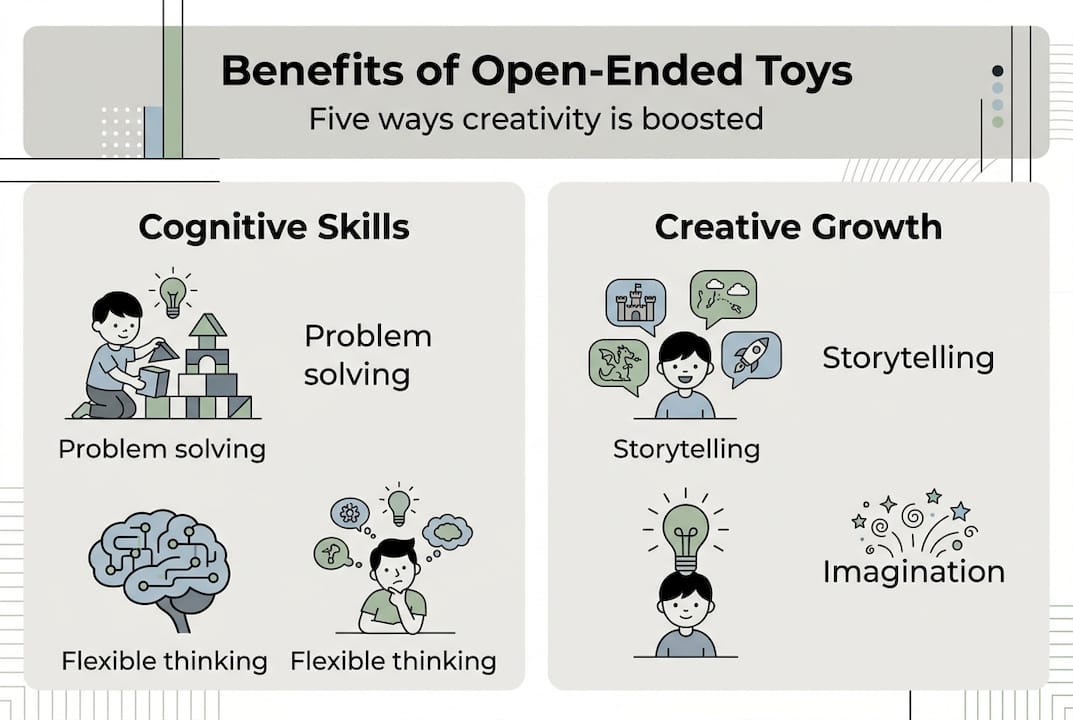
The cognitive benefits are significant. When a child picks up a set of blocks with no instructions, their brain immediately starts problem-solving. They test ideas, fail, adjust, and try again. That cycle builds flexible thinking, which is one of the most valuable skills a child can develop before entering school.
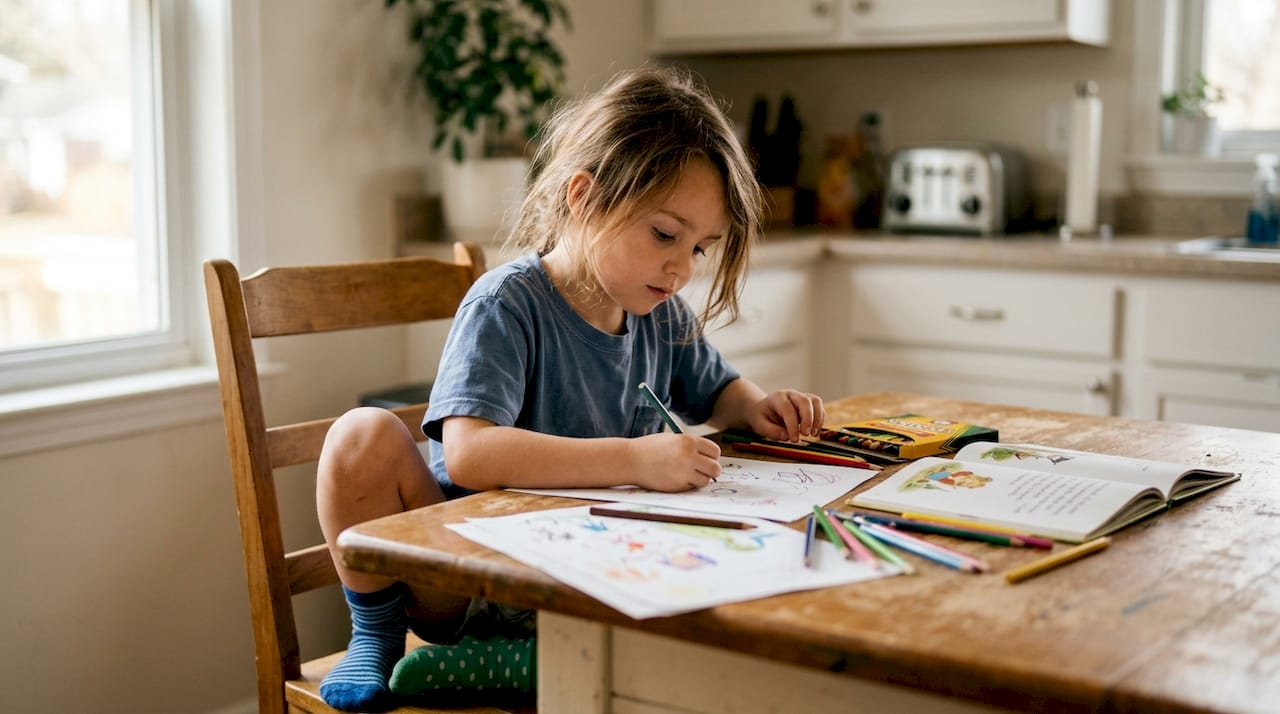
Language and communication also get a real boost. Open-ended play almost always involves storytelling. Children narrate their scenarios, negotiate roles with friends, and invent new vocabulary to describe what they are building or imagining. Research confirms that preference for open-ended toys correlates with higher imagination scores and greater originality in children’s thinking.
A systematic review on loose parts found that open-ended materials are linked to stronger problem-solving, creativity, and early academic skills including pre-math and pre-literacy concepts. Here is a quick comparison to put that in perspective:
| Benefit area | Open-ended toys | Closed-ended toys |
|---|---|---|
| Creative thinking | High | Low to moderate |
| Problem-solving | High | Moderate |
| Language development | High | Low |
| Rule-following | Low | High |
| Replayability | Very high | Limited |
| Social negotiation | High | Moderate |
The imaginative play benefits stack up quickly, and pairing open-ended toys with innovative toys for child development can create a well-rounded play environment.
Pro Tip: Look for toys that can be part of many different stories or challenges. If your child can only use it one way, it probably is not truly open-ended.
Are all open-ended toys equally effective?
While open-ended toys can offer many benefits, not every option on the shelf delivers the same results.
Some toys are marketed as open-ended but are actually heavily themed or overly complex. A building set that only makes one specific spaceship, or a figurine tied to a popular movie franchise, limits the child’s imagination because the story is already written for them. The toy tells the child what to think instead of inviting them to create.
The TIMPANI study found that only simple, versatile toys scored highest in quality play observations. Toys with a fixed theme or branded narrative consistently ranked lower, even when they were technically “open-ended” in their marketing.
Here is what to look for when evaluating effectiveness:
| Factor | More effective | Less effective |
|---|---|---|
| Design simplicity | Plain, minimal detail | Highly themed or branded |
| Versatility | Many possible uses | One or two uses |
| Narrative freedom | No built-in story | Tied to a movie or show |
| Sensory engagement | Varied textures, sizes | Single material, uniform |
It is also worth noting that some studies show mixed results after controlling for factors like family background, socioeconomic status, and child age. Open-ended toys are not a magic solution. They work best as part of a broader, play-rich environment.
Pro Tip: Prioritize toys without a set story or fixed purpose. Plain wooden blocks will outlast and outperform a themed plastic set in almost every developmental measure.
If you are exploring building-based options, Lego-compatible sets for creative minds offer a middle ground, and even adult LEGO builders confirm that open-ended building play has lifelong appeal.
How to choose open-ended toys for every age group
Knowing the key qualities, let’s make the process practical with simple steps for choosing the best open-ended toys by age group.
Research confirms that open-ended toys benefit children from age 3 and up, with the strongest developmental impact in early childhood. Here is a straightforward guide:
- Ages 3 to 5: Focus on sensory and physical play. Wooden blocks, stacking rings, kinetic sand, and simple art supplies are ideal. Look for large pieces that are safe to handle and easy to clean. Avoid anything with small parts or complex assembly.
- Ages 6 to 8: Introduce more complexity. Building sets with no fixed instructions, loose craft materials, and figurines without a branded story work well. Children this age can handle smaller pieces and benefit from toys that encourage group play and negotiation.
- Ages 9 and up: Shift toward creative challenges. Open-ended STEM kits, art workbooks, and modular building systems support both independent and collaborative projects. Look for toys that grow with the child’s interests rather than locking them into one theme.
For all age groups, consider how toy color and design can influence engagement. Neutral or natural tones often encourage more imaginative use than bright, character-branded colors.
Pro Tip: Rotate your child’s toys every two to three weeks. Bringing a toy back after a break makes it feel new again and sparks fresh creative play without spending a dollar.
Exploring top innovative toys can also help you identify which newer products genuinely support open-ended play versus which ones just claim to.
Open-ended toys in today’s playroom: Trends and real-world impact
Finally, let’s put this all in context by seeing how open-ended toys are shaping real playrooms and what trends to watch.
The toy market is shifting. Parents and educators are pushing back against screen-heavy, passive entertainment and actively seeking toys that require children to do something. Retail demand for open-ended toys has grown steadily, with brands responding by launching more minimalist, versatile product lines.
Here is what we are seeing across homes and classrooms right now:
- Montessori-inspired materials are appearing in mainstream toy stores, not just specialty shops
- Loose parts play is being formally introduced in early childhood education programs
- STEM-focused open-ended kits are bridging the gap between imaginative play and structured learning
- Educators report that children who regularly use open-ended toys show stronger focus and peer collaboration
- Parents note that these toys hold attention longer than electronic alternatives, reducing screen time naturally
“When we replaced most of the themed toys in our classroom with simple blocks and art materials, the quality of play changed immediately. Children started talking more, arguing less, and building things we never expected.” — Early childhood educator, reported in classroom observation research
Modern playrooms increasingly blend classic open-ended toys with carefully chosen tech-enabled options. The key is balance. Future-proof toys are designed to grow with children, and interactive toys and development research shows that technology works best when it supports, rather than replaces, imaginative play.
It is also worth acknowledging that more research is needed to confirm the long-term effects of open-ended play, particularly around STEM skills and executive function. The early evidence is strong, but the field is still growing.
Discover creative open-ended toys for your child
If you are ready to build a playroom that genuinely supports your child’s development, the right starting point is a curated selection of toys designed for open-ended, imaginative use. At ToylandEU, we carry a wide range of options that put creativity first.
For younger children, the Montessori drawing kit is a standout choice. It encourages self-directed art exploration without rigid instructions, making it a perfect open-ended tool for ages 3 and up. For children who love combining creativity with early learning, the drawing and math learning set blends imaginative drawing with foundational math concepts in a playful, flexible format. Both ship worldwide with free delivery, so building a smarter playroom has never been easier.
Frequently asked questions
What makes a toy ‘open-ended’?
Open-ended toys are designed for flexible play, allowing children to use them in many different ways and encouraging imagination instead of following set rules. The defining quality is that there is no single correct way to play with them.
Are open-ended toys better than electronic toys for learning?
Research suggests open-ended toys support creativity and problem-solving more than most electronic toys, though both can have a place in play. Higher-quality play is consistently observed with open-ended options in structured studies.
What age is best for introducing open-ended toys?
Open-ended toys are most impactful from ages 3 and up, but benefits continue into older childhood. The strongest developmental effects are seen in early childhood, making ages 3 to 6 a particularly valuable window.
How do I know if a toy is truly open-ended?
Check if the toy can be used in many different ways, does not rely on batteries or strict instructions, and supports imaginative play without a built-in story or branded narrative.
Is there strong evidence open-ended toys boost academic success?
Research links open-ended toys to early cognitive and language growth, but long-term academic effects still need more study. The current evidence is promising, especially for pre-literacy and pre-math skills.
Recommended
- The Benefits of Imaginative Play for Children - Toyland EU – ToylandEU
- Top Innovative Toys for Child Development in 2025 | Parent’s Guide – ToylandEU
- Future-Proof Toys 2025: Innovation, Sustainability & Smart Play – ToylandEU
- Embrace Eco-Friendly Creativity: Our Top Picks for Building Toys – ToylandEU