

What makes a toy truly giftable? How to choose well
TL;DR:
- Giftable toys are durable, open-ended, and promote active, child-led play over time.
- Age-appropriate, challenging toys that inspire imagination and growth are most valued.
- Simple, versatile toys like blocks and art supplies often provide lasting engagement and joy.
Every parent and gift buyer has been there: you spend real money on a toy that gets played with for three days and then quietly disappears under the bed. The packaging looked amazing, the reviews seemed solid, and the child’s eyes lit up on opening day. But a week later? Forgotten. Choosing a toy gift that actually sticks requires more than good instincts. It takes a clear understanding of what separates a giftable toy from a forgettable one, and that’s exactly what this guide delivers: practical, expert-backed criteria to help you pick something a child will genuinely treasure.
Table of Contents
- Defining a giftable toy: More than just a pretty box
- Choosing the right giftable toy for different ages
- Giftable toys that stand out: Examples and comparisons
- Expert tips: Educational and innovative giftable toys for special occasions
- Why simple, durable, and open-ended toys matter most: Our take
- Find the perfect giftable toy with ToylandEU
- Frequently asked questions
Key Takeaways
| Point | Details |
|---|---|
| Core giftable traits | Giftable toys inspire active play, are durable, offer open-ended use, and fit well into daily family life. |
| Match toys by age | The best giftable toy changes with a child’s age and developmental needs—choose accordingly. |
| Value open-ended play | Open-ended toys engage kids longer and foster creativity, making them excellent gifts. |
| Consider education and innovation | STEM and creative bundles are smart choices for birthdays and holidays, blending fun with learning. |
Defining a giftable toy: More than just a pretty box
Walk down any toy aisle or scroll through an online store and you’ll notice something: nearly every toy claims to be “educational,” “innovative,” or “the gift of the year.” The packaging is bold, the price points vary wildly, and the sheer volume of options is overwhelming. But price and flashiness are poor predictors of a toy’s lasting value. A giftable toy is defined not by what it costs or how many lights it has, but by how well it performs in the hands of a child over time.
Toy experts and researchers have long worked to define what makes a toy genuinely worthwhile. The Museum of Play maintains the National Toy Hall of Fame, and their criteria represent a gold standard for quality: a toy should be iconic, long-lasting, innovative in some way, and should foster discovery and imagination. Notice that none of those criteria mention flashing lights, licensed characters, or social media trends. They focus entirely on play value and staying power.
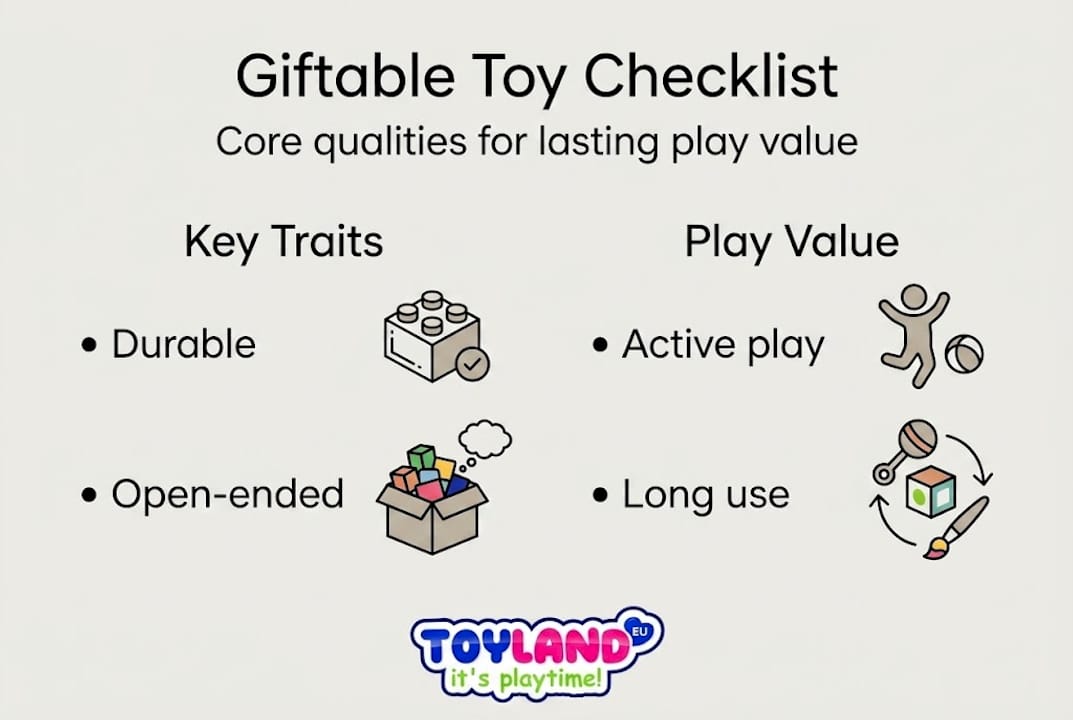
According to Hall of Fame evaluation standards, the key qualities of a truly giftable toy include inspiring active, child-led play (like pushing, pulling, and building), sturdiness to survive rough use, open-ended multiple uses (similar to classic building blocks), an appropriate challenge level that grows with the child, and good household fit, meaning low noise, easy storage, and manageable mess.
Here’s a quick breakdown of what to look for:
- Active play potential: Does the toy get the child moving, building, or creating rather than just watching?
- Open-ended use: Can it be used in more than one way, or does it have a single “correct” play mode?
- Durability: Will it survive a year of real play, or will it break in the first month?
- Appropriate challenge: Does it stretch the child’s abilities without causing frustration?
- Household fit: Is it something the family can realistically live with, in terms of size, noise, and cleanup?
“The best toy is the one the child reaches for again and again, not the one that impressed adults on unboxing day.” This principle drives every strong gifting decision.
A useful shortcut from our toy gifting guide is to ask yourself: “Will this toy still be interesting in six months?” If the honest answer is “probably not,” it’s worth reconsidering. The most giftable toys invite children to bring their own ideas to the play experience, which means the toy gets richer as the child grows, not more boring.
Choosing the right giftable toy for different ages
Age-appropriateness is one of the most overlooked factors in toy gifting. A toy that’s too simple bores a child quickly; one that’s too advanced causes frustration and gets abandoned. The sweet spot is a toy that’s just challenging enough to keep a child engaged while being accessible enough that they can succeed without constant adult help. Getting this balance right requires knowing what different developmental stages actually look like in practice.
Here’s a practical reference table for matching toys to developmental stages:
| Age range | Developmental focus | Ideal toy types | Examples |
|---|---|---|---|
| 0 to 2 years | Sensory exploration, motor skills | Soft blocks, stacking toys, simple push-pull toys | Cloth books, ring stackers |
| 3 to 5 years | Imagination, social play, early problem-solving | Building sets, dress-up, art supplies | Magnetic tiles, Duplo, finger paints |
| 6 to 8 years | Creativity, rule-based games, coordination | Board games, construction kits, craft sets | LEGO, puzzles, activity kits |
| 9 to 12 years | Logic, strategy, skill-building | STEM kits, coding toys, model kits | Coding robots, chemistry sets |
| 12 and up | Identity, complexity, depth | Strategy games, advanced building, creative tools | 3D puzzles, RC vehicles, art workbooks |
For preschoolers specifically, research from Consumer Reports confirms that building sets like Duplo and magnetic tiles, dress-up items, and basic art supplies are among the most developmentally valuable options for ages 3 to 5. These toys support imagination, early social play, and creative problem-solving all at once.
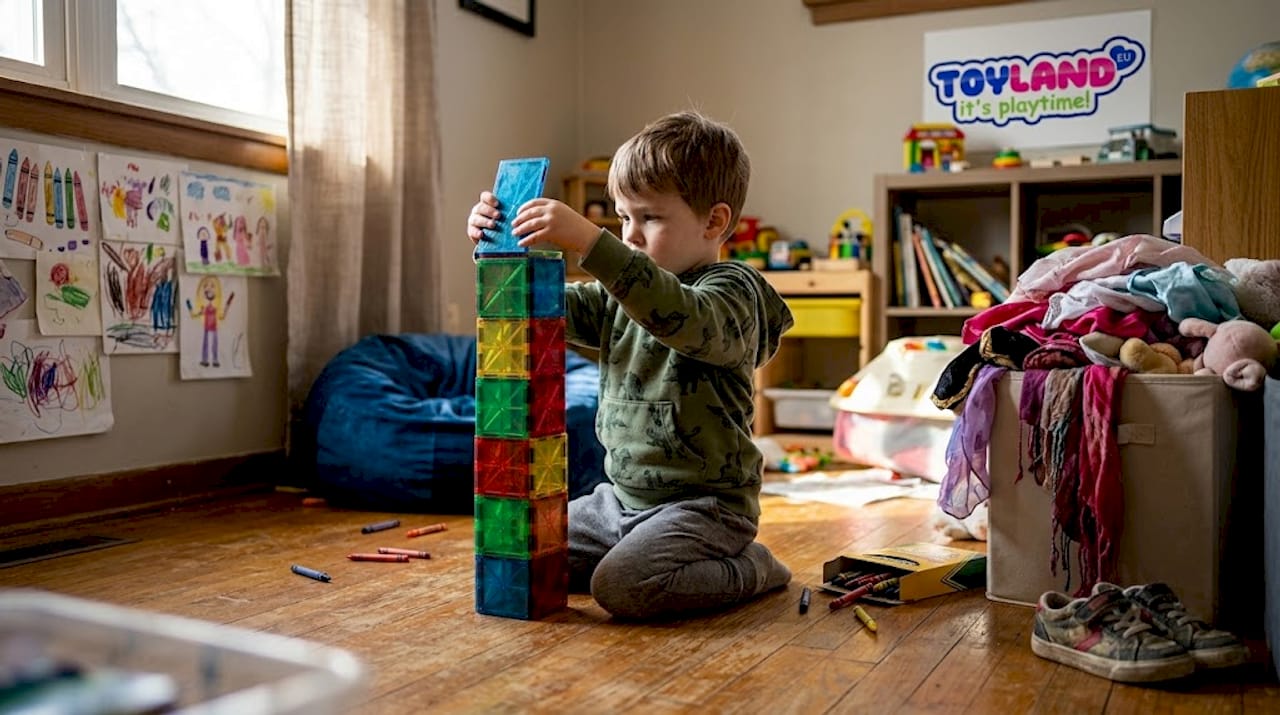
Pro Tip: When in doubt, choose a toy that belongs to an “open system,” meaning it can be expanded or combined with other pieces. Magnetic tile sets, building blocks, and art supply collections are examples. The child’s interest grows as the system grows, and you can add to it for future birthdays and holidays.
When shopping for a child’s toy gift, work through these four questions before adding anything to your cart:
- Is this age-appropriate? Check the manufacturer’s recommended age, but also consider the specific child’s abilities and interests.
- Does it invite active participation? Passive toys (ones that perform while the child watches) lose appeal fast.
- Will the parents approve? Think about noise, mess, size, and safety, because a toy the parents dread is one they’ll quietly put away.
- Can it grow with the child? A toy that stays relevant for two or three years delivers far more value than one tied to a single moment.
For younger children in particular, we’ve found that the best toys for preschoolers tend to share a common trait: they give children control over the play experience. When a child directs the play, engagement is deeper and lasts longer. That’s a principle worth keeping in mind no matter what age you’re shopping for.
Giftable toys that stand out: Examples and comparisons
Knowing what makes a toy giftable in theory is useful. Seeing how specific toy categories stack up against each other in practice is even more useful. Three categories dominate most gift lists: open-ended toys (blocks, tiles, building sets), collectibles (trading cards, figurines, themed sets), and plush toys (stuffed animals, comfort characters). Each has genuine strengths, but they differ significantly in play value and staying power.
Research on educational gifts shows that open-ended toys like blocks engage children 73% longer than toys with a fixed play mode. That’s a striking number. It means a child playing with magnetic tiles or a basic building set stays absorbed in play for nearly twice as long as a child with a single-function electronic toy. For parents who care about screen-free time and creative development, this statistic alone is worth considering.
Here’s how the three main categories compare across the criteria that matter most for gifting:
| Criteria | Open-ended toys | Collectibles | Plush toys |
|---|---|---|---|
| Play longevity | Very high (months to years) | Medium (depends on series) | High (emotional attachment) |
| Creative engagement | Very high | Low to medium | Low |
| Replay value | Very high | Medium (trading, sorting) | Medium (comfort role) |
| Emotional connection | Medium | High (ownership, pride) | Very high |
| Educational value | High | Low to medium | Low to medium |
| Household friendliness | High | Medium (small pieces) | Very high |
The takeaway is clear: open-ended toys win on play value and educational benefit, making them strong default choices for most gifting situations. Collectibles shine for children who are passionate about a specific theme or franchise, because that emotional investment drives continued engagement. Plush toys, while lower in structured play value, often become treasured companions that provide comfort and emotional development for years.
Some giftable standouts in each category worth considering:
- Open-ended: Magnetic tile sets, classic wooden blocks, modular building kits, and sand or water play tables
- Collectibles: Well-known card game sets, themed miniature figurines with a storyline, and educational fossil or gem kits
- Plush: Handcrafted character animals, puppets that encourage storytelling, and interactive plush with simple sound features
For a deeper look at why open-ended options deliver such strong results, the open-ended toys benefits resource walks through the research in detail. If you’re considering plush options, the plush toys explained article covers safety standards and collector appeal, which matters especially for younger recipients.
Expert tips: Educational and innovative giftable toys for special occasions
Special occasions call for gifts that feel thoughtful and exciting. Birthdays, holidays, and milestones are moments when you want a toy that genuinely wows and delivers long-term enjoyment. The good news is that the current toy market offers genuinely innovative options that weren’t available even five years ago, and experts are taking notice.
The Toy Insider’s 2026 Spring and Summer Gift Guide highlights STEM toys, coding robots, and activity bundles as the standout categories for the year. These aren’t just trends; they represent a genuine shift in how children learn through play. Magnetic tiles that double as geometry lessons, coding robots that teach sequencing logic to preschoolers, and art kits that build fine motor skills while encouraging creativity are all examples of toys that deliver on multiple levels simultaneously.
Top innovative giftable ideas for 2026 and beyond:
- Coding robots for young children: Devices like simple programmable bots that respond to physical commands (not just screens) teach logic and problem-solving in a tactile way
- Magnetic construction sets with STEM themes: Sets that build bridges, towers, and geometric shapes while teaching spatial reasoning
- Sensory and art activity bundles: Multi-piece kits that combine drawing, sculpting, and coloring for creative exploration across one sitting or many
- Gesture-controlled vehicles: Remote-controlled cars and stunt vehicles operated by hand movements rather than traditional controllers, adding a physical coordination element
- Science exploration kits: Crystal growing, volcano experiments, and simple electronics kits that turn curiosity into hands-on discovery
For a broader look at where innovative educational toys are heading, the landscape is evolving fast and in genuinely exciting directions.
Pro Tip: For high-stakes occasions like birthdays or major holidays, bundles are an underrated solution. A well-curated bundle (say, an art workbook paired with a modeling clay set) reduces your decision fatigue and gives the child a richer play experience right away. It also signals thoughtfulness, because you’ve assembled something cohesive rather than grabbing a single item off a shelf. Explore our educational toys for children resource for bundling inspiration across age groups.
Why simple, durable, and open-ended toys matter most: Our take
There’s a real temptation when buying a toy gift to go for the thing that looks the most impressive. The robot that dances, the playset with forty-seven pieces, the electronic device with an app. These toys photograph beautifully and generate instant excitement. But in our experience, the children who get the most out of their toys aren’t the ones with the most sophisticated gear. They’re the ones with a bucket of blocks, a box of art supplies, or a well-made puppet.
Experts who evaluate toys against Hall of Fame standards consistently favor toys that promote active play over passive observation. A toy that requires a child to do something, to build, imagine, move, or create, will always outlast a toy that does the performing itself. The child is the engine of play, and the best toys give that engine the best fuel.
We’ve seen this play out in real situations repeatedly. A simple set of wooden blocks or a basic art kit will quietly become a child’s most-reached-for item, long after the flashier gifts have lost their appeal. Durability matters here too: a toy that breaks in month two sends the message that play has a short shelf life. The toys children remember are the ones that stayed with them, literally and emotionally. Our benefits of open-ended toys resource expands on this thinking if you want to explore the research behind it.
Find the perfect giftable toy with ToylandEU
Now that you know what to look for, finding the right toy doesn’t have to feel overwhelming.
At ToylandEU, we carry over 30,000 toys specifically chosen to meet the criteria you’ve just read about: active play, open-ended use, durability, and educational value. Whether you’re shopping for a birthday, a holiday, or just because, you’ll find options across every age group and interest. Start with something like the enchanting art workbook for creative kids, the vibrant clay modeling kit for hands-on fun, or the gesture-controlled stunt car for something genuinely exciting. Free worldwide shipping makes it easy to send joy anywhere.
Frequently asked questions
What characteristics make a toy truly giftable?
A giftable toy is sturdy and open-ended, inspiring active child-led play with multiple uses, an appropriate challenge level, and a good fit for the family’s home and lifestyle.
What are the best giftable toys for preschoolers?
Building sets like Duplo and magnetic tiles, dress-up items, and art supplies are top picks for ages 3-5, because they support imagination, social development, and early problem-solving all at once.
Why are open-ended toys often recommended as gifts?
Open-ended toys engage children up to 73% longer than fixed-function toys, and they support creativity, problem-solving, and sustained play in ways that single-use toys simply cannot match.
Are educational or innovative toys always the best gift choice?
STEM kits and coding robots are standout options for many occasions, but the best gift always balances genuine playfulness, durability, and the specific child’s current interests and abilities.
How do I make sure the toy I gift will be used and loved?
Choose toys that meet Hall of Fame standards: iconic, long-lasting, and discovery-driven. Toys that grow with the child and invite active participation are consistently the ones children return to again and again.