

Top early learning toys: expert-backed examples for smarter play
Walk down any toy aisle and you’ll face hundreds of options, each promising to make your child smarter, more creative, or better prepared for school. The reality is that most toys don’t deliver on those claims. Research consistently shows that a small category of toys, chosen with specific criteria in mind, genuinely supports early brain development, language growth, and problem-solving skills. This guide cuts through the noise by applying science-backed standards to real toy examples, so you can shop with confidence and stop guessing at what actually works for your child’s growth.
Table of Contents
- What makes a toy great for early learning?
- Classic examples: Blocks, stacking cups, and nesting toys
- STEM learning starts early: Robot kits and programmable toys
- Loose parts, art, and puzzles: Surprising brain-builders
- Head-to-head: Comparing top early learning toys
- Why simple, open-ended toys often win—despite the tech hype
- Explore the best early learning toys at ToylandEU
- Frequently asked questions
Key Takeaways
| Point | Details |
|---|---|
| Focus on open-ended play | Blocks, stacking cups, and loose parts spark creativity and broad skill development. |
| Choose age-appropriate toys | Select toys that match your child’s developmental stage for safe, effective learning. |
| STEM toys boost critical skills | Robot kits and hands-on STEM sets build computational thinking and executive function. |
| Joint play multiplies benefits | Parent-child playtime greatly enhances the educational value of any toy. |
| Simple is powerful | Basic art supplies and household items can foster deep, lasting learning. |
What makes a toy great for early learning?
Before diving into specific examples, let’s clarify what truly qualifies as an educational toy. Not every toy with a math symbol on the box earns that label. Genuine early learning toys share a few key traits that researchers have identified across decades of child development studies.
First, the best toys invite open-ended play. These are toys with no single correct answer or outcome. A child can use them in dozens of ways, which keeps engagement high and builds imagination and self-regulation. As one resource on open-ended toys benefits explains, this type of play gives children control over their own learning process.
Second, physical manipulation matters enormously. Toys that require stacking, nesting, sorting, or building directly support fine motor skills and cognitive development. Stacking cups and nesting toys develop hand-eye coordination, size judgment, problem-solving, and cause-and-effect understanding from as early as 9 months.
Third, simpler is often better. Open-ended toys outperform electronic ones, with blocks, art materials, and puzzles preferred over flashy battery-powered alternatives for sustained play and long-term development.
Here’s a quick checklist to evaluate any toy before you buy:
- Does it have more than one way to play? Open-ended wins.
- Does it require the child to do something physical? Manipulation builds skills.
- Is it age-appropriate? Too easy breeds boredom; too hard causes frustration.
- Can a caregiver join in naturally? Parent engagement multiplies benefits.
- Does it rely heavily on batteries or screens? If yes, look for a simpler version.
“The best toy is one that a child can use in ten different ways on ten different days.” This is the core principle behind choosing toys that grow with your child.
Pro Tip: Before buying, ask yourself whether you could play with the toy alongside your child. If the answer is yes, it’s probably a keeper.
For a broader look at how to apply these criteria, the educational toys for children resource offers helpful guidance organized by age and skill area.
Classic examples: Blocks, stacking cups, and nesting toys
With a clear framework in mind, let’s see how classic toy choices meet these criteria. Wooden blocks, stacking cups, and nesting toys have been recommended by child development experts for generations, and the science still backs them up in 2026.
Wooden unit blocks are perhaps the most studied toy in early childhood research. Wooden blocks and magnetic tiles teach physics concepts like balance and stability, spatial reasoning, engineering thinking, and creativity through open-ended construction. These aren’t just fun. They’re building the mental frameworks children will use in math and science for years.
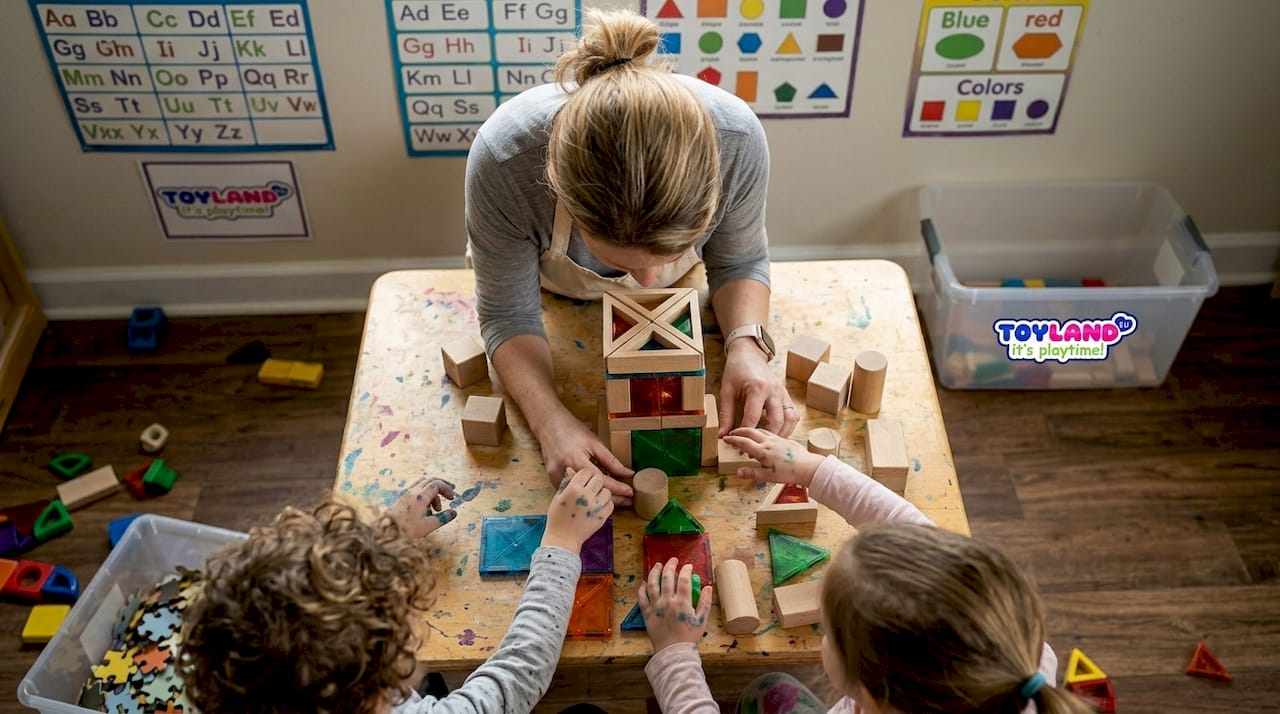
Stacking cups serve a similar function for younger children. A set of colorful cups can be stacked, nested, filled with water, used as pretend cups, or lined up by size. That versatility is exactly what makes them so powerful. The benefits of open-ended play are especially visible with toys like these, where a child’s imagination sets the rules.
Here’s how to match these classics to your child’s age:
- Under 12 months: Large, soft stacking rings or simple nesting cups with no small parts.
- 12 to 24 months: Wooden unit blocks with basic shapes, stacking cups with size gradations.
- Ages 2 to 3: Duplo-style bricks, magnetic tiles, and more complex nesting sets.
- Ages 3 to 5: Full wooden block sets, magnetic tile systems, and pattern blocks.
Choosing toys with natural materials like wood also reduces plastic waste and tends to produce more durable, longer-lasting play items.
Pro Tip: Rotate your child’s block set every few weeks. Putting half the blocks away and reintroducing them later makes the toy feel new and sparks fresh creative play.
For families interested in environmentally responsible choices, sustainable STEM toys that evolve with your child’s skills are worth exploring. The Zero to Three organization also offers practical tips for choosing toys at each developmental stage.
STEM learning starts early: Robot kits and programmable toys
Beyond the classics, innovative STEM toys are reshaping how children engage with foundational concepts. Programmable robots designed for young children are no longer just novelty gadgets. They’re research-validated learning tools.
A landmark study found that robot programming outperforms unplugged activities for preschoolers’ computational thinking and executive functions, including inhibition, working memory, and cognitive flexibility. These are the same executive function skills that predict academic success in elementary school.
Here’s what robot kits and programmable toys teach:
- Sequencing: Children must plan steps in order to make a robot move.
- Cause and effect: Push this button, the robot turns left. Simple logic, big learning.
- Problem-solving: When the robot doesn’t do what was expected, kids debug their thinking.
- Teamwork: Many robot activities work best with two or more children collaborating.
| Toy type | Best age | Key skill | Screen-free? |
|---|---|---|---|
| Programmable floor robot | 3 to 5 years | Sequencing, CT | Yes |
| Gear and circuit sets | 4 to 6 years | Engineering, logic | Yes |
| Coding robot with app | 5 years and up | Programming, EF | No |
| Simple push-button bot | 2 to 3 years | Cause and effect | Yes |
Pro Tip: For children under 3, stick to screen-free robots with large buttons. Save app-connected kits for age 4 and above, when children can better understand the connection between input and outcome.
For parents curious about how these toys fit into a broader learning strategy, cognitive-boosting toys and innovative educational toys offer deeper context on the technology behind modern STEM play.
Loose parts, art, and puzzles: Surprising brain-builders
Some of the most effective brain-boosters may already be in your home or recycling bin. Loose parts, a term from educational theory, refers to any open-ended material that children can move, combine, and rearrange freely. Think cardboard boxes, fabric scraps, wooden spools, or bottle caps.
Research shows that loose parts elicit more spontaneous STEM behaviors than fixed toys. A child given a cardboard box and some fabric will invent a spaceship, a fort, or a puppet theater. A child given a single-function electronic toy will press the same button repeatedly.
Art materials are equally powerful. Crayons, paper, clay, and paint develop creativity, planning, and fine motor control simultaneously. Open-ended art and puzzles are consistently preferred over electronic alternatives for long-term development.
Puzzles deserve special mention. They build spatial reasoning, persistence, and problem-solving in a way that few other toys match. Even a simple 6-piece puzzle for a toddler requires planning, trial and error, and a satisfying sense of completion.
| Material | Cost | Skills developed | Age range |
|---|---|---|---|
| Cardboard boxes | Free | STEM, creativity, social play | 18 months and up |
| Crayons and paper | Very low | Fine motor, creativity, planning | 18 months and up |
| Simple puzzles | Low | Spatial reasoning, persistence | 2 years and up |
| Clay or playdough | Low | Fine motor, creativity, sensory | 2 years and up |
Loose parts cost almost nothing but produce some of the richest, most complex play behaviors researchers have observed in young children.
For families who want structured options, interactive puzzles for kids that build math skills are a great bridge between free play and guided learning. You can also explore eco-friendly STEM toys that combine sensory play with early math concepts.
Head-to-head: Comparing top early learning toys
To help you decide, here’s a practical, side-by-side comparison of key toy types covered so far. Different toys excel in specific developmental domains, and understanding those differences helps you build a balanced toy collection rather than doubling up on similar skills.
| Toy type | Primary skill | Best age | Parent involvement | Cost range |
|---|---|---|---|---|
| Wooden blocks | Spatial reasoning, physics | 12 months to 5 years | Medium | Low to medium |
| Stacking cups | Hand-eye coordination | 6 to 24 months | Low | Low |
| Programmable robot | Computational thinking | 3 to 6 years | Medium | Medium to high |
| Loose parts | Creativity, STEM | 18 months and up | Low | Free to low |
| Art supplies | Fine motor, creativity | 18 months and up | Low to medium | Very low |
| Puzzles | Spatial reasoning, persistence | 2 to 6 years | Medium | Low |
One finding that stands out across all toy categories is the role of caregivers. Object interactions at 12 months predict cognitive scores at 30 months in young children, and frequent parent-joint engagement consistently amplifies those developmental gains. The toy matters, but how you play with it matters just as much.
Key takeaways for building your toy selection:
- Prioritize variety: Cover spatial, creative, and logical skill areas.
- Match to age: A toy that’s too advanced frustrates more than it teaches.
- Play together: Your presence turns a good toy into a great learning experience.
- Rotate regularly: Novelty keeps engagement high without buying more toys.
For a curated overview of what’s working right now, top child development toys offers a well-organized starting point.
Why simple, open-ended toys often win—despite the tech hype
Having examined the main options, it’s worth stepping back and rethinking what play and learning really look like. We’ve seen impressive data on robot kits and programmable toys, and those results are real. But here’s what often gets lost in the excitement over tech-driven learning: the most durable, flexible, and creativity-rich play still happens with the simplest materials.
Open-ended toys outperform electronic ones for imagination and self-regulation, and that gap widens over time. A programmable robot holds a child’s attention for weeks. A set of wooden blocks holds it for years, because the child is always the one setting the challenge.
The real magic, though, isn’t the toy at all. It’s the adult sitting on the floor, asking “what happens if we put the big one on top?” or “can you build a bridge that holds this car?” No app replicates that. No flashing light replaces genuine curiosity shared between a caregiver and a child.
Don’t underestimate a cardboard box. Don’t overlook the open-ended toy benefits of a simple block set. The best investment you can make isn’t always the most expensive one on the shelf.
Explore the best early learning toys at ToylandEU
Ready to add these learning-boosting toys to your child’s playroom? Here’s where to start. ToylandEU carries a wide selection of research-aligned toys that match the criteria covered in this guide, from hands-on STEM kits to creative play sets designed for every age and developmental stage.
For a hands-on introduction to coding and engineering, the robotics car kit is a standout option for children aged 8 and up who are ready for real programming challenges. For younger learners, the drawing and math set blends creativity with early numeracy in a single engaging package. Browse the full learning toy selection to find expert-approved options with free worldwide shipping.
Frequently asked questions
What age is best to introduce early learning toys?
You can start with simple blocks and stacking cups from birth, focusing on large pieces for under 18 months. Stacking and nesting toys actively develop hand-eye coordination and problem-solving from 9 months onward, so earlier is better.
Are electronic toys or open-ended toys better for early learning?
Open-ended toys outperform electronic ones for self-regulation and sustained engagement, making blocks, puzzles, and art materials the stronger long-term choice for most children.
How important is joint play with parents for learning?
Extremely important. Parent-joint engagement consistently amplifies cognitive, language, and social development beyond what any toy achieves on its own.
Do robot kits really help preschool children learn?
Yes. Robot programming outperforms unplugged activities for building computational thinking and executive functions in preschool-aged children, according to peer-reviewed research.
Are common household items like boxes and fabric really ‘toys’?
Absolutely. Loose parts like boxes and fabric elicit more spontaneous STEM behaviors than many store-bought fixed toys, making them genuinely valuable learning materials.
Recommended
- AI-Powered Toys for Kids: Boost Learning Without More Screen Time – ToylandEU
- Sustainable STEM Toys That Grow With Your Child - Screen-Smart Picks – ToylandEU
- Top Innovative Toys for Boosting Children’s Cognitive Skills in 2026 – ToylandEU
- Top Innovative Toys for Child Development in 2025 | Parent’s Guide – ToylandEU