

Why Is My Kid Scared of Dogs? A Parent's Guide
TL;DR:
- Most children’s fear of dogs often stems from a negative experience, learned anxiety, or a cautious temperament.
- A gradual, child-led exposure approach grounded in cognitive behavioral therapy effectively reduces this fear.
Most children who are scared of dogs can trace it back to one upsetting moment, a pattern of anxious adult behavior they absorbed without realizing it, or simply a temperament that makes them more sensitive to unpredictable animals. The good news: child fear of dogs is common, well-understood, and very treatable with the right approach.
Quick Summary
- Most dog fear in children stems from a single negative experience, observational learning from anxious adults, or a naturally cautious temperament.
- The gold standard for overcoming dog fear is gradual, child-led exposure grounded in cognitive behavioral therapy (CBT), not forced contact.
- Teach the “Be A Tree” technique (stop, fold arms, look down) when your child is calm. Dr. Lucy Russell and other child psychologists consistently recommend this as the first safety anchor.
TL;DR
- Right now: Create distance. Pick up a small child. Stay calm yourself.
- Today: Name the feeling briefly (“That was scary. I’ve got you.”) and move on. Don’t dwell.
- This week: Start a gradual plan. Never force contact.
Table of Contents
- Why kids develop a fear of dogs
- What to do during a dog encounter
- Common mistakes that make fear worse
- A CBT-aligned, step-by-step plan
- At-home tools and activities
- When to seek professional help
- Realistic timeline and expectations
- Key Takeaways
- Perspective
- Toylandeu™ toy-based tools
- FAQ
Table of Contents
- Why is my kid scared of dogs? The main causes
- What should you do during a dog encounter?
- Common mistakes that make a child’s fear worse
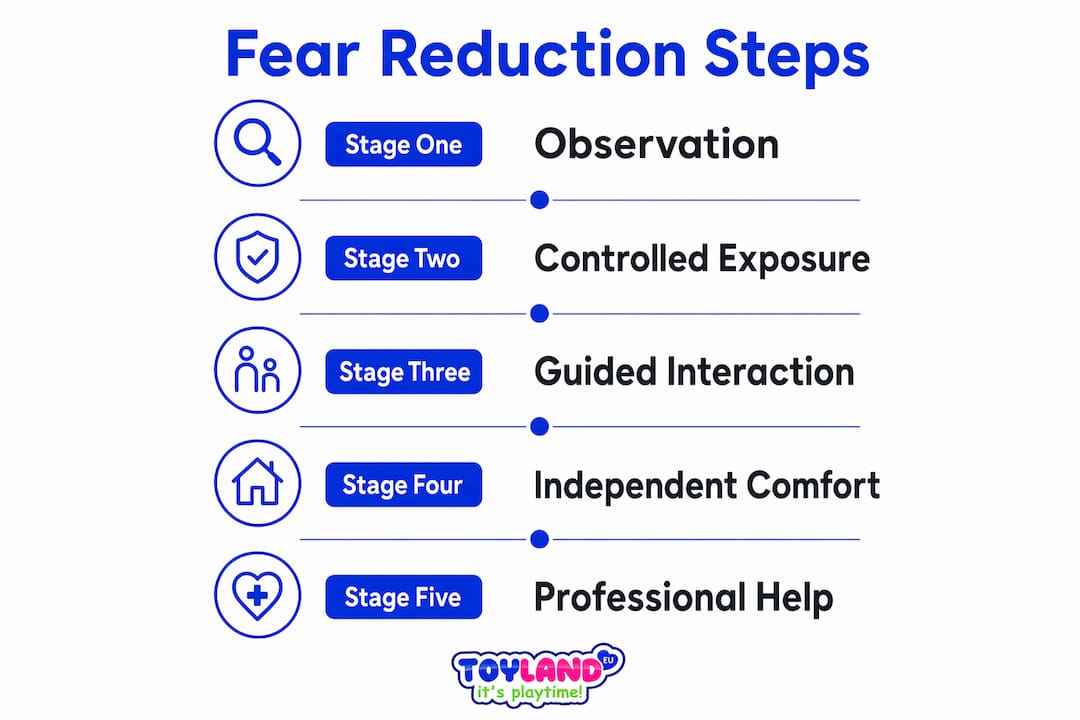
- A CBT-aligned, step-by-step plan to reduce fear
- At-home tools and activities that support gradual exposure
- When should you consult a pediatrician or therapist?
- What’s a realistic timeline for progress?
- Key Takeaways
- Why play matters more than parents realize
- Toylandeu™ has the tools to make practice feel like play
- FAQ
Why is my kid scared of dogs? The main causes
The four leading causes of dog phobia in children are a single overwhelming event, learned anxiety from adults, temperament, and generalized anxiety. Understanding which one applies to your child shapes everything you do next.
- A single negative event. A dog that jumped up, knocked a child over, or barked suddenly at close range can create a lasting fear memory, even when no injury occurred. The brain encodes emotionally intense moments deeply.
- Observational learning. Children absorb adult anxiety without a word being spoken. A parent who tenses, crosses the street, or grabs a child’s hand near dogs teaches fear nonverbally.
- Temperament and developmental stage. Naturally cautious or emotionally sensitive children are more likely to generalize a single bad moment into a broader fear. Toddlers and preschoolers also lack the cognitive tools to distinguish a friendly dog from a threatening one.
- Generalized anxiety. A child already prone to worry tends to extend that anxiety to unpredictable animals. Dogs move fast, make noise, and don’t follow social rules children understand.
“Children learn not only from what they experience but from what they observe. If a parent or sibling is anxious around dogs or frequently issues cautionary warnings, the child may learn that dogs are inherently unsafe.” — Hanne Grice, Pet Trainer & Behaviourist
Pro Tip: Audit your own body language before the next dog encounter. Are you holding your breath, tightening your grip, or pulling your child away? Those signals land louder than anything you say aloud.
Psychotherapist Andrea Nair also cautions against identity-labeling — saying “he’s afraid of dogs” as a fixed fact. Use temporary language instead: “Right now, dogs feel scary to him.” That small shift preserves your child’s sense that change is possible.
What should you do during a dog encounter?
Act fast, stay calm, and create space. Your child reads your body language first.
- Stop moving. Sudden movement excites dogs and can escalate the situation.
- Get between your child and the dog without rushing or shouting.
- Pick up a small child if you can do so calmly.
- Observe the owner. Ask them to leash or restrain the dog.
- Move away slowly once you have control of the situation.
Once you’re at a safe distance, teach the “Be A Tree” technique for future encounters: stop, fold arms across the chest, look down at roots (feet), and stay still. Dogs lose interest in stationary, non-threatening targets. DoggoneSafe offers free demonstrations parents can watch with children at home.
A child in high physiological arousal cannot learn safety steps. Restore calm first — deep breaths, a quiet space, a sensory toy — then coach the technique.
Screaming and running can provoke dogs and create a feedback loop that deepens the child’s fear. “Be A Tree” breaks that loop by giving the child a concrete, controllable action.
Safety reminder: No dog, regardless of temperament, should be left unsupervised with a young child.
Common mistakes that make a child’s fear worse
Well-meaning parents cause real setbacks here. The three most damaging responses:
- Flooding (forcing contact). Putting a child in direct contact with a dog before they’re ready doesn’t build tolerance. It deepens the phobia by confirming the child’s sense of danger and stripping away their control.
- Labeling the child. “She’s just scared of dogs” said in front of others locks the identity in place. Children live up to the story adults tell about them.
- “Talking up” dogs while the child is panicking. Saying “He’s so friendly! Just pet him!” while a child is in fight-or-flight doesn’t reassure. It signals that their fear is being dismissed.
Psychologist Anthony Berrick warns: “Pushing contact while a child is in full fight-or-flight increases the sense of danger. Parents should restore calm and control first.”
Avoid leading questions like “Was that dog scary?” afterward. Ask open-ended ones instead: “How did that feel?” Let the child name the experience without you planting the language.
A CBT-aligned, step-by-step plan to reduce fear
Gradual, child-led exposure inside a CBT framework is the evidence-based standard. The child sets the pace. You provide the structure and the safety.
- Look at photos of dogs for a few seconds. No pressure to react positively.
- Watch short videos of calm, leashed dogs. Narrate calmly: “Look how slowly he’s walking.”
- Play with plush dogs and puppets. Role-play vet visits, feeding, and walking.
- Observe a calm, leashed dog from a distance (across the street or from a car).
- Sit near a leashed dog with the owner present, no interaction required.
- Brief supervised interaction — the child chooses if and when to reach out.
| Stage | Activity | Readiness Cue |
|---|---|---|
| 1 | Photos of dogs | Child looks without turning away |
| 2 | Short dog videos | Child watches without distress |
| 3 | Plush/puppet play | Child engages playfully |
| 4 | Distant real dog (car/window) | Child observes without panic |
| 5 | Same room, leashed dog | Child stays calm for 2+ minutes |
| 6 | Brief supervised touch | Child initiates or agrees willingly |
“Exposure therapy in a predictable and controlled environment with lots of rewards is the approach that works.” — Stefani Cohen, LCSW, author of Overcoming Your Child’s Fear of Dogs
Pro Tip: Never move to the next stage until your child shows the readiness cue for the current one. Rushing a stage resets progress.
If your child stalls at stage 2 or 3 for weeks, that’s a signal to bring in a professional rather than push harder at home.
At-home tools and activities that support gradual exposure
Toys and play give children a sense of control, which is exactly what fear takes away. The right tools make each exposure stage feel like play, not a test.
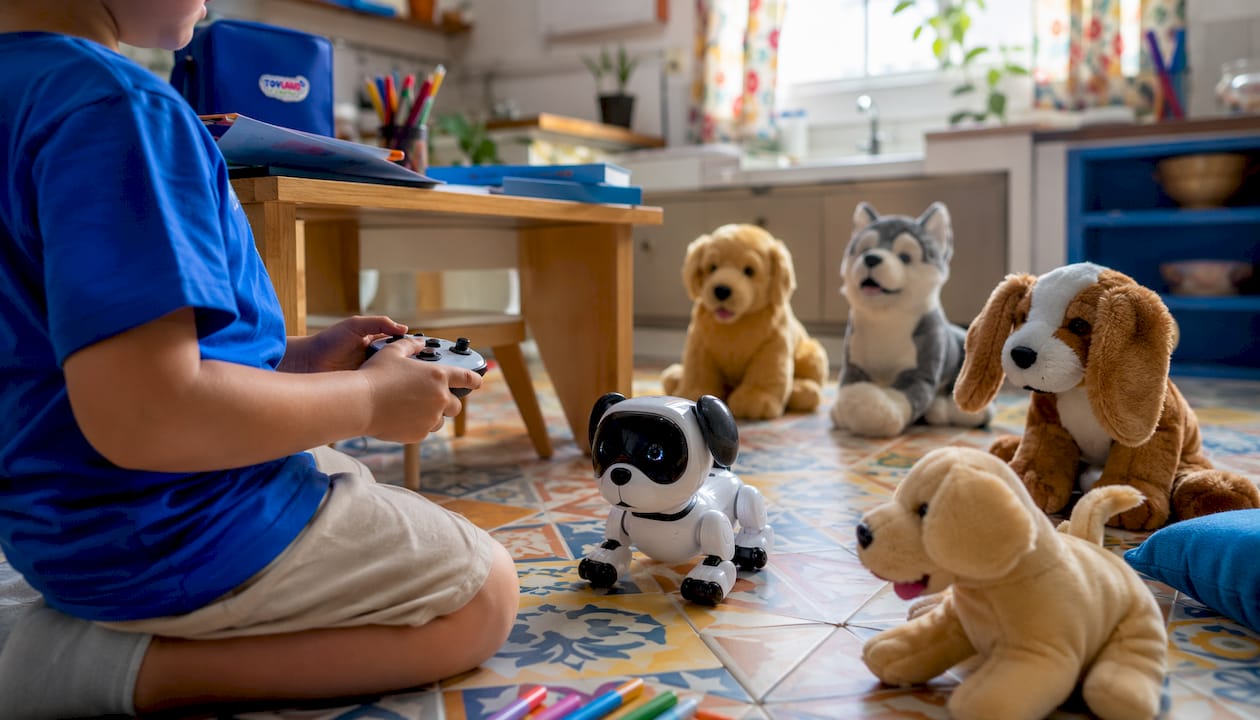
- Plush dogs. A soft, realistic dog plush lets a child practice handling, feeding, and “walking” a dog on their own terms. Look for anxiety-targeted plush options designed for comfort.
- Hand puppets. Puppet play lets children direct the narrative. They can make the “dog” approach slowly, stop on command, or sit. That sense of control is therapeutic.
- Picture books about dogs. Reading about friendly dogs in a low-arousal setting builds positive associations without any real-world pressure.
- Dog videos with adult narration. Watch together and describe what the dog is doing calmly. “He’s sniffing because he’s curious.” This builds a child’s ability to read dog behavior.
- RC Interactive Robo Dog Toys. A remote-controlled robotic dog from Toylandeu™ is one of the most practical distance-practice tools available. The child controls the dog’s movement from across the room, building familiarity with dog-like motion while staying fully in charge. Interactive tech toys like this support emotional development alongside the exposure work.
- Sensory and calming toys. Before any exposure session, a calming sensory toy helps bring a child to a regulated baseline. Clay modeling kits work well for this.
Age notes: Keep small parts away from children under 3. Plush and puppets suit ages 2 and up; RC robotic toys are best for ages 4 and up with adult supervision.
When should you consult a pediatrician or therapist?
Most dog fear in children is normal and responds to a patient, gradual approach at home. Seek professional support when:
- The fear has lasted six months or more without improvement
- Your child avoids parks, school trips, or family visits because of dogs
- Panic attacks occur (racing heart, difficulty breathing, inability to calm down)
- The fear is affecting friendships or daily routines
Nearly 10% of children have some kind of fear or phobia. When avoidance disrupts daily life, it may meet clinical criteria for cynophobia, and a trained child psychologist can run formal exposure therapy far more efficiently than a parent working alone.
Start with your pediatrician. Ask for a referral to a child psychologist with experience in anxiety and exposure therapy. CBT-based treatment for specific phobias in children is typically short-term and highly effective.
Play therapy and family coaching are also options for younger children who aren’t ready for structured CBT sessions.
What’s a realistic timeline for progress?
Progress is gradual and non-linear. Expect weeks to months for steady improvement; an entrenched phobia can take longer.
- Weeks 1–2: Child tolerates photos and videos without distress.
- Weeks 3–4: Puppet and plush play feels comfortable and fun.
- Month 2: Child can observe a real dog from a distance without panic.
- Month 3+: Brief supervised proximity becomes possible.
- Setbacks happen. A loud bark or an unexpected encounter can reset a stage. That’s normal. Return to the previous stage, rebuild the readiness cue, and move forward again.
Track small wins, not just the end goal. A child who used to cry at a photo of a dog and now watches a dog video calmly has made real progress, even if they’re nowhere near touching a real dog yet.
Key Takeaways
Child fear of dogs responds best to calm, gradual, child-led exposure grounded in CBT — never to forced contact or dismissal of the child’s feelings.
| Point | Details |
|---|---|
| Safety first | Use the “Be A Tree” technique and create distance during any unexpected dog encounter. |
| Never force contact | Flooding deepens phobia; always let the child set the pace through each exposure stage. |
| Model calm behavior | Your nonverbal cues teach fear or confidence — audit your own body language around dogs. |
| Use play as practice | Plush dogs, puppets, and RC robotic dog toys build familiarity safely at home. |
| Toylandeu™ tools | The RC Interactive Robo Dog Toy and plush options from Toylandeu™ support gradual, child-led exposure at every stage. |
Why play matters more than parents realize
The conventional advice for a child scared of dogs tends to land in one of two unhelpful places: either “just let them meet a friendly dog and they’ll get over it,” or a vague “be patient and don’t push.” Neither gives parents anything concrete to work with.
What actually moves the needle is giving the child a sense of control. Fear is, at its core, the feeling of being out of control. Every toy-based activity that puts the child in charge — directing a puppet, operating an RC dog, choosing when to look at a photo — chips away at that feeling. The exposure is real. The threat is not.
Parents often underestimate how much of this work can happen at home, before a child ever needs to be near a real dog. A well-chosen plush dog or a robotic toy the child can command from across the room isn’t a distraction from the therapeutic process. It’s the first several steps of it. Toylandeu™'s blog on child development and toy selection reflects exactly this thinking: the right toy, used intentionally, does real developmental work.
The parents who see the fastest progress aren’t the ones who find the friendliest dog. They’re the ones who build the most consistent, low-pressure practice routine at home first.
Toylandeu™ has the tools to make practice feel like play

When a child is scared of dogs, the last thing they need is pressure. What they need is a way to practice feeling safe, on their own terms, at their own pace. Toylandeu™ carries a range of toys built for exactly that kind of gentle, parent-guided exposure work.
The RC Interactive Robo Dog Toy lets a child control a dog-like figure from a distance, building comfort with dog movement and sound without any real-world unpredictability. Pair it with a soft plush dog for comfort-stage practice, and a hand puppet for role-play sessions where your child gets to be in charge. For calming baseline work before any exposure session, the Vibrant 24-Color Clay Modeling Kit gives anxious hands something grounding to do.
Browse Toylandeu™'s full range of RC and interactive toys to find the right fit for your child’s age and current stage in the exposure plan.
FAQ
Why is my child suddenly scared of dogs?
A sudden onset of dog fear usually follows a single upsetting encounter, such as a dog jumping up, barking loudly at close range, or knocking the child over. Even without physical harm, the brain can encode that moment as a threat.
What is the “Be A Tree” technique for kids?
“Be A Tree” means stopping, folding arms across the chest, and looking down at your feet when a dog approaches. This calm, still posture signals non-threat to the dog and gives the child a concrete action to take instead of running or screaming.
How long does it take a child to get over a fear of dogs?
With consistent, gradual exposure, many children show meaningful progress within two to three months. Entrenched phobias or cases with significant avoidance may take longer and benefit from professional CBT-based treatment.
Should I force my child to pet a dog to help them get over it?
No. Forcing contact, known as flooding, typically deepens the fear by confirming the child’s sense of danger and removing their control. A child-led, step-by-step approach is far more effective and less distressing.
When does a child’s fear of dogs become a phobia?
When the fear lasts six months or more and causes avoidance that disrupts daily activities, school trips, or family visits, it may meet clinical criteria for cynophobia and warrants a referral to a child psychologist.
This article is general information for parents and is not a substitute for professional medical or psychological advice. If your child’s fear is significantly affecting daily life, consult your pediatrician or a licensed child therapist.