How Pets Affect Children: Development, Health, and Growth
TL;DR:
- Children raised with pets demonstrate stronger communication skills, prosocial behavior, and lower developmental delays. Parental supervision and the type of pet influence how these benefits manifest and whether potential drawbacks occur.
Children who grow up with pets show measurably stronger communication skills, more prosocial behavior, and lower rates of developmental delays than those who don’t, according to longitudinal research from Japan’s large-scale birth cohort study. The benefits are real, but they’re not automatic. Pet type, timing of exposure, and how involved parents stay all shape the outcome significantly.
Here’s what the evidence actually shows:
- Communication and motor skills: Infants exposed to family dogs show reduced developmental delays in communication, motor skills, problem-solving, and social domains.
- Emotional support: Dr. Gail Melson’s research finds that many 5-year-old pet owners cite their pets as primary sources of comfort, with lower anxiety scores to match.
- Language and prosocial behavior: Longitudinal data links pet ownership to improved language development and stronger prosocial behavior.
- Mixed cognitive outcomes: The same data shows minor associations with lower scholastic self-esteem at age 8 and slightly reduced educational attainment in some subjects.
- Allergy protection: Babies exposed to two or more pets in infancy cut their risk of common allergies by more than half by age 7.
The picture is nuanced. Pets are not a developmental shortcut, but when the conditions are right, they’re one of the more powerful influences in a child’s early years.
Quick Summary
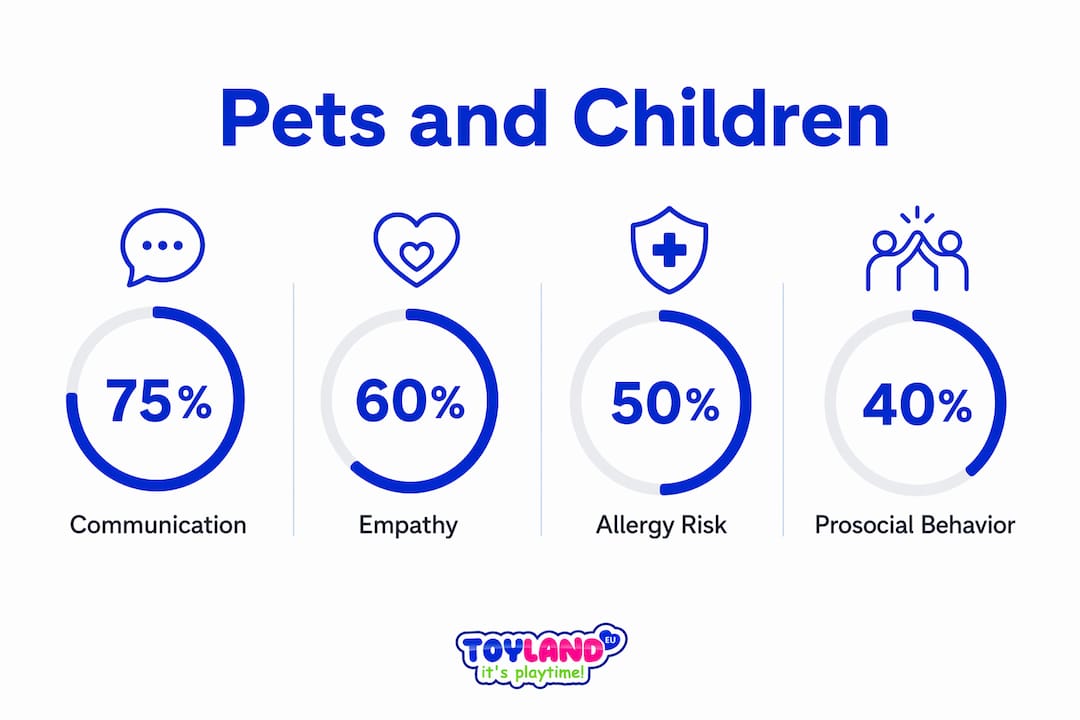
Growing up with pets, especially dogs introduced before age 3, supports children’s communication, empathy, and prosocial behavior. Early multi-pet exposure also cuts allergy risk significantly. Cognitive and emotional health outcomes are more mixed, and parental involvement is what separates a positive experience from a harmful one.
TL;DR
- Dogs introduced in infancy reduce developmental delays across multiple domains.
- Over 40% of 5-year-olds name pets as their top comfort source.
- Two or more pets in infancy can cut common allergy risk by more than half.
- Pets improve language and social skills but show mixed effects on academic self-esteem.
- Parents must supervise all pet-child interactions, especially under age 4.
Table of Contents
- How pets shape children’s emotional development
- Cognitive and social development: what the research says
- Parental roles and caregiving in child-pet relationships
- Allergies and immune health: what early pet exposure does
- Pet loss and grief in children
- Long-term effects of growing up with pets
- Key Takeaways
- FAQ
How pets shape children’s emotional development
Pets give children something most adults underestimate: a judgment-free relationship. Kids tell their pets secrets, cry in front of them without embarrassment, and practice emotions they’re not yet ready to show other people. The American Academy of Child and Adolescent Psychiatry (AACAP) identifies pets as powerful mediums for teaching empathy, responsibility, and nonverbal communication, provided parents stay involved.
“Pets can teach children empathy and responsibility. They can also be a source of comfort and unconditional love. Children often confide in their pets, sharing secrets and feelings they might not share with others.” — American Academy of Child and Adolescent Psychiatry
Dr. Melson’s work adds a specific data point: many 5-year-olds with pets name them as primary comfort sources, and those children score lower on anxiety and withdrawal measures. That’s not a small effect for a child who hasn’t yet developed the vocabulary to process fear or stress.
| Emotional Benefit | Evidence Level | Notes |
|---|---|---|
| Reduced anxiety and withdrawal | Strong (Dr. Melson) | Especially in children aged 4–7 |
| Empathy development | Strong (AACAP) | Requires parental modeling |
| Nonverbal communication skills | Moderate | Learned through reading animal cues |
| Comfort during stress | Strong | Pets cited as primary support by many 5-year-olds |
| Self-disclosure and emotional processing | Moderate | Children confide in pets before peers |
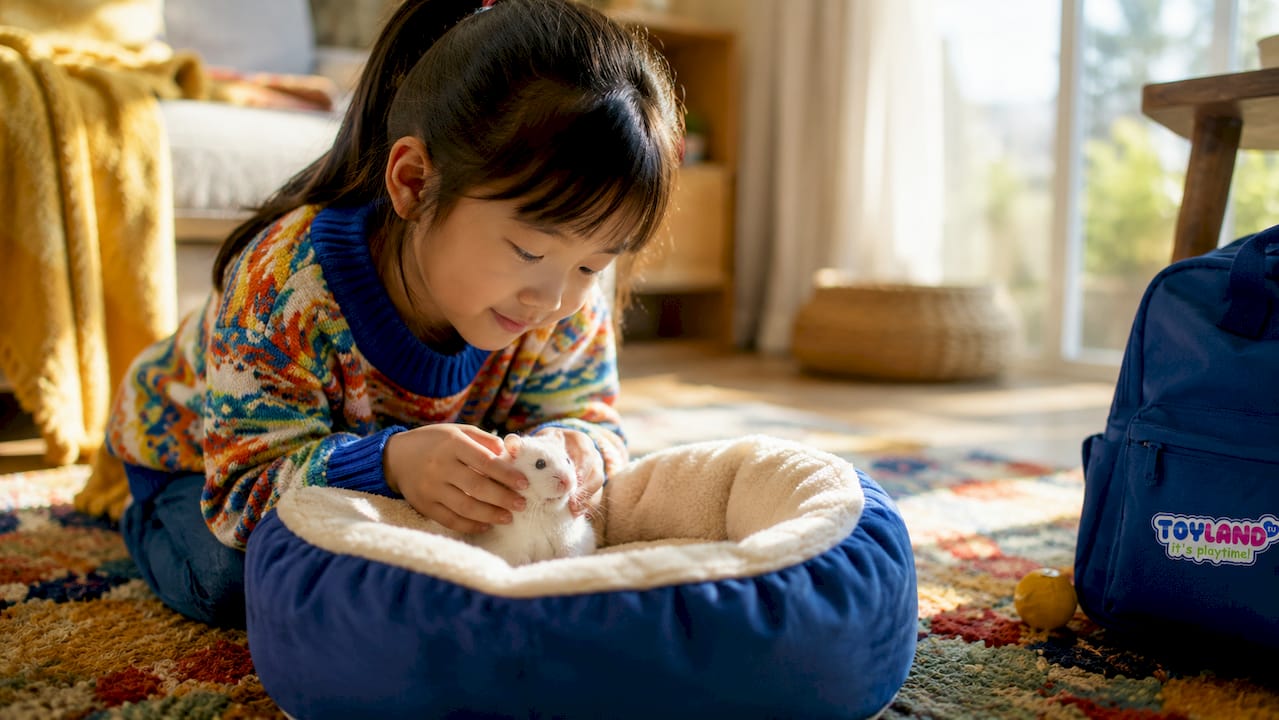
Smaller pets with consistent daily contact, like hamsters or fish, can support emotional regulation more reliably than sporadic interaction with larger animals. Cats show mixed results in children aged 4–5, likely because their independence makes the bond less predictable for young kids who need consistency.
Pro Tip: Model empathy toward the pet out loud. Say things like “She looks tired, let’s give her some quiet time.” Children absorb that framing and apply it to peers faster than you’d expect.
Cognitive and social development: what the research says
The social benefits of pet ownership are well-documented. The language and prosocial gains are real. The cognitive picture, though, is more complicated than most parenting articles admit.
A UK birth cohort study using ALSPAC data tracked children over years and found pet ownership linked to better language development and stronger prosocial behavior. At the same time, it flagged minor associations with lower scholastic self-esteem at age 8 and slightly reduced attainment in some academic subjects. The researchers call for nuanced interpretation rather than blanket enthusiasm.
- Language development: Children with pets tend to develop richer vocabularies earlier, partly because they narrate their interactions with animals.
- Prosocial behavior: Pet owners show stronger tendencies toward sharing, cooperation, and helping peers.
- Nonverbal communication: Reading a dog’s body language or a cat’s mood trains children to pick up social cues from people too.
- Problem-solving: Caring for an animal with needs that can’t be verbally communicated builds practical reasoning skills.
- Peer relations: Pets act as social catalysts. A child walking a dog or talking about a pet at school gets more peer engagement than one without that shared topic.
- Self-esteem: Mixed. Pets can boost confidence in shy children, but the ALSPAC data shows a slight dip in scholastic self-esteem at age 8 in some pet-owning groups.
- Academic attainment: Minor negative associations in some subjects, possibly because time and attention given to pet care competes with study time in older children.
| Domain | Direction of Effect | Confidence |
|---|---|---|
| Language skills | Positive | Moderate-High |
| Prosocial behavior | Positive | High |
| Nonverbal communication | Positive | Moderate |
| Scholastic self-esteem (age 8) | Slightly negative | Moderate |
| Academic attainment | Mixed | Moderate |
| Peer social engagement | Positive | Moderate-High |
The social catalyst effect is one of the more underappreciated findings: pets reduce loneliness and social anxiety by giving children a natural conversation starter and a shared interest with peers. That effect shows up consistently across studies, even when emotional and cognitive outcomes are less clear-cut.
Parental roles and caregiving in child-pet relationships
Parents don’t just facilitate pet ownership. They determine whether it helps or harms. The AACAP is direct on this: children under 3–4 years lack the impulse control to interact safely with animals without adult supervision, and young children cannot manage pet care independently at any age.
- Supervise all interactions between children under 4 and any pet, regardless of the animal’s temperament.
- Model responsible behavior by demonstrating feeding, grooming, and gentle handling rather than just instructing.
- Choose age-appropriate pets. Fish or small rodents suit children under 6. Dogs and cats require more parental management until children are school-aged.
- Watch for neglect signals: an untended water bowl, a pet left outside in bad weather, or a child avoiding the animal can all indicate the relationship needs a reset.
- Address aggression immediately. Both child-to-pet and pet-to-child aggression need direct intervention, not just redirection.
Pro Tip: Assign one small, non-negotiable pet care task per day to children aged 5 and up, like refilling the water dish. Consistency builds the habit of responsibility faster than occasional big tasks.
Parental involvement also shapes how children process the harder parts of pet ownership, including illness, injury, and eventually death. A parent who models compassion during a pet’s vet visit teaches more about empathy than any classroom lesson.
Allergies and immune health: what early pet exposure does
Early pet exposure does more than shape behavior. It appears to train the immune system. A study tracking babies through age 7 found that exposure to two or more pets in infancy cut the risk of common allergies, including ragweed and dust-mite allergies, by more than half compared to no pet exposure.

The relationship is dose-dependent: more pets in early life correlates with lower allergy incidence. Timing matters too. The protective effect is strongest when exposure begins in the first year of life, during the window when the immune system is still calibrating its responses.
| Allergy Type | Effect of Early Multi-Pet Exposure | Timing |
|---|---|---|
| Ragweed allergy | Risk reduced by more than half | Infancy (year 1) |
| Dust-mite allergy | Risk reduced by more than half | Infancy (year 1) |
| General atopic conditions | Reduced with dose-dependent pattern | First 3 years |
This doesn’t mean every family should rush out and get two dogs for allergy prevention. Children with a strong family history of severe allergies need a conversation with a pediatric allergist before any pet is introduced. But for families without that history, the immune data adds another layer to the case for early pet exposure.
Pet loss and grief in children
Losing a pet is often a child’s first direct encounter with death. That’s not a small thing. For many children, the grief is as intense as losing a human family member, and adults who minimize it (“it was just a fish”) do real damage to a child’s trust and emotional processing.
Children under 5 typically don’t understand death as permanent. They may ask when the pet is coming back, or expect to find it when they look in its usual spot. School-aged children understand permanence but may not have the language to express the loss. Adolescents often grieve privately and resist showing emotion around family.
What helps most is honest, age-appropriate language. “Died” is clearer than “passed away” or “went to sleep” for young children, who can develop fears around sleep if euphemisms are used carelessly. Rituals matter too: a small burial, a drawing, or a memory box gives children a concrete way to honor the relationship. The grief process after a pet’s death also teaches children that love and loss are connected, a lesson that builds emotional resilience for harder losses later in life.
Long-term effects of growing up with pets into adolescence
Children who grow up with pets don’t just benefit in early childhood. The effects carry forward. Adolescents who had pets during childhood tend to show stronger empathy scores, better stress management, and more comfort with physical affection and nonverbal communication than peers who didn’t.
The timing of exposure matters more than duration alone. Early life contact, particularly before age 3, shows the strongest associations with reduced developmental delays and better communication outcomes. But pets introduced during middle childhood still support social development, especially for children who struggle with peer relationships or social anxiety.
There’s a caveat worth naming. Adolescents who took on heavy pet care responsibilities without adequate parental support sometimes show signs of caregiver fatigue, particularly when a pet becomes ill. The lesson isn’t to shield teenagers from responsibility, but to make sure the load is shared and the emotional weight of a sick or aging animal is acknowledged rather than ignored.
Pets also give teenagers a low-stakes relationship to practice emotional skills they’re still developing: consistency, patience, reading another being’s needs without being told. Those skills transfer directly to friendships and eventually to adult relationships.
Key Takeaways
Growing up with pets, especially dogs introduced before age 3, supports children’s communication, empathy, and prosocial behavior, though effects on academic self-esteem and cognition are mixed and depend heavily on parental involvement.
| Point | Details |
|---|---|
| Early timing matters most | Dog exposure before age 3 shows the strongest reduction in developmental delays across communication and social domains. |
| Emotional support is well-documented | Over 40% of 5-year-old pet owners cite pets as primary comfort sources, with lower anxiety scores. |
| Allergy protection is dose-dependent | Exposure to two or more pets in infancy cuts common allergy risk by more than half by age 7. |
| Cognitive outcomes are mixed | Pets improve language and prosocial behavior but show minor links to lower scholastic self-esteem at age 8. |
| Parents are the deciding factor | Parental supervision, modeling, and age-appropriate pet selection determine whether pet ownership helps or harms. |
FAQ
How does having a pet affect a child’s development?
Pets support communication, empathy, and prosocial behavior, especially when introduced early. Effects on cognitive outcomes and emotional health are more mixed, and parental involvement shapes the overall impact significantly.
What age is best to introduce a pet to a child?
Research points to the first three years of life as the most impactful window, particularly for dogs. AACAP recommends close parental supervision for all children under 3–4 years due to impulse control limitations.
Can pets reduce allergy risk in children?
Babies exposed to two or more pets in infancy show a risk reduction of more than half for common allergies like ragweed and dust-mite by age 7, with the protective effect strongest when exposure begins in year one.
How should parents handle pet loss with children?
Use clear, honest language (“died” rather than euphemisms), allow the child to grieve openly, and create a small ritual to mark the loss. Minimizing the grief delays emotional processing and can damage trust.
Do all types of pets benefit children equally?
No. Dogs show the strongest developmental benefits, especially for communication. Smaller pets like hamsters and fish support emotional regulation through consistent daily contact. Cats show mixed results in children aged 4–5, likely due to their independence.
Recommended reads
If you’re thinking about how to support your child’s development beyond pet ownership, interactive toys for emotional growth cover many of the same empathy and social skill pathways. For younger children, interactive dolls that build empathy offer a structured way to practice the same caregiving instincts pets naturally encourage. And if you’re looking at the broader picture of what drives child development, why developmental toys matter is worth a read.
Looking for toys that reinforce the responsibility, creativity, and focus children develop through pet ownership? Toylandeu™ carries over 30,000 educational and play-based products, including the Montessori Drawing Kit and the 24-Color Clay Modeling Kit, both designed to build the fine motor and creative skills that grow alongside a child’s relationship with animals.