What to Do When Toddlers Hit: A Parent's Guide
TL;DR:
- When toddlers hit, respond calmly by blocking, setting a clear boundary, and offering a replacement behavior. Most outgrow hitting as their language and impulse control develop between 18 months and 3 years.
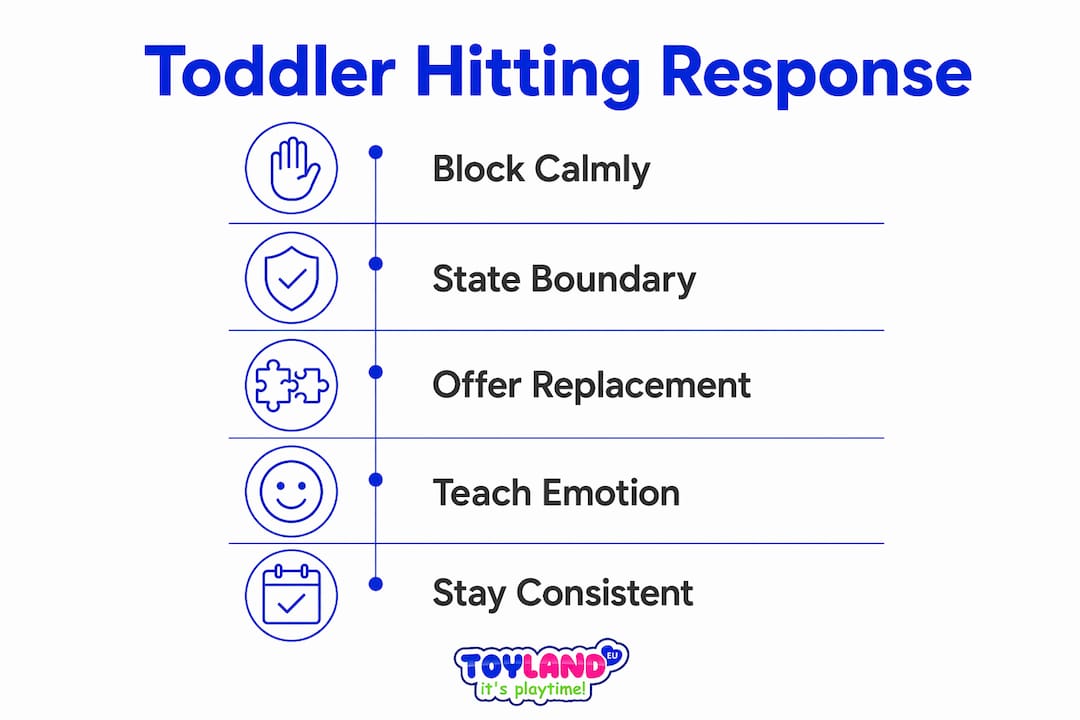
Toddler hitting is one of the most common and jarring behaviors parents face, and the good news is that your response in the first few seconds matters more than anything else. The most effective approach is simple: block calmly, state a clear boundary, and immediately offer an alternative behavior. That sequence, done consistently, is what actually teaches toddlers to stop.
Quick Summary
When a toddler hits, the research-backed response is to block the hit calmly, say one firm boundary phrase (“I won’t let you hit”), offer a replacement behavior like stomping feet, and repair the situation once your child is calm. Hitting peaks between 18 months and 3 years as toddlers lack the language and impulse control to express big emotions. Most children outgrow it as those skills develop.
Table of Contents
- What to do when toddlers hit: the immediate response
- Why toddlers hit: developmental reasons
- Effective discipline strategies for toddlers who hit
- What to expect by age: when does hitting stop?
- When to seek professional help
- How modeling positive behavior reduces hitting
- FAQ
1. What to do when toddlers hit: the immediate response {#immediate}
The goal in the moment is not punishment. It is to stop the hit, keep everyone safe, and teach a replacement behavior your child can actually use.
- Block calmly. Move in close and gently place your hand between your toddler and the other person. Keep your face neutral and your voice steady.
- State one boundary phrase. Use the same short sentence every time: “I won’t let you hit” or “Hands are not for hitting.” One sentence, said calmly, repeated consistently.
- Offer one replacement immediately. Say, “You can stomp your feet” or “Squeeze this pillow.” Show them physically if needed. The replacement has to come right after the boundary, not later.
- Comfort the victim first. If another child was hit, comfort the victim first before turning attention back to your toddler. You do not want hitting to be the fastest way to get your attention.
- Repair after calm. Once your toddler has settled, say, “Hitting hurts. Let’s check on them.” Do not force an apology. Focus on a meaningful action like bringing a tissue or waving.
- Skip the lecture. Toddlers cannot process a long explanation mid-meltdown. Keep every message to one sentence.
Pro Tip: Your own calm is the most powerful tool you have. When a caregiver meets a child’s big emotion with more emotion, it escalates the behavior. Take a breath first, then respond.

2. Why toddlers hit: developmental reasons {#why}
Toddlers hit because their brains are not yet built for impulse control, not because they are aggressive by nature. The prefrontal cortex, which handles self-regulation and reasoning, is still years from maturity. When a big feeling hits fast, the body reacts before the thinking brain can catch up.
Common triggers include frustration, jealousy, fatigue, hunger, overstimulation, and sudden changes in routine. A toddler who hits at the playground after skipping a nap is not misbehaving strategically. They are overwhelmed and out of tools.
Hitting peaks between 18 months and 3 years, exactly when toddlers are discovering independence but still lack the language to negotiate or express frustration verbally. Toddler biting and hitting often appear together during this window for the same reason: both are physical expressions of feelings that words cannot yet carry.
Statistic callout: Aggressive behavior including hitting is considered a developmentally normal part of early childhood, with the behavior most common between 18 months and 3 years as language and impulse control are still forming.
Recognizing this does not mean accepting the behavior. It means you can respond with the right tool: teaching, not punishment.
3. Effective discipline strategies for toddlers who hit {#discipline}
Discipline and punishment are not the same thing. According to the AAP, discipline teaches through positive reinforcement, clear expectations, and patience. Punishment, especially physical punishment, teaches a toddler that hitting is acceptable when you are bigger or angrier. That is the opposite of the lesson you want.
Here is what actually works:
- Use one consistent boundary phrase every time. “I won’t let you hit” works because repetition is how toddlers learn, not because they understand it the first time.
- Practice replacement behaviors daily, not just during incidents. Stomp feet, squeeze a pillow, rip paper, take deep breaths. Practice these when your child is calm so they are available when emotions spike.
- Validate feelings without approving the behavior. “You’re really angry that she took your toy. It’s okay to feel angry. Hitting is not okay.” That two-part message builds emotional vocabulary over time.
- Avoid corporal punishment entirely. Research is clear that physical punishment increases aggression rather than reducing it.
- Use time-outs only as a last resort for cooling down, not as punishment. A quiet corner with pillows and a stuffed animal is a reset space, not a penalty box. Overusing time-outs makes them ineffective quickly.
- Align every caregiver on the same response. Consistency across all caregivers is one of the strongest predictors of how fast a toddler learns self-regulation. If one adult blocks and redirects while another ignores or yells, the mixed signals slow everything down.
- Reduce triggers before they fire. Offer a snack before outings. Give a five-minute warning before transitions. Use a visual timer. These small adjustments cut the number of incidents before they start.
Pro Tip: Keep a simple hit log for one week: time, location, what happened right before. Patterns show up fast. You might find that most incidents happen around transitions or before meals, which gives you a clear target for prevention.
Creative activities at home can also serve as built-in outlets for frustration, giving toddlers a physical and emotional release before the pressure builds.
4. What to expect by age: when does hitting stop? {#age}
Most toddlers outgrow hitting by preschool age as language and emotional regulation improve. That is the honest timeline: not weeks, but months of consistent work.
- Hitting typically peaks around 18 months to 3 years, then declines as vocabulary expands and children gain more tools for expressing frustration.
- By around age 7, physical expressions of aggression should taper off significantly as verbal skills mature, according to Cleveland Clinic pediatric psychologist guidance.
- Toddlers cannot genuinely understand remorse or apologies yet. Demanding an immediate “sorry” after hitting teaches nothing. Pointing out what happened during a calm moment, “When you hit Marcus, it hurt him and he cried,” builds understanding gradually over time.
- Individual timelines vary. Some children move through this phase quickly; others take longer, especially if language development is slower or stress at home is higher.
The most important thing you can do is stay consistent and patient. Toddlers cannot reason through emotions during an aggressive episode because emotional centers override thinking centers in their developing brains. Success comes from physical outlets and clear boundaries, not from expecting logical understanding in the moment.
5. When to seek professional help {#professional}
Most toddler hitting resolves with consistent, patient caregiving. But some situations call for a pediatrician’s input sooner rather than later.
The AAP recommends contacting your child’s pediatrician if your toddler is fixating on violent themes, being sent home from daycare repeatedly for aggression, physically injuring themselves or others, attacking adults, or acting unusually aggressive for longer than a few weeks. These are not signs of bad parenting. They are signals that your child may need more support than behavioral strategies alone can provide.
Underlying conditions like ADHD, anxiety, undiagnosed learning disabilities, or autism can present as aggressive behavior or communication challenges. A pediatrician can rule these out or refer you to a pediatric psychologist who specializes in exactly this. If you are struggling to cope on your own, the Substance Abuse and Mental Health Services Administration (SAMHSA) is available 24/7 at 1-800-662-HELP (4357).
6. How modeling positive behavior reduces hitting {#modeling}
Children learn emotional regulation by watching the adults around them, not by being told what to do. When you stay calm during a hitting incident, you are not just managing the moment. You are demonstrating the exact skill you want your toddler to build.
This extends beyond crisis moments. When you stub your toe and say, “I’m frustrated right now, I need a minute,” you are teaching your child that big feelings are normal and manageable. When you apologize to your partner after snapping, you are showing what repair looks like. Toddlers absorb all of it.
Praising self-control specifically and immediately reinforces the behavior you want. “You stomped your feet when you were mad instead of hitting. That was a great choice.” Specific praise lands better than generic encouragement because it tells the child exactly what they did right. Sensory toys can also support this process by giving toddlers a physical outlet that channels energy constructively during calm play, building the regulation habits they need before the next hard moment arrives.
Key Takeaways
Toddler hitting peaks between 18 months and 3 years and declines as language and emotional regulation improve with consistent, compassionate caregiving.
| Point | Details |
|---|---|
| Immediate response sequence | Block calmly, state one boundary phrase, offer a replacement behavior, repair after calm. |
| Developmental context | Hitting peaks between 18 months and 3 years as toddlers lack impulse control and language skills. |
| Avoid corporal punishment | Physical punishment increases aggression; discipline should teach, not punish. |
| Caregiver consistency | All adults using the same phrases and replacements speeds up behavioral learning. |
| When to get help | Consult a pediatrician if hitting persists past preschool age, causes injury, or disrupts daily functioning. |
FAQ
How do you discipline a toddler for hitting?
Use a calm, immediate response: block the hit, state a clear boundary (“I won’t let you hit”), and offer a replacement behavior like stomping feet or squeezing a pillow. Avoid punishment, shaming, or corporal responses, which the AAP links to increased aggression rather than reduced hitting.
What do I do if my toddler hits me?
Block the hit with a neutral face, say your boundary phrase once, then step slightly back and offer a replacement. If hitting continues, calmly move away briefly while staying in sight. Connection and warmth should happen during calm moments, not as a response to aggressive behavior.
Hitting typically peaks between 18 months and 3 years and declines as language and emotional regulation improve. Most toddlers outgrow it by preschool age; individual timelines vary.
What is the 3-3-3 rule for toddlers?
The 3-3-3 rule is not a standardized framework in pediatric or child development guidelines. If you have seen it referenced, definitions vary by source. The consistent expert guidance from ZERO TO THREE and the AAP focuses on immediate response, replacement behaviors, and caregiver consistency rather than any numbered rule.
Recommended Reads
- Stress relief toys for kids and adults — practical options for redirecting toddler energy after hitting incidents
- Top toys for toddlers — developmental picks that keep toddlers engaged and reduce frustration
- Anxiety toys that actually work — calming sensory options to help toddlers regulate emotions
Looking for toys that help channel toddler energy constructively? Toylandeu™ carries active play options designed to give kids a physical outlet and keep them engaged. Browse the full collection at Toylandeu™.