

Toy Guns and Children: Expert Guidance for Safe Play
TL;DR:
- Over 16,000 children visit emergency rooms annually for toy gun-related eye injuries, mostly involving boys aged 7 to 12.
- Pretend gun play promotes creativity, emotional regulation, and social skills, with no proven link to violence.
- Using colorful, non-realistic toy guns and supervising play reduces safety risks effectively.
Over 16,000 children in the U.S. visited emergency rooms for toy gun-related eye injuries in less than two decades, and yet millions of kids play with toy guns every single day without incident. That gap tells you something important: the risks are real, but so is the context. Parents are caught between alarming headlines and equally passionate child development experts who insist pretend gun play is healthy and normal. This article cuts through the noise by looking at what the data actually shows about physical injuries, what research says about child development, and what practical steps you can take to make informed, confident decisions for your family.
Table of Contents
- Understanding the physical risks: What the data shows
- Pretend play and child development: What the evidence says
- Toy gun realism and safety: Distinguishing toys from real firearms
- Practical advice for parents: Setting healthy boundaries and alternatives
- Our perspective: Rethinking toy gun play for modern families
- Explore creative alternatives to toy guns
- Frequently asked questions
Key Takeaways
| Point | Details |
|---|---|
| Toy guns pose real injury risks | Physical injuries, especially eye trauma, are common in toy gun play, so supervision and safety measures are essential. |
| Pretend play aids development | Playing with child-made props strengthens imagination and emotional skills without increasing aggression. |
| Realistic toys increase confusion | Children struggle to tell real guns from realistic toys, making brightly colored or non-replica toys preferable. |
| Expert consensus favors balance | Safe boundaries, open communication, and creative alternatives help parents provide healthy play environments. |
Understanding the physical risks: What the data shows
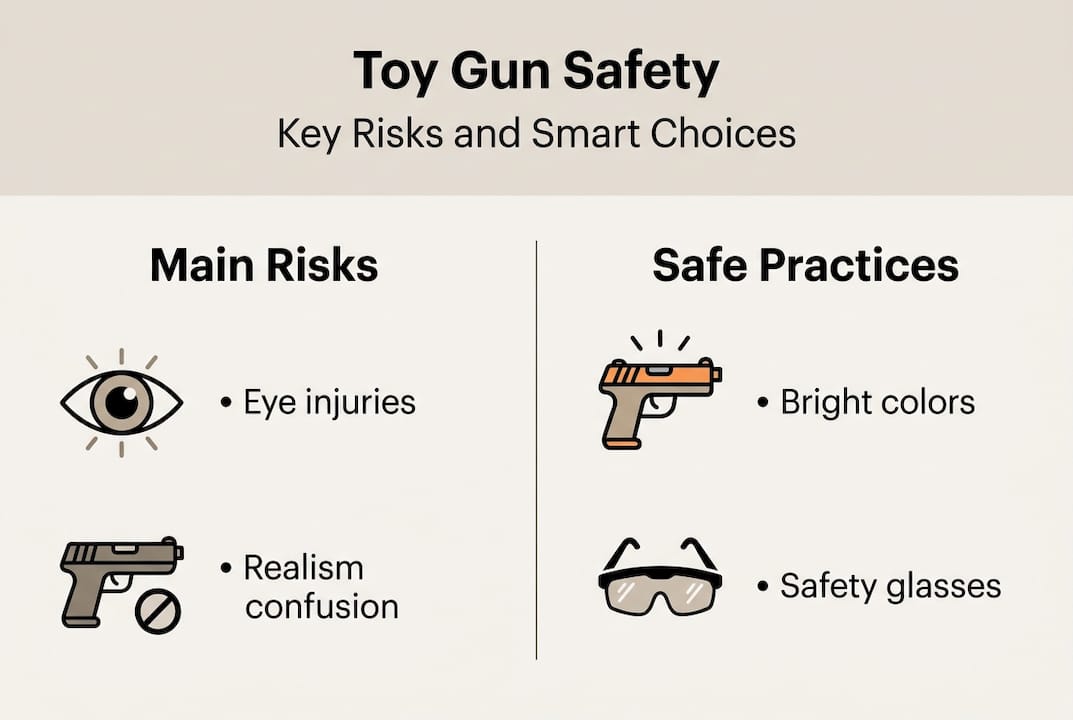
The numbers deserve a serious look before anything else. Toy gun-related injuries sent an estimated 16,325 children to U.S. emergency departments between 2005 and 2024, with the vast majority being boys between the ages of 7 and 12. These are not minor scrapes. The injuries recorded include some of the most serious eye trauma a child can sustain.
Here is a breakdown of the most common injury types reported in that dataset:
| Injury type | Description | Severity |
|---|---|---|
| Corneal abrasion | Scratch on the eye’s surface | Moderate |
| Hyphema | Bleeding between iris and cornea | Serious |
| Ruptured globe | Tear in the wall of the eye | Severe/Surgical |
| Contusion | Blunt trauma bruising | Moderate to Serious |
Several factors increase the risk of serious injury:
- Realistic-looking toy guns that fire at higher velocities (pellet guns, gel blasters)
- Lack of adult supervision during play, especially outdoors
- No protective eyewear for either the shooter or bystanders
- Close-range firing at faces or eyes
- Older children supervising younger ones without proper safety training
These risks are not reasons to panic, but they are reasons to prepare. The type of toy gun matters enormously. Foam dart blasters, for example, carry far lower injury risk than metal BB guns or airsoft guns with high muzzle velocity. Reviewing toy gun safety advice before purchasing can help you distinguish between genuinely safe options and those that carry higher danger.
Pro Tip: Require safety glasses or goggles for all children during toy gun play, not just the one holding the toy. Bystanders account for a meaningful share of eye injuries in the research data.
When selecting any toy that fires a projectile, choosing safe toys means reading velocity specs, checking for age recommendations, and prioritizing foam or soft-tip projectiles over hard plastic or metal pellets. Supervision is not optional. It is the single most effective risk-reduction strategy you have available.
With the risks clear, parents also wonder about the developmental impact of toy gun play.
Pretend play and child development: What the evidence says
Here is where many parents are surprised. The research on pretend gun play and child development is far more reassuring than most media coverage suggests. Pretend gun play supports imagination, problem-solving, empathy, social skills, physical activity, and emotional regulation, and there is no established evidence linking this type of play to real-world violence.
Children use play to process big emotions they do not yet have the vocabulary to express. Power, conflict, danger, and resolution are themes that matter deeply to kids, and pretend combat play is one of the ways they safely explore those themes. Stopping this play outright does not make the emotions disappear. It just removes the healthy outlet.
The imaginative play benefits children gain from this kind of activity include:
- Narrative building: Kids create scenarios, assign roles, and negotiate story outcomes together
- Conflict resolution practice: Children learn to set and respect rules within the game
- Physical coordination: Running, aiming, dodging, and cooperating build motor skills
- Emotional regulation: Playing out “danger” scenarios in a safe space reduces anxiety about real-world fears
One important distinction worth knowing is the difference between child-made props and plastic replicas:
| Play tool | Developmental value | Safety profile |
|---|---|---|
| Sticks, blocks, hands | High: maximizes imagination | Safest: no projectile risk |
| Foam/soft toy guns | Good: structured play with props | Low risk with supervision |
| Realistic plastic replicas | Moderate: less imaginative demand | Higher risk: confusion potential |
Pretend gun play research consistently shows that the act of imagining a weapon matters more for development than the physical object itself. A child pointing a finger and saying “pew pew” is engaging the same imaginative capacity as one holding a toy gun.
Pro Tip: When your child wants to play with interactive toys for development, suggest props like capes, shields, or adventure gear alongside or instead of toy guns. You broaden the story without eliminating the excitement.
While development matters, the realism of toy guns introduces another layer of concern.
Toy gun realism and safety: Distinguishing toys from real firearms
This is the part that catches most parents off guard. A 2018 study found that only 41% of children aged 7 to 17 correctly identified both real and toy guns from photographs. That means the majority of kids in that age range could not reliably tell the difference.
This finding matters for two distinct reasons. First, a child who cannot identify a real firearm may handle one as if it were a toy. Second, law enforcement and other adults cannot always distinguish realistic toy guns from real ones either, which creates tragic risk in public settings. The problem is not imagination. The problem is design.
Here is a practical guide for evaluating toy gun safety before you buy:
- Choose bright, non-realistic colors. Neon orange, blue, or green guns communicate “this is a toy” clearly to everyone.
- Avoid metal or wood-finish replicas. These are designed to look real and offer no developmental advantage over colorful alternatives.
- Check for the orange tip. In the U.S., federal law requires an orange tip on toy guns, but this can be removed or painted over, so look for designs where color is built into the body.
- Read the age recommendation carefully. Products rated for ages 14 and up often have projectile velocities that pose real injury risk to younger kids.
- Ask where play will happen. Realistic-looking toys in public spaces create safety risks beyond just the child playing with them.
Experts recommend avoiding realistic replica toy guns to prevent confusion with real firearms, preferring child-made props where possible, and note that outright bans on pretend weapon play may suppress healthy emotional processing in children.
When browsing toy selection tips or looking at innovative toy ideas, apply the realism test first: the more a toy looks like a real gun, the more careful you need to be.
Having examined realism, it is crucial to integrate expert guidance for practical decisions.
Practical advice for parents: Setting healthy boundaries and alternatives
Balancing physical safety with emotional and developmental needs is exactly what good parenting looks like here. The good news is that no definitive empirical link exists between toy gun play and increased real-world aggression, as long as context and supervision are in place. That gives you real flexibility to craft boundaries that work for your family.
Here are safety practices and communication strategies that make a measurable difference:
- Establish clear rules before play begins. No pointing at faces. No shooting at non-players. Game pauses when someone says stop.
- Store toy guns separately from real firearms if any are present in the home. Confusion between the two is a documented safety risk.
- Talk regularly about real gun dangers. Children who understand why real guns are different are far less likely to mishandle one. Medical organizations consistently emphasize real gun risks and the importance of parent-led safety conversations.
- Keep play visible. Backyard or living room play under adult supervision is categorically safer than unsupervised outdoor adventures.
- Revisit the rules as kids grow. A 6-year-old and a 12-year-old need different conversations about the same toy.
Pro Tip: Use toy gun play as an opening for conversations about power, fairness, and empathy. Ask your child how they think it would feel to be on the receiving end of the game. These discussions build the emotional intelligence that truly prevents aggression.
For parents who want to reduce risk further without eliminating active imaginative play, exploring tech toys for emotional growth offers a path to the same developmental benefits through different, equally engaging formats.
These insights lead to a nuanced perspective for parents making informed choices.
Our perspective: Rethinking toy gun play for modern families
Conventional wisdom says toy guns lead to aggression. The evidence says something far more specific: realistic toy guns, unsupervised play, and no safety education are the actual risk factors. Those are solvable problems.
At ToylandEU, we see thousands of parents every year searching for toys that are both fun and responsible. What we have learned is that the most confident parents are not the ones who banned toy guns or the ones who ignored every concern. They are the ones who stayed curious, read the research, and made deliberate choices.
Allowing imaginative play while avoiding realistic weapons is not a compromise. It is the smartest position the evidence supports. Context and supervision determine outcomes far more than the toy itself does.
Pro Tip: Involve your child in choosing their next toy. When kids have a say in selecting safe, creative options, they are more invested in respecting the rules that come with them. Exploring a Texan’s opinion on this topic together can even spark a great family conversation about values, safety, and play.
Explore creative alternatives to toy guns
If you are looking for toys that spark the same imaginative energy without the risks that come with toy firearms, ToylandEU has you covered with a wide range of creative, developmental options that kids genuinely love.

Our art workbook for creative play gives children an expressive outlet for storytelling and emotion, while our creative art scroll kit turns art-making into a hands-on adventure. For tactile, sensory-rich fun, the clay modeling kit lets kids build entire worlds with their hands. These options support imagination, creativity, and emotional development without introducing the injury or confusion risks tied to realistic toy guns. Browse our full catalog with free worldwide shipping on every order.
Frequently asked questions
Does playing with toy guns make children more violent?
Pretend gun play does not cause violence but instead helps children process power, safety, and emotion in a safe setting. Supervision and play context matter far more than the toy itself.
What types of toy guns are safest for kids?
Non-realistic, brightly colored toy guns or child-made props like sticks and blocks are the safest choices. Experts recommend avoiding realistic replicas because children and adults alike struggle to distinguish them from real firearms.
How can I talk to my child about real gun safety?
Explain the difference between pretend play and real firearms in age-appropriate terms, set clear household rules, and revisit the conversation as your child grows. Parents should teach children the specific dangers of real guns while keeping supervision active during toy gun play.
Are there alternatives to toy guns that give similar developmental benefits?
Absolutely. Pretend play with blocks, art kits, dolls, and accessories fosters the same creativity and social skill development without introducing projectile injury risks or confusion with real firearms.