

Toy Choking Hazards: A Safety Guide for Parents
Yes, many common toys are choking hazards, and children under three are at the highest risk. If a child’s airway is fully blocked right now, call 911 immediately and begin age-appropriate first aid. For everything else, the next five minutes matter more than most parents realize.
Do this right now:
- Walk the play area and pick up anything small enough to fit inside a toilet-paper roll.
- Remove or secure any loose batteries, coins, pen caps, or jewelry within reach.
- Check that all battery compartments on toys have screw closures, not just snap lids.
- Place a toilet-paper roll near the toy bin as a quick-check tool.
If a child is choking:
- Assess whether the child can cough, cry, or breathe. If yes, encourage coughing and watch closely.
- If the airway is fully blocked (silent distress, blue lips, no air movement), call 911 and begin first aid immediately.
- For infants: deliver five back blows between the shoulder blades, then five chest thrusts. For children over one year: perform abdominal thrusts (Heimlich maneuver).
Pro Tip: Tape a printed first-aid chart for infant and child choking to the inside of a kitchen cabinet. The American Red Cross offers a free downloadable version.
Key Takeaways
Toy choking hazards are preventable when parents combine the CPSC small-parts test, regular home inspections, age-sorted storage, and basic first-aid readiness into a simple weekly routine.
| Point | Details |
|---|---|
| Know the CPSC cylinder | Any object fitting a 31 mm × 57 mm cylinder is a small part — unsafe for children under three. |
| Test every toy at home | Use a toilet-paper roll as a quick screen; apply it to every detachable piece, not just the assembled toy. |
| Secure all battery compartments | Button batteries cause chemical burns within hours; only accept screw-closure compartments on toys for young children. |
| Sort and store by age | Keep small-part toys for older children in separate, latched bins out of reach of toddlers. |
| Toylandeu™ for safer choices | Toylandeu™ carries age-graded, large-component toys and RC items with secure battery compartments — filter by age before browsing. |
Table of Contents
- What do regulators mean by a “small part” and required warning labels?
- What are the most common toy-related choking hazards?
- How do you check a toy at home for choking risk?
- Which toys are right for each age stage?
- What daily and weekly routines cut choking risk most?
- Why are button and coin batteries uniquely dangerous?
- What should you do if a child is choking?
- How do you check for toy recalls and report unsafe toys?
- What does the research say about toy-related choking?
- A parent’s honest take on building a safety habit
- Safe toy shopping starts with knowing what to filter for
- Sources
- FAQ
What do regulators mean by a “small part” and required warning labels?
The U.S. Consumer Product Safety Commission defines a small part using a physical cylinder that measures 31 mm in diameter by 57 mm in length (roughly 1.25 inches by 2.25 inches). Any object that fits entirely inside that cylinder is classified as a small part and is considered unsafe for children under three. That cylinder dimension is not arbitrary: it approximates the diameter of a young child’s airway, so anything that disappears into it can disappear into a toddler’s throat.
The legal framework behind this is 16 C.F.R. part 1501, which governs small-parts testing and enforcement for toys and children’s products. Manufacturers must test toys intended for children under three against this standard before they reach store shelves.
What the choking-hazard warning label must say
Under 16 C.F.R. § 1500.20, any toy marketed for children ages three through six that contains small parts must carry a standardized choking-hazard warning. The label must state that the product contains small parts and is not suitable for children under three. You will see this on packaging and on product detail pages online, usually near the age-grade information.
| Label Signal | What It Means for Parents |
|---|---|
| “CHOKING HAZARD — Small parts” | Contains parts that fit the CPSC 31 mm × 57 mm cylinder; unsafe for under-3 |
| Age grade “3+” or “4+” | Manufacturer has determined small parts are present; not a marketing suggestion |
| “Not for children under 3 years” | Regulatory requirement, not optional copy |
| No warning label present | Toy passed small-parts testing for the stated age range — but still inspect for wear |
Age grading is a safety signal, not a developmental milestone marker. The American Academy of Pediatrics is clear that age labels reflect mechanical risks and mouthing behaviors, not just how “advanced” a child is. A gifted two-year-old is still a two-year-old when it comes to airway diameter.
Pro Tip: When shopping online, search the product listing for “choking” or “small parts” before adding to cart. Reputable retailers display this information in the product description or safety section.
What are the most common toy-related choking hazards?
Latex balloons are the leading cause of toy-related choking deaths in young children, according to the Children’s Hospital of Philadelphia (CHOP). A deflated or burst balloon conforms to the shape of a child’s airway in a way that rigid objects do not, making it nearly impossible to dislodge. That single fact should change how you handle balloons at every birthday party.
Beyond balloons, the highest-risk items fall into predictable categories:
- Latex balloons (deflated, burst, or partially inflated): highest fatality risk among toy-related items.
- Coins: among the most frequent non-food choking items in emergency rooms, per CPSC and AAP reporting.
- Marbles and small balls: classic hazards; any ball smaller than 1.75 inches in diameter is regulated.
- Small detachable toy parts: doll eyes, wheel axles, decorative buttons, snap-on accessories.
- Button and coin batteries: a dual hazard (choking and chemical burn — covered in detail below).
- Small magnets: especially high-powered rare-earth magnets, which can attract through tissue if multiple are swallowed.
- Beads and loose stuffing from plush toys: seam failures release small pellets and fiberfill that pack an airway.
- Broken toy pieces: a toy that passed small-parts testing when new can produce dangerous fragments after normal play.
Non-toy household items cause at least as many incidents as toys themselves. Pen caps, screws, jewelry clasps, hair ties, and watch batteries are all small enough to pass the CPSC cylinder test and are routinely found at toddler height. Choking is the leading cause of injury among children younger than three, with coins and toys accounting for the highest share of non-food-related incidents.
How do you check a toy at home for choking risk?
The toilet-paper-roll test is the fastest screen available to any parent. CHOP endorses this method: if an object fits entirely inside a standard cardboard toilet-paper roll, it is small enough to block a young child’s airway. Commercially available choke-check tubes (sometimes called choke tubes or small-parts testers) replicate the CPSC 31 mm × 57 mm cylinder more precisely and cost a few dollars online.
Step-by-step home inspection:
- Gather all toys accessible to children under three in one place.
- Hold each toy and every detachable part over the toilet-paper roll. If it drops in or fits with room to spare, set it aside.
- For toys with multiple pieces (building sets, play kitchens, doll accessories), test each piece individually, not just the assembled toy.
- Check battery compartments: press and try to open without a tool. If it opens without a screwdriver, it fails.
- Squeeze and flex soft toys to feel for hard internal pellets, squeakers, or rattle components that could escape a seam.
- Pull on eyes, buttons, wheels, and decorative attachments with firm force. If anything comes loose, the toy is unsafe for unsupervised play.
- Inspect for cracks, splits, or broken edges that could produce sharp fragments or newly small pieces.
What to do with items that fail:
- Detachable small parts that cannot be permanently secured: discard or store out of reach until the child is older.
- Broken toys: discard immediately rather than repair, unless the repair is structural and permanent.
- Secondhand toys: apply the full checklist above. Older toys may predate current CPSC standards and may not carry required warning labels.
Pro Tip: Set a monthly calendar reminder to run this checklist. Toys degrade faster than most parents expect — a seam that was tight in October can be splitting by December after daily play.
Which toys are right for each age stage?
The age ranges below reflect CPSC small-parts rules and AAP developmental guidance. “Small parts unsafe” means any toy with parts that fit the CPSC cylinder should be kept away from that age group entirely.
| Age Stage | Safe Toy Characteristics | Small Parts Rule |
|---|---|---|
| — | Large, one-piece rattles; soft cloth books; teething rings over 1.75 in. | No small parts; nothing that fits the 31 mm × 57 mm cylinder |
| 1–3 years | Large wooden blocks; push-pull toys; chunky puzzles with pieces too large to swallow | No small parts; apply toilet-paper-roll test to every piece |
| 3–5 years | Simple board games; larger building bricks; art supplies designed for age 3+ | Small parts may be present, so require close supervision and separate storage from younger siblings |
The 20-toy rule in practice
Limiting accessible toys to around 20 age-appropriate items at any one time reduces the chance that small pieces from different sets get mixed together. It also makes it easier to notice when something is missing or broken. Rotate toys in and out of storage weekly rather than keeping every toy available at once. Fewer toys in the play space means fewer parts on the floor and faster visual sweeps.
- Keep toys for different age groups in clearly labeled, separate bins or shelves.
- Store older siblings’ small-part toys (building sets, craft kits, collectibles) in rooms or on shelves the youngest child cannot access.
- When gift-givers ask what to buy, share the age grade and the 20-toy guideline. A well-meaning relative who buys a marble run for a four-year-old may not realize the toddler sibling will find those marbles within minutes.
For a broader checklist on age-appropriate gift selection, Toylandeu™ has a practical guide worth bookmarking before the next birthday or holiday.
What daily and weekly routines cut choking risk most?
Supervision is the single most effective intervention, but it is not sustainable as a solo strategy. Routines that reduce the number of hazards in the environment do the real work.
Daily habits:
- Sweep the floor at the end of each play session. Get down to toddler eye level to spot items adults walk past.
- Return toys to age-sorted bins after use. Mixed bins are where small parts from older-kid sets end up in reach of younger children.
- Check that battery compartments are still secured after play, especially on toys that get dropped or thrown.
Weekly maintenance:
- Run the toilet-paper-roll test on any toy that has been dropped, chewed, or visibly worn.
- Check seams on plush toys. A seam that is starting to separate should be repaired with a needle and thread before the next play session, or removed from the play area.
- Discard any toy that cannot be repaired to its original structural integrity. Experts recommend against keeping older hand-me-downs that may not meet current CPSC standards.
Storage and labeling:
- Label bins by age: “Under 3” and “3 and up” at minimum. Color-coded lids work well for households with multiple children.
- Keep craft supplies, beads, and small-piece building sets in containers with latching lids, stored above toddler reach.
- Limit small-piece crafts (beading, clay with small tools, mosaic kits) to supervised table time only, and sweep the area immediately after.
Pro Tip: Coaching older siblings is more effective than rules alone. Show a five- or six-year-old how to run the toilet-paper-roll test and make them a “safety helper.” Children who understand why a rule exists follow it more consistently.
Why are button and coin batteries uniquely dangerous?
A button battery is not just a choking hazard. When swallowed, it generates an electrical current that reacts with saliva and tissue fluid, producing hydroxide at the negative pole. That chemical reaction can burn through the esophagus very rapidly. The American Academy of Pediatrics identifies button and coin battery ingestion as a rapidly growing risk, with severe injuries occurring even when the battery appears dead.
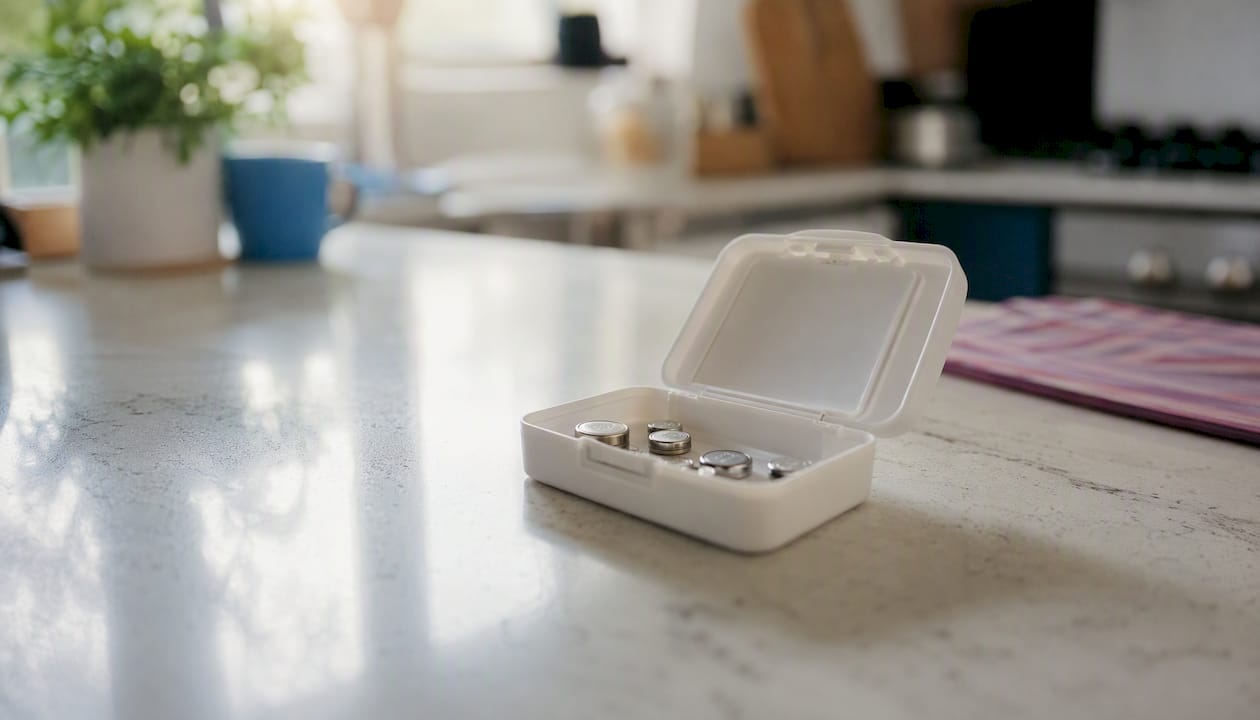
The size range of button batteries (roughly 5–25 mm in diameter) means most of them pass the CPSC small-parts test. They are present in remote controls, key fobs, musical greeting cards, bathroom scales, and dozens of toy types.
Emergency steps if you suspect ingestion:
- Do not give the child anything to eat or drink.
- Do not try to induce vomiting.
- Call Poison Control immediately: 1-800-222-1222 (U.S.).
- Go to the nearest emergency room. Tell the triage nurse specifically that a battery may have been swallowed — this changes the urgency of imaging.
- Bring the battery packaging or an identical battery if available, so medical staff can identify the exact size and chemistry.
Prevention:
- Only purchase toys with battery compartments that require a screwdriver to open.
- On older toys with snap-close compartments, apply a strip of strong tape over the compartment as a temporary barrier.
- Store spare batteries in a locked drawer or high cabinet, never loose in a junk drawer.
- Dispose of dead batteries immediately rather than leaving them on a counter.
Pro Tip: Before buying any battery-operated toy for a child under five, flip it over and try to open the battery compartment with your fingernail. If it opens, the toy does not meet the standard you should require.
What should you do if a child is choking?
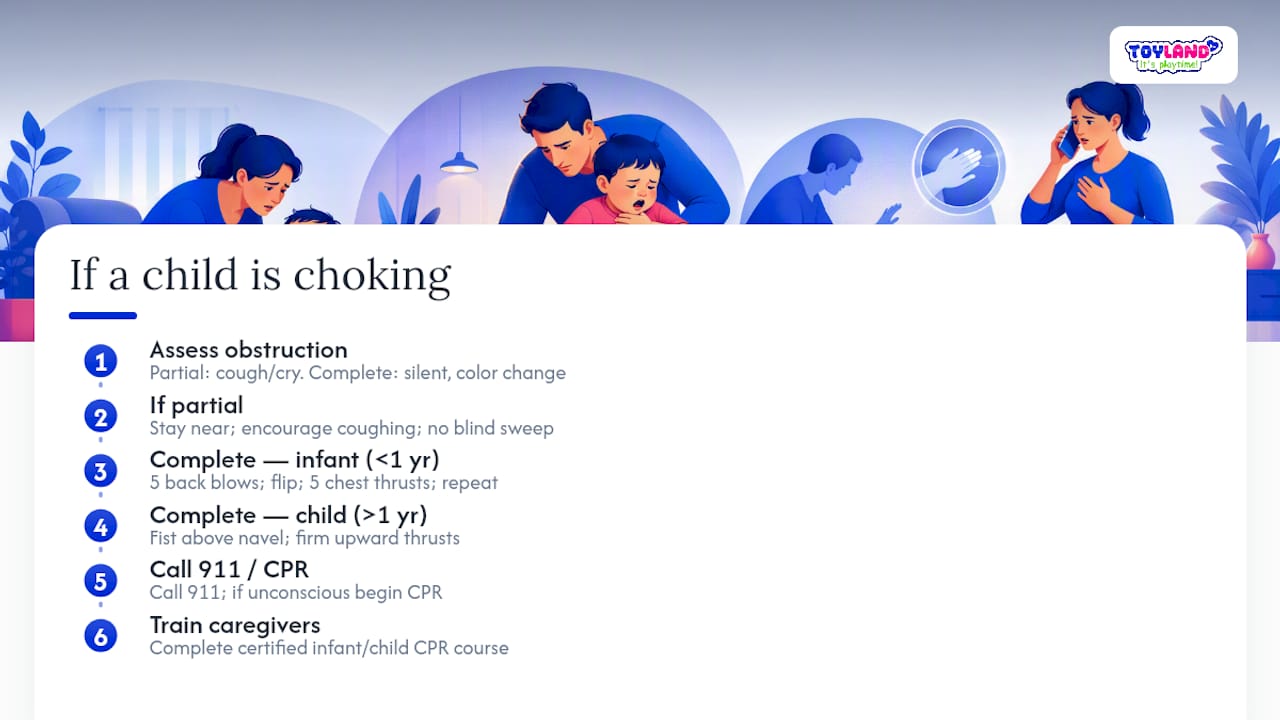
Recognizing the difference between partial and complete airway obstruction is the first decision point.
Partial obstruction: the child is coughing forcefully, crying, or can speak. The airway is not fully blocked. Stay close, encourage coughing, and do not reach into the mouth blindly. Blind finger sweeps can push an object deeper.
Complete obstruction: the child cannot cough, cry, or make sound; the face may be turning red or blue; the child may clutch the throat. This is the emergency.
Act immediately for complete obstruction. For infants under one year: hold the baby face-down on your forearm and deliver five firm back blows between the shoulder blades with the heel of your hand, then flip face-up and give five chest thrusts with two fingers on the center of the chest. Alternate back blows and chest thrusts until the object is expelled or the infant loses consciousness. For children over one year: stand or kneel behind the child, make a fist just above the navel, cover it with your other hand, and deliver firm upward abdominal thrusts. Repeat until the object is dislodged or the child loses consciousness. If the child loses consciousness, begin CPR and call 911 if you have not already.
Call 911 at the start of a complete obstruction, or have someone else call while you perform first aid. Tell the dispatcher the child’s age, what was swallowed if known, and whether the child is conscious.
Pro Tip: Every caregiver in a household should complete a certified infant and child CPR and first-aid course. The American Red Cross and American Heart Association both offer in-person and online options. Knowing the steps in theory is not the same as having practiced them.
How do you check for toy recalls and report unsafe toys?
The CPSC maintains a searchable recall database at CPSC.gov, updated whenever a product is recalled. You can search by brand name, product type, or hazard category. Sign up for email alerts to receive notifications automatically.
Saferproducts is the federal portal where consumers can both search existing incident reports and file new ones. If a toy breaks in a way that creates a hazard, or if a child is injured, filing a report there contributes to the data the CPSC uses to initiate recalls.
Steps when a toy is recalled:
- Stop use immediately and move the toy out of reach.
- Follow the recall notice instructions: most specify whether to return, dispose, or request a repair kit.
- Register for the manufacturer’s recall alerts if the option exists.
- Keep the receipt, original packaging, and any photos of the product. These speed up refund or replacement processing.
Record-keeping habits that help:
- Photograph the product label (including model number and batch code) when you open a new toy.
- Save digital receipts in a dedicated folder labeled “Toy Purchases.”
- Note the manufacturer name and country of origin from the packaging before discarding it.
For a deeper look at how recent toy safety regulations affect what reaches store shelves, Toylandeu™'s regulatory overview is a useful read.
What does the research say about toy-related choking?
CHOP’s injury prevention data identifies latex balloons as the single leading cause of toy-related choking deaths, with coins close behind as the most frequent non-food choking item seen in pediatric emergency departments. Children under three account for the overwhelming majority of these incidents, driven by the developmental behavior of mouthing objects.
A peer-reviewed analysis published in PMC raises a point that most parents never hear: current laboratory small-parts testing may not fully replicate the way children actually chew, bite, and break toys during real play. A toy that passes the CPSC cylinder test as manufactured can produce small parts after a child bites off a wheel or cracks a seam. This is precisely why home inspection routines matter even for toys that carry no warning label.
Key evidence points:
- Latex balloons account for more choking deaths than any other toy-related item.
- Coins are the most common non-food item involved in pediatric choking ER visits.
- Children under three are the highest-risk group due to airway size and mouthing behavior.
- Lab testing gaps mean a passed test is a starting point, not a guarantee.
Pro Tip: When evaluating a toy’s safety, look beyond the label. Check independent safety testing pages like BANZ® Safety Testing to understand what rigorous product testing actually involves — then apply that standard of scrutiny to any toy you buy.
A parent’s honest take on building a safety habit
The hardest part of toy safety is not knowing the rules. Most parents who read this article will know the toilet-paper-roll test, the CPSC cylinder dimensions, and the button-battery emergency number before they finish. The hard part is making the check automatic.
What actually works is attaching the inspection to something you already do. A quick floor sweep at the end of bath time. A battery-compartment check when you put toys away on Sunday. A five-second pull-test on any new toy before it goes into the bin. None of these take more than a minute, and together they close most of the gaps that lead to incidents.
The other thing worth saying plainly: age labels are not suggestions for advanced children. A two-year-old who can count to ten is still a two-year-old with a two-year-old’s airway. The CPSC cylinder does not grade on a curve.
Toylandeu™ publishes safety education alongside its toy catalog because the two are inseparable. Knowing what to look for makes you a better shopper, and a better shopper makes the play environment safer. That is the whole point.
Safe toy shopping starts with knowing what to filter for
Buying safer toys does not require a separate safety checklist for every purchase. It requires knowing which product-page signals to look for and which categories carry lower risk by design.
When shopping on Toylandeu™ or any retailer, check the product listing for the age grade, the choking-hazard warning status, and whether battery compartments are described as screw-secured. Toylandeu™'s catalog includes product types that reduce choking risk by design: large-format art kits like the Enchanting Kids Art Workbook Montessori Drawing Kit, which uses oversized components suited to supervised creative play, and battery-operated RC toys like the Gesture-Controlled Stunt Car, which features a secure battery compartment. For parents who want smart buying guidance beyond the basics, Toylandeu™'s shopping guides walk through age-appropriate filtering step by step. Browse the full catalog at Toylandeu™ and use the age-filter to narrow results to your child’s stage before you look at anything else.
Sources
- Small parts for toys and children’s products - U.S. Consumer Product Safety Commission
- Choosing safe toys for toddlers and preschoolers | Nemours KidsHealth
- Toy safety - Children’s Hospital of Philadelphia (CHOP)
- Choking hazards: Are current product testing methods for small parts adequate? - PMC
- Saferproducts
This article is general information, not a substitute for advice from a qualified doctor. Consult a qualified healthcare professional about your own circumstances before acting on anything here.
FAQ
How do I know if a toy is a choking hazard?
If any part of the toy fits entirely inside a toilet-paper roll, it is a choking hazard for children under three. Check every detachable piece individually, not just the assembled toy, and look for the CPSC choking-hazard warning label on the packaging.
What is the 20-toy rule?
The 20-toy rule is a practical guideline recommending that no more than 20 age-appropriate toys be accessible to a young child at one time. Limiting the number of toys in the play area reduces the chance that small parts from different sets get mixed together and makes it easier to spot missing or broken pieces.
What are the top choking hazards for young children?
Latex balloons are the leading cause of toy-related choking deaths in children, followed by coins, marbles, small balls, button batteries, small magnets, and detachable toy parts such as doll eyes and wheel axles. Non-toy household items like pen caps and jewelry clasps carry equal or greater risk.
At what age are small toys no longer a choking hazard?
The CPSC small-parts standard applies to children under three, and most regulatory guidance treats age three as the threshold for supervised exposure to small-part toys. That said, children develop at different rates, and close supervision remains important through age five for toys with small components.
What should I do if my child swallows a button battery?
Call Poison Control immediately at 1-800-222-1222 and go to the nearest emergency room. Do not induce vomiting. Tell medical staff specifically that a battery was swallowed, since button-battery ingestion requires urgent imaging and can cause severe internal burns within two hours.