

What Is Toy Safety? A Parent's Guide for 2026
TL;DR:
- Many toys, despite safety regulations, can become hazards over time or through misuse.
- Parents should regularly inspect toys, verify safety markings, and stay informed about evolving standards to ensure child safety.
Not every toy sold online or in stores has been properly tested. That’s the uncomfortable reality behind toy safety, and it’s why understanding this topic matters more than most parents realize. What is toy safety, exactly? It covers how toys are designed, tested, and regulated to protect children from physical harm, chemical exposure, electrical hazards, and even digital risks. With toys accounting for 15% of EU safety alerts in 2025, knowing how to evaluate what your child plays with is one of the most practical parenting skills you can develop.
Table of Contents
- Key takeaways
- What toy safety standards actually cover
- Why age labels are a safety system, not a suggestion
- Hidden hazards that packaging won’t warn you about
- How to ensure toy safety when buying and at home
- Decoding safety marks and standards at a glance
- My take on parental vigilance beyond the label
- Safe, certified toys your child will actually love
- FAQ
Key takeaways
| Point | Details |
|---|---|
| Toy safety is multi-layered | It covers physical, chemical, electrical, flammability, and digital hazards, not just sharp edges. |
| Age labels are safety tools | Age grading reflects real hazard testing, not just marketing. Ignoring them causes preventable injuries. |
| Regulations don’t catch everything | Unsafe toys enter the market, especially through online cross-border sales. Active parental checking is required. |
| Official markings matter | Look for CE, ASTM, or CPSC marks. These signal third-party testing, not just a manufacturer’s claim. |
| Toys degrade over time | Regular inspection of battery compartments, seams, and small parts is a critical habit, not a one-time check. |
What toy safety standards actually cover
Toy safety is a legal framework, not just a suggestion. In the United States, the Consumer Product Safety Commission (CPSC) enforces mandatory compliance with ASTM F963-23, the updated standard that became law in 2024. This standard governs five major hazard categories: mechanical safety (sharp edges, projectiles), chemical safety (lead, phthalates, allergenic substances), flammability, electrical safety, and digital safety.
The European Union recently overhauled its toy safety rules. The updated regulation, adopted in late 2025, bans allergenic fragrances in toys for children under 3, adds stricter chemical restrictions targeting endocrine disruptors, and requires manufacturers to assess digital hazards before a toy reaches store shelves. Connected toys now face scrutiny for mental health and privacy risks, which is a significant expansion beyond traditional physical hazards.
One feature of the new EU rules that parents should know about: digital product passports. Within a 4.5-year transition period starting late 2025, toys sold in the EU must include a QR code linking to detailed safety and compliance data. That means you will soon be able to scan a toy in a store and pull up its full certification history.
Here is a quick breakdown of what testing actually involves:
- Mechanical testing: Drop tests on hard surfaces, torque and tension tests on small attached parts, and projectile tests on toy guns
- Chemical testing: Solubility tests in acid that mimics stomach conditions to measure ingestion risk
- Flammability testing: Exposure to flame to ensure toys do not ignite or sustain burning
- Electrical testing: Voltage, current, and battery access controls for powered toys
- Digital testing (new): Assessment of data privacy and psychological impact for internet-connected toys
Pro Tip: When you read “tested to ASTM standards” on packaging, verify it says ASTM F963-23 specifically. Older versions of the standard had weaker battery access requirements, and some manufacturers still reference them.
Why age labels are a safety system, not a suggestion
Most parents read age labels as a rough recommendation. They’re not. Age grading reflects actual hazard testing tailored to specific developmental stages and physical vulnerability. A toy rated 3+ has been evaluated for the risks posed to children who can walk, have stronger grip, and are past the stage of putting everything in their mouths. A toy rated 8+ may include small powerful magnets or complex mechanical parts that are genuinely dangerous for younger kids.
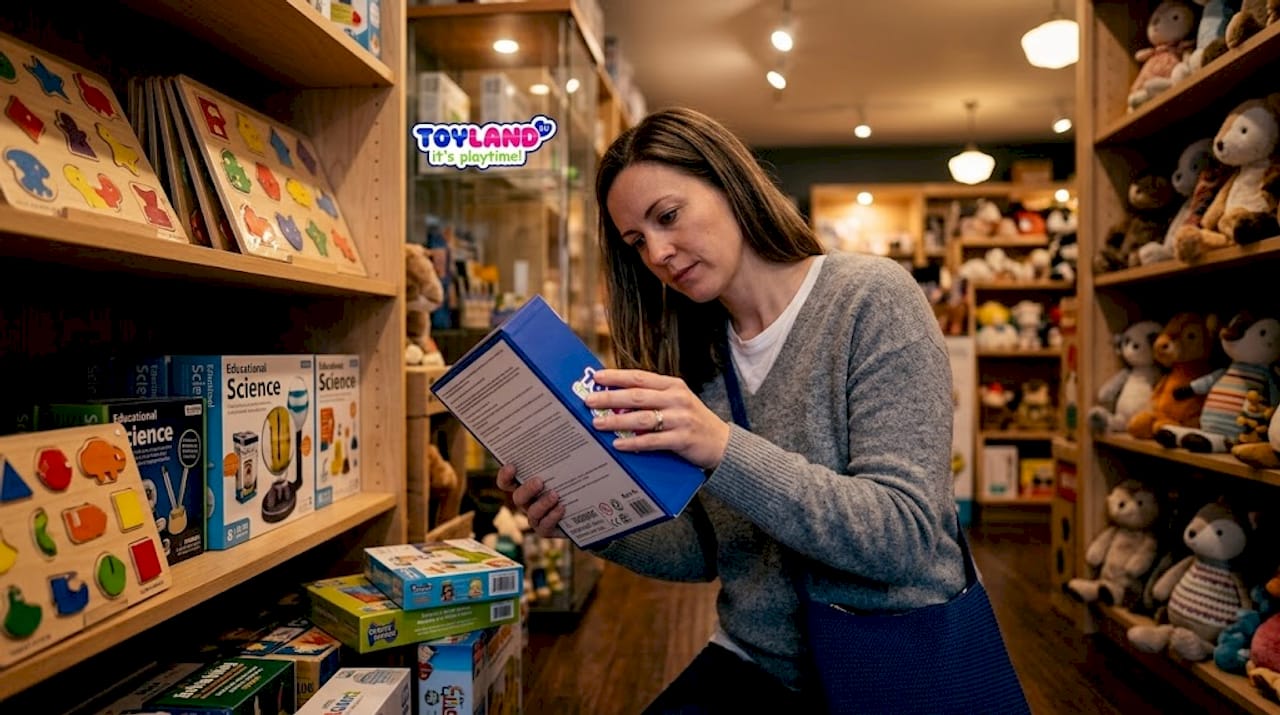
The most frequently misunderstood requirement involves children under 36 months. Under ASTM F963-23, any toy for this age group must pass a small parts cylinder test, confirming no detachable part is small enough to lodge in a child’s throat. Battery compartments must also require a household tool to open, preventing toddlers from accessing coin cell batteries, which are a leading cause of serious internal injuries when swallowed.
Here is a practical approach to reading age labels correctly:
- Trust the lower bound, not just the upper. A toy labeled 3-8 years is not safe for a 2-year-old, even if it looks simple.
- Read warning text on the back. Phrases like “Not for children under 3” or “Contains small parts” carry legal weight.
- Account for younger siblings. A 7-year-old’s toy left on the floor becomes a hazard for a crawling baby.
- Check battery compartment security. If you can open it without a screwdriver, it does not meet current standards.
Pro Tip: Craft kits and art sets often carry age labels that reflect skill level, not safety. A “6+” clay kit may still contain chemical risks for young children who will put it in their mouths. Verify the material safety sheet, not just the age label.
Hidden hazards that packaging won’t warn you about
Here is what catches most parents off guard: even compliant toys become dangerous as they age, get misused, or break. A well-made toy at purchase can become a serious hazard six months later.
The risks fall into a few clear categories:
- Physical hazards: Strings and cords over 30cm on toys for young children pose strangulation risks. Toys that crack or split can expose sharp internal edges.
- Chemical hazards: Lead paint and phthalates remain concerns in toys from markets with weaker enforcement. Magnet ingestion and toxic craft kits have triggered serious recalls and hospitalizations.
- Battery hazards: Lithium coin cell batteries, when swallowed, can cause chemical burns to the esophagus within two hours. Loose battery compartments that no longer require a tool to open are a critical red flag.
- Digital hazards: Smart toys that connect to Wi-Fi can expose children’s voices and location data. Some have been shown to encourage manipulative play patterns that affect behavior.
Routine inspection is not optional. Check toys every month for broken seams, cracked plastic, exposed battery compartments, and frayed cords. Retire any toy that has become structurally compromised, even if it still functions.
A good rule: if you would not hand a toy to your child for the first time today in its current condition, it should not be in the toy box.
How to ensure toy safety when buying and at home
Knowing what to look for makes the difference between a confident purchase and a costly mistake. These steps cover how to ensure toy safety both in the store and after the toy comes home:
- Check for official markings. In the U.S., look for CPSC compliance statements. In Europe, the CE mark is required. These are not optional stickers. They indicate the product has been tested to legally required standards.
- Search recall databases before buying. The CPSC maintains a searchable recall list at CPSC.gov. The EU’s RAPEX system lists unsafe toys flagged across member states.
- Buy from reputable sources. Unsafe toys frequently enter the market through cross-border online sales. Unknown third-party sellers on large marketplaces carry higher risk.
- Inspect the toy on arrival. Check battery compartment security, look for loose parts, and confirm the packaging matches the product description.
- Stay current on regulations. The 2025 toy safety regulatory changes and upcoming 2026 rules affect what markings and digital features you should expect.
Pro Tip: Once the EU digital product passports roll out fully, scanning a QR code on the packaging will give you direct access to a toy’s chemical composition, safety testing history, and certification status. Until then, your best tool is the recall database and official markings.
Decoding safety marks and standards at a glance
| Standard / Mark | Region | What it covers |
|---|---|---|
| ASTM F963-23 | United States | Mechanical, chemical, flammability, electrical, and digital hazards |
| EN 71 | European Union | Mechanical safety, chemical limits, flammability, and electrical safety |
| CE Mark | European Union | Legal requirement confirming conformity with EU toy safety regulations |
| CPSC Certification | United States | Manufacturer certification of compliance with ASTM F963-23 |
| Canadian Toys Regulations | Canada | Based on ASTM F963 with additional Health Canada chemical restrictions |
| UKCA Mark | United Kingdom | Post-Brexit equivalent of CE mark for the UK market |
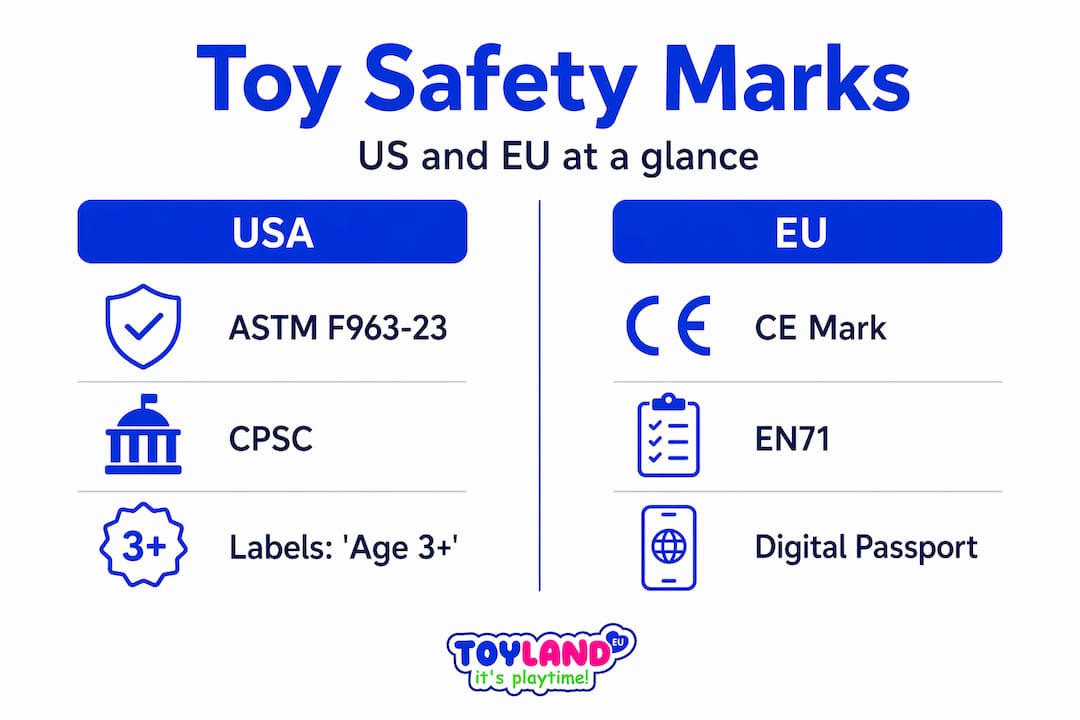
The CE mark is one of the most misunderstood labels in toy retail. It is not a third-party quality seal. It is a legal declaration by the manufacturer that the product meets EU requirements. This is why checking for both the CE mark and the specific test standard cited in product documentation matters, especially for toys purchased from international sellers.
My take on parental vigilance beyond the label
I’ve looked at toy safety from a retailer’s perspective for long enough to say this clearly: regulations are a floor, not a ceiling. The rule-making process takes years. A hazard identified in 2024 may not appear in a binding standard until 2027. That gap is real, and children are exposed to it every day.
What I’ve found is that the parents who feel most confident aren’t the ones who read every regulation. They are the ones who have built two simple habits: checking recalls before any purchase and inspecting toys monthly. Neither takes more than five minutes. Both catch most preventable risks.
The rise of connected toys adds a layer that current regulation has only just started to address. Digital toy hazards covering privacy and psychological manipulation are now legally required assessment areas in the EU. But parents shouldn’t wait for legislation to ask basic questions. Does this toy transmit data? Who stores it? What does it do when my child uses it?
Balancing safety with fun isn’t complicated. It just requires staying informed and treating toy buying as a small but serious decision, every single time.
— Thane
Safe, certified toys your child will actually love
If you want toys you can trust without spending hours researching certifications, Toylandeu has done the work for you. Every product in the catalog is sourced with safety markings, age-appropriate design, and material quality in mind.
Creative kids will thrive with the Montessori Drawing Kit, a non-toxic, age-graded art workbook designed for hands-on learning. For something with more motion, the gesture-controlled stunt car comes with a locked battery compartment meeting current ASTM standards. You can also explore the full range of age-appropriate, safety-conscious picks through Toylandeu’s parent buying guide to find the right match for your child’s stage and interests.
FAQ
What is toy safety and why does it matter?
Toy safety refers to the design, testing, and regulation standards that protect children from physical, chemical, electrical, and digital hazards during play. It matters because many injuries and recalls involve toys that reached the market despite failing to meet current safety requirements.
How do I check if a toy meets safety standards?
Look for official marks such as CE (EU), CPSC compliance statements (U.S.), or ASTM F963-23 certification on the packaging. You can also search the CPSC recall database or the EU’s RAPEX system before purchasing.
Are age labels on toys legally required?
Yes. In both the U.S. and EU, age grading labels and hazard warnings on toys are legally mandated. They reflect actual safety testing results, not just a manufacturer’s opinion on skill level.
What toy hazards are most commonly overlooked?
Degraded battery compartments, worn seams that expose sharp edges, and strong small magnets in toys meant for older children are frequently overlooked. Toy wear over time converts safe purchases into real hazards.
What are digital product passports for toys?
Digital product passports are QR codes on toy packaging that link to detailed compliance and safety data, including chemical composition and certification history. The EU is requiring them for all toys sold within a transition period starting late 2025.