

Toy material safety: A parent's guide to smart choices
TL;DR:
- Many toys labeled “natural” or “organic” require careful testing of added chemicals to ensure safety during mouthing behaviors. The risk from toys depends more on surface coatings, dyes, and plasticizers than the base material itself, with migration testing being critical for child safety. Compliance with recognized standards like CE, ASTM, or EN 71-3, alongside verified third-party testing, is essential for assessing real chemical risks, especially for toys intended for mouthing children under three years old.
When you pick up a toy labeled “natural wood” or “organic cotton,” it’s tempting to assume the job is done. But the real safety story starts where the marketing stops. The base material of a toy, whether it’s wood, plastic, or textile, tells you almost nothing about actual risk. What matters is what’s been added to that material through dyes, plasticizers, coatings, and finishes, and how those additives behave when a toddler chews, drools, or gnaws on the toy for thirty minutes straight. This guide breaks down the science, the standards, and the practical steps you need to shop with real confidence.
Table of Contents
- Why toy material choice matters: Beyond the surface
- Toy safety standards: US and EU frameworks explained
- Chemical migration: What really happens when children mouth toys
- Sustainable textiles: What certification really covers
- Shopping smart: Practical tips for evaluating toy materials
- Our hard-won lessons: What most parents miss about toy material safety
- Discover safe, creative toys at ToylandEU
- Frequently asked questions
Key Takeaways
| Point | Details |
|---|---|
| Material isn’t everything | Toy safety depends on chemical additives and how materials behave with child play, not just the base material. |
| Regulation matters | Choosing toys that comply with US or EU safety frameworks helps minimize risk from chemicals and migration. |
| Real-world behaviors drive risk | A child’s licking, mouthing, or chewing determines the true chemical exposure from toys. |
| Sustainability labels aren’t enough | Environmental certifications reduce some risks but don’t guarantee toy-specific chemical safety. |
| Always verify documentation | Request and review compliance certificates for age-specific play and material claims for informed decisions. |
Why toy material choice matters: Beyond the surface
Most parents think of toy safety in simple categories: plastic is bad, wood is good, organic is best. The truth is messier and more interesting. A piece of untreated, unfinished beechwood may be perfectly safe. That same piece of wood, once painted with a colorful finish and sealed with a synthetic lacquer, becomes a completely different chemical object.
Children interact with toys in ways that dramatically increase exposure risk. Babies and toddlers mouth objects for an average of 25 to 50 minutes per day, which means saliva is constantly in contact with surfaces. Licking, chewing, and biting are developmentally normal behaviors, and they are exactly the behaviors that drive real-world chemical exposure. The plastic vs wood toys debate often misses this point entirely.
Here is what actually drives safety risk:
- Base polymer or material: Whether plastic, wood, or fabric
- Colorants and dyes: Often applied as surface coatings that can flake or dissolve
- Plasticizers: Chemicals added to make plastics soft and pliable, such as phthalates
- Binders and adhesives: Used to hold layers together, which can release compounds
- Surface coatings: Paints, lacquers, varnishes, and wax finishes
“Safety isn’t just about base material — it’s about what’s added and what can migrate under mouthing and play.”
The word “migrate” here has a specific technical meaning. It refers to chemicals moving from the toy surface into saliva or body tissue. Even trace amounts of certain heavy metals, phthalates, or aromatic amines can cause health concerns when exposure is repeated daily over months or years.
Pro Tip: When evaluating a toy, look beyond the product description and check for third-party testing documentation. A CE marking or ASTM compliance label indicates that someone has actually tested migration and chemical release, not just the raw material.
Toy safety standards: US and EU frameworks explained
Understanding how safety regulations work gives you a real advantage when shopping. Both the United States and the European Union have detailed frameworks, but they approach the problem differently and cover different chemical groups.
In the US, CFR 16 Part 1252 governs toy safety for hazardous chemicals. The framework focuses on migration and solubility testing, and it includes strict limits for phthalates, bisphenols, and other endocrine-disrupting compounds. The Consumer Product Safety Improvement Act (CPSIA) requires third-party testing for children’s products and mandates that manufacturers and importers provide Children’s Product Certificates with supporting test data.
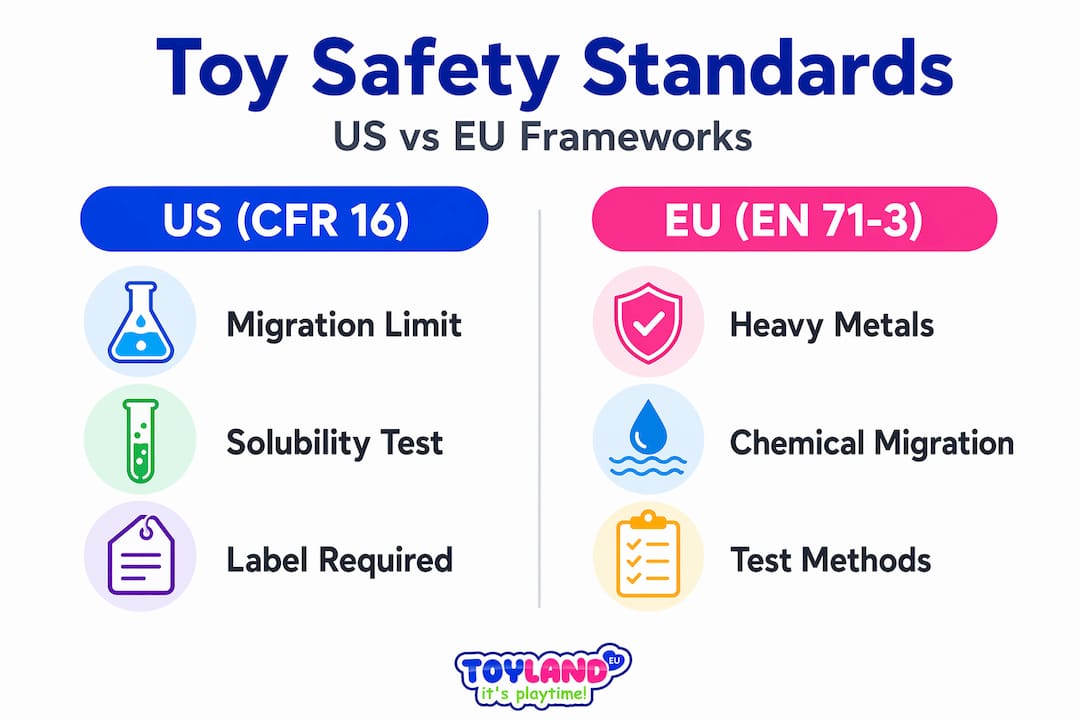
The EU framework, particularly EN 71-3, specifies test methods for the migration of multiple chemical elements from toy materials. The standard separates toy materials into categories: dry, brittle, powder-like, or scraped material; liquid or sticky material; and modelling materials. Each category has different migration limits because each behaves differently during mouthing. The EU Parliament Toy Safety directive now goes further, banning the intentional use of PFAS (per and polyfluoroalkyl substances) in toys and restricting dangerous bisphenols, with migration testing directly linked to real child mouthing behaviors.
Here is a side-by-side comparison of the two major frameworks:
| Feature | US (CPSIA/CPSC) | EU (EN 71-3/Toy Safety Directive) |
|---|---|---|
| Governing body | Consumer Product Safety Commission | European Commission / CEN |
| Phthalate limits | Yes, strict | Yes, strict |
| Bisphenol limits | Yes, for BPA | Yes, including alternatives |
| PFAS restrictions | Emerging guidance | Banned intentionally added PFAS |
| Migration testing | Required | Required, material-category specific |
| Third-party testing | Mandatory | Mandatory for CE marking |
Key chemicals regulated under both frameworks include:
- Phthalates: Used as plasticizers in PVC toys; linked to hormonal disruption
- Bisphenols: Including BPA and several alternatives; associated with developmental effects
- Heavy metals: Lead, cadmium, antimony; found in some colorants and stabilizers
- PFAS: Water and stain-resistant coatings; linked to immune and thyroid disruption
When choosing toys safely, always check whether the toy is designed for mouth contact. A toy intended for children under 36 months is legally assumed to be mouthed and must meet stricter standards than a toy for older children. The non-toxic toys guide explains what specific labels to look for at point of sale. For parents who want to stay updated, the latest toy safety standards page covers evolving regulatory trends that affect purchasing decisions in 2026.
Chemical migration: What really happens when children mouth toys
Migration sounds abstract, but the research makes it concrete and a little alarming. Scientists use artificial saliva, a solution designed to mimic the chemical environment of a child’s mouth, and soak or rub toy samples in it under controlled conditions. What dissolves out represents what a real child could absorb.
A 2025 study published in RSC Analytical Methods found that bisphenol release from toy polymers varies significantly by polymer type under simulated saliva conditions. Polyethylene (PE) and polypropylene (PP) showed the highest bisphenol release rates. This is counterintuitive because PE and PP are generally considered among the safer plastics. The finding shows how additive chemistry can override the properties of the base material.
Common toy polymers and their relative migration considerations:
| Polymer | Common use in toys | Key migration concern |
|---|---|---|
| Polyethylene (PE) | Squeaky toys, balls | Bisphenol additives |
| Polypropylene (PP) | Building bricks, containers | Bisphenol additives |
| Polyurethane (PUR) | Foam toys, padding | Aromatic amines |
| Polyethylene terephthalate (PET) | Transparent parts | Antimony catalyst residue |
| PVC | Soft figures, bath toys | Phthalate plasticizers |
A separate USEtox modeling study published in Nature found that children’s BPA exposure depends on toy material, chemical properties, and behavioral factors, and that several BPA alternatives may actually result in higher aggregate exposure doses for children. This is a critical point. Many brands have switched to BPA alternatives as a marketing move, but without independent testing, those alternatives could pose equal or greater risk.
Here is a practical numbered approach for understanding migration risk:
- Identify the polymer type: Check the resin identification code (the number inside the recycling symbol) on plastic toys
- Check the age range: Toys for under 3 years must meet the most stringent migration limits
- Look for tested certification: CE marking (EU) or third-party CPSC compliance documents (US) confirm actual testing
- Consider the toy’s surface: Painted or coated surfaces often carry higher migration risk than uncoated materials
- Think about wear: Worn or scratched surfaces can release more chemical material than new ones
Pro Tip: A toy that has been chewed repeatedly is chemically different from a new one. If your child’s favorite toy shows significant wear or surface damage, consider replacing it even if it originally passed safety standards.
Resources on children’s toy safety explain how newer manufacturing advances are reducing migration risks in 2026’s toy lineup.
Sustainable textiles: What certification really covers
Textile toys, cloth dolls, fabric blocks, and soft puppets present a different set of considerations. Parents often reach for “organic cotton” products assuming they are both safe and sustainable. Organic cotton is a meaningful environmental choice, but it does not automatically mean the finished product is chemically safe for mouthing.
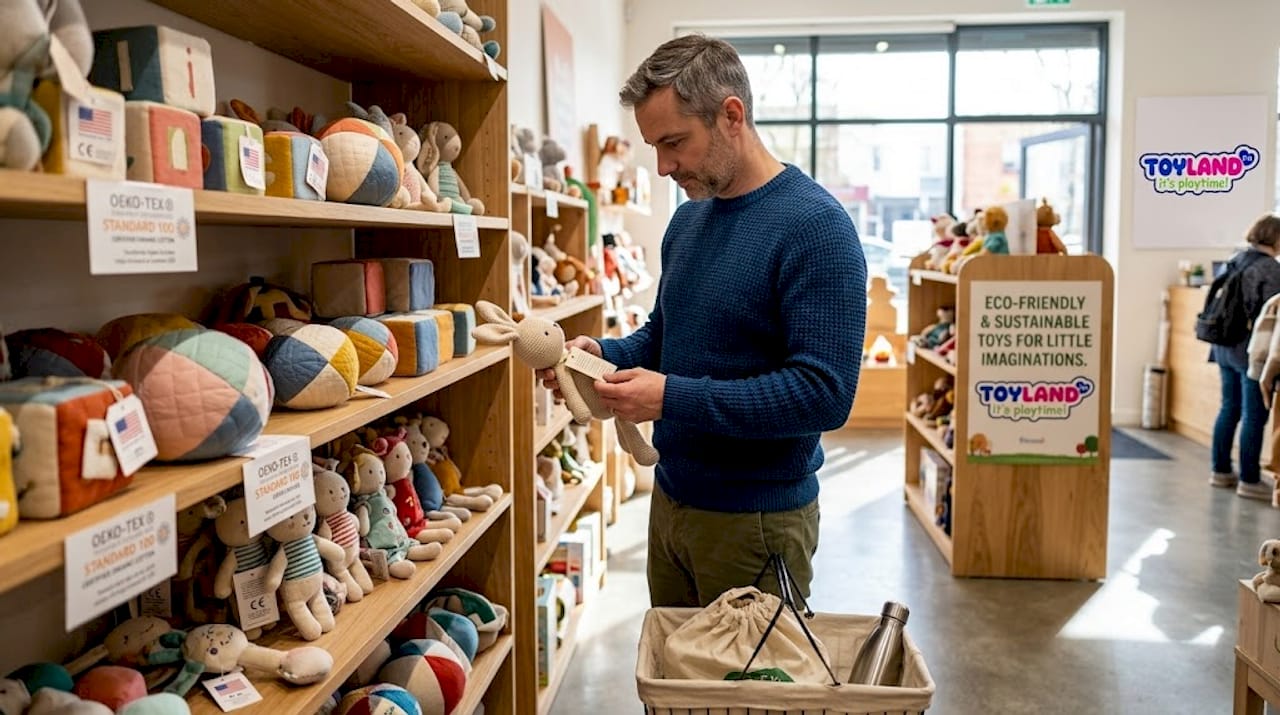
The OEKO-TEX Organic Cotton Standard applies to textiles and accessory materials comprising more than 70% organic cotton. It covers limits on harmful chemicals used during fiber production and dyeing, including pesticide residues, heavy metal colorants, and formaldehyde. This is genuinely valuable. However, the certification does not automatically guarantee toy-specific chemical migration safety under the conditions of sustained mouthing.
What OEKO-TEX certification covers:
- Pesticide residues from cotton farming
- Heavy metals in dyes and pigments
- Formaldehyde in finishing agents
- pH value and color fastness
- Allergenic dyes and sensitizing substances
What it does not cover:
- Migration testing under simulated saliva conditions specific to toys
- Toy safety directive compliance (EN 71 or CPSIA)
- Physical hazard testing such as part detachment or flammability in toy use
The EU Parliament Toy Safety directive makes clear that sustainability labels reduce risk in one dimension but that parents need both environmental assurance and toy-safety compliance documentation. Think of it as a Venn diagram: you want a product that sits in the overlap zone.
For parents shopping for infant textiles, products like an organic cotton bodysuit that carry dual certification demonstrate what genuinely comprehensive compliance looks like. Similarly, a purpose-designed teething tie toy that carries both textile safety and toy-specific migration testing is a model example of overlapping certifications done right.
Pro Tip: Ask the retailer or manufacturer for both the textile safety certification and toy safety compliance documentation. If they can only produce one, the product only covers half of the risk picture.
Shopping smart: Practical tips for evaluating toy materials
Armed with this understanding, you can approach toy shopping as an informed process rather than a guessing game. The key is matching the right material approach to your child’s age, development stage, and actual play behaviors.
Here is a step-by-step evaluation framework:
- Identify your child’s age and mouthing habits: Under 3 years requires the strictest material standards; 3 to 6 years still involves significant mouthing risk
- Check the age label: Legally mandated age labels reflect safety testing scope, not just developmental appropriateness
- Look for compliance marking: CE (Europe) or ASTM/CPSC documentation (US) confirms actual third-party testing
- Request test documentation: Reputable manufacturers and retailers can provide test reports on request
- Examine the surface finish: Painted or heavily coated toys require chemical migration testing for those specific coatings
- Consider the use environment: Bath toys face repeated wet exposure, which can accelerate chemical release and mold growth
Additional things to look for when evaluating any toy:
- No strong chemical odor: A plastic smell may indicate residual solvents or high plasticizer content
- Stable surface: Peeling paint or crumbling coatings indicate potential migration hazard
- Manufacturer transparency: Brands that publish safety data sheets or test reports are worth trusting more
- Country of manufacture plus certification body: Certification by a recognized EU or US lab carries more weight than a self-declared claim
The CFR 16 Part 1252 benchmark is straightforward: verify that claims align with compliance frameworks and intended age-use, and check for mouth-contact design documentation. For deeper guidance on this, the choosing toys safely resource covers practical verification steps. You can also check parenting-focused resources like safe teething tips for age-specific advice on what to look for in chewable and mouthable products.
Pro Tip: Take a photo of the toy’s certification label and compliance markings before purchasing. If concerns arise later, you will have the documentation you need to contact the manufacturer or report the product.
Our hard-won lessons: What most parents miss about toy material safety
Here is the uncomfortable reality after reviewing the science, the standards, and the research: most parents are asking the wrong question. The question is not “is this toy made of safe material?” The better question is “has this specific toy, with its specific additives and coatings, been tested under the actual conditions my child will use it?”
We have seen parents choose a “natural wood” toy with a brightly colored painted surface, assuming it is categorically safer than a tested plastic toy. In many cases, the tested plastic toy is the safer choice. The wood is simply the base; what matters is everything applied to it, and whether that finished product has been independently verified.
The same logic applies to sustainability claims. A toy marketed as eco-friendly, sustainable, or planet-safe may use recycled materials, responsible packaging, or low-carbon production without ever having undergone chemical migration testing. Environmental responsibility and child safety are different dimensions of quality. They sometimes overlap, but they require separate verification.
Real-world child behavior is the actual test of any toy’s safety profile. A child who drools heavily while teething creates a very different exposure scenario than one who plays with a toy only with dry hands. If you have a drooler or a dedicated chewer, you need to be especially rigorous about migration testing documentation. The discussion of material choices in toys shows how the two most common material types compare when you factor in real-world behaviors rather than surface-level assumptions.
The practical takeaway: trust compliance documentation over branding. A toy with clear CE marking, a manufacturer-published test report, and an appropriate age range label has been subjected to real scrutiny. A toy with attractive packaging, a sustainability story, and no third-party test documentation has not.
Discover safe, creative toys at ToylandEU
Understanding toy material safety is the first step. Finding toys that actually meet those standards is the next one.
At ToylandEU, our catalog of over 30,000 toys spans age-appropriate options with a focus on verified quality and creative engagement. Whether you are looking for educational play, artistic development, or hands-on building experiences, you can explore options like the Montessori drawing kit for creative learning, the wooden hockey ball game for active play with natural materials, or the clay modeling kit for tactile, sensory development. We offer free worldwide shipping and support parents looking for gifts that are both fun and responsibly made.
Frequently asked questions
Are wooden toys always safer than plastic toys?
Wooden toys can be safer, but safety depends on coatings, paints, and actual migration testing results, not just the base material. A painted wooden toy without compliance documentation is not automatically safer than a tested plastic alternative.
What certification should I look for on textile toys?
Look for OEKO-TEX and GOTS certification for organic cotton content, but also request toy-specific chemical migration documentation. The OEKO-TEX Organic Cotton Standard covers textiles over 70% organic cotton but does not substitute for toy-specific migration safety testing.
Why are BPA alternatives sometimes riskier than BPA?
Some BPA alternatives migrate at higher rates from toy materials, and USEtox modeling shows that multiple alternatives resulted in higher aggregate exposure doses for children than BPA itself in certain scenarios. Always verify independent testing rather than relying on “BPA-free” labeling alone.
How can I check if a toy is safe for my child’s mouthing behaviors?
Verify that the toy meets region-specific standards such as CPSC/CPSIA in the US or EN 71-3 in Europe, and confirm that testing documentation specifically addresses mouth-contact use and the toy’s intended age group.