

How to Build Team Skills with Toys: A Step-by-Step Guide
TL;DR:
- Toys can foster teamwork in children when used intentionally with structured activities and clear goals. Effective collaboration depends on the activity design, environment, adult support, and reflection, not just shared materials. Guided, purposeful play leads to lasting social skills and better group participation over time.
Children often struggle to work together, even when they’re surrounded by amazing toys. You might set up a fun building challenge or hand out a board game, only to watch one child take over while the others drift away. The frustration is real, and it happens in classrooms and living rooms every day. The good news is that toys genuinely can build strong teamwork habits, but only when you use them with intention. This guide walks you through everything: how to pick the right toys, prepare the right environment, and run sessions that actually develop lasting collaborative skills in children of all ages.
Table of Contents
- Understanding how toys can build teamwork
- Choosing the right toys and setting for team skill building
- Preparing for collaborative play: Structure, rules, and support
- Guided play: Step-by-step strategies for building team skills
- Measuring progress and troubleshooting common team play hurdles
- The overlooked truth: Why adult-led teamwork with toys often falls flat
- Get started with team-building toys that inspire real collaboration
- Frequently asked questions
Key Takeaways
| Point | Details |
|---|---|
| Structure matters most | Collaborative skills flourish when toy-based play is guided with clear objectives and roles. |
| Age and materials count | Choose toys and environments that match children’s developmental stages and teamwork opportunities. |
| Active support is key | Facilitate teamwork with prompts, models, and feedback rather than just providing toys. |
| Assess and adapt often | Track skills and update group rules to resolve conflicts or stuck patterns as children develop. |
Understanding how toys can build teamwork
Many people assume that any shared toy automatically creates teamwork. It doesn’t. Research shows that cooperative play gains are most reliably supported when the activity is structured and time-bounded, not when children simply play side by side with the same materials. There’s a big difference between parallel play, where children share space but not goals, and true collaborative play, where they must coordinate to succeed.
Understanding the different collaboration modes helps you design better sessions. Some children are action-first learners: they want to dive in, build something, and figure out communication along the way. Others are silent allies who contribute without much talking, responding to cues and actions rather than words. Then there are verbal planners who need to talk through every step before touching a single piece. Collaboration with hands-on materials can involve all of these coordination pathways simultaneously, which is why group toy play is so rich when facilitated well.
Here’s what actually drives teamwork in toy-based play:
- A shared goal that no single child can achieve alone
- Materials that require division of labor or complementary roles
- Time limits that create gentle pressure to coordinate
- Adult-designed structure that makes collaboration the path of least resistance
“Play becomes a rehearsal for real-world cooperation when children must negotiate, adapt, and compromise to reach a shared outcome.” This is precisely why the benefits of team-building games go far beyond entertainment.
Some toys naturally support nonverbal collaboration, like stacking games or physical construction kits, while others demand verbal communication, like cooperative board games with hidden information. Knowing which type you’re working with helps you match the toy to the group’s current skill level. Our brain development toys guide and group learning toys guide offer deeper breakdowns of which formats work best for different developmental stages.
| Toy type | Collaboration mode | Best age range |
|---|---|---|
| Block construction sets | Action-first, nonverbal | 5 to 10 years |
| Cooperative board games | Verbal planning | 4 to 12 years |
| Creative art kits | Mixed, low pressure | 6 to 14 years |
| STEM challenge kits | All modes | 8 to 14 years |
Understanding how play translates into collaboration lays the groundwork for smart preparation.
Choosing the right toys and setting for team skill building
Once you understand the mechanics of collaborative play, the next step is picking the right tools. Not every toy promotes teamwork. Highly competitive games, where only one child can win, can actually work against collaboration because they incentivize guarding information rather than sharing it. Solitary toys with no shared component simply don’t offer a platform for coordination at all.
Here’s what to look for by age group:
- Ages 3 to 5: Cooperative board games with a simple shared objective (all players win or lose together) and block sets with soft, clear pieces. Avoid any game that highlights individual scores prominently.
- Ages 6 to 9: Block construction skills linked to math and spatial reasoning work best when children are given a defined mission rather than free play. Think “build a bridge that holds five books” rather than “build whatever you want.”
- Ages 10 and up: Creative challenge kits, mystery build sets, and games with evolving roles offer the complexity older kids need. Check out our resources on educational toys for teenagers for more targeted ideas.
For preschoolers specifically, cooperative board-game design with a shared objective and no player-versus-player framing is strongly recommended to reduce conflict and keep the focus on working together. Games where the whole group hunts for objects or solves a collective puzzle fit this model beautifully.
Pro Tip: When setting up a physical play space, arrange seating so all children face each other and the play materials are centrally placed. Children who can see each other’s faces naturally communicate and coordinate better than those sitting side by side at a table.
The physical environment matters more than most parents and educators realize. A cramped space with unclear zones often leads to territorial behavior. A circular setup with the toy in the middle, and enough room to gesture and point, encourages children to treat the task as shared territory. Group-based bingo games for team settings are a great example of activities designed from the start with physical group interaction in mind.
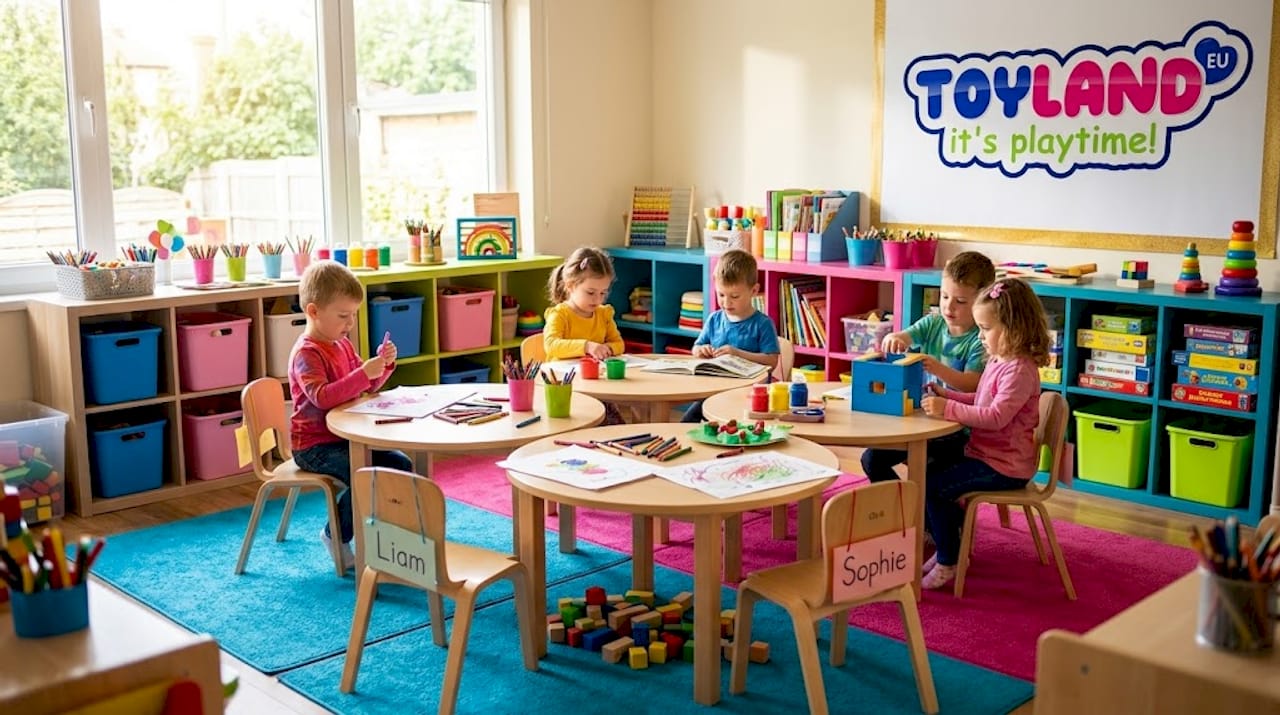
Also consider which Lego-compatible sets and Lego alternatives give teams a wide variety of pieces without any single child hoarding “the best parts.” Variety in materials reduces dominance patterns and encourages more balanced participation.
Once you’ve chosen the right tools and environment, strategic preparation sets the stage for success.
Preparing for collaborative play: Structure, rules, and support
Here’s a truth that surprises many adults: simply handing children a shared task does not guarantee collaboration. Giving kids a shared hands-on task alone may not prompt coordinated interaction; some groups will remain in parallel or solitary play modes unless the task design, materials, and support structure actively enable teamwork.
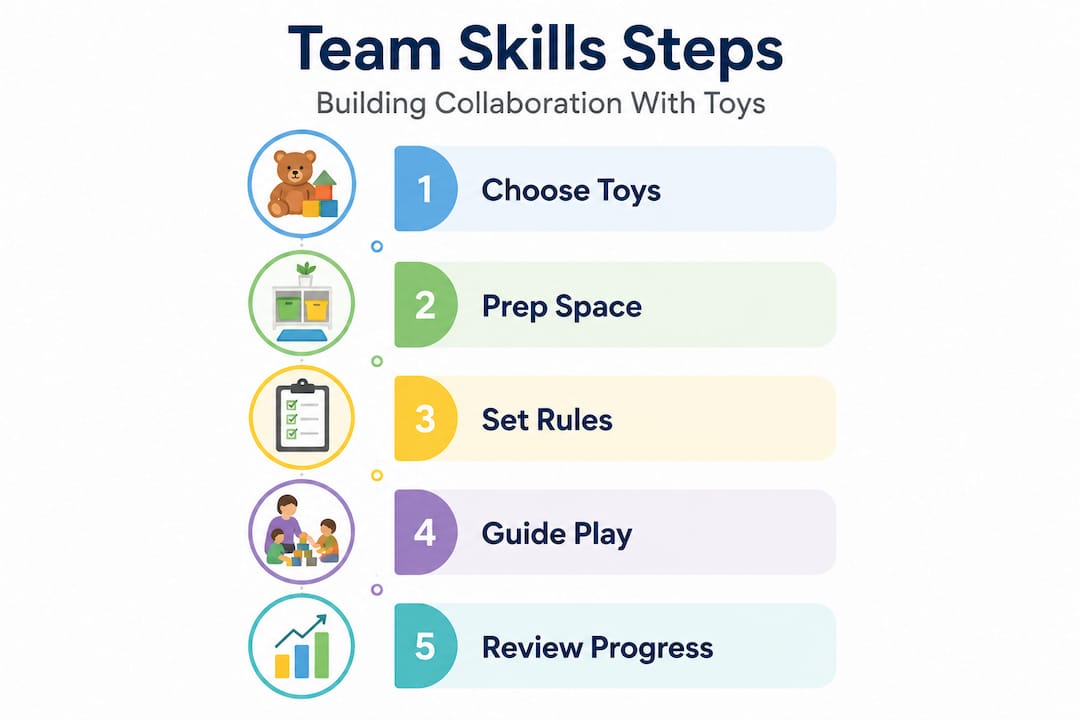
That’s why preparation matters so much. Follow these steps before every collaborative play session:
- Assign roles before starting. Give each child a named job: the Builder, the Supplier, the Timer, or the Planner. Roles should shift across sessions so no child gets locked into one identity.
- State the mission clearly. “Build the tallest tower that can hold a book” is clearer than “build something together.” Specific goals direct effort.
- Set a time limit. Ten to fifteen minutes works well for younger children; twenty to thirty for older groups. Time pressure encourages coordination without panic.
- Model the behaviors you want to see. Before play begins, briefly demonstrate what helping looks like: “Watch how I ask before taking a piece” or “See how I point and wait for a nod.”
- Introduce a shared-build prompt. Using improvisation-like prompts such as “build on what your partner does next” or “your job is to add one piece to whatever they just placed” externalizes the collaboration rule and makes it feel like a game, not a lecture.
“The most effective collaborative play structures treat teamwork as a skill to practice, not a personality trait to hope for.” When adults frame collaboration as learnable, children internalize it faster and with less frustration.
Pro Tip: Keep a visible “team agreement” card on the table with just three rules, like “ask before taking,” “everyone adds one piece,” and “celebrate every step.” Children as young as five can follow simple visual rules if they’re posted at eye level.
Peer support matters too. Pairing a more hesitant child with a patient, communicative peer rather than a dominant one can dramatically change the group dynamic. And nudges, like a quiet timer visible to all, remind children to check in with their team rather than race ahead on their own. These tools are explored further in our guide on how to supercharge learning with toys.
Clear setup leads to effective execution: now it’s time to put teamwork toys into action.
Guided play: Step-by-step strategies for building team skills
Now that everything is set up, the session itself needs guidance. Here’s how to run a genuinely effective team-building toy activity:
- Launch with the mission. Read it aloud together. Ask each child to repeat what their role is. This small ritual creates shared ownership before anyone touches a toy.
- Model collaboration out loud. For the first minute, narrate what you see: “Look, Maya just handed a piece to Theo without being asked. That’s helping!” Narration teaches children to recognize teamwork when it’s happening.
- Step back, then step in. Give children space to figure things out on their own. If they stall for more than sixty seconds, offer a small prompt: “What does the Timer think we should do next?” rather than solving the problem for them.
- Celebrate process, not just product. When the time is up, acknowledge the effort and coordination, not just whether the tower stood or the puzzle was finished. “I saw four moments of great sharing” matters more than “nice job.”
- Debrief with three questions. Ask: “What worked?” “What was hard?” and “What would you do differently next time?” These reflection questions are where the real learning gets locked in.
Research backs this structured approach. Toy-based teamwork is most persuasive when paired with structured, evaluable outcomes rather than assuming collaboration will emerge from “STEM-branded” play alone. A label on the box means nothing without facilitation.
Statistic to keep in mind: Studies on cooperative games and structured group tasks consistently find that children in guided, debriefed sessions show stronger prosocial behavior than those in unguided play by a wide margin. The debrief alone can double the retention of learned behaviors.
Pro Tip: Record a short video of the group working together and play it back during the debrief. Children are often surprised by what they see and are more open to reflection when they can watch themselves rather than rely on memory.
For more ideas, our practical guide to group learning toys covers session formats for different group sizes and age ranges. And digital group games offer a useful complement to physical toys for older children who respond well to screen-based challenges.
With teamwork strategies applied, it’s time to assess what worked and how collaboration is developing.
Measuring progress and troubleshooting common team play hurdles
Progress in teamwork doesn’t always look dramatic. You’re watching for subtle shifts over weeks, not overnight transformations. Here are the key signals that collaboration is genuinely developing:
- More balanced turn-taking: fewer moments where one child monopolizes materials or decisions
- Increased helping behaviors: children offering pieces, holding things steady, or asking if a teammate needs support
- Easier role transitions: less resistance when roles switch between sessions
- Conflict that resolves faster: disagreements still happen, but children navigate them with less adult intervention
Cooperative behavior meaningfully improved in structured, time-bounded interventions, and those improvements held at follow-up sessions weeks later. That’s strong evidence that consistency pays off.
Common hurdles you’ll run into include:
- Dominant personalities: One child constantly directs or takes over. Fix: rotate the “decision lead” role each round and make it a visible badge or card.
- Loss-aversion stress: Some children shut down when they fear the group will fail. Fix: frame the goal as an experiment, not a test.
- Unclear roles: Children drift or conflict when they don’t know whose job is whose. Fix: use labeled role cards on the table.
| Hurdle | Observable sign | Adjustment strategy |
|---|---|---|
| Domination | One child speaks 80% of the time | Rotate the “decider” role every five minutes |
| Withdrawal | Child disengages or plays solo | Pair them with a patient peer; reduce role complexity |
| Conflict over materials | Grabbing, arguing over pieces | Pre-sort materials into individual trays with shared “trade” zone |
| Loss aversion | Tears or refusal after mistakes | Reframe: “mistakes are our best data” |
Note that board-game cooperation can reduce head-to-head conflict but may introduce sensitivity to time pressure or losing as a group. Adjust game difficulty so the team wins roughly sixty percent of the time to keep motivation high.
Pro Tip: After every three sessions, do a quick five-question verbal check-in with each child: “What’s one thing your team is great at?” and “What’s one thing you want to get better at together?” Their answers will guide your next rule adjustments. More evidence-based ideas are available in our toy learning tips resource. For broader context, revisiting the team-building game benefits research helps remind you why this investment is worth the effort.
After troubleshooting, it’s useful to reflect on what really works and why.
The overlooked truth: Why adult-led teamwork with toys often falls flat
Here’s something most articles won’t tell you: the biggest obstacle to toy-based teamwork isn’t the children. It’s the adult facilitation model. Most well-meaning parents and educators set up a group toy session and then either hover too closely or walk away entirely. Neither works.
When adults hover and correct every misstep, children stop taking collaborative risks. They wait for approval instead of negotiating with each other. When adults disappear entirely, strong personalities fill the vacuum and weaker collaborators disengage. The sweet spot is what we call purposeful nudging: staying close enough to redirect with a single question, but far enough to let the group feel the genuine pressure of solving things together.
The deeper issue is that many adults believe simply building as a team with a shared kit will automatically generate collaboration. Research says otherwise. Solo and side-by-side play often persist even with group-friendly toys unless the intervention is intentional. Children need feedback loops: a moment after each session where they hear what worked and get a small, concrete goal for next time. Without that loop, habits don’t form.
The best teamwork gains come from sessions where children are allowed to fail as a group, adapt together, and try again with gentle adult guidance. That’s not comfortable for most adults to watch. But it’s exactly where real collaboration skills get built.
Get started with team-building toys that inspire real collaboration
Ready to put these strategies into practice? The right toy can make every session easier to set up and more rewarding for every child involved.
At ToylandEU, we’ve curated options that match different teamwork styles and age groups. The collaborative art scroll kit is a wonderful low-pressure option for mixed-age groups: children contribute to a shared visual story, practicing turn-taking and creative respect. The clay modeling collaboration set works beautifully for tactile learners who collaborate through action rather than words. And for groups ready for a real construction challenge, our Lego-compatible building kits give teams a rich mission-ready building experience. All ship free, worldwide.
Frequently asked questions
What types of toys are best for building teamwork in young children?
Cooperative board games and open-ended block sets with shared goals are most effective. Cooperative board-game design is specifically recommended for preschoolers because it reduces player-versus-player conflict and keeps all children working toward the same outcome.
How can I encourage my child to play collaboratively with others?
Set a clear group goal, assign roles, and use prompts that require building or solving together. Improvisation-like prompts such as “add to what your partner just built” make collaboration feel like a natural game rule rather than an adult instruction.
Does LEGO help with both collaboration and learning?
Yes, especially when used with defined missions rather than free play. Block construction linked to math and spatial skills for children ages 7 to 9 shows the strongest results when learning aims are clear and the group works toward a shared build target.
How can I tell if my child is improving in teamwork skills?
Watch for more balanced participation, more frequent helping behaviors, and greater ease when switching roles. Cooperative behavior improved consistently in structured, time-bounded interventions, with gains that held at follow-up, so regular short sessions outperform occasional long ones.
What if one child always takes over during group activities?
Rotate the decision-making role using a visible card or badge, and set time limits for each child’s turn as leader. Making leadership a structured, rotating responsibility removes the social pressure that pushes dominant children to fill every gap.