

Best toys for group learning: a practical guide
- Open-ended, collaborative toys foster critical thinking and communication across ages 4 to 12.
- Effective group toys support role division, scalability, and minimal reading to ensure engagement.
- Versatile STEM kits like Magna-Tiles and Snap Circuits promote long-term inclusion and learning.
Finding toys that keep a group of kids engaged, cooperative, and actually learning something is harder than it sounds. One child takes over, another loses interest, and suddenly your carefully planned group session turns into a negotiation disaster. The good news is that the right toy changes everything. Research consistently shows that open-ended, collaborative play builds critical thinking, empathy, and communication skills across ages 4 to 12. This guide walks you through exactly what to look for, how to set up successful group sessions, and how to spot when real learning is happening.
Table of Contents
- What makes a great group learning toy?
- What you need: Toy selection checklist and age-appropriate options
- Step-by-step: Setting up and facilitating effective group play
- How to troubleshoot common group play challenges
- How to verify success: Signs of effective group learning
- Our perspective: Why versatile STEM toys outperform ‘trend’ group games
- Shop group learning toys for creative kids
- Frequently asked questions
Key Takeaways
| Point | Details |
|---|---|
| Open-ended is best | Toys that allow creative freedom and flexible roles keep group learning fun and cooperative. |
| Age-appropriate selection | Choose toys simple enough for young children yet challenging for older kids for optimal engagement. |
| Preparation matters | Successful group play starts with clear rules, defined roles, and suitable toys for the group size. |
| Monitor and adapt | Watch for signs of frustration or boredom and be ready to adjust toys or group rules as needed. |
| STEM toys scale well | Versatile STEM kits such as magnetic tiles and marble runs adapt for kids aged 4 to 12 and different group sizes. |
What makes a great group learning toy?
Not every toy belongs in a group setting. The best ones share a few key traits that make them worth your time and money.
A great group learning toy should offer:
- Open-ended play so children can explore without a fixed “right answer”
- Role division so every child has a meaningful job, whether building, planning, or testing
- Scalability that works for ages 4 through 12 without a complete overhaul
- Negotiation opportunities that teach kids to listen and compromise naturally
- Minimal reading requirements for younger groups, so no one feels left out
Open-ended group toys allow role division and negotiation, while cooperative games build empathy without creating losers. That distinction matters more than most people realize. When there’s no loser, every child stays motivated.
Magna-Tiles building sets support collaboration and core skills for ages 3 and up, making them one of the most classroom-tested options available. Their magnetic edges click together easily, so younger kids contribute alongside older ones without frustration.
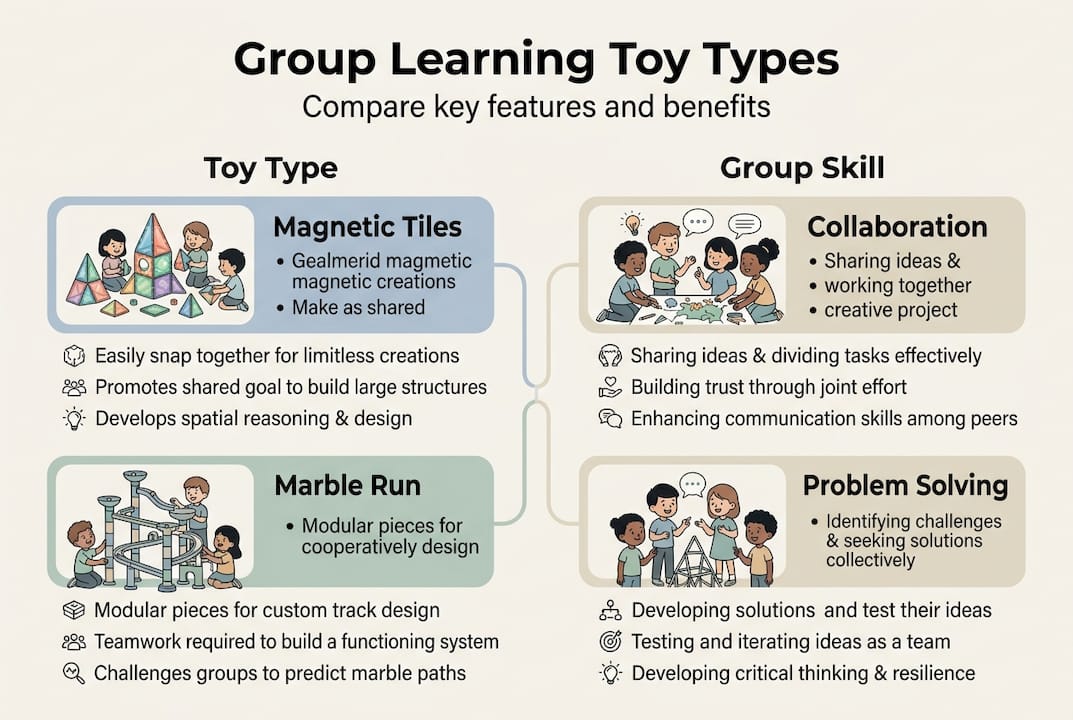
Here’s a quick comparison of popular toy types for group play:
| Toy type | Collaboration style | Best age range | Competitive risk |
|---|---|---|---|
| Magnetic tiles | Build together | 3 to 10 | Very low |
| Life-size foam blocks | Physical, spatial | 4 to 8 | Low |
| Cooperative board games | Turn-based strategy | 6 to 12 | Medium |
| Construction kits | Role-divided building | 6 to 12 | Very low |
| Marble runs | Sequential teamwork | 5 to 12 | Very low |
A tensegrity marble run is a great example of a toy that naturally divides tasks. One child feeds the marble, another adjusts the track, and a third watches for errors. Every role feels important.
For older groups, a building blocks STEM set adds engineering complexity without requiring adult-level reading skills.
Pro Tip: For children under 6, avoid any toy with a winner-loser outcome. The emotional sting of losing at that age often shuts down the learning entirely.
What you need: Toy selection checklist and age-appropriate options
Once you understand what makes a toy ideal for group play, the next step is finding one that fits your group’s specific needs.
Before purchasing, run through this checklist:
- Group size: Does the toy support 2 kids or 10? Check the recommended player count.
- Skill level: Is the assembly complexity right for the youngest child in the group?
- Supervision: Will an adult need to stay close, or can kids self-direct?
- Durability: Will it survive repeated group sessions without breaking?
- Cleanup: Can kids pack it up in under 10 minutes?
- Expandability: Can you add pieces later as the group grows or skills improve?
Magna-Tiles are recommended for collaborative building, compatible with sets ranging from 32 to 100 or more pieces, and widely used in classrooms. Their interchangeable design means you can combine sets from different families without compatibility issues.
Snap Circuits Jr. is a durable electronics kit for ages 8 and up, fostering group exploration through hands-on circuit building. Kids take turns snapping components together and testing results, which naturally encourages patience and shared problem-solving.
For a tactile, visually rewarding option, a marble run construction set gives groups a shared goal: build a track that actually works. The trial-and-error process is where the real learning happens.
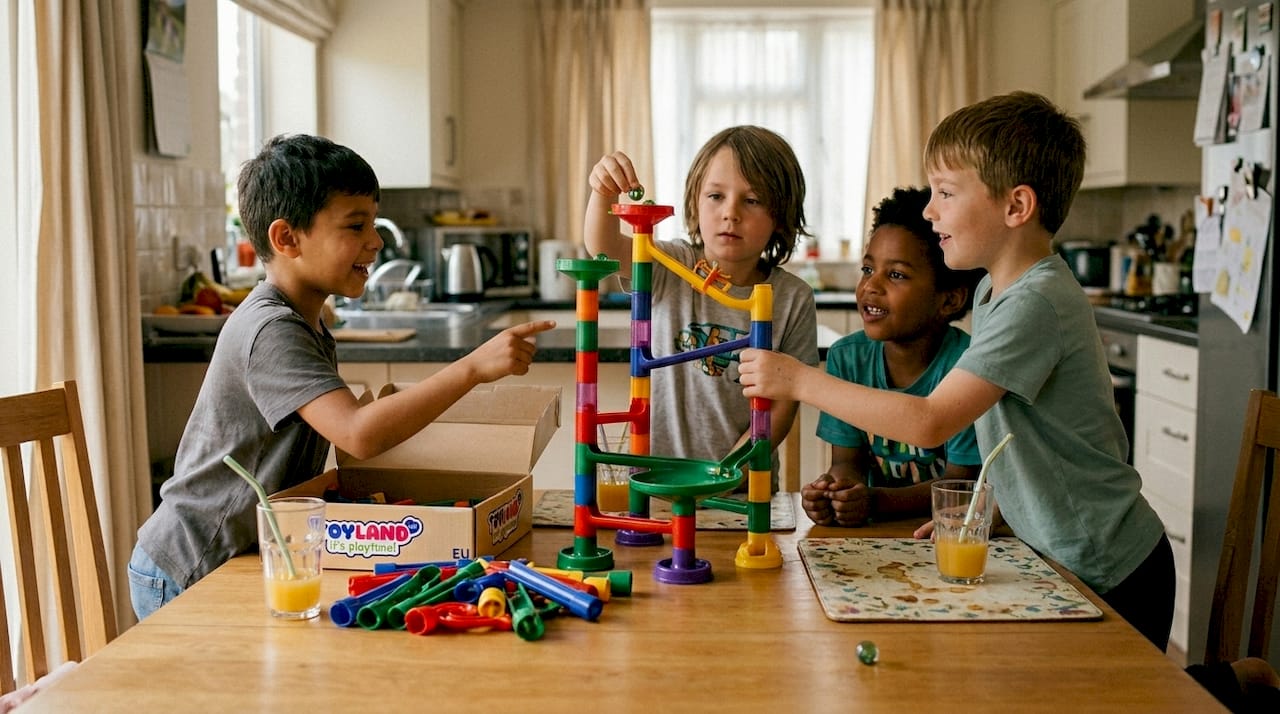
If you want to see how interactive marble runs perform in real-world group settings, independent reviews confirm they hold up well across age ranges.
| Toy type | Recommended age | Group size | Key skills | Setting |
|---|---|---|---|---|
| Magna-Tiles | 3 to 10 | 2 to 6 | Spatial reasoning, cooperation | Indoor |
| Snap Circuits Jr. | 8 to 12 | 2 to 4 | Electronics, logic | Indoor |
| Marble run kit | 5 to 12 | 2 to 6 | Engineering, sequencing | Indoor |
| Foam building blocks | 4 to 8 | 4 to 10 | Physical coordination | Indoor/outdoor |
Pro Tip: For ages 4 to 6, choose toys with simple snap or stack assembly and no reading required. If a child needs to read instructions to participate, they’re already excluded.
Step-by-step: Setting up and facilitating effective group play
With the right toy selected, here’s how to ensure group learning unfolds smoothly.
Start by choosing a flat, clear play area with enough room for every child to reach the toy without bumping into each other. Organize children into groups based on the toy’s complexity. Simpler kits work for larger groups; detailed engineering toys work better in pairs or trios.
- Unpack and set up the toy before children arrive so the session starts with momentum, not confusion.
- Introduce rules and roles clearly. Explain what each role does: builder, designer, tester, reporter.
- Demo basic play yourself first. Show one simple move or connection so kids understand the starting point.
- Oversee turns during the first round without jumping in too quickly. Let kids work through small frustrations.
- Encourage teamwork by asking questions like “What would happen if you moved that piece?” rather than giving answers.
- Wrap up with reflection. Ask each child to name one thing the group built or figured out together.
Group engineering toys like Magformers Sky Track encourage collaborative development through design, building, and testing together, which mirrors real engineering workflows in a way kids naturally absorb.
A marble run building kit works especially well for steps 3 and 4 because the marble’s path gives instant, visible feedback. Kids see immediately whether their design works.
Safety note: Always check moving parts and weighted pieces before a session. Marble runs and construction kits with small components need a quick sweep for loose or cracked pieces, especially after previous group use.
Pro Tip: Assign rotating roles across sessions. If a child is always the builder, they miss the learning that comes from observing and reporting. Rotate every 15 to 20 minutes.
How to troubleshoot common group play challenges
Even with the best setup, groups sometimes hit snags. Here’s how to keep playtime on track.
Common problems and quick fixes:
- One child dominates: Pre-assign roles before play starts. If dominance continues, physically separate pieces so each child controls their own section.
- Boredom sets in: Introduce a new challenge mid-session, like “Can you make the marble go slower?” or “Build the tallest structure that still stands.”
- Conflict over pieces: Use a visible timer. Each child holds a piece for 60 seconds, then passes. This removes the argument entirely.
- Toy breakage: Keep a small repair kit nearby, extra connectors, tape, or replacement marbles. A broken toy mid-session kills momentum fast.
- Group frustration: Break the group into pairs temporarily. Smaller units solve problems faster and rebuild confidence before rejoining.
Snap Circuits Jr. has been tested as durable in group settings and is ideal for electronics exploration with multiple children. Its snap-together components are designed to survive repeated assembly and disassembly without losing function, which matters enormously in classroom or playgroup environments.
A creative marble run adds a sensory twist that can reset a frustrated group quickly. The novelty of water or light elements refocuses attention without requiring adult intervention.
The most underrated fix is simply reducing group size. Sometimes four kids sharing one kit is two kids too many. Split the group and watch the dynamic shift immediately.
How to verify success: Signs of effective group learning
After the session, it’s key to check whether the group learning toy met your goals.
Here’s what to look for:
- Shared laughter during problem-solving, not just at the end result
- On-task cooperation where children reference each other’s ideas, not just their own
- Evolving group strategies where the group tries a new approach after one fails
- Creative problem-solving that wasn’t prompted by an adult
- Minimal adult interference needed to keep the session moving
Research encourages focusing on communication, collaboration, and mutual problem-solving as the real signs of toy effectiveness, not just whether the final structure looks impressive.
| Observable behavior | Toy example | Group benefit |
|---|---|---|
| Kids explain their choices to each other | Marble run | Communication skills |
| Group revises a failed design | Snap Circuits Jr. | Resilience and logic |
| Younger child teaches older one a step | Magna-Tiles | Peer learning |
| Group celebrates a shared win | Any construction kit | Emotional bonding |
An interactive marble run blocks set is particularly useful here because the motorized element gives the group a clear, shared success moment when the marble completes the full track.
After the session, ask each child one question: “What did your group figure out today?” Their answers will tell you more than any observation checklist.
Our perspective: Why versatile STEM toys outperform ‘trend’ group games
Here’s an honest take that most buying guides skip entirely. Novelty group games fade fast. The branded box with a celebrity character on the front gets used twice, then sits on a shelf. A well-designed STEM construction kit, by contrast, grows with the children using it.
WIRED and DigiKidz prefer versatile STEM toys over branded options for group learning value, and we agree completely. The reason is simple: open-ended kits scale naturally. A 6-year-old builds a simple tower. A 10-year-old builds a suspension bridge with the same pieces. No new purchase required.
Too many group games are built around competition dressed up as cooperation. Someone still loses. Someone still feels excluded. A rainbow marble run set has no loser. The marble either makes it through or it doesn’t, and the group decides together how to fix it.
The real win is when every child feels included, successful, and eager for another creative group session. That’s the outcome worth spending money on.
We’d rather see a family invest in one quality open-ended STEM kit than five trend-driven games that collect dust. The learning compounds. The engagement lasts. And the toy earns its price tag over years, not weeks.
Shop group learning toys for creative kids
If you’re inspired to lead a group play session, ToylandEU has everything you need to get started. With over 30,000 toys and free worldwide shipping, finding the right kit for your group is straightforward.
For creative group sessions, the Montessori drawing kit gives every child a structured but open-ended art experience that works beautifully in small groups. The drawing scroll kit is another crowd favorite for collaborative art projects where kids contribute to one shared canvas. For tactile, hands-on creativity, the clay modeling kit brings color and imagination to any group setting. Browse the full selection at ToylandEU and find the kit your group will reach for again and again.
Frequently asked questions
Are expensive group learning toys really worth it?
Magna-Tiles and Snap Circuits are classroom-proven durable and adaptable across age groups, making their higher price worthwhile over years of repeated use rather than months.
What’s the best group toy for kids of mixed ages?
Open-ended kits like Magna-Tiles scale to support all ages, allowing younger children to build simple shapes while older kids tackle complex structures with the same pieces.
How many kids can use Snap Circuits Jr. at once?
Snap Circuits Jr. supports small group learning and role division best with 2 to 4 children per kit, keeping every child hands-on and engaged.
Do board games count as group learning toys?
Cooperative games build empathy without winner-loser outcomes in young kids, but open-ended construction toys offer more creative and lasting learning value across sessions.
Recommended
- Top early learning toys: expert-backed examples for smarter play – ToylandEU
- Why toys make great gifts: fun, learning, memories – ToylandEU
- Toy Rotation for Lasting Learning: Build Low-Screen STEM Play – ToylandEU
- Interactive dolls: foster imagination, empathy & learning – ToylandEU
- Guide to preschool learning at home for East London families