

Top educational toys for teenagers to boost STEAM skills
- Effective educational toys for teens are hands-on, with clear growth paths and real-world relevance.
- Robotics kits significantly boost motivation and interest in STEAM careers compared to passive tools.
- Matching a toy to a teen’s interests and ensuring consistent engagement is key to meaningful learning.
Picking the right educational toy for your teenager is genuinely hard. You want something that challenges them without frustrating them, keeps their attention beyond the first weekend, and builds skills that actually matter. With hundreds of kits on the market claiming to teach coding, robotics, and engineering, the choices blur fast. The good news: a focused framework, a handful of standout products, and a side-by-side comparison can cut through the noise. This guide covers everything you need to match the right STEAM toy to your teen’s interests, learning style, and long-term growth.
Table of Contents
- How to choose educational toys for teenagers
- Top recommended educational toys for teens
- A side-by-side comparison of the best STEAM toys
- Situational picks: Matching toys to your teen’s needs
- The missing link: Why engagement beats perfection in educational toys
- Find the right educational toy for your teen at ToylandEU
- Frequently asked questions
Key Takeaways
| Point | Details |
|---|---|
| Focus on engagement | Teens learn best with toys they genuinely enjoy and use consistently. |
| Choose modular kits | Expandable sets that progress in difficulty keep teens challenged and interested. |
| Balance motivates learning | Hands-on, real-world kits inspire greater interest in STEAM, especially when paired with digital tools. |
| Match to teen interests | Pick toys aligned with your teen’s passions for better long-term retention and skills. |
How to choose educational toys for teenagers
The single biggest mistake parents make is buying the most impressive-looking kit. A towering box full of parts means nothing if your teen loses interest after day two. What actually works is a toy built around hands-on engagement with a clear path for growth. When a teen can see a project go from idea to working model, they experience a feedback loop that keeps them coming back.
Here are the core criteria worth evaluating before you buy:
- Engagement level: Does the kit require active problem-solving, or is it mostly following instructions to assemble one static model?
- Modularity and expandability: Toys that grow with skills let teens revisit projects at a higher level rather than outgrowing the kit in weeks.
- Skill alignment: Look for kits targeting the specific area your teen gravitates toward: coding, mechanical design, electrical circuits, or creative technology blends.
- Cognitive load management: A kit that throws advanced programming at a beginner produces frustration, not learning. STEM education research consistently shows that scaffolded progression is more effective than high complexity from the start.
- Real-world application: Teens respond to toys that solve tangible problems. Hydraulics, robotics, and circuit kits all tie to careers they can visualize.
Modular kits with progression from visual block coding to text-based languages are especially strong because they mirror how professional developers actually learn. Kits with modularity and cognitive monitoring are consistently rated best for this age group. Look at the newer educational toy technologies entering the market, as many now include adaptive challenge levels built into their apps.
Pro Tip: Before purchasing, write down your teen’s top interest area: robotics, circuits, mechanics, or art-tech blends. Then filter every kit against that single criterion first. One strong match beats three mediocre fits.
Top recommended educational toys for teens
Now that you know how to evaluate toys, let’s look at the leading options and what makes them stand out.
These five kits consistently rank at the top for teens in the 12 to 16 age range, each targeting a different strength within STEAM:
- Engino 60-in-1 Motorized Maker Master: 223 parts, 60 buildable models, and a motorized component that brings mechanical engineering to life. Great for teens who love understanding how things move.
- Snap Circuits 100 Explorer Kit: Real electrical components, 100+ circuit projects, and a snap-together design that removes soldering risk while keeping the science authentic. Ideal for electronics-curious teens.
- Lego Spike Prime: Combines physical building with Scratch-based coding. Teens can prototype a robot and program its behavior in one session, building both spatial and computational thinking.
- Makeblock mBot2: Starts with block coding and scales to Python, making it genuinely competition-ready. The mBot2 review highlights its strong sensor suite and active community of challenge builders.
- Teach Tech Hydrobot: Six-axis arm powered by hydraulic fluid, entirely manual. No screen required, which makes it a standout choice for teens who learn better through direct physical feedback.
One statistic worth remembering: robotics kits generate 1.4 to 2.1 times higher STEAM career interest in teens compared to passive learning tools. That kind of motivation shift matters when you’re investing in a gift that needs to last. Explore more STEAM toy picks or go deeper on coding robots for teens if robotics is the primary interest.
These best STEAM kits each shine in a different category, which is why matching to your teen’s interest matters more than chasing the highest price point.
Pro Tip: Use each manufacturer’s challenge guide or companion app after the first build. Most kits have 3 to 5 difficulty tiers that dramatically extend the toy’s useful life.
A side-by-side comparison of the best STEAM toys
To make your choice easier, here’s a head-to-head look at the top educational toys for teens.
| Product | Projects | Coding language | Expandable | Skill focus |
|---|---|---|---|---|
| Engino 60-in-1 | 60 | None (mechanical) | Yes | Mechanics, engineering |
| Snap Circuits 100 | 100+ | None (analog) | Limited | Electronics, circuits |
| Lego Spike Prime | Unlimited | Scratch/Python | Yes | Robotics, coding |
| Makeblock mBot2 | Unlimited | Block to Python | Yes | Coding, robotics |
| Teach Tech Hydrobot | 1 complex | None (manual) | No | Hydraulics, mechanics |
Here’s a quick guide to who should pick what:
- Snap Circuits suits teens fascinated by electricity and how devices work at a component level.
- Engino 60-in-1 fits teens who prefer physical construction and mechanical reasoning over screens.
- Lego Spike Prime works best for teens already familiar with Lego who want to add programming.
- Makeblock mBot2 is the right call for teens serious about coding who want a clear skill path toward Python.
- Teach Tech Hydrobot is perfect for hands-on learners who need a break from digital interfaces entirely.
“A meta-analysis of STEM education interventions shows a moderate effect size of d=0.46, with robotics kits producing some of the most consistent gains in both motivation and achievement across age groups.”
Experts consistently emphasize one thing: prioritize kits that encourage experiments over those that reward pure assembly. A teen who modifies a design, tests it, and troubleshoots failure is learning engineering thinking. One who only follows steps is doing crafts. For families focused on sustainability, browse eco-friendly robotics options that pair strong learning outcomes with responsible materials.
Situational picks: Matching toys to your teen’s needs
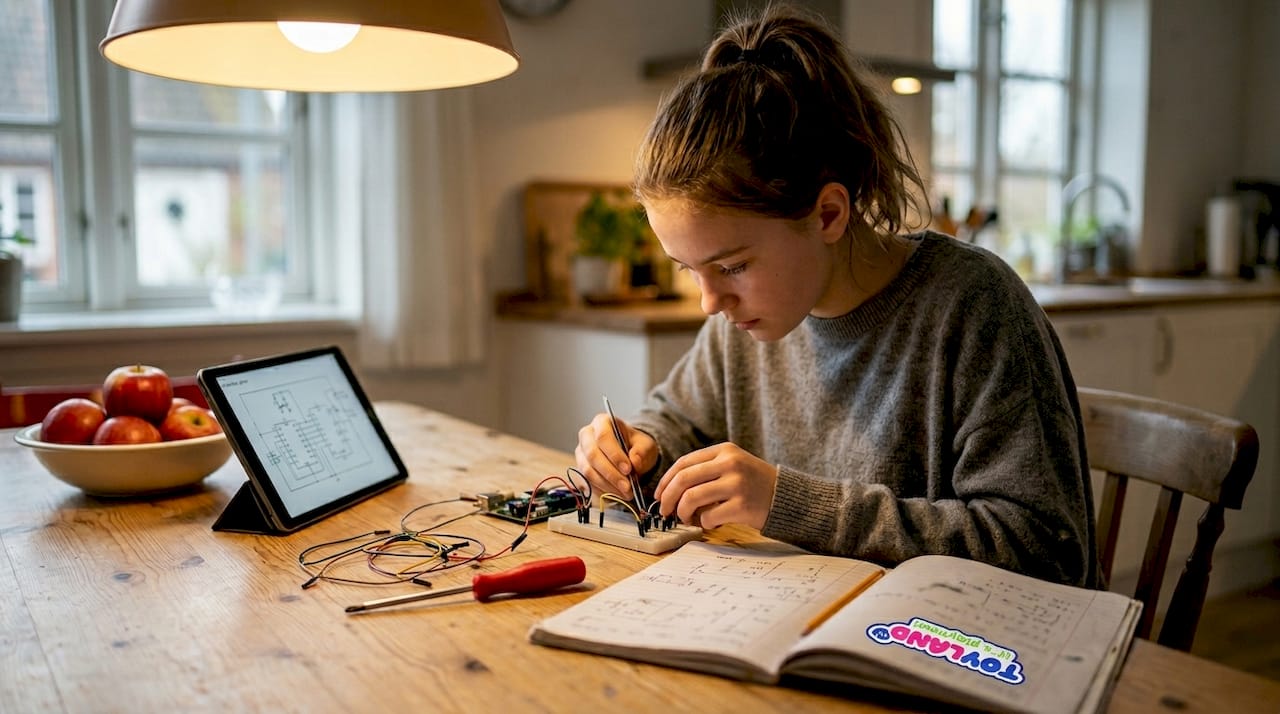
Even the best toy is only effective if it matches your teen’s interests and learning style.
Here’s how to choose based on specific situations:
- The creative teen who loves art and science blends: Look for kits that combine design with function, such as LED art sets or architecture modeling kits. These bridge aesthetic thinking with technical execution.
- The coder who wants hardware to go with the software: Makeblock mBot2 or Lego Spike Prime give them a physical object that responds to their code, which is far more motivating than purely screen-based exercises.
- The hands-on teen who dislikes screens: Engino and Teach Tech Hydrobot both offer deep engagement with zero required screen time. Low-screen learning tools are underrated for this profile.
- The teen with learning challenges: Hands-on kits often boost participation and motivation for teens with attention or processing differences. Choose adaptable kits with clear visual instructions and multiple difficulty levels.
- The social teen who learns better with others: Some kits, including Lego Spike Prime and Makeblock mBot2, are built for team challenges. Pairing your teen with group learning toys can dramatically increase both enjoyment and skill retention.
One important point: research published in the Journal of Computer Assisted Learning confirms no strong gender differences in how teens benefit from robotics and STEAM kits. Choose based on your teen’s specific motivation and skill level, not assumptions about what “type” of kid they are. The Wirecutter picks reinforce this, showing strong outcomes across a wide range of learner profiles.
Pro Tip: Set up a mini-challenge around the kit, such as “build something that can carry a small object across the table” rather than just unboxing it. Peer and sibling collaboration during this kind of challenge doubles sustained interest within the first month.
The missing link: Why engagement beats perfection in educational toys
Here’s something most buying guides skip entirely: the single strongest predictor of a STEAM toy’s impact is not its feature list. It’s how consistently your teen uses it over time.
We’ve seen families invest in the most advanced robotics kit on the market, only to watch it sit in a corner by week three. Meanwhile, a simpler circuit kit that matched their teen’s genuine curiosity got used every Saturday for a year. That consistent use produced far deeper learning than any spec sheet could promise.
A FIRST longitudinal study found that sustained motivation and real-world engagement matter more than initial technical complexity. Teens who stayed active in hands-on STEAM programs showed lasting gains in confidence, academic performance, and career direction.
The practical takeaway: buy the toy your teen will actually return to, not the one that looks most impressive. Match the learning curve to where they are today, not where you’d like them to be. Build in challenges and social moments to refresh their interest. Browse inspiring educational toys for additional ideas that prioritize genuine engagement over novelty.
Perfection in a toy means nothing if it collects dust. Consistency is the real skill-builder.
Find the right educational toy for your teen at ToylandEU
Ready to take the next step? Explore featured options that empower self-driven, hands-on learning.
At ToylandEU, we’ve curated a selection of top-rated STEAM kits built specifically for teenagers who are ready to learn by doing. Whether your teen is drawn to coding, robotics, or creative technology, the right kit is already waiting.
Check out the STEM robotics car kit for teens ready to move from block coding to Python with a real working robot. For the creative learner, the LED Art Desk Set blends artistic expression with hands-on science in one beautiful package. Browse the full range of ToylandEU educational toys with free worldwide shipping, competitive pricing, and over 30,000 products ready to ship to your door.
Frequently asked questions
What types of skills do educational toys for teenagers develop?
These toys build problem-solving, coding, design, critical thinking, and technical skills depending on the kit’s focus area. STEAM toys develop a wide range of practical and cognitive abilities suited for real-world application.
Are robotics kits better than screen-based coding toys for teens?
Robotics kits generally boost motivation and performance, but they can also increase cognitive load for beginners. A balance of robotics and screen-based coding tends to produce the best long-term outcomes.
How can I tell if a toy is suitable for my teen’s specific interests?
Focus on the kit’s skill category, mechanics, electronics, coding, or creativity, and confirm it offers clear progression and expansion options. Modular and expandable kits fit a much wider range of teen interests over time.
Do educational toys work for teenagers with learning challenges?
Hands-on kits frequently increase motivation and participation for teens with learning differences, making them a strong choice when paired with adaptable challenge levels. The motivational impact is especially pronounced for reluctant and diverse learners.