

Abacus Benefits for Kids: What the Research Shows
Abacus training reliably speeds mental math and can strengthen visuospatial working memory and attention when practiced consistently — but the size of those gains depends on the child’s age, how many hours per week they practice, and whether training progresses from physical beads to full mental calculation. Here is what peer-reviewed research actually confirms, plus a practical plan parents and teachers can use today.
The core abacus benefits, backed by evidence:
- Mental calculation speed and accuracy — trained children solve arithmetic problems faster and with fewer errors
- Visuospatial working memory — the ability to hold and manipulate spatial images in mind, strengthened by mentally “moving beads”
- Concentration and sustained attention — measurable in trials as short as 8 weeks
- Number sense and numerical magnitude processing — stronger automatic links between symbols and their quantities
- Confidence and classroom engagement — children who master a visible skill tend to participate more
- Fine motor coordination — physical bead manipulation builds precise finger control
Studies supporting these claims range from randomized controlled trials to neuroimaging and long-term cohort work, so the evidence base is broader than most parents realize. That said, no study shows abacus training raises general IQ, and short or low-intensity programs often fall short of producing lasting gains.
Key Takeaways
Abacus training produces real, specific cognitive gains in children — strongest on mental math, visuospatial working memory, and concentration — when practiced at sufficient intensity over time.
| Point | Details |
|---|---|
| Benefits are real but specific | AMC improves arithmetic, VSWM, and concentration; it does not raise general IQ. |
| Age 7–10 is the optimal window | Start physical abacus at 5–7; introduce AMC training between ages 7 and 12 for best results. |
| Dose determines outcomes | Two hours per week over at least one school year is the minimum for meaningful arithmetic gains. |
| Short programs still help | An 8-week program can produce measurable attention and auditory memory improvements. |
| Toylandeu™ starter kits | The Creative Learning Set and Montessori Drawing Kit support the physical and fine motor foundations AMC requires. |
Table of Contents
- Quick Summary
- TL;DR
- What an abacus is and how mental calculation (AMC) works
- The specific cognitive and educational benefits your child can develop
- What the research actually shows — and where it falls short
- What age to start and how long before you see results
- A practical starter plan for home and classroom
- How to choose abacus tools, apps, and classes
- Common misconceptions and how abacus compares to other methods
- An educator’s honest take on abacus learning
- Toylandeu™ has the starter kits to put this plan into action
- Sources
- FAQ
Quick Summary
Abacus training builds mental math speed, visuospatial working memory, and concentration in children ages 5–12. Benefits are strongest when practice runs at least 2 hours per week over multiple months. The mental abacus technique (AMC) drives the deepest cognitive gains. Short programs can improve attention quickly; arithmetic mastery takes longer.
TL;DR
- Start physical abacus around age 5–7; introduce AMC at 7–12
- Practice 2+ hours per week for meaningful gains
- Strongest benefits: mental math, working memory, focus
- No evidence it raises general IQ
- Soroban (Japanese) suits most U.S. curricula; Suanpan (Chinese) has more beads
Table of Contents
- What an abacus is and how mental calculation works
- The specific cognitive and educational benefits
- What the research shows — and where it falls short
- Best age to start and realistic timelines
- A practical starter plan for home and classroom
- How to choose tools, apps, and classes
- Common misconceptions and comparisons
- Editorial perspective
- Toylandeu™ starter kits
- Key Takeaways
- Useful sources
- FAQ
What an abacus is and how mental calculation (AMC) works
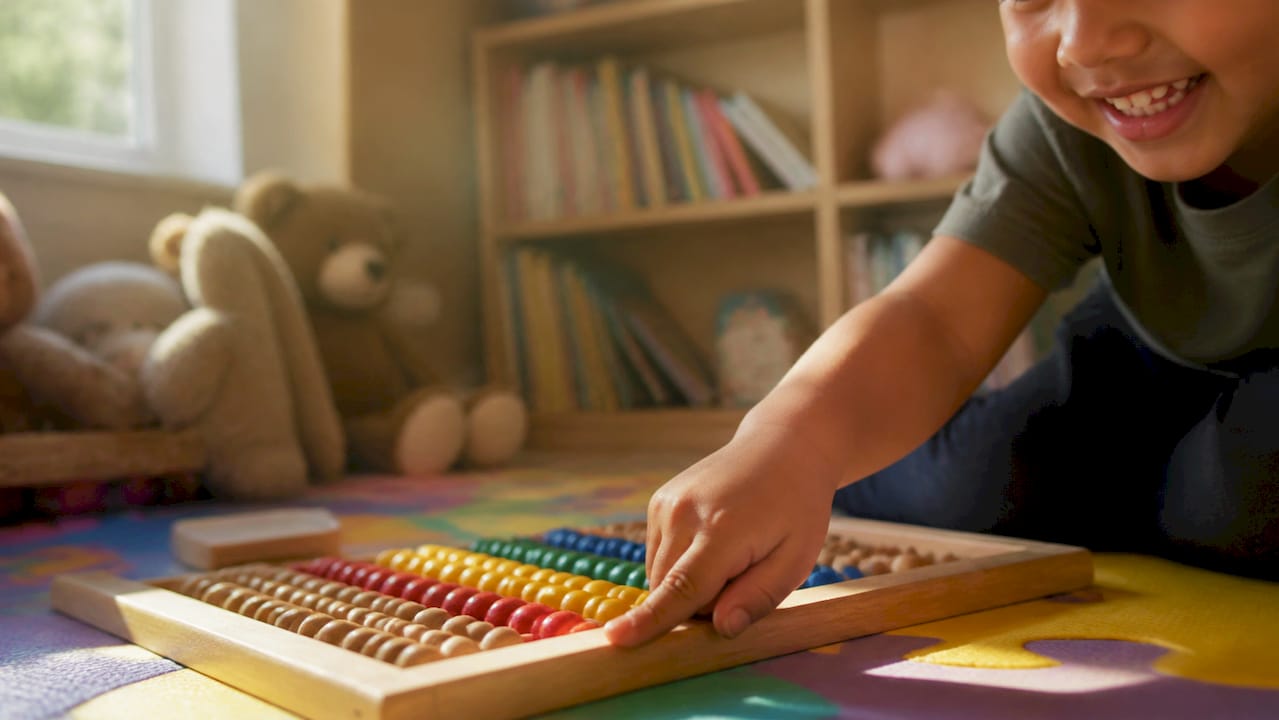
A physical abacus is a frame of rods holding movable beads, used to represent numbers and perform arithmetic by sliding beads into specific positions. Two types dominate modern abacus education. The Soroban (Japanese abacus) has one bead above the dividing bar and four below on each rod, representing values in base-10. The Suanpan (Chinese abacus) uses two beads above and five below, which allows for hexadecimal calculations but adds complexity for beginners. Most U.S. abacus programs use the Soroban because it maps cleanly onto the decimal system American children learn in school.
The more powerful concept is abacus-based mental calculation, or AMC. Once a child can fluently manipulate a physical Soroban, training shifts to finger movements in the air, then to purely mental manipulation of an imagined abacus. The child visualizes the bead frame, “moves” beads mentally, and reads off the answer. This is not a memory trick; it is a genuine visuospatial computation that engages frontal–parietal and occipital–temporal brain regions in ways standard arithmetic does not. Curricula like UCMAS (Universal Concept of Mental Arithmetic System) are built around this physical-to-mental progression, using timed drills and increasing digit complexity to build AMC capacity.
The specific cognitive and educational benefits your child can develop
The advantages of using an abacus go well beyond faster addition. Here is what research and classroom observation show, benefit by benefit.
- Mental calculation speed and accuracy. Children trained in AMC consistently outperform peers on timed arithmetic. The mechanism is efficiency: the brain processes bead positions in parallel rather than sequentially, so multi-digit problems resolve faster.
- Numerical magnitude processing / number sense. An EEG/ERP study found trained participants showed earlier congruence effects — a neural marker of stronger automatic links between number symbols and their actual quantities. That translates to better intuition about whether an answer is reasonable.
- Visuospatial working memory (VSWM). Holding an imagined abacus in mind while moving beads is a direct VSWM workout. A five-year controlled study found children who trained 2 hours per week outperformed controls on VSWM tasks, with corresponding changes in brain activation patterns.
- Attention and concentration. An 8-week RCT with 65 primary-school children found significant improvements in concentration scores versus controls. Teachers often notice this first: abacus students tend to stay on task longer during math lessons.
- Immediate auditory memory. The same RCT measured auditory memory and found gains, likely because AMC requires children to hold spoken number sequences while simultaneously manipulating a mental image.
- Problem-solving and creativity. The RCT also reported improved creativity scores, possibly because AMC trains flexible mental manipulation rather than rote recall.
- Fine motor coordination. Physical bead work requires precise, controlled finger movements. For younger children, this is a genuine developmental benefit that carries over to writing and other fine motor tasks. Hands-on manipulatives like abacuses support attention and manual dexterity in ways screen-based tools typically do not.
- Confidence and classroom engagement. Mastering a visible, concrete skill gives children a tangible sense of progress. That confidence tends to generalize: children who feel competent at math participate more and resist giving up when problems get harder.
Observable signs for parents: your child starts doing multi-step mental addition without counting on fingers; they self-correct arithmetic errors faster; they stay focused on homework for longer stretches without prompting.
Classroom activity example: ask students to solve a 3-digit addition problem mentally, then describe the bead positions they “saw.” This verbal report doubles as a comprehension check and reinforces the visuospatial habit.
Pro Tip: If a child struggles to transition from physical to mental abacus, have them close their eyes and trace the bead frame on a flat surface with one finger before attempting air movements. The tactile memory bridges the gap.
What the research actually shows — and where it falls short
The evidence for abacus benefits is real but uneven. Here is an honest summary.
Key studies at a glance:
| Study type | Key finding | Limitation |
|---|---|---|
| RCT, n=65, ages 7–11, 8 weeks | Significant gains in concentration, auditory memory, perceptual attitudes, creativity vs. controls | Small sample; single school setting |
| Long-term cohort, 5 school years, 2 h/week | Better arithmetic and VSWM vs. controls; altered frontal–parietal–occipital activation; no change on Raven’s IQ | Observational design for behavioral arm; fMRI subset |
| EEG/ERP, trained vs. untrained adults | Earlier congruence effects; greater numerical-processing efficiency | Adult sample; cannot directly generalize to children |
| Classroom-randomized trial, grades 1–2, 1 year | First-graders largely failed to master AMC; second-graders showed modest gains only | Low intensity; highlights age and dose dependence |
The pattern across these studies is consistent: near-transfer benefits (tasks that share cognitive processes with AMC, like working memory and arithmetic) show up reliably. Far-transfer benefits (general IQ, broad academic achievement) do not. A systematic review of behavioral and neuroimaging studies put it plainly: AMC training has the potential to enhance mathematics, working memory, and numerical magnitude processing, but researchers urge caution about overgeneralizing to broad cognitive claims.
A one-year U.S. classroom-randomized trial is the most important caution for American educators: first-graders often failed to master mental abacus within a year, and second-graders showed only modest benefits. Short or low-intensity programs may not produce the broad cognitive gains that program marketing sometimes promises.
What this means practically: expect concentration and attention improvements within weeks of consistent practice. Expect meaningful arithmetic gains after several months. Expect VSWM and number-sense gains after a year or more of 2-hours-per-week training. Do not expect a general IQ boost.
A broader systematic review synthesizing roughly 29 studies across age groups confirms AMC is a feasible school-based intervention with near-transfer gains across children and even older adults, though methodological quality and sample sizes vary considerably across the literature.
What age to start and how long before you see results
Age and training dose are the two variables that matter most. Getting them wrong is the main reason parents feel disappointed after a short program.
- Ages 4–6: Physical abacus familiarization is appropriate. Focus on bead counting, one-to-one correspondence, and basic addition. Do not push AMC yet; the visuospatial working memory needed for mental manipulation is still developing.
- Ages 7–10: The optimal window for beginning structured AMC training. Children in this range have sufficient VSWM capacity to hold a mental bead image and the fine motor control to practice physical manipulation fluently. Research on individual differences suggests children with stronger baseline VSWM tend to show larger gains.
- Ages 10–12: Still a productive entry point, especially for children who already have solid arithmetic foundations. Progress to AMC proficiency may be faster because they bring more prior number knowledge.
- Teens and adults: AMC is learnable but harder to automate. Most research on large gains focuses on the 7–12 window.
Practice frequency guidance:
- Minimum effective dose: 2 hours per week, sustained over at least one school year
- Short programs (8 weeks at 2–3 sessions per week) can produce measurable attention and memory gains
- AMC mastery and durable arithmetic advantages typically require multiple years at 2 hours per week
- Daily short sessions (15–20 minutes) tend to outperform one long weekly session for skill retention
Timeline expectations:
- Weeks 1–8: Improved concentration and auditory memory are the first observable gains
- Months 3–6: Faster mental arithmetic on problems within the trained digit range
- Year 1+: Stronger VSWM and number sense; AMC begins to feel automatic
- Years 2–5: The full profile of benefits seen in long-term cohort studies
A practical starter plan for home and classroom
This plan works for a parent running 15-minute daily sessions or a teacher fitting 3 sessions per week into a math block.
Step-by-step progression:
- Introduce the physical abacus (weeks 1–2). Show the child how each rod represents a place value. Practice setting any number from 1–99 by moving beads. No arithmetic yet — just fluent number representation.
- Single-digit addition and subtraction (weeks 3–4). Work only with the ones rod. Drill until the child can complete 20 problems in under 3 minutes without hesitation.
- Two-digit problems with carrying (weeks 5–8). Introduce the tens rod. Teach the complementary bead rules (e.g., adding 6 when only 4 beads are free). Use timed retrieval: 30 problems, record the time, beat it next session.
- Air-finger practice (weeks 9–12). Remove the physical abacus. Have the child mimic bead movements in the air while solving problems. Start with single-digit problems; return to the physical abacus whenever accuracy drops below 80%.
- Mental visualization (month 4 onward). Ask the child to solve problems with hands still, eyes closed. Gradually increase digit count as accuracy stabilizes. Progress only when the child can reliably translate between bead positions and Arabic numerals.
- Timed mixed drills. Once AMC is established, use timed sheets mixing addition, subtraction, and eventually multiplication. Track weekly personal bests to maintain motivation.
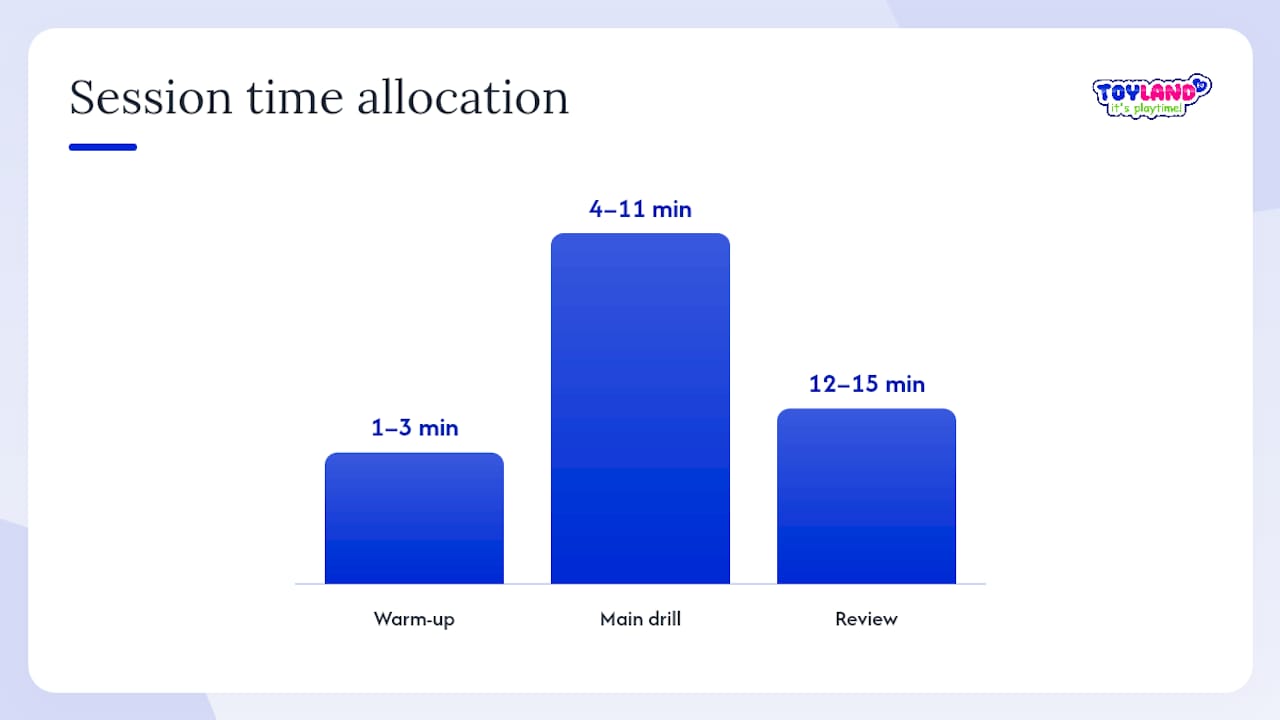
Sample 8-week session structure (15 minutes each):
- Minutes 1–3: Warm-up (set 10 numbers on the abacus as fast as possible)
- Minutes 4–11: Main drill (current skill level, timed)
- Minutes 12–15: Review errors and one new concept introduction
For motivation ideas, short animated prompts or digital surprise content can re-engage children who hit a frustrating plateau, particularly around the transition to air-finger practice.
Pro Tip: The most common early frustration is rushing the transition to mental abacus. If a child’s accuracy drops sharply when you remove the physical tool, go back one step for a full week rather than pushing forward. Speed comes after accuracy, never before.
How to choose abacus tools, apps, and classes
Not all abacuses, apps, or programs are equal. Here is what to look for and what to avoid.
Selection criteria:
- Size and bead spacing: For children ages 5–8, choose a Soroban with beads at least 1 cm apart and a frame no wider than 30 cm. Cramped beads cause frustration and slow physical fluency.
- Material: Wooden frames with smooth-sliding beads are preferable to plastic. Beads that stick or rattle break concentration.
- Soroban vs. Suanpan: For U.S. school curricula aligned to base-10, the Soroban is the right choice. The Suanpan’s extra beads add confusion without benefit for standard arithmetic.
- Program credentials: Look for instructors trained in a structured AMC curriculum (UCMAS is the most widely recognized in the U.S.). Ask whether the program has a written progression from physical to mental abacus and whether it tracks student accuracy over time.
- Evidence-backed claims: A good program will describe near-transfer benefits (arithmetic, working memory) and give realistic timelines. Walk away from any program claiming to raise IQ or guarantee grade-level jumps in 4 weeks.
- Apps: Apps can supplement physical practice but should not replace it, especially in the early stages. Look for apps that follow a scaffolded progression (single-digit before multi-digit, physical before mental) rather than gamified flashcard formats with no structured skill build.
Red flags:
- No stated practice frequency or minimum session length
- Claims of “whole-brain development” or IQ improvement without citing studies
- Apps that reward speed alone without tracking accuracy or progression
- Programs that skip physical abacus and jump straight to mental calculation for beginners
What to ask a program instructor: “How do you decide when a student is ready to move from physical to mental abacus?” A good answer involves accuracy thresholds, not just time elapsed. Also ask whether the curriculum aligns with cognitive development research on physical manipulatives and whether there is a parent guide for home practice.
Common misconceptions and how abacus compares to other methods
Myth 1: “Abacus training makes kids smarter overall”
This is the most persistent overclaim. The benefits are real and meaningful; they are just specific, not general.
Myth 2: “Calculators make abacus training obsolete”
These tools serve different goals. A calculator computes; abacus training builds the mental architecture that makes a child a better estimator, error-spotter, and mathematical thinker. The abacus vs. calculator question is a false choice: calculators handle computation, abacus training builds number sense and working memory. Children who understand what a reasonable answer looks like catch calculator errors; children who only know how to press buttons do not.
Myth 3: “Any abacus program produces the same results”
Dose and structure matter enormously. A one-year U.S. classroom trial found first-graders largely failed to master AMC, while longer, more intensive programs produced the gains seen in cohort studies.
How abacus compares to other approaches:
| Method | Primary benefit | Evidence level | Best age | Time required | Format |
|---|---|---|---|---|---|
| Abacus / AMC | Mental math speed, VSWM, number sense | RCTs + neuroimaging | 7–12 | 2 h/week, 1–5 years | Physical tool, then mental |
| Calculator drills | Procedural fluency, speed on standard operations | Observational | 10+ | Low | Device-based |
| Kumon-style drill | Arithmetic fluency, procedural accuracy | Observational | 6–12 | Daily, years | Worksheet-based |
| Math apps (general) | Engagement, basic fact recall | Mixed, often weak | 5–10 | Variable | Screen-based |
Abacus and Kumon-style drill are not competitors; they are complementary. Kumon builds procedural accuracy through repetition; AMC builds the visuospatial mental model that makes mental calculation feel natural. Many families run both. The key difference is that abacus training produces documented VSWM gains that worksheet drill does not.
An educator’s honest take on abacus learning
The abacus has a marketing problem. Programs sometimes oversell it as a cognitive cure-all, which sets parents up for disappointment when a 10-week class does not transform their child’s report card. The research tells a more useful story: abacus training is one of the few elementary-school interventions with neuroimaging evidence behind it, and its benefits on working memory and arithmetic are among the most replicated findings in math-education research. That is worth something.
What gets underestimated is the role of the physical tool itself. Parents often want to skip straight to an app or a mental drill, but the physical Soroban is not a stepping stone you discard. It is the foundation. The tactile feedback of sliding beads is what builds the mental image children later manipulate in their heads. Rushing past it is the single most common mistake in home abacus programs. Cognitive development research consistently shows that physical manipulatives build conceptual understanding in ways that screen-based tools replicate poorly, especially before age 10.
The other underrated point: abacus training works best as a complement to standard math instruction, not a replacement. Children who use AMC alongside their regular curriculum tend to develop stronger number intuition. That intuition shows up not on abacus tests but on word problems, estimation tasks, and the kind of flexible thinking standardized tests increasingly reward.
Toylandeu™ has the starter kits to put this plan into action
Getting the right physical abacus matters more than most parents expect, and the wrong one — beads that stick, a frame too wide for small hands, no teacher guide — can stall a child’s progress in the first two weeks.
Toylandeu™ carries educational kits designed for exactly the age ranges and practice goals described in this guide. The Creative Learning Set for kids ages 3–12 pairs math games with hands-on tools, making it a natural companion to early abacus sessions. For children who need fine motor warm-ups before bead work, the Montessori Drawing Kit builds the precise finger control that physical abacus practice demands. Browse the full educational range at Toylandeu™ and filter by age to find the right starting point for your child. Free worldwide shipping is included on every order.
Sources
The studies below form the evidence base for this article. RCTs provide the strongest causal evidence; neuroimaging studies explain the mechanism; observational and cohort studies show long-term effects.
- Development of Cognitive Abilities through the Abacus in Primary Education Students: A Randomized Controlled Clinical Trial
- Training on Abacus-Based Mental Calculation Enhances Visuospatial Working Memory in Children - PMC
- A One-Year Classroom-Randomized Trial of Mental Abacus Instruction for First- and Second-Grade Students
How to read study strength: RCTs with control groups provide the strongest evidence for causation. Neuroimaging studies explain why benefits occur but do not prove them in isolation. Observational and cohort studies show what happens over time but cannot fully rule out confounding factors. Use all three together for the clearest picture.
FAQ
What is the main advantage of abacus training for kids?
The strongest advantage is faster, more accurate mental arithmetic combined with improved visuospatial working memory. These are near-transfer benefits confirmed across multiple RCTs and long-term cohort studies.
What age is best to start abacus learning?
Ages 7–10 are the optimal window for beginning structured AMC training. Physical abacus familiarization can start at 5–7, but the visuospatial working memory needed for mental calculation develops most fully in the 7–10 range.
Does abacus training really help kids, or is it just hype?
The benefits are real but specific. Peer-reviewed studies confirm gains in mental math, working memory, and concentration. No study shows it raises general IQ, and short or low-intensity programs often produce limited results.
Is abacus better than Kumon for math development?
They target different skills and work well together. Kumon builds procedural accuracy through worksheet repetition; abacus AMC training builds the visuospatial mental model behind mental calculation and has documented working memory gains that worksheet drill does not produce. Many families use both.