

Why Playing on the Floor Is Good for Child Development
TL;DR:
- Floor play is an essential developmental tool that builds physical strength, cognitive skills, and emotional bonds through daily, unstructured ground activity. Active parental engagement during short sessions enhances emotional connection and promotes overall growth, making a clean, firm floor sufficient for optimal play.
Floor play is defined as any unstructured or guided activity where children engage directly on the ground, and it is one of the most powerful developmental tools available to parents. The CDC’s 2026 guidance specifically recommends daily floor play for infants to build muscle strength and explore cause-and-effect concepts by around 6 months. The Greenspan Floortime approach and NAEYC research both confirm that floor time benefits span physical, cognitive, and emotional growth. Understanding why playing on the floor is good gives you a concrete, cost-free way to support your child every single day.
Quick Summary
Floor play builds core strength, coordination, sensory awareness, and emotional bonds. The CDC, NAEYC, and the Greenspan Floortime method all support daily floor time as a foundation for healthy child development.
TL;DR
- Floor play develops core muscles and motor milestones naturally.
- Unstructured floor time builds problem-solving and cognitive flexibility.
- Adult engagement during floor play deepens emotional bonds and communication.
- Short, frequent sessions work better than long forced ones.
- A clean, firm floor is all you need.
Table of Contents
- How floor play builds physical strength and coordination
- Cognitive and sensory benefits of floor time
- Social and emotional development through floor play
- Practical tips for parents on maximizing floor time
- Key Takeaways
- Perspective
- Floor play toys from Toylandeu™
- FAQ
How floor play builds physical strength and coordination
Floor play is the most direct path to building a child’s core strength, balance, and body awareness. Occupational therapists confirm that floor positions like rolling, reaching, kneeling, and crawling build foundational motor skills without feeling like work. Children gain these benefits because they are engaged and having fun, not because they are following a structured exercise program. That “hidden work” is exactly what makes floor play so effective.
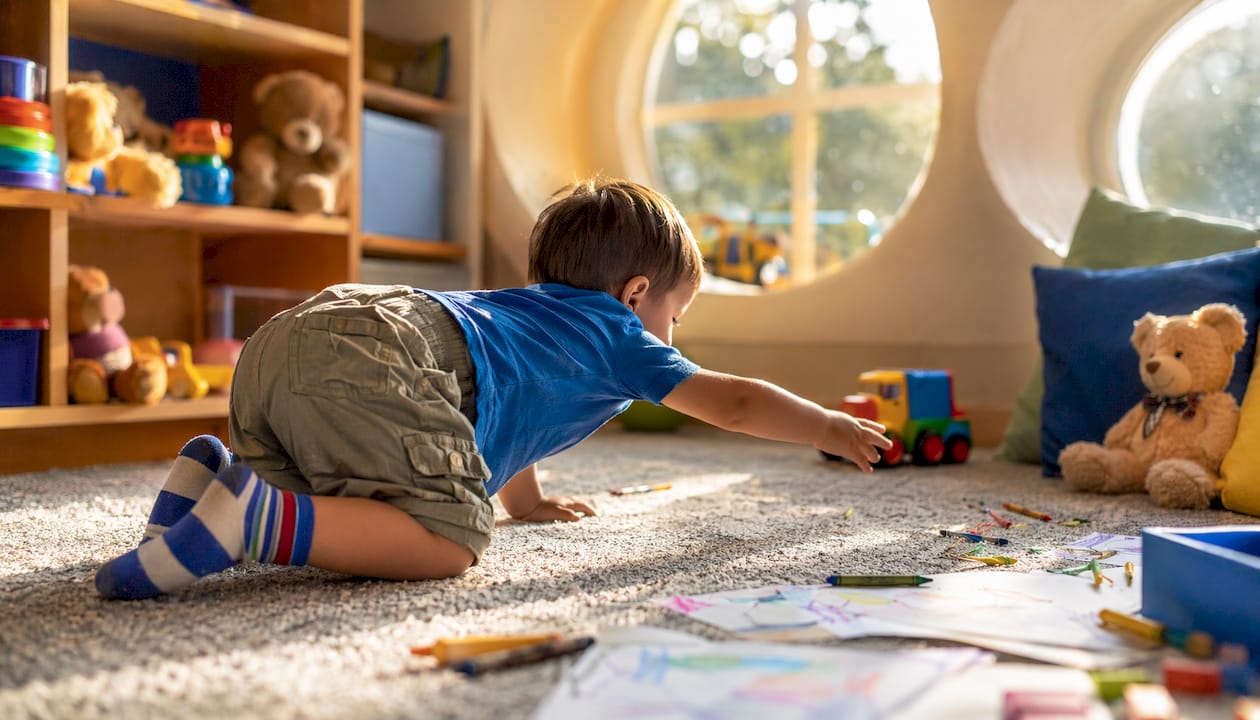
Each position a child moves through on the floor targets a different muscle group. Rolling activates the trunk. Reaching forward on the belly strengthens the shoulders and neck. Crawling coordinates the left and right sides of the brain. These motor milestones directly support later skills like handwriting, walking steadily, and sitting upright in a classroom chair.
The floor itself is the best developmental environment available. Restrictive baby equipment limits motor progress, while a clean, firm floor space costs nothing and delivers more. No special gear is required. A flat, safe surface gives children the resistance and stability they need to push, pull, and explore freely.
Key physical milestones supported by floor play:
- Rolling from back to belly and belly to back
- Pushing up onto hands and knees
- Reaching and grasping objects at different distances
- Sitting independently with core control
- Pulling to stand using nearby furniture
Pro Tip: Place a favorite toy just out of reach during floor time. That small challenge motivates reaching and rolling, which builds the exact muscles children need for crawling.
What are the cognitive and sensory benefits of floor time?
Unstructured floor exploration produces stronger cognitive flexibility and executive function than scripted early instruction. The NAEYC’s 2026 position affirms that play from birth through age 8 is essential for building critical learning skills. Children who spend time freely exploring on the floor learn to test ideas, notice cause and effect, and adapt when something does not work. These are the building blocks of problem-solving.
The floor also provides a unique sensory environment. Floor surfaces offer a stable base for movement exploration that supports sensory integration. Children receive tactile feedback from textures, temperature, and resistance that softer surfaces like couches or mattresses cannot provide. That grounding input helps children with sensory processing differences feel calm and focused.
The Greenspan Floortime approach adds an important layer to cognitive development. Rather than directing children toward educational toys, Floortime asks parents to follow the child’s lead and create back-and-forth interaction “circles.” Each completed circle, where a child initiates, a parent responds, and the child reacts again, builds communication pathways and emotional regulation alongside cognitive growth.
Cognitive skills strengthened by floor play:
- Cause-and-effect reasoning (push a toy, it moves)
- Spatial awareness (navigating around objects)
- Attention and focus during self-directed exploration
- Early language development through adult narration and response
- Sensory processing and tactile discrimination
How does floor play support social and emotional development?
Adult involvement during floor play is the single biggest factor in its emotional impact. Following the child’s lead and engaging in back-and-forth exchanges builds communication skills and self-regulation. When you get down on the floor and respond to what your child is doing, you send a clear message: what you do matters, and I am here with you. That message is foundational for secure attachment.
The Greenspan Floortime method recommends 2–3 playful floor sessions daily for typical children. Each session does not need to be long. What matters is the quality of the interaction, specifically the warmth, responsiveness, and playfulness you bring to the floor. Children who experience this kind of engagement develop stronger emotional intelligence and social competence over time.
Floor time also benefits parents. Lying on a firm floor activates a parasympathetic state that lowers stress hormones and promotes relaxation. Shared floor time creates a mutual calm that strengthens the parent-child bond beyond just play. It is one of the few daily activities that genuinely benefits both of you at the same time.
Steps to build emotional connection during floor play:
- Get fully on the floor at your child’s level. Avoid hovering from above.
- Watch before you act. Let your child choose the activity.
- Join what they are already doing rather than redirecting.
- Narrate their actions in simple language to build vocabulary.
- Close interaction circles by responding to every gesture or sound your child makes.
Pro Tip: Put your phone in another room during floor time. Even a face-down phone on the floor reduces the quality of your attention, and children notice the difference.
Practical tips for parents on maximizing floor time benefits
Short, frequent sessions produce better results than long forced ones. Multiple 1–2 minute sessions spread across wake windows support infant motor development more effectively than a single extended session. This is especially useful for parents with busy schedules. You do not need a dedicated “play hour.” You need consistent, positive exposure throughout the day.
The environment matters more than the equipment. A clean, firm floor with enough space to roll and reach is all you need. Remove clutter that could cause injury and place a few carefully chosen objects within reach. Avoid filling the space with too many toys, since fewer options encourage deeper exploration of each one.
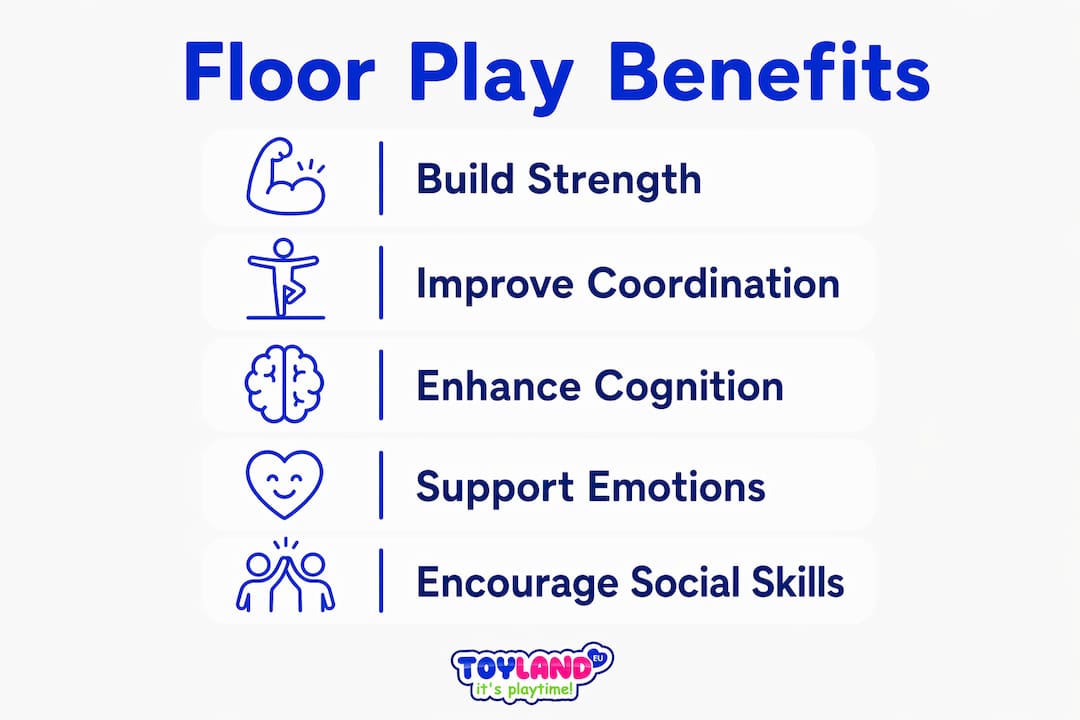
Toy selection shapes what children practice on the floor. Interactive and sensory toys that encourage open-ended exploration align best with the developmental benefits of floor play. Think textured balls, stacking cups, simple puzzles, and art materials. These objects invite children to manipulate, experiment, and create rather than passively watch.
Floor time setup checklist:
- Clear a firm, flat surface free of sharp edges or small objects
- Place 2–3 age-appropriate toys within reach
- Position yourself at the child’s eye level
- Keep sessions positive and end before the child becomes frustrated
- Rotate toys weekly to maintain novelty and curiosity
Key Takeaways
Floor play is the most accessible and research-supported tool parents have for building physical strength, cognitive skills, and emotional bonds in young children.
| Point | Details |
|---|---|
| Daily floor time is CDC-recommended | The CDC’s 2026 guidance supports daily floor play for infant developmental milestones from birth. |
| Short sessions beat long ones | Multiple 1–2 minute sessions across wake windows outperform single extended floor time. |
| Adult presence multiplies impact | Following your child’s lead and closing interaction circles drives social and cognitive growth. |
| No equipment needed | A clean, firm floor is the most effective developmental environment and costs nothing. |
| Sensory and cognitive gains are real | Floor surfaces provide tactile feedback and grounding input that support sensory integration and problem-solving. |
The thing most parents get wrong about floor play
Most parents I talk to treat floor play as something children do on their own while adults supervise from the couch. That misses the point entirely. The research on Floortime and NAEYC’s position both make clear that your active, warm presence on the floor is what transforms simple play into a developmental experience. Physical positioning is not enough. Emotional engagement is the variable that actually moves the needle.
I have also noticed that parents underestimate how much developmental work is happening when a child appears to be “just playing.” A baby pushing a ball and watching it roll is running a physics experiment. A toddler stacking blocks and knocking them down is learning structural reasoning. None of that looks like learning from the outside, but it absolutely is.
The other thing worth saying directly: floor play is hard to sustain when you are tired, busy, or distracted. That is real, and no amount of research changes the demands of daily parenting. But even two or three genuine, phone-free minutes on the floor each day adds up. The emotional and developmental benefits of that presence compound over time in ways that structured activities simply cannot replicate.
— Thane Holland
Floor play toys worth having on hand
The right toy does not replace floor time. It extends it. Toylandeu™ carries creative kits designed to complement exactly the kind of open-ended, sensory-rich floor play that builds the skills covered in this article. The Montessori Drawing Kit supports fine motor development and imaginative expression during floor sessions. The Colorful Drawing Scroll encourages color recognition and creativity in a format children can spread out and explore at ground level. Toylandeu™ ships worldwide with free delivery, so the right tools for floor time are never far away. Browse the full range at toylandeu.com.
FAQ
Why is playing on the floor good for babies?
Floor play builds core strength, balance, and motor coordination by moving children through developmental positions like rolling, reaching, and crawling. The CDC’s 2026 guidance recommends daily floor time for infants to support these milestones.
How long should floor play sessions be?
Short, frequent sessions of 1–2 minutes repeated across wake windows are more effective than long forced sessions. Consistent positive exposure matters more than total duration.
What is the Greenspan Floortime approach?
The Greenspan Floortime approach is a structured method where parents engage in playful, child-led floor sessions 2–3 times daily to build social, emotional, and cognitive development through back-and-forth interaction circles.
Does floor play help with sensory processing?
Floor surfaces provide a stable, grounding base that supports sensory integration and tactile feedback. This environment is especially beneficial for children with sensory processing differences.
What toys are best for floor play?
Open-ended, sensory toys like textured balls, stacking cups, art kits, and simple puzzles encourage the deepest exploration. Avoid toys that do all the work for the child, since active manipulation drives the most developmental gain.