

How toys shape your child's cognitive development
TL;DR:
- Open-ended, hands-on toys outshine electronic gadgets in supporting long-term cognitive development.
- Parental engagement during play significantly enhances a child’s learning and curiosity.
- Matching toys to developmental stages and combining them with active involvement yields the best results.
Most parents instinctively reach for more toys when they want to give their child an edge. More blocks, more puzzles, more gadgets. But the research tells a more nuanced story. Electronic toys can reduce parent-child verbal interaction, which is one of the most powerful drivers of early learning. This guide cuts through the noise to show you exactly which toys support cognitive growth, why they work at a brain level, and how your involvement as a parent transforms any toy into a powerful learning tool.
Table of Contents
- Why toys matter for cognitive development: What the science says
- How toys stimulate the brain: Key mechanisms explained
- Theory in action: Piaget, Vygotsky, and the psychology of play
- Finding the right toys: What actually works by age and interest
- Pitfalls, misconceptions, and what to avoid
- Our take: The overlooked secret to maximizing toy-based learning
- Explore cognitive-boosting toys at ToylandEU
- Frequently asked questions
Key Takeaways
| Point | Details |
|---|---|
| Open-ended toys work best | Blocks, loose parts, and creative materials promote the most robust cognitive growth in children. |
| Parent-child play is key | Learning accelerates when parents join in and scaffold play, rather than leaving children alone. |
| Electronic toys can hinder | Some electronic and overly prescriptive toys reduce interaction and provide less benefit for development. |
| Match toys by age | Children’s cognitive needs change rapidly, so tailor toy choices to their current stage. |
Why toys matter for cognitive development: What the science says
Cognitive development in early childhood covers a broad range of skills: problem-solving, language acquisition, imaginative thinking, and academic readiness. These skills don’t develop in isolation. They build on each other through repeated, meaningful play experiences. Toys are the medium through which children practice all of them.
A review of 25 studies on play materials found that 20 out of 25 studies showed positive associations between open-ended toys, blocks, loose parts, and art sets and cognitive outcomes. That’s an 80% positive rate across independent research. The mechanisms are straightforward: sensory exploration builds neural pathways, problem-solving with physical objects teaches logic, and creative play stretches imagination and language use simultaneously.
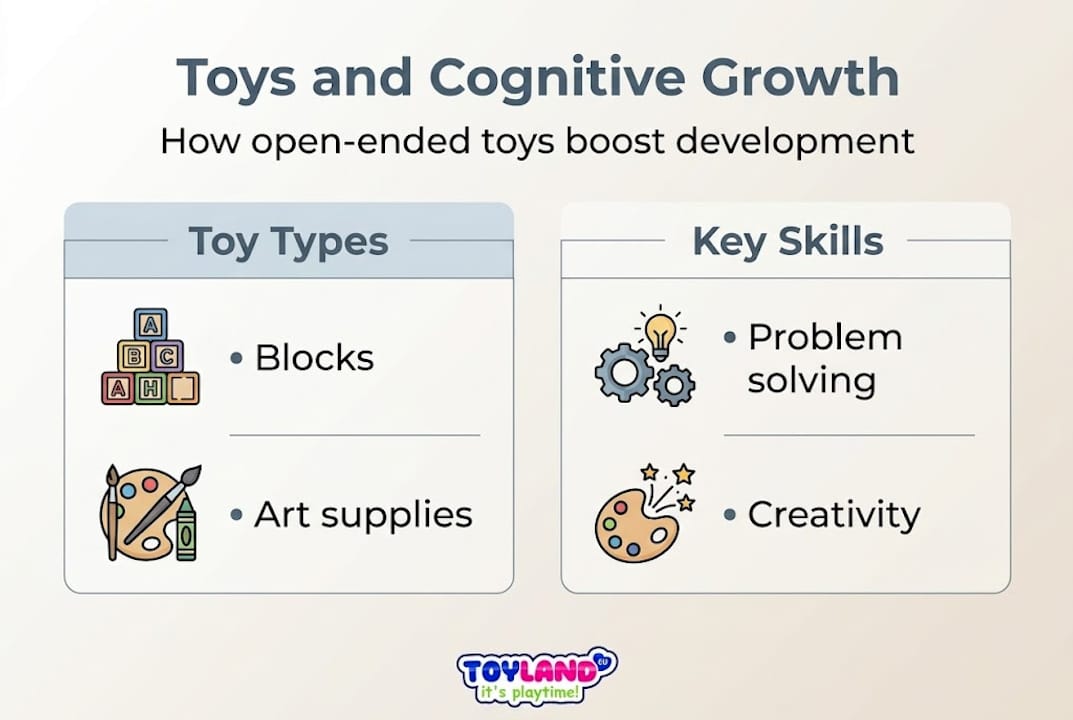
Not all toys deliver these benefits equally. The benefits of open-ended toys are consistently stronger than those of closed, single-use toys. A toy with one correct outcome teaches one thing. A toy with infinite outcomes teaches children to think.
Here’s a quick summary of how different toy types connect to specific cognitive skills:
| Toy type | Primary cognitive skill | Evidence strength |
|---|---|---|
| Blocks and building sets | Spatial reasoning, math readiness | Strong |
| Art and loose parts | Creativity, language, fine motor | Strong |
| Pretend play props | Social cognition, narrative thinking | Moderate |
| Electronic toys | Limited; may reduce verbal interaction | Weak to negative |
| Puzzles | Problem-solving, persistence | Moderate to strong |
The data is clear. Open-ended, hands-on toys outperform electronic alternatives when it comes to sustained cognitive growth. Understanding interactive toys and development helps parents make smarter choices rather than defaulting to whatever is most heavily marketed.
Key benefits of hands-on, open-ended play:
- Encourages children to generate their own rules and outcomes
- Supports longer attention spans through self-directed exploration
- Builds vocabulary naturally through narration and social play
- Develops persistence when challenges arise without a pre-set solution
How toys stimulate the brain: Key mechanisms explained
Now that we know why toys matter, let’s discover how they actually influence young brains. The mechanisms are specific, and understanding them helps you choose toys with intention rather than guesswork.
Sensory exploration is the first pathway. When a child handles a wooden block, they process texture, weight, temperature, and shape simultaneously. Wooden toys increase somatosensory neural activity by 23%, and varied weights improve spatial reasoning by 31%. That’s not a small effect. Plastic toys with uniform weight and smooth surfaces simply don’t activate the same range of neural input.
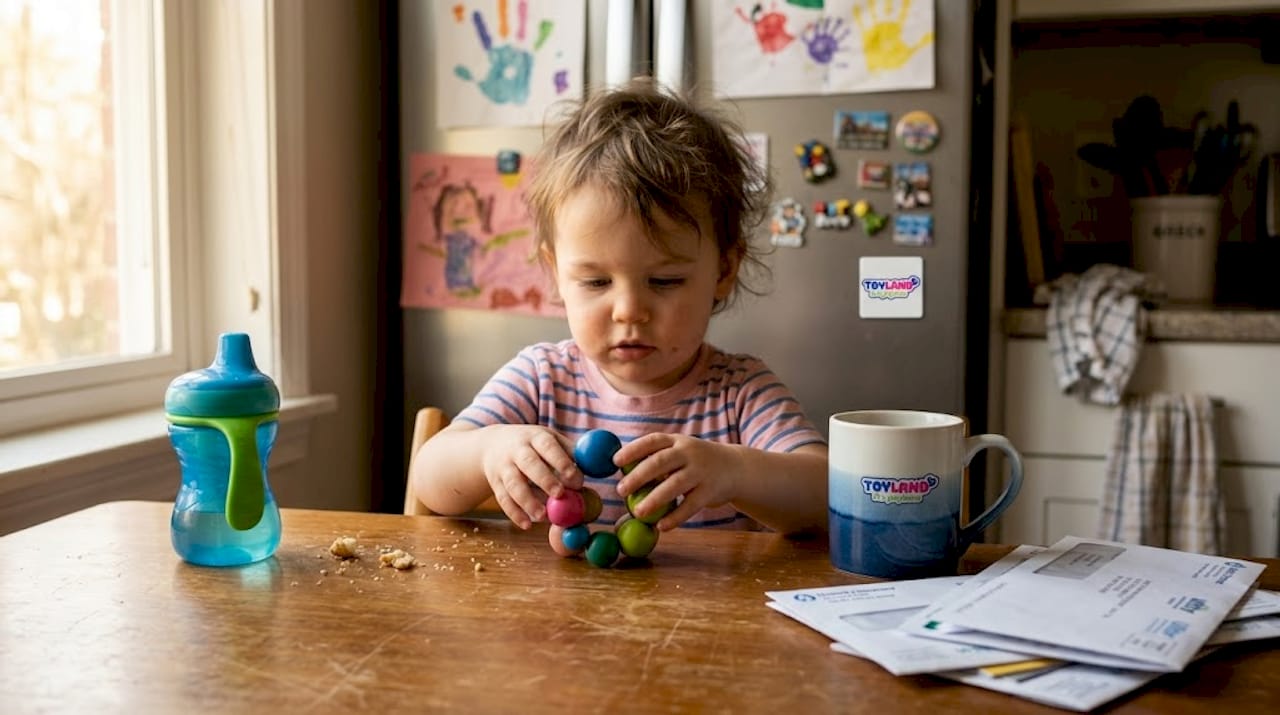
Cause-and-effect learning is the second mechanism. When a child stacks blocks and they fall, or pushes a button and hears a sound, they’re building a mental model of how actions lead to outcomes. This is the foundation of logical thinking and early scientific reasoning. The key difference is that with open-ended toys, the child controls the cause. With electronic toys, the toy controls it.
Self-correction is the third pathway, and it’s one of the most underappreciated. Montessori-style toys are designed so that errors are visible and correctable without adult intervention. A shape sorter that doesn’t fit tells the child something is wrong. This builds persistence and internal motivation, two qualities that predict academic success far better than raw intelligence. You can explore innovative toys for cognitive skills that incorporate this design philosophy.
Social scaffolding is the fourth and most powerful mechanism. When a parent plays alongside a child, asks questions, and models curiosity, the learning depth multiplies. A toy on its own is a tool. A toy used with an engaged adult becomes a conversation, a lesson, and a bonding experience all at once.
Here’s how different toy categories compare across these mechanisms:
| Mechanism | Wooden toys | Electronic toys | Open-ended toys |
|---|---|---|---|
| Sensory input | High | Low | High |
| Cause-and-effect learning | Moderate | High but passive | High and active |
| Self-correction | High | Low | High |
| Social scaffolding potential | High | Low | High |
| Language development | High | Low | High |
Pro Tip: Sit on the floor with your child during play. Don’t direct. Ask questions like “What happens if you put the big one on top?” This simple act of curious presence dramatically increases the cognitive value of any toy session.
Theory in action: Piaget, Vygotsky, and the psychology of play
Understanding the brain is only part of the equation. Let’s see what psychology teaches us about play and how two landmark theories can guide your toy choices at home.
Jean Piaget believed children construct knowledge through direct, hands-on interaction with their environment. Every time a child manipulates a toy, they build what Piaget called a “schema,” a mental framework for understanding how things work. When new information doesn’t fit an existing schema, the child adjusts their thinking. This process, called accommodation, is the engine of cognitive growth.
Lev Vygotsky took a different angle. He argued that social play and private speech mediate cognitive development through interaction with more skilled partners. In his view, a child playing alone with a puzzle learns less than a child playing that same puzzle with a parent who asks guiding questions. The gap between what a child can do alone and what they can do with support is what Vygotsky called the Zone of Proximal Development.
“The most significant moment in the course of intellectual development occurs when speech and practical activity converge.” — Lev Vygotsky
Here’s how both theories translate into practical toy use:
- Piaget approach: Give children unstructured time with building blocks, clay, or sorting toys. Let them explore without instruction. Resist the urge to show the “right” way.
- Vygotsky approach: Join the play. Narrate what you’re doing. Ask open questions. Introduce a slightly harder challenge once the child masters the current one.
- Blended approach: Offer the toy freely, then join in after a few minutes. Follow the child’s lead, but gently stretch their thinking with questions and gentle challenges.
A real-life example: your child is working on a simple wooden puzzle. The Piaget approach says let them struggle productively. The Vygotsky approach says sit beside them and say, “I wonder if the round piece goes near the round hole.” Both are right, and using them together is more powerful than either alone. Exploring Montessori math toys is one practical way to apply both frameworks simultaneously at home.
Finding the right toys: What actually works by age and interest
Theory is powerful, but parents want to know exactly what toys to offer at home. Here’s how to put research into action.
Cognitive development follows a rough sequence of milestones, and the best toys match where your child is right now, not where you want them to be. Pushing a toy that’s too advanced creates frustration. Offering one that’s too simple creates boredom. The sweet spot is a toy that’s just slightly beyond the child’s current comfort zone.
Age-based toy recommendations grounded in developmental milestones:
- 0 to 6 months: High-contrast visual cards, soft rattles, textured fabric books. Focus is on sensory input and tracking.
- 6 to 18 months: Stacking rings, simple shape sorters, cause-and-effect push toys. Focus is on object permanence and early logic.
- 18 to 36 months: Pretend play sets, simple puzzles, art supplies, and building blocks. Focus is on imagination, language, and early problem-solving.
- 3 to 5 years: Complex building sets, board games with simple rules, dress-up props, and early STEM kits. Focus is on planning, social cognition, and abstract thinking.
A product like the Montessori pegboard mushroom toy is a strong example of a toy that hits multiple milestones at once: color recognition, fine motor control, counting, and self-correction. It works across the 18-month to 4-year range because children find new challenges in it as they grow.
Pro Tip: Rotate your child’s toys every one to two weeks instead of leaving everything out at once. Research consistently shows that fewer toys available at one time leads to longer, more focused, more creative play. Less clutter equals deeper engagement.
The emphasis on open-ended toys for creativity isn’t just theoretical. Parents who make this shift often notice their children playing independently for longer stretches and inventing more complex narratives during pretend play.
Pitfalls, misconceptions, and what to avoid
Even with the best intentions, parents can fall into common traps. Awareness of myths and mistakes is key to making play time actually count.
The biggest myth is that more toys equal more learning. In reality, toy overload leads to shorter attention spans and less creative play. Children who have fewer, better toys tend to engage more deeply and develop stronger problem-solving skills over time.
The second myth is that electronic toys boost intelligence. Heavily marketed “educational” electronic toys often deliver the opposite of what they promise. Electronic toys reduce verbal interaction between parent and child, and verbal interaction is one of the strongest predictors of language development and IQ. A toy that talks to your child is not the same as you talking to your child.
The third myth is that all play is equally beneficial. Passive screen time and button-pressing toys don’t activate the same cognitive processes as building, drawing, or pretend play. The type of engagement matters enormously.
Common pitfalls to watch for:
- Buying toys based on age labels alone rather than your specific child’s interests and current skills
- Choosing toys that entertain without requiring any effort or decision-making from the child
- Relying on electronic toys as a substitute for parent interaction during play
- Overloading play spaces with too many options, which reduces focus and depth of play
- Ignoring the child’s lead and pushing toys that adults find impressive but children find uninteresting
“Not all studies support equal benefits for all toy types. Inconsistencies often reflect differences in how studies measure outcomes, the age groups studied, and cultural contexts around play.”
This is worth noting because no single toy is a magic solution. The research points to patterns and tendencies, not guarantees. Your child’s individual temperament, interests, and learning style all shape how much any given toy benefits them.
Our take: The overlooked secret to maximizing toy-based learning
Here’s what most toy guides miss entirely, and it’s the thing that makes the biggest difference of all.
The toy itself is almost secondary. What matters most is whether you show up for the play. We see parents invest heavily in premium wooden toys, Montessori sets, and STEM kits, then leave the child to figure it out alone. The toy sits in the corner. The child plays with a cardboard box instead.
The research is unambiguous on this point. Parental involvement during play and scaffolding within the child’s optimal learning zone produce the strongest cognitive outcomes. Not the toy brand. Not the price. Your presence and engagement.
This doesn’t mean hovering or directing every move. It means sitting nearby, narrating what you see, asking genuine questions, and modeling curiosity. “I wonder what would happen if…” is one of the most cognitively stimulating sentences a parent can say.
We also think there’s something deeper here. When you play with your child, you’re not just boosting their IQ. You’re showing them that learning is social, joyful, and worth doing together. That attitude toward curiosity and exploration will serve them far longer than any specific cognitive skill they pick up from a puzzle.
The best toy investment you can make isn’t a new product. It’s fifteen minutes of focused, curious, floor-level play with whatever your child already has. The creativity benefits of open-ended toys are real, but they’re amplified tenfold when you’re in the room, engaged and curious alongside your child.
Explore cognitive-boosting toys at ToylandEU
Ready to apply what you’ve learned and pick out toys with confidence?
At ToylandEU, we carry over 30,000 toys spanning every developmental stage and learning style. From open-ended creative sets and Montessori-inspired tools to hands-on STEM kits like the STEM robotics car kit that builds real programming skills, our catalog is built for parents who want play to mean something. For older kids ready for more active challenges, the gesture-controlled stunt car combines physical coordination with cause-and-effect thinking in a way that keeps children genuinely engaged. We ship worldwide for free, so finding the right toy for your child’s next developmental leap has never been easier.
Frequently asked questions
What types of toys are best for cognitive development?
Open-ended toys like blocks, loose parts, and art supplies are most effective because they encourage creative problem-solving and language use, with positive associations with cognitive skills confirmed across multiple studies.
At what ages do toys make the biggest impact?
Toys support development from infancy through preschool, with key milestones at 0-6 months, 6-18 months, and 18-36 months for sensory processing, cause-and-effect learning, and early problem-solving.
Are electronic toys harmful to learning?
Some electronic toys can reduce parent-child verbal interaction, which is a critical driver of language development and cognitive growth in early childhood.
Do all children benefit equally from the same toys?
No. Every child has unique interests, temperament, and developmental timing. Matching toys to your child’s current curiosity and skill level matters more than following rigid age guidelines.
How can parents maximize the impact of toys?
Playing alongside your child, asking open questions, and modeling genuine curiosity all help toys support deeper cognitive growth, as parental scaffolding during play consistently produces the strongest developmental outcomes.