

Why physical toys matter for kids in the digital age
TL;DR:
- Children who engage with physical toys develop stronger cognitive, emotional, and social skills than those relying on screens. Active, hands-on play supports overall child development by fostering motor coordination, resilience, creativity, and language skills, which passive digital engagement cannot replicate. Limiting screen time and enriching play environments with tactile toys promotes healthier growth, better attention, and emotional well-being in children.
Children who spend more time with physical toys develop stronger academic skills, richer emotional lives, and better social abilities than children who rely heavily on screens. That’s not a hunch but a finding echoed across recent pediatric research. Physical play supports multiple domains of development, from coordination and self-regulation to coping skills, in ways passive digital engagement simply cannot replicate. If you’ve ever wondered whether all those apps and kid-friendly games are truly enough, this article gives you the evidence, the balance sheet, and the practical steps to make real toys a daily priority.
Table of Contents
- The fundamental role of physical toys in child development
- How much is too much? Screen time vs. physical play
- Physical toys vs. digital entertainment: What research shows about outcomes
- Making screen-free time work: Tips for parents in a digital-first world
- Here’s what most articles miss about real play in the digital age
- Explore hands-on toy solutions for modern families
- Frequently asked questions
Key Takeaways
| Point | Details |
|---|---|
| Physical toys drive growth | Hands-on play with real toys develops kids’ physical, social, and emotional skills that screens cannot match. |
| Balance beats extremes | Combining limited, purposeful screen time with active, screen-free play gives children the most benefits. |
| Evidence favors real play | Recent studies show physical play supports academic, mental, and physical health better than digital-only engagement. |
| Parents shape the home | Simple routines like rotating toys and scheduling unplugged periods make a lasting impact on healthy development. |
The fundamental role of physical toys in child development
Most parents already sense that building blocks and pretend kitchens do something good for kids. The science confirms it in detail. When a child stacks cups, rolls a car across the floor, or dresses a doll, their brain is doing several things at once: solving spatial problems, regulating emotions, and rehearsing social scripts. No tap-to-win app replicates that layered experience.
Physical toys actively build what researchers call “whole-child” development:
- Motor coordination: Gripping puzzle pieces, threading beads, or maneuvering a remote-controlled car all strengthen fine and gross motor skills simultaneously.
- Emotional regulation: When a tower falls, a child must manage frustration and try again. That micro-moment of coping is practice for larger life challenges.
- Social skills: Sharing a box of LEGOs teaches negotiation, turn-taking, and collaborative problem-solving in real time.
- Creative thinking: Open-ended toys have no “correct” ending. Children invent stories, test hypotheses, and adapt plans when reality doesn’t match expectation.
- Language development: Pretend play naturally generates rich vocabulary and complex sentence structures.
Screen-based play, by contrast, is typically sedentary and reactive. A child follows a pre-scripted set of choices; the system responds with lights and sounds. The connection between interactive toys and child development is much more dynamic because real toys demand that children generate the action, not just respond to it.
“Physical play with toys supports multiple domains of development, including physical coordination, social relationships, and emotional wellbeing, while helping children build self-regulation and coping skills that passive screen engagement alone cannot provide.” — American Academy of Pediatrics
Pro Tip: Rotate your toy selection every two to three weeks. Keeping only five to eight toys visible at a time prevents overwhelm, reignites curiosity, and forces children to use their imagination rather than defaulting to a favorite passive activity.
How much is too much? Screen time vs. physical play
Understanding the guidelines makes the balancing act far less stressful. Both the World Health Organization (WHO) and the American Academy of Pediatrics (AAP) have published specific recommendations, and they’re more nuanced than a simple “less is better” message.
Recommended daily screen time by age
| Age group | Recommended recreational screen time | Typical observed daily usage |
|---|---|---|
| Under 2 years | None (except video calls) | 1–2 hours |
| 2 to 4 years | Up to 1 hour, high quality | 2–3 hours |
| 5 to 8 years | Consistent limits, no clear ceiling | 3–4 hours |
| 9 to 12 years | Consistent limits, protect sleep/play | 4–6 hours |
The gap between recommended and actual usage is stark for most families, and it matters. Screen-based sedentary time is specifically limited in early childhood guidance because screens displace more beneficial activities like moving, reading aloud with caregivers, and imaginative play. Every hour a child spends in front of a screen is an hour not spent building coordination and practicing real-world social skills.
The academic cost is measurable too. Higher total screen time in elementary-aged children is associated with worse standardized outcomes in both reading and math. The relationship isn’t casual: when screens crowd out reading, conversation, and play, foundational skills erode.
Here are the primary risks parents should keep in mind:
- Disrupted sleep: Blue light from screens suppresses melatonin, delaying sleep onset and reducing total sleep time, which in turn affects mood, attention, and learning.
- Reduced physical activity: Children who use screens heavily are less likely to meet the 60-minute daily moderate-to-vigorous activity guideline.
- Weakened attention: Fast-paced digital content conditions children to expect constant stimulation, making slower, more effortful tasks like reading or building feel unrewarding.
- Missed social development: Online interaction lacks the body language, tone, and spontaneity of face-to-face play.
Parents looking for a solid starting point will find real value in exploring innovative toys for child development that are specifically designed to replace passive screen time with active engagement. A growing category of screen-smart STEM toys bridges the gap by using physical manipulation to teach coding and engineering concepts without a screen.
Pro Tip: Use a visual sand timer or a designated “toy bin drop-zone” as a physical signal that screen time has ended. Children respond better to concrete, tangible cues than to abstract verbal reminders, especially children under age seven.
Physical toys vs. digital entertainment: What research shows about outcomes
The evidence isn’t just anecdotal. A growing body of peer-reviewed research compares the developmental trajectories of children with different screen-to-toy ratios, and the findings consistently favor hands-on play.
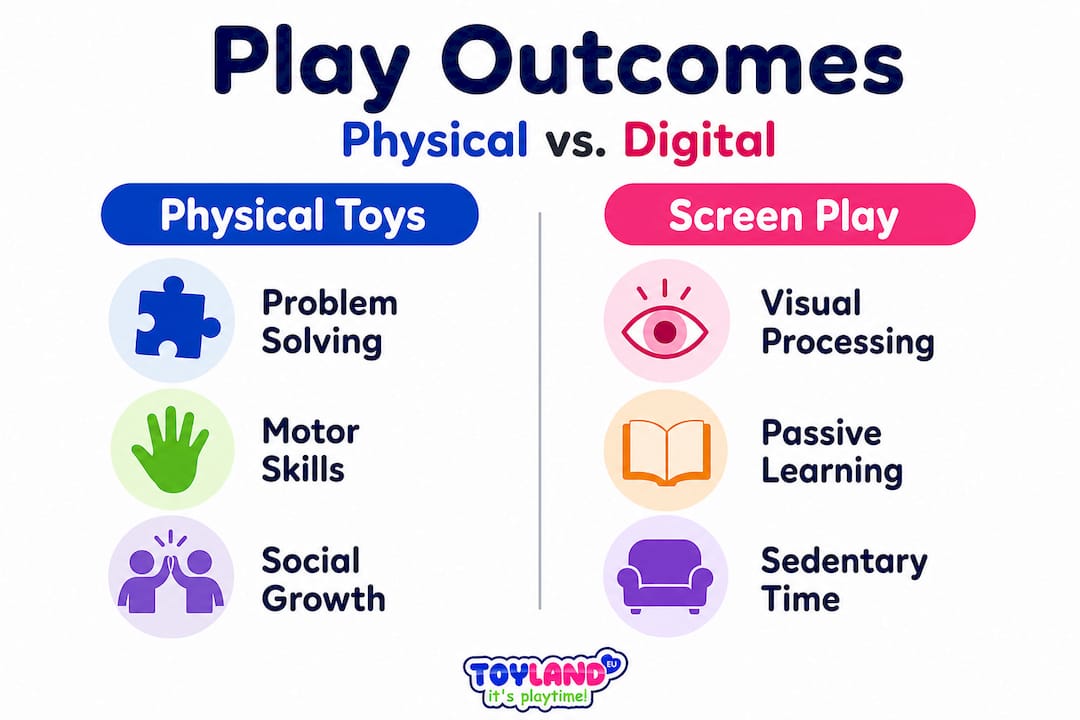
Head-to-head comparison: Physical toys vs. screen entertainment
| Developmental domain | Physical toys | Screen entertainment |
|---|---|---|
| Cognitive skills | Problem-solving, spatial reasoning, cause-and-effect | Pattern recognition, some procedural memory |
| Emotional regulation | Frustration tolerance, resilience, patience | Emotional arousal, impulsivity risk |
| Physical development | Motor skills, coordination, sensory processing | Sedentary; minimal physical benefit |
| Creativity | Open-ended invention and storytelling | Guided by pre-set content |
| Social skills | Negotiation, cooperation, empathy | Limited; mostly parallel or solo |
| Mental health | Associated with lower anxiety and better mood | Associated with higher anxiety at high doses |
Digital media use broadly shows associations with poorer child outcomes across developmental domains, supporting the case for making physical toy play a genuine counterbalance in the home environment. This isn’t about demonizing technology. It’s about recognizing that screens and toys serve genuinely different functions, and children need both in the right proportions.
Pretend play is one area where toys win decisively. Play with real objects and toys actively supports pretend-play learning and the ability to generalize lessons from one context to another because toys encourage active, flexible action rather than passive content consumption. A child who uses a toy kitchen to “cook dinner” for stuffed animals is practicing sequencing, role-playing caregiver relationships, and building narrative skills all at once.
“Children who engage regularly in active, object-based play develop more flexible thinking and stronger emotional regulation compared to those whose leisure time is dominated by screen use.”
The mental health dimension is also worth noting. Active, physical play is associated with reductions in anxiety and depression symptoms in school-age children. When children move, build, and create, they release pent-up energy, process difficult emotions, and experience the deep satisfaction of making something real. You can browse a wide range of physical toy options to see how varied and age-appropriate tactile play can be. For parents who want to go deeper on the science, the page on tactile STEM toys offers a detailed roadmap for hands-on, screen-minimized learning.
Making screen-free time work: Tips for parents in a digital-first world
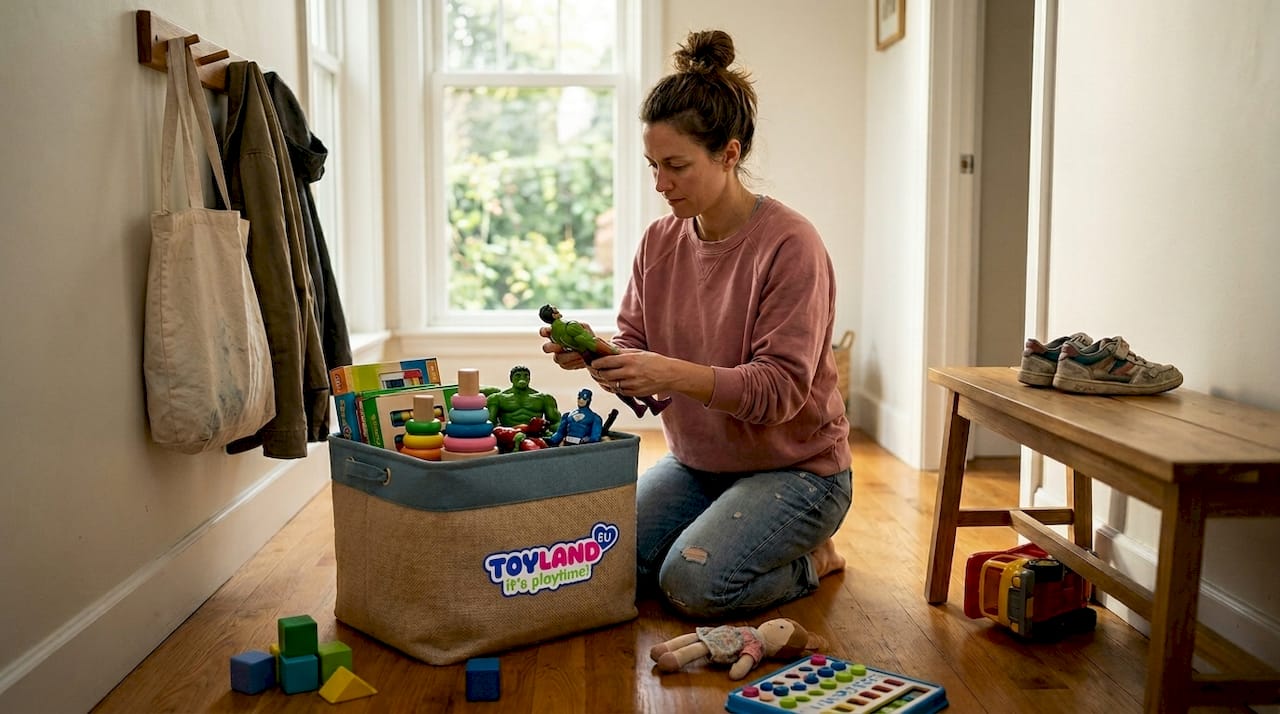
Knowing the research is one thing. Creating a home environment where physical play actually happens every day is another. The biggest mistake parents make is treating screen-free time as a punishment or a void rather than as a purposeful, joyful space.
AAP guidance for the digital age emphasizes context and quality over rigid rules, while specifically protecting sleep, exercise, and family interaction time through screen-free routines and co-use strategies. Physical toys are central to this because they naturally create the protected, active blocks where children move, negotiate, and explore.
Active toy alternatives can replace sedentary screen time with moderate-to-vigorous activity opportunities, making the swap genuinely healthy rather than just restrictive.
Here are five parent-tested strategies to make hands-on play a consistent part of your child’s day:
- Create a play zone that is always ready. A low shelf with toys visible and accessible removes the friction that causes kids to default to a nearby screen. When play materials are easy to reach, children initiate play spontaneously without prompting.
- Schedule “maker time” just like you schedule dinner. A consistent 30-to-45-minute block after school or before bath time signals to your child that this is what we do now. Routine reduces negotiation and builds habit.
- Get on the floor with them. Parental involvement increases the complexity and duration of children’s play. Even ten minutes of active participation from you teaches children that play is valuable, not just babysitting.
- Offer choice, not commands. Instead of saying “put down the tablet,” say “do you want to build with LEGO or do your art kit?” Autonomy increases buy-in dramatically, especially for children ages five and up.
- Rotate and refresh the toy selection. Novelty drives engagement. Swapping out toys every couple of weeks makes the familiar feel new again without spending a dollar.
For a deeper breakdown of building a screen-minimized household, the screen-minimized play roadmap is an excellent companion resource that walks through real-world implementation in detail.
Pro Tip: Involve your child in choosing the toys you rotate in. Let them pick two or three items from a storage bin. Ownership of the choice dramatically reduces the “I’m bored” response and gives kids a sense of agency that reinforces the positive associations with screen-free play.
“Activity design is key when replacing screens. It’s not just about subtracting screen time, but actively adding movement, creativity, and real-world interaction that children genuinely enjoy.”
Here’s what most articles miss about real play in the digital age
Most conversations about screens and kids center on limits: cap the hours, block the apps, enforce the rules. That framing misses the deeper point entirely. The goal is not to subtract screens. It’s to add something richer.
When we talk with parents, the families who thrive aren’t the ones who wage daily battles over iPads. They’re the ones who have built environments so rich in physical, hands-on options that screens simply aren’t the most interesting thing available. That’s a fundamentally different strategy, and it works far better than willpower-based restriction.
Here’s the honest truth: a child who has genuinely engaging physical toys, who has been shown how to use them, and who has a parent occasionally willing to sit on the floor alongside them, will naturally drift toward real play. Not every hour, not every day, but consistently enough to make a difference. That’s what the research on tech toys and emotional growth keeps circling back to: it’s less about the medium and more about the quality of engagement and whether an adult is present and involved.
What children gain from physical toys that is genuinely hard to replicate anywhere else is the experience of testing their own ideas against real-world resistance. A block tower that falls gives instant, honest feedback. A pretend shop that runs out of “product” forces creative problem-solving. A RC car that needs to navigate around chair legs demands spatial reasoning in real time. These aren’t soft benefits. They are the building blocks of resilience, adaptability, and confidence.
The families who understand this stop asking “how do I limit my child’s screen time?” and start asking “what am I filling that time with instead?” That question leads somewhere genuinely useful.
Explore hands-on toy solutions for modern families
Ready to put the research into practice? At ToylandEU, we curate hands-on toys specifically chosen to support creative, active play for children aged 3 to 12.

Whether your child is captivated by motion and mechanics or drawn to building and programming, there’s something here that swaps passive screen time for genuine developmental engagement. The RC adventure stunt car combines spatial reasoning with physical movement and pure excitement, while the STEM robotics car kit introduces real coding and engineering principles through hands-on building rather than a screen tutorial. With free worldwide shipping and over 30,000 items, the full ToylandEU catalog makes it easy to find the right toy for every age, interest, and development stage.
Frequently asked questions
Are digital games ever beneficial compared to physical toys?
Some interactive digital games can support certain types of learning, but they should supplement rather than replace the broad developmental benefits children get from playing with real, physical toys.
How can I encourage my child to choose physical toys over screens?
Make hands-on options easily visible and accessible, rotate toys every couple of weeks to maintain novelty, and protect daily family time for physical play to model that active, creative play is a household priority.
What’s the recommended screen time for children ages 3 to 12?
For ages 2 to 4, no more than one hour per day of high-quality content is recommended; for older children, consistent screen time limits are advised to protect sleep, physical activity, and genuine face-to-face interaction.
Are there specific types of physical toys best for development?
Open-ended toys like building sets, pretend play kits, STEM construction materials, and arts and crafts supplies consistently show the strongest benefits for creativity, flexible thinking, and emotional regulation across the 3 to 12 age range.