

How toys power STEAM learning for kids aged 3-12
TL;DR:
- Toys serve as powerful mediational tools that actively enhance children’s STEAM learning through hands-on exploration.
- Effective selection and adult support in toy play foster critical skills, social-emotional development, and positive attitudes toward STEM.
Toys are not just a way to keep children occupied. They are one of the most effective learning tools available to parents and educators, and the role of toys in STEAM education (Science, Technology, Engineering, Art, and Math) is backed by a growing body of research that most people never see. A child building a ramp out of cardboard tubes is doing physics. A child programming a small robot is learning computational thinking. A child mixing colors and drawing patterns is doing art and math at the same time. This article breaks down exactly how different toys support STEAM skills at each developmental stage and gives you practical steps to apply this knowledge today.
Table of Contents
- Understanding the connection between toys and STEAM learning
- Choosing the right toys: open-ended, technology-enhanced, and loose parts play
- Matching toys to developmental milestones in children aged 3-12
- Real-life examples: how play-based STEAM toys shape skills in early and primary education
- Maximizing STEAM learning with toys: practical strategies for parents and educators
- Rethinking toys’ role in STEAM: beyond play, a powerful learning medium
- Explore ToylandEU’s STEAM-enhancing toys for curious kids
- Frequently asked questions
Key Takeaways
| Point | Details |
|---|---|
| Toys foster STEAM skills | Open-ended and technology-enhanced toys develop critical thinking, creativity, and collaboration in children aged 3-12. |
| Choose toys wisely | Selecting toys that match developmental milestones maximizes learning and maintains engagement in STEAM. |
| Consistent play matters | Regular interaction with appropriate toys builds deeper STEM understanding than frequent changes in toys. |
| Educator support is vital | Teacher training is essential to unlock the full STEAM learning potential of educational toys. |
| Toys can bridge skills | Effective STEAM toys also help develop social-emotional skills alongside STEM competencies. |
Understanding the connection between toys and STEAM learning
Most people think of toys as recreation and school as learning. That split is artificial, and it costs children real opportunities. When a child picks up a toy, they are not switching off their brain. They are activating it, often in ways that a worksheet or lesson cannot.
Toys act as what educational researchers call “mediational tools,” meaning they bridge a child’s current thinking and a new, more complex concept. The benefits of toys in education are especially visible in STEAM domains, where hands-on exploration is the best way to internalize abstract ideas like gravity, symmetry, or sequence.
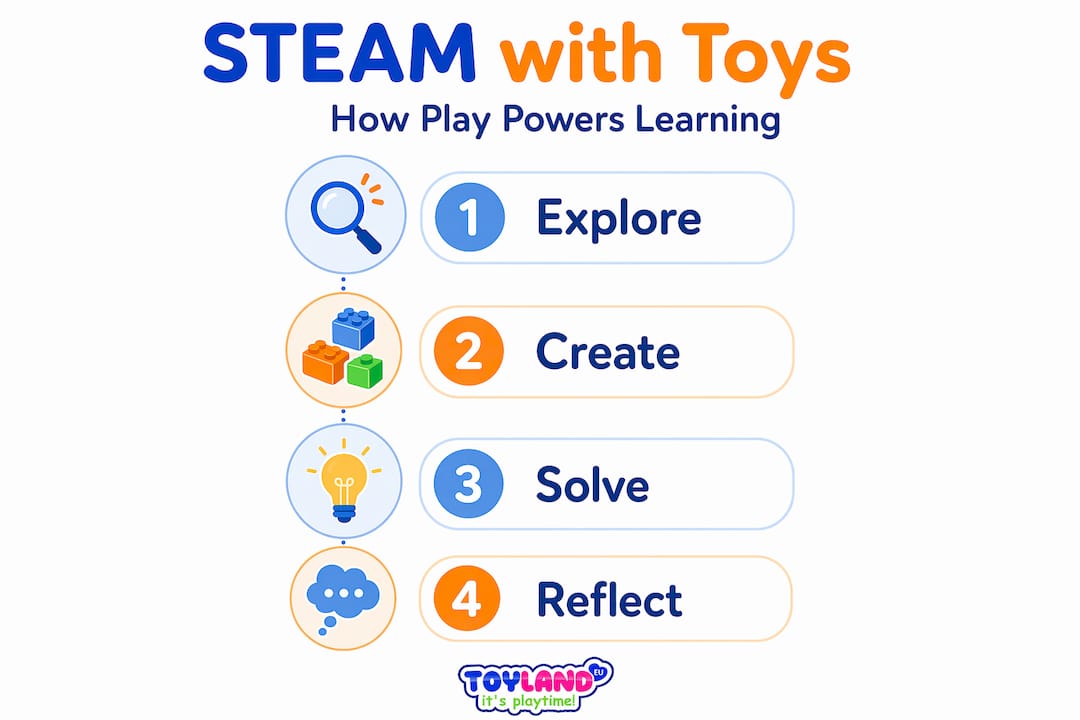
The research is specific. Technology-enhanced toys (often called TETs) have been shown to enhance problem-solving, computational thinking, and collaboration in young children. These are not just nice extras. They are the core skills that STEAM fields demand. A child who learns to debug a simple robot at age six is building the same mental muscle that engineers use at age thirty.
The Toy Association’s STEAM Toy Assessment Framework offers a structured way to evaluate which toys genuinely support cognitive growth across STEAM domains for children aged 3 to 12. The framework emphasizes open-ended play, meaning toys that can be used in multiple ways without a single correct answer.
Key STEAM skills that toys develop through play:
- Problem-solving: Children try, fail, and try again when building or programming, which builds persistence.
- Spatial reasoning: Block play, puzzles, and construction kits develop the mental rotation skills tied to math and science performance.
- Creativity: Open-ended materials push children to invent solutions rather than follow instructions.
- Collaboration: Many STEAM toys naturally invite two or more children to work together, modeling real scientific teamwork.
- Computational thinking: Programmable toys teach sequencing and cause-and-effect logic long before children write a line of code.
Choosing the right toys: open-ended, technology-enhanced, and loose parts play
Not every toy earns its place in a STEAM learning environment. The type of toy matters more than the price tag or the number of features on the box. Children demonstrate significantly more STEM behaviors during unstructured play with loose parts, such as cardboard tubes, wooden blocks, pipes, and fabric scraps, than with limited-function toys that do one thing and stop there.
Open-ended programmable toys like Bee-Bot and Coko Robot are a step up from loose parts. Research shows these toys elicit longer engagement and higher-quality problem-solving activity than closed-ended alternatives. The child is not watching the toy perform. The child is directing it, which is a fundamentally different cognitive experience.
Here is a comparison of the main toy categories and their STEAM value:
| Toy type | Examples | STEAM strength | Limitation |
|---|---|---|---|
| Loose parts | Cardboard, pipes, fabric | High creativity and STEM behaviors | Requires adult setup and guidance |
| Open-ended construction | Blocks, LEGO, magnetic tiles | Spatial reasoning, engineering | May need prompts to extend play |
| Technology-enhanced (TETs) | Programmable robots, coding kits | Computational thinking, collaboration | Needs educator or parent familiarity |
| Closed-ended, single-function | Wind-up toys, basic battery toys | Low STEAM engagement | Limits exploration quickly |
| Art and math games | Pattern games, geometry toys | Creativity, math reasoning | Best when paired with discussion |
When selecting toys, also consider evidence-based toy tips that match cognitive and executive function demands to the child’s current developmental level. A toy that is too complex frustrates. A toy that is too simple bores. The goal is the productive middle ground.
What to look for when choosing STEAM toys:
- Multiple uses: Can the toy be used in at least three different ways?
- Room for failure: Does the toy allow children to make mistakes and correct them?
- No single solution: Does the toy have more than one “right” outcome?
- Social potential: Can two or more children use it together naturally?
Pro Tip: Before buying a new toy, ask yourself, “Will this toy make my child do the thinking, or will it do the thinking for them?” If the toy performs and the child watches, its STEAM value is low.
Check out our guide on must-have STEM toys for kids for curated picks across age groups.
Matching toys to developmental milestones in children aged 3-12
STEAM learning with toys works best when the toy matches what a child’s brain is actually ready to do. Pushing a five-year-old into advanced coding robots is counterproductive. Keeping a ten-year-old on simple stacking blocks is equally wasteful. The science of developmental milestones gives us a clear map.
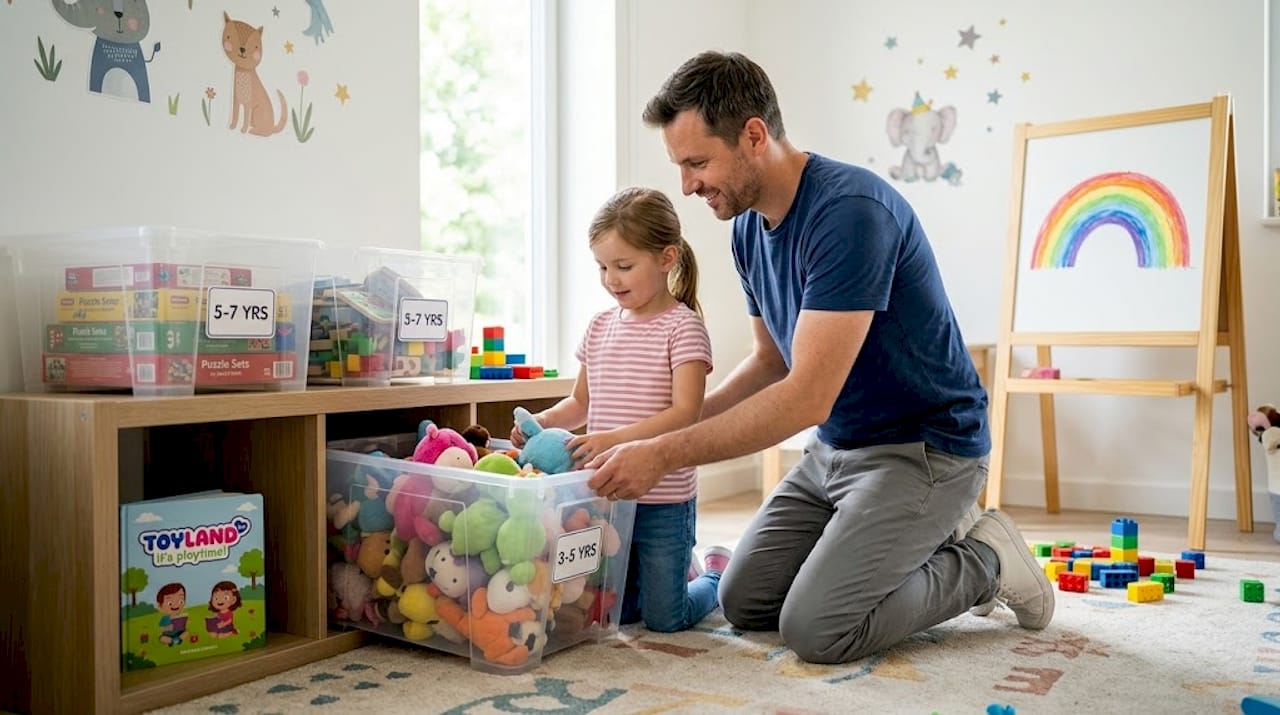
Research on STEM toy age milestones shows that children aged 3 to 4 benefit most from pattern spotting with blocks and sorting games, while children aged 5 to 7 are ready to test mechanics with ramps, levers, and basic construction challenges. By ages 8 to 12, children can engage with more complex engineering challenges, simple coding sequences, and multi-step math games.
Simple block play and puzzles build foundational math and spatial skills in toddlers more effectively than high-tech kits, especially when that play happens consistently over time. The latest robot kit is not automatically better. Consistency with a simple, well-matched toy beats novelty every time.
How to align toys with developmental stages:
- Ages 3 to 4: Focus on pattern recognition, color sorting, and simple stacking. Large blocks, sorting cups, and basic puzzles are ideal. The goal is cause-and-effect awareness and early spatial thinking.
- Ages 5 to 7: Introduce mechanics and simple construction. Ramp and ball kits, gear sets, and beginner coding robots (with pictures, not text) fit this stage. Children this age are ready to hypothesize and test.
- Ages 8 to 10: Move to multi-step challenges. LEGO Technic sets, basic electronics kits, and pattern-based math games work well. Encourage children to explain what they built and why it works.
- Ages 11 to 12: Introduce open-ended engineering challenges and programmable robotics with text-based interfaces. At this stage, children can plan, build, test, and revise with real intention.
Pro Tip: Rotate toys rather than replacing them. A set of magnetic tiles used one way at age four can be reintroduced at age seven with a more complex challenge like building a bridge that holds a specific weight.
Our STEM toy setup workflow guide walks you through how to structure toy-based learning sessions at home or in the classroom step by step.
Real-life examples: how play-based STEAM toys shape skills in early and primary education
Theory only goes so far. These real examples show what happens when the right toys meet the right environment.
A yearlong afterschool program built around LEGO robotics helped four and five-year-olds develop not just foundational science, math, technology, and engineering skills, but also social-emotional skills including collaboration, self-regulation, and empathy. The children were not just building robots. They were learning how to work together, handle frustration, and celebrate each other’s successes. Those are not soft extras. They are essential life skills that STEAM careers demand.
A separate study involving Poly-Universe educational games found that playing these geometry and pattern-based games shifted children’s attitudes toward math in a measurably positive direction and enhanced creative thinking for children aged 3 to 7. Math anxiety starts early. Toys that make math feel like play can interrupt that pattern before it forms.
| Program or toy | Age group | STEAM skills gained | Bonus outcomes |
|---|---|---|---|
| LEGO robotics afterschool | Ages 4 to 5 | Science, math, engineering, technology | Collaboration, self-regulation, empathy |
| Poly-Universe games | Ages 3 to 7 | Math, art, pattern recognition | Positive math attitude, creative thinking |
| Loose parts unstructured play | Ages 3 to 8 | Engineering, science exploration | Autonomy, executive function |
| Programmable robots (TETs) | Ages 5 to 10 | Computational thinking, problem-solving | Persistence, peer collaboration |
Key takeaways from real-world STEAM toy programs:
- Social-emotional learning and STEAM skills develop together, not separately, when toys are used in structured programs.
- Art-integrated math games reduce early math anxiety and build genuine enthusiasm.
- Play-based programs outperform drill-based instruction for foundational STEM concept retention in early childhood.
Learn more about how innovative toys support child development with current examples from 2025 and beyond.
Maximizing STEAM learning with toys: practical strategies for parents and educators
Owning the right toy is only half the equation. How adults frame and support toy play determines whether children extract the STEAM value or just have fun. Both matter, but the best outcomes come from both happening at once.
Educators who integrate TETs effectively have received professional development on how to do it, meaning the adult skill level directly influences child outcomes. This is not about hovering. It is about knowing when to ask a question, when to step back, and when to introduce a new challenge.
Verbal scaffolding and executive function support at home also strengthen the STEM behaviors children show during open-ended play. Simply asking, “What do you think will happen if you change that?” turns a play session into a science experiment.
Practical strategies to maximize STEAM outcomes from toy play:
- Set up the environment intentionally. Put materials at child height. Create a “maker space” corner at home or in the classroom where STEAM toys are always accessible. Availability drives use.
- Facilitate without controlling. Ask open questions. Resist the urge to show the child how to do it. The struggle is where the learning happens.
- Mix toy types deliberately. Pair loose parts with a programming toy challenge. For example, ask children to build a structure for their robot to navigate around.
- Make it gender-neutral from the start. Offer all STEAM toys to all children equally. Avoid labeling toys as “for boys” or “for girls.” The research is clear that stereotyping limits STEAM participation, especially for girls.
- Connect home and school play. If a child is exploring ramps at school, bring ramp challenges home. Continuity reinforces learning in ways that isolated sessions cannot.
Pro Tip: Keep a simple play journal. After each STEAM play session, jot down one thing the child tried, one thing that did not work, and one question they asked. Over a month, you will see patterns in their thinking that guide your next toy choices.
Explore more ideas on innovative learning at home with tech toys and additional ways to supercharge learning through play.
Rethinking toys’ role in STEAM: beyond play, a powerful learning medium
Here is what most articles on this topic miss: the toy itself is rarely the most important variable. The adult in the room is.
We tend to look for the magic toy, the one that will make a child love science or fall in love with math. But MIT professor Mitchel Resnick’s work makes this point sharply. STEM toys enable creative learning through projects, passion, peers, and play, and critically, they build confidence through failure and experimentation. The toy creates the conditions. The adult helps the child navigate them.
The second thing most articles gloss over is equity. Not every child has access to well-stocked toy shelves. Not every classroom has a budget for programmable robots. And not every girl is encouraged to pick up the building set. Gender-neutral encouragement is not just socially progressive. It is scientifically necessary if we want diverse, capable STEAM fields in twenty years.
The third overlooked truth is that failure during play is the actual mechanism of learning, not a sign that the toy is wrong or the child is struggling. When a structure collapses, a robot goes the wrong direction, or a math game produces an unexpected answer, the child’s brain is doing exactly what STEAM education is meant to develop: noticing a problem, forming a new hypothesis, and trying again. Adults who rush to fix the failure short-circuit that entire process.
The evidence-based principles for using toys in learning consistently point to the same conclusion. High-quality play with appropriate toys, combined with a curious, patient adult presence, produces STEAM outcomes that formal instruction alone cannot replicate. The toy is the medium. The child is the scientist. And you are the best lab partner they have.
Explore ToylandEU’s STEAM-enhancing toys for curious kids
If you are ready to put this knowledge into practice, ToylandEU’s catalog makes it straightforward to find toys that match your child’s age, interests, and STEAM learning goals.
The gesture-controlled stunt car is a standout pick for children aged 7 and up who are ready to explore cause-and-effect mechanics in a way that feels like pure fun. For younger children focused on creativity and fine motor development, the kids art workbook drawing kit builds the “A” in STEAM through Montessori-inspired drawing challenges. And the creative learning drawing and math game, designed for ages 3 to 12, combines visual art with foundational math concepts in a format children actually want to return to. Free worldwide shipping means your child’s next STEAM tool is never more than a few clicks away.
Frequently asked questions
What types of toys best support STEAM learning for young children?
Open-ended toys like programmable robots and loose parts that encourage creativity and problem-solving offer the strongest STEAM outcomes, as technology-enhanced toys have been shown to directly improve STEM behaviors in young children. Avoid single-function toys that perform for the child rather than inviting the child to think.
How can parents encourage equal STEAM play among boys and girls?
Offering gender-neutral building toys like LEGO to all children equally and avoiding STEAM stereotypes from the start is the most effective approach. Research from the National Girls Collaborative Project shows that open-ended building toys counter parental bias by developing equal skills in boys and girls regardless of how the toy is marketed.
Why is consistency important in using STEAM toys for toddlers?
A toddler who plays with the same set of blocks three times a week gains more foundational math and spatial skill than one who gets a new toy every week, because consistent block play builds lasting neural pathways that novelty alone cannot establish. Depth beats breadth at this developmental stage.
What role do educators play in maximizing the benefits of STEAM toys?
Educators who receive professional development are significantly more effective at integrating STEAM toys into classroom learning. Teacher training ensures children engage meaningfully with STEM concepts through play rather than just interacting with a toy on the surface level.
How do STEAM toys support social-emotional learning as well as STEM skills?
The social context of toy-based STEAM play naturally builds collaboration, self-management, and empathy alongside technical skills. The LEGO robotics research found that structured play programs develop these social-emotional competencies in children as young as four, showing that STEAM and SEL (social-emotional learning) are not separate goals but two outcomes of the same well-designed play experience.