

What is a puzzle toy? A parent's guide to educational play
TL;DR:
- Puzzle toys are problem-solving objects that challenge children to manipulate and assemble pieces for specific goals, promoting development. They uniquely train fine motor skills and inhibitory control, essential for self-regulation and cognitive growth. Selecting age-appropriate puzzles aligned with a child’s skills enhances sustained, meaningful learning experiences.
Puzzle toys look simple from the outside. A few interlocking pieces, a colorful tray, maybe a wooden frame. But what is a puzzle toy, really? It’s one of the most effective developmental tools you can put in your child’s hands. Fine motor skill improvement has been directly linked to puzzle play in preschool-aged children, yet most parents think of puzzles as quiet-time fillers rather than serious learning experiences. This guide covers what puzzle toys actually are, how they work developmentally, which types suit different ages, and how to use them so your child gets real, lasting benefits.
Table of Contents
- What is a puzzle toy? Understanding the basics
- How puzzle toys support cognitive and fine motor development
- Types of puzzle toys and how to choose the right one for your child
- Maximizing learning and fun: tips for using puzzle toys effectively
- Puzzle toys vs. other educational toys: understanding the unique benefits
- Why tailoring puzzle difficulty to your child’s self-regulation skills is key
- Explore educational puzzle and creative learning toys at ToylandEU
- Frequently asked questions
Key Takeaways
| Point | Details |
|---|---|
| Puzzle toys defined | Puzzle toys are playthings designed to challenge children’s problem-solving and patience skills through specific tasks. |
| Boosts development | Engaging with puzzle toys improves fine motor skills and cognitive functions like inhibitory control in children. |
| Match difficulty wisely | Selecting puzzle toys suited to a child’s self-regulation and frustration tolerance enhances learning and enjoyment. |
| Variety matters | Different types of puzzles and themes cater to various ages and developmental needs for optimal engagement. |
| Effective use tips | Gradually increasing puzzle difficulty and encouraging independent problem solving maximize developmental benefits. |
What is a puzzle toy? Understanding the basics
A puzzle toy is any play object that challenges a child to solve a problem by manipulating, arranging, or assembling pieces to reach a defined goal. The key word there is problem. According to Oxford Reference, a puzzle is fundamentally “a problem with specific objectives designed to exercise ingenuity and patience.” That distinguishes it from a building block set, a dollhouse, or a remote-controlled car, where the play is open-ended and self-directed without a defined solution.
What makes a toy qualify as a puzzle toy comes down to three things:
- A defined end state. There’s a correct answer, a completed picture, a matched shape, or an assembled structure.
- Physical or mental manipulation. The child must interact with the pieces in a thoughtful way, not just press buttons.
- Challenge scaled to the child. The puzzle must require real effort from the child’s current skill level to deliver its developmental benefits.
Puzzle toys are found in virtually every culture and every era of childhood. From ancient tangram boards to modern 3D foam puzzles, the core idea hasn’t changed: give a child a solvable challenge and let them work through it. Children are drawn to puzzles because solving them triggers a genuine sense of accomplishment. That small rush of satisfaction when the last piece clicks into place is a powerful intrinsic motivator.
It’s worth distinguishing puzzle toys from other educational play objects. A shape sorter counts as a puzzle toy. An art kit does not, because there’s no single correct outcome. Interactive puzzles for kids that involve math or spatial reasoning also qualify, because the child is working toward a defined answer with their hands and mind together.
The educational value of puzzle toys is real and measurable, but only when the puzzle fits the child. More on that shortly.
How puzzle toys support cognitive and fine motor development
Puzzle play does two things that most other toys don’t do simultaneously: it trains the hands and the brain at the same time.
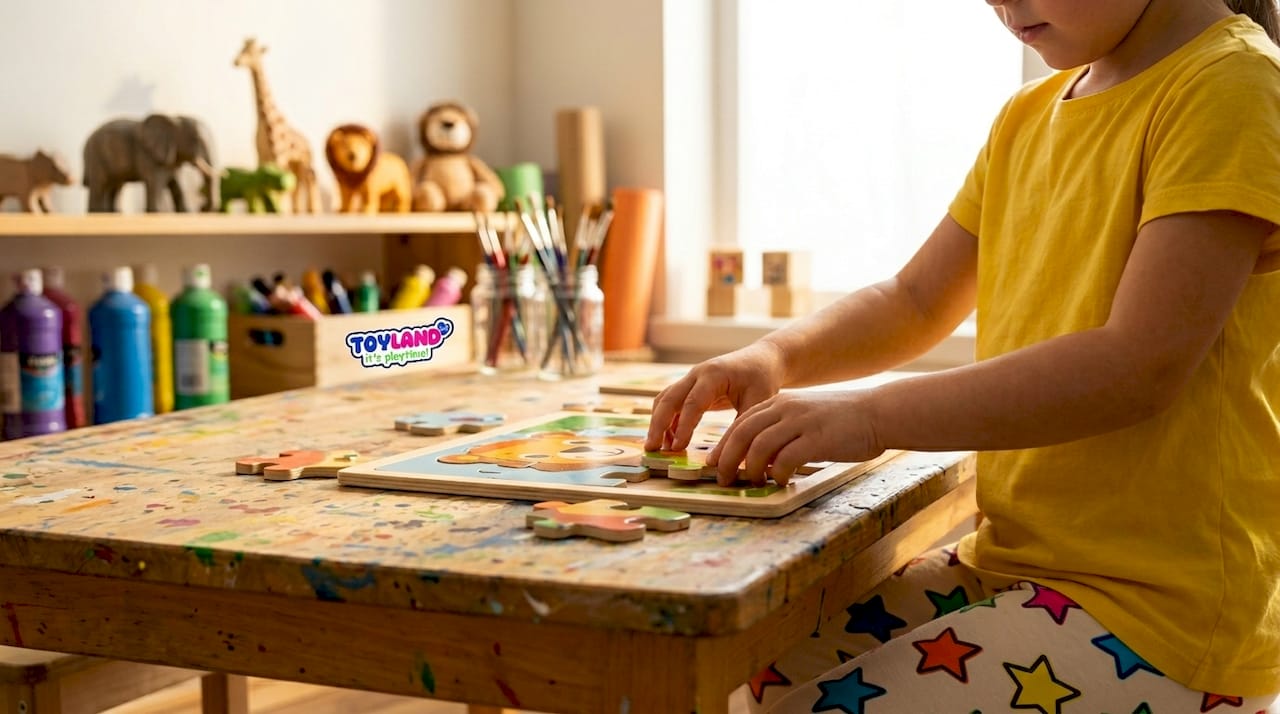
On the physical side, puzzle-based stimulation enhances fine motor development, with children showing measurable improvement on fine motor tasks after regular puzzle play. This matters because fine motor skills, the precise movements of fingers and hands, underpin writing, drawing, buttoning clothes, and using utensils. Puzzles with knobs, small pieces, or shaped slots require children to pinch, grasp, rotate, and place with real precision. That repeated controlled movement builds the hand muscles and coordination children need for school readiness.
On the cognitive side, the picture is even more interesting. Research shows that inhibitory control predicts puzzle performance in preschoolers and partially explains why older children outperform younger ones even on puzzles they’ve never seen before. Inhibitory control is the ability to pause an impulse, think before acting, and resist picking up a wrong piece just because it looks close. It’s the foundation of self-regulation, focus, and academic success.
“Inhibitory control significantly predicts puzzle performance and partially mediates the effect of age on puzzle solving in preschoolers.” — Early Childhood Education Journal, 2025
Here’s what that means for you as a parent. The benefits children get from toys that supercharge learning depend heavily on whether the activity demands just enough cognitive effort to require self-control without triggering shutdown. When a child works a puzzle that’s slightly challenging, they’re not just assembling pieces. They’re practicing the mental skill of checking impulses and trying again.
Key cognitive and physical skills strengthened by regular puzzle play:
- Inhibitory control (pausing, planning, checking before placing)
- Spatial reasoning (rotating pieces mentally before moving them physically)
- Fine motor precision (controlled grasping and placement)
- Persistence and patience (working toward a goal over time)
- Visual discrimination (spotting shape, color, and pattern differences)
Types of puzzle toys and how to choose the right one for your child
Not all puzzle toys are the same, and matching the type to your child’s age, fine motor skill level, and self-regulation capacity makes a significant difference. Puzzle performance varies by difficulty, theme, and a child’s inhibitory control, which means that picking based on the box’s age label alone often misses the mark.
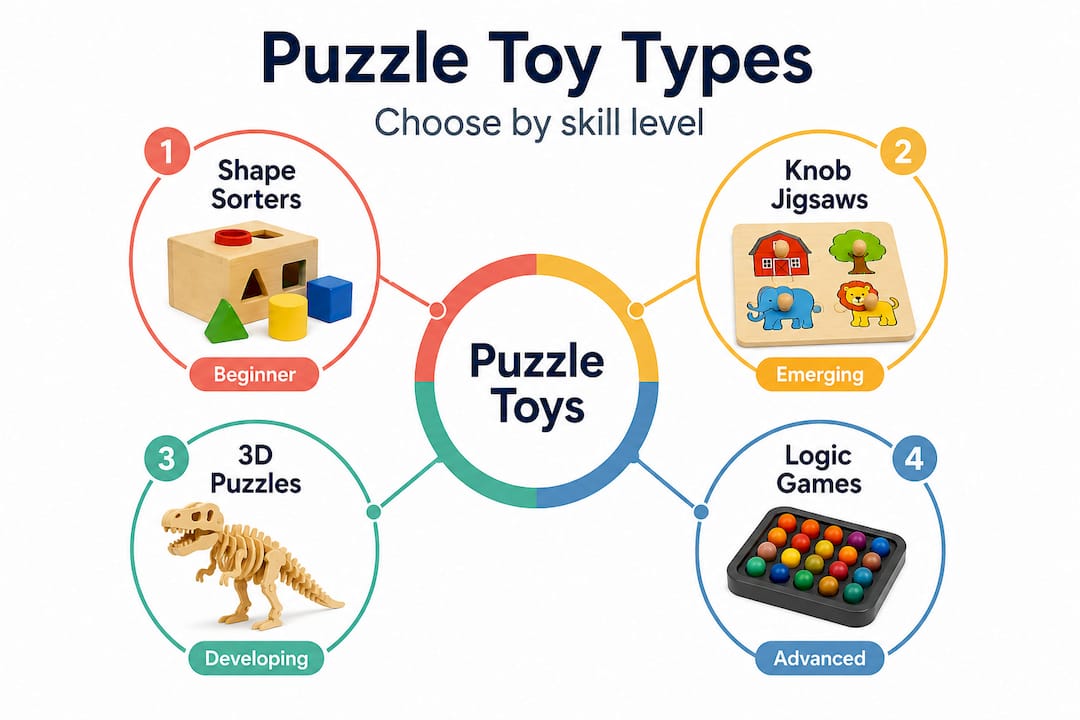
Here’s an overview of the most common types:
| Puzzle type | Best age range | Key developmental benefit | Difficulty level |
|---|---|---|---|
| Peg puzzles | 18 months to 3 years | Pincer grasp, shape recognition | Low |
| Shape sorters | 18 months to 3 years | Spatial reasoning, problem solving | Low |
| Chunky jigsaw (4 to 12 pieces) | 2 to 4 years | Visual discrimination, patience | Low to medium |
| Standard jigsaw (20 to 100 pieces) | 4 to 8 years | Planning, persistence, spatial reasoning | Medium |
| 3D puzzles and tangrams | 6 to 12 years | Advanced spatial reasoning, creativity | Medium to high |
| Logic and sequence puzzles | 7 to 12 years | Inhibitory control, deductive reasoning | High |
How to choose the right puzzle toy in five steps:
- Assess your child’s current fine motor skill level. Can they pick up small objects with two fingers? If not, start with knob or chunky pieces.
- Watch how your child handles mild frustration. A child with strong self-regulation can handle more pieces and more complexity.
- Start one step below what you think they can handle. Early success builds the confidence to take on harder challenges.
- Pick themes your child already loves. Animals, vehicles, or favorite characters make the content motivating.
- Check the piece size and physical demands. Tiny pieces with irregular shapes are high fine motor demand, even if the design looks simple.
Pro Tip: Ignore the age label on the box if it conflicts with what you observe. A four-year-old with strong focus and finger control may thrive on a 40-piece puzzle, while a six-year-old with lower frustration tolerance may still be best served by 24 pieces. Trust your observations over the packaging, and consult a resource like choosing the best toys if you want a broader framework.
Maximizing learning and fun: tips for using puzzle toys effectively
Owning the right puzzle is only half the equation. How you introduce and support puzzle play shapes how much your child benefits from it.
Practical tips to get more from puzzle time:
- Start below the frustration threshold. Introduce a new puzzle with fewer pieces than you think your child needs. Build up gradually as they succeed.
- Sit nearby, but don’t solve it for them. Your physical presence signals safety and support. But jumping in to place pieces robs the child of the cognitive reward.
- Name what they’re doing. “You tried three pieces before finding the right one. That’s called persistence.” Labeling the skill makes the child aware they’re practicing something real.
- Rotate puzzles every two to three weeks. Familiarity lowers the challenge. Bring back old puzzles after a break and they’ll feel fresh again.
- Celebrate the process, not just the finish. Commenting on their strategy, “I noticed you sorted all the edge pieces first,” builds more confidence than “Good job!”
Pro Tip: Pair puzzle time with a calm, low-distraction environment. Background noise from screens competes for the same focused attention puzzle-solving requires. Even ten focused minutes with a puzzle delivers more developmental benefit than thirty distracted minutes. Explore brain development toys to round out the play environment with complementary options.
Puzzle toys vs. other educational toys: understanding the unique benefits
Parents today have access to a wide range of educational toys, from STEM kits to coding robots to art supplies. Understanding where puzzle toys fit, and what they do that other toys don’t, helps you build a play environment that covers all the developmental bases.
| Feature | Puzzle toys | Interactive electronic toys | STEM building kits | Art and craft toys |
|---|---|---|---|---|
| Fine motor training | High | Low to medium | Medium | Medium |
| Independent problem-solving | High | Low (adult or device-led) | Medium | Low |
| Inhibitory control practice | High | Low | Medium | Low |
| Creativity and open-ended play | Low to medium | Low | High | High |
| Screen-free engagement | Yes | Often no | Yes | Yes |
The standout advantage of puzzle toys is that the child drives the entire experience. There’s no app telling them what to try next, no flashing light rewarding a random tap. The feedback is intrinsic: the piece either fits or it doesn’t. That self-directed engagement is what builds genuine problem-solving confidence over time.
Where puzzle toys can feel limited is in creativity and imagination. A 48-piece animal jigsaw doesn’t let a child invent a story or build something new. That’s why puzzle toys work best as part of a broader toy mix rather than a replacement for everything else.
Key ways puzzle toys complement other educational toys:
- Pair jigsaw puzzles with STEM learning toys to combine spatial reasoning with engineering thinking.
- Use tangram puzzles alongside art materials to reinforce shape and composition skills.
- Introduce logic puzzles alongside early math games for children aged six and above.
Why tailoring puzzle difficulty to your child’s self-regulation skills is key
Most parents choose puzzle toys based on two things: the age range on the box and the piece count. Both are useful starting points, but they miss the factor that research now identifies as the strongest predictor of whether a child will succeed and benefit from a puzzle: inhibitory control.
Inhibitory control is your child’s ability to pause, suppress an incorrect response, and try a different approach. It’s the mental brake that stops them from forcing a piece that doesn’t fit. A child with strong inhibitory control will work through a difficult puzzle methodically. A child still developing that skill will hit a wall fast, even on a puzzle that looks age-appropriate on paper.
Choosing puzzles slightly below a child’s frustration threshold keeps their self-control intact long enough for real learning to happen. When a child’s regulatory system is overwhelmed, they’re no longer learning. They’re just surviving the discomfort. And if that happens repeatedly with puzzle toys, they stop wanting to engage with them at all.
The conventional advice is to increase difficulty gradually, which is right. But what most guides leave out is that the signal for when to move up shouldn’t be age or time. It should be behavior. Watch for focused trial and error, self-correction, and the ability to return to the puzzle after a short break without a meltdown. Those are signs the self-regulation capacity is growing. That’s the right moment to introduce more complexity.
We’d also push back on the idea that frustration is always a problem to eliminate. Mild, manageable challenge is actually where the most growth happens. The goal isn’t to make puzzles so easy your child breezes through them. It’s to keep the challenge just inside their window of tolerance so they stay curious, not defeated. Pair this thinking with guidance on STEM toys by age to build a developmental toy rotation that grows alongside your child.
Explore educational puzzle and creative learning toys at ToylandEU
If this guide has helped you see puzzle toys in a new light, the next step is finding products that actually deliver on the developmental promise.
At ToylandEU, we’ve curated a selection of educational play products designed with real developmental thinking behind them. The Montessori drawing adventure matching game blends spatial reasoning with creative engagement, ideal for ages 3 to 12. For children ready for a more advanced spatial challenge, the TOBEFU 3D tangram puzzle builds three-dimensional thinking in a hands-on, interactive format. And for families who want to complement puzzle play with artistic development, the enchanting kids art workbook rounds out the creative learning experience. All orders ship free, worldwide.
Frequently asked questions
What age is best to start introducing puzzle toys to children?
Children as young as 18 months can engage with simple peg or shape-sorting puzzles, but puzzle toys designed for ages 3 and up are ideal for supporting growing fine motor and cognitive skills more deliberately.
How do puzzle toys help with a child’s cognitive development?
Puzzle toys strengthen problem-solving, patience, and focus, and inhibitory control predicts puzzle success in preschoolers, meaning regular puzzle play actively trains the self-regulation skills children need throughout their education.
How can I tell if a puzzle toy is too hard for my child?
Consistent frustration, avoidance, or anger during puzzle time are clear signs the challenge is too high. Research recommends starting below the frustration threshold to keep self-control intact and learning on track.
Are all puzzle toys equally beneficial for fine motor development?
No. Puzzles that require deliberate grasping and precise placement, like knob puzzles or shaped piece jigsaws, deliver the strongest fine motor benefits, with controlled placement tasks showing the clearest gains in preschool-aged children.
How do puzzle toys differ from other educational toys?
Puzzle toys are uniquely self-directed. Unlike electronic educational toys that prompt the child through each step, puzzle toys require the child to generate and test their own solutions independently, building stronger intrinsic problem-solving confidence over time.