

What is a puppet toy? Meaning, benefits, and types
- Puppet play reduces children’s anxiety and promotes emotional regulation through creative storytelling.
- Different puppet types support developmental skills like language, imagination, and social interaction.
- Safety, size, materials, and age appropriateness are key factors in choosing effective puppet toys.
Many parents glance at puppet toys on a store shelf and wonder whether they belong in the same conversation as tablets, STEM kits, or building sets. The truth is, puppet play has measurable science behind it. A randomized controlled trial found that puppet sessions significantly reduced anxiety and lowered heart rates in young children, with results strong enough to reach statistical significance at p<0.001. Far from being a relic of Saturday morning TV, puppet toys sit at a rare intersection of creativity, language growth, and emotional learning. This article breaks down exactly what a puppet toy is, the main types available, what the research says about their benefits, and how to choose one wisely.
Table of Contents
- What is a puppet toy?
- Types of puppet toys: Hand, finger, sock, and more
- Developmental and educational benefits of puppet play
- Choosing and using puppet toys safely and effectively
- Integrating puppet toys into daily play and learning
- Why puppet toys still matter: An expert perspective
- Discover more toys to inspire learning and play
- Frequently asked questions
Key Takeaways
| Point | Details |
|---|---|
| Puppet toys defined | A puppet toy is a figure moved by hand, rods, or strings, perfect for play and storytelling. |
| Types for all ages | Hand, finger, and sock puppets offer choices from babies to adults with options for every skill level. |
| Real-world benefits | Research proves puppet play boosts creativity, language, social confidence, and emotional regulation. |
| Safe, creative play | Soft, washable puppets sized for your child provide the safest and most engaging experiences. |
| Easy integration | Puppets fit naturally into daily routines, from storytime to helping kids talk about feelings. |
What is a puppet toy?
Now that you know puppet toys support learning, let’s clarify what actually defines a puppet toy. According to Wikipedia, a puppet toy is a manipulable figure resembling humans, animals, or creatures, controlled by hand, rods, or strings to animate it for play, storytelling, and performance. That definition covers a wide range of objects, from a simple sock with button eyes to an elaborate marionette with jointed limbs.
At its core, every puppet toy shares a few defining features:
- A figure or character form: Human, animal, monster, or fantasy creature
- A control mechanism: Fingers, whole hand, rods, or strings
- An expressive element: Moving mouth, nodding head, or waving arms
- Child-safe materials: Fabric, felt, foam, or soft vinyl
Mechanics range from simple to complex. A basic hand puppet slides over the whole hand, letting fingers control a moving mouth. More advanced versions add rod-controlled arms or articulated fingers. The simplest entry points are hand puppets and finger puppets, which require no special skill to operate.
Materials matter a lot for young children. Most quality puppet toys for kids use soft, washable fabrics or non-toxic felt. If you are curious about more elaborate construction, the craft of wooden puppets crafting offers a fascinating look at how traditional materials come together. For families who enjoy making things together, exploring DIY puppet ideas can turn a rainy afternoon into a creative project.
Pro Tip: If your child is new to puppets, start with a hand puppet that fits their small hand snugly. A puppet that flops around because it is too large kills the fun fast.
Types of puppet toys: Hand, finger, sock, and more
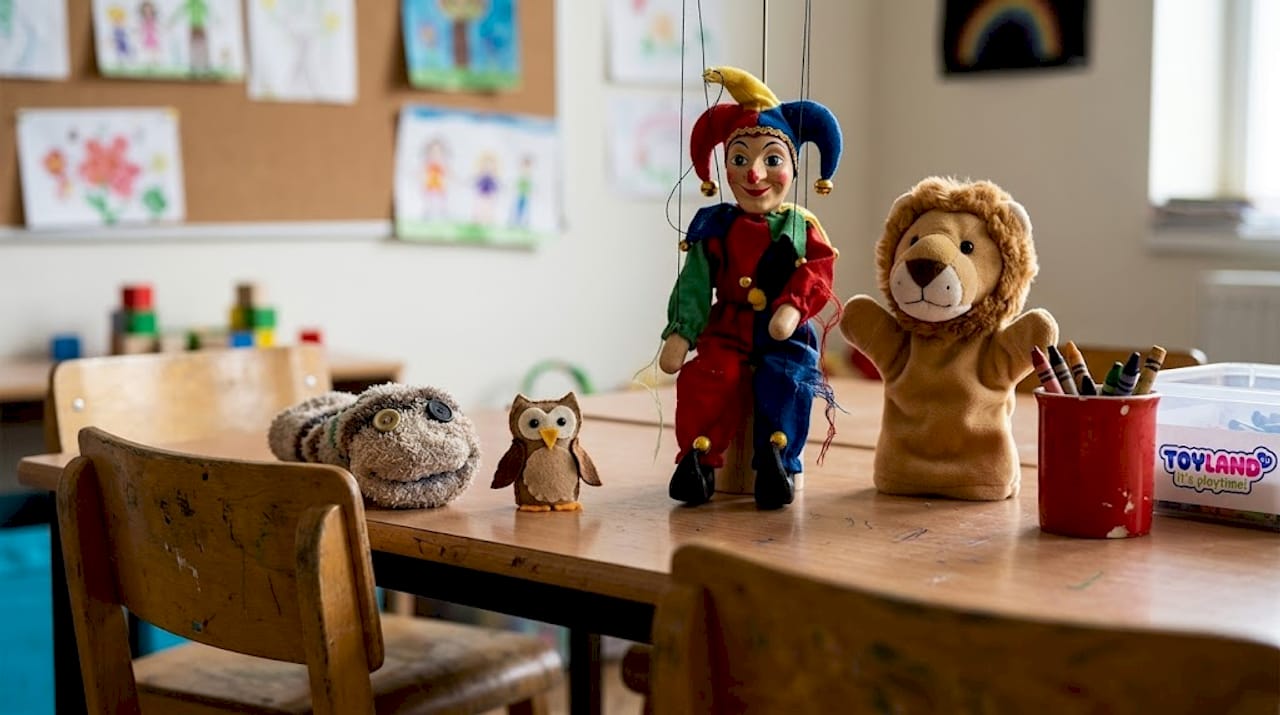
With the basics covered, it is useful to see what varieties of puppet toys you might find. Common types for young children include hand puppets, finger puppets, and sock puppets, each with distinct advantages depending on your child’s age and interests.
| Type | Best age | Complexity | Key advantage |
|---|---|---|---|
| Hand puppet | 2 to 6 years | Low | Expressive, easy to use |
| Finger puppet | 1 to 4 years | Very low | Portable, great for travel |
| Sock puppet | 3 years and up | DIY-friendly | Encourages creativity |
| Marionette | 7 years and up | High | Develops fine motor skills |
| Rod puppet | 5 years and up | Medium | More dramatic movement |
Here is a quick breakdown of what makes each type distinct:
- Hand puppets slip over the whole hand like a glove. Your fingers control the mouth and head movements, making them feel alive instantly. They are the most popular choice for preschool-aged children.
- Finger puppets are tiny characters that fit over individual fingers. They are perfect for storytelling on the go and work especially well for top toys for toddlers because they are compact and easy to grip.
- Sock puppets are the ultimate accessible option. An old sock, two buttons, and some felt scraps become a character in minutes. The DIY nature of sock puppets adds a layer of ownership that kids love.
- Marionettes use strings attached to a control bar. They look spectacular but require real coordination, making them better suited to older children or adult performers.
- Rod puppets sit between hand puppets and marionettes in complexity. A central rod holds the body while additional rods move the arms, allowing for more theatrical gestures.
Choosing the right type comes down to your child’s age, patience, and how you plan to use the puppet together.
Developmental and educational benefits of puppet play
Understanding different puppet types leads to a key question: what do these toys actually offer your child’s growth? The answer is more substantial than most parents expect.
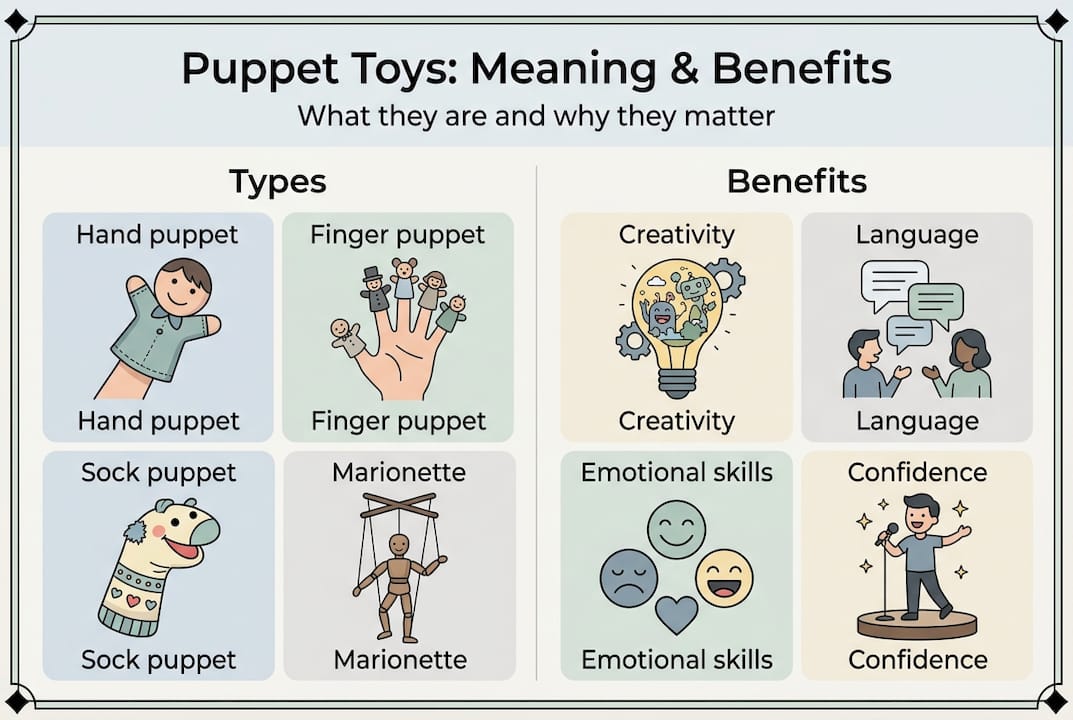
Creativity. A puppetry workshop study found measurably improved creativity scores in preschoolers after structured puppet sessions. Children who regularly engage in puppet play generate more original ideas and show stronger imaginative thinking. The broader research on imaginative play benefits confirms that open-ended, character-driven play is one of the most powerful tools for creative development.
Language development. When children voice a puppet, they practice vocabulary, sentence structure, and storytelling rhythm without the pressure of speaking as themselves. This indirect approach lowers self-consciousness and encourages more complex language use.
Emotional regulation. A puppet gives children a safe distance from difficult feelings. A child who struggles to say “I am scared” might have their puppet say it instead. Research shows puppet sessions reduced anxiety and lowered heart rates from a range of 94 to 106 bpm, a meaningful physiological shift. For children who need extra support, calming sensory toys and puppet play can work together as part of a broader toolkit.
Social skills. Puppet play naturally involves turn-taking, listening, and responding to another character. These micro-interactions build empathy and cooperation in ways that feel like play, not practice.
Here is a simple sequence to maximize these benefits at home:
- Choose a familiar story your child already loves
- Assign a puppet character to each person in the scene
- Act out the story once, then let your child change the ending
- Ask open questions: “How does your puppet feel right now?”
- Let your child lead a second round completely on their own
Educators at Edutopia confirm that puppet activities can anchor an entire kindergarten curriculum, covering literacy, math, and social-emotional learning in a single session.
Pro Tip: Retell a real situation your child found confusing or upsetting using puppets. The distance the puppet provides often unlocks conversations that would otherwise stay closed.
Choosing and using puppet toys safely and effectively
Knowing the benefits, parents can maximize both enjoyment and safety if they follow a few key steps. Safety guidelines from childcare professionals recommend soft, non-toxic materials and slow, gentle movements for babies to avoid startling them, with supervision required whenever small parts are present.
Follow these steps when selecting a puppet toy:
- Check materials first. Look for washable fabric, non-toxic dyes, and no sharp edges. Puppets go in mouths. That is just reality.
- Match size to the child’s hand. A puppet that fits properly is far more engaging than one that slips off constantly.
- Assess moving parts. Buttons, googly eyes, and decorative beads can detach. For children under three, choose puppets with embroidered or printed features instead.
- Consider complexity. Younger children need simple hand or finger puppets. Save marionettes for age-appropriate puppet choices that match their developmental stage.
- Plan for washing. Puppets that cannot be cleaned become hygiene problems quickly. Check the label before buying.
For maintenance, most fabric puppets can be hand-washed in cool water with mild soap. Air dry them flat to preserve their shape. Avoid machine drying, which can warp foam inserts or cause colors to bleed.
When it comes to play, move the puppet slowly and deliberately at first. Sudden, jerky movements can frighten younger children. Build up to more animated performances as your child grows comfortable. Exploring best toys for preschoolers alongside puppets can round out a well-balanced play environment.
Pro Tip: Prioritize durable, washable, and child-hand-sized puppets over elaborate ones. A simple puppet your child uses every day beats a fancy one that stays on the shelf.
Integrating puppet toys into daily play and learning
Once you have selected the right puppet, here is how to weave it into your child’s everyday routines and learning. The key is consistency and variety, not elaborate setups.
Simple home activities that work well include:
- Story retelling: After reading a book together, act out the story with puppets. This reinforces comprehension and lets children reinterpret the narrative.
- Emotion check-ins: Use a puppet at the start or end of the day to ask how your child is feeling. Many children find it easier to answer as or through a character.
- Transition routines: A puppet that “announces” bedtime or cleanup time can reduce resistance. Children respond to characters in ways they do not always respond to direct instruction.
- Make-believe conversations: Let the puppet interview your child about their day, favorite foods, or imaginary adventures. This builds conversational fluency naturally.
Puppets also integrate surprisingly well into academic learning. Puppet activities for curriculum show how hand puppets are ideal for young children due to their easy manipulation and intimate engagement, while marionettes suit older learners who can handle the added complexity. You can use puppets to count objects in math, act out the water cycle in science, or practice letter sounds in literacy.
For families who want to extend creative play beyond puppets, interactive dolls for creativity offer a complementary avenue for imaginative, character-driven play. You can also find a solid overview of puppet basics at Kiddle’s puppet resource, which is written accessibly for families.
Pro Tip: Rotate puppets or swap in new characters every few weeks. Novelty keeps the play fresh and gives children new emotional and creative territory to explore.
Why puppet toys still matter: An expert perspective
Beyond practical tips, it is worth asking why puppet toys remain relevant today. Screens offer animation. Robots offer interactivity. So why does a fabric figure on a child’s hand still hold up?
The answer is that puppet play asks something of the child that passive entertainment never does. The child is the animator, the writer, the voice, and the audience all at once. That creative demand is irreplaceable. Modern toys may be more complex, but few match puppets’ low-pressure creativity and emotional engagement.
There is also a timing argument. Research confirms that puppet play benefits are empirically strongest in early childhood and decline in older education. The window is real. A five-year-old gains far more from puppet play than a ten-year-old will. That makes the early years uniquely important for this kind of investment.
For shy, anxious, or neurodivergent children, the value goes even deeper. The puppet creates a layer of emotional distance that lowers the stakes of self-expression. A child who freezes when asked to speak directly may flourish when speaking through a character. Simple and handmade options, like those explored in wooden puppet crafting, make this accessible to every family regardless of budget.
Puppet toys are not nostalgic novelties. They are one of the most efficient creative and emotional tools available for young children, and they cost far less than most alternatives.
Discover more toys to inspire learning and play
Inspired to boost your child’s creative play with puppet toys and more? At ToylandEU, we have spent years curating toys that do more than entertain. They build skills, spark imagination, and grow with your child.
If you are looking for the next step after puppets, our princess reborn toddler doll is a beautifully crafted soft vinyl collectible that encourages nurturing, imaginative play in a similar spirit. For children ready to build and create, our DIY princess dollhouse combines hands-on construction with storytelling. Both ship free worldwide, and our full catalog of over 30,000 toys means you will always find something that fits your child’s stage and your family’s values.
Frequently asked questions
What age is best for introducing puppet toys?
Hand puppets and finger puppets are suitable from birth with supervision, but children aged 2 to 6 get the most engagement and developmental benefit from regular puppet play.
Are puppet toys safe for toddlers?
Yes, as long as you choose soft, non-toxic, washable puppets and avoid designs with small detachable pieces that could become choking hazards.
How do puppet toys help with language development?
Puppet play encourages children to speak, listen, and imagine simultaneously, which strengthens vocabulary and communication. Research shows language and speaking skills improve measurably after structured puppet sessions.
Are DIY puppet toys as effective as store-bought ones?
Absolutely. DIY puppets are just as beneficial for creativity and learning. Simple handmade options actually emphasize accessibility and handcrafting, adding personalization that store-bought toys cannot replicate.
Can puppet toys help children with anxiety or special needs?
Yes. Puppet play is actively used in therapeutic settings. Anxiety and heart rates both dropped significantly in children who participated in puppet sessions, making it a well-supported tool for emotional support.