

3.4 Ounce Rule and Batteries: TSA Toy Rules for U.S. Parents
Most toys can travel on U.S. commercial flights, but realistic weapon replicas, oversized liquid or gel toys, and improperly packed lithium batteries have special rules. The TSA rules toys fall under mostly follow common sense: if it looks dangerous on an X-ray screen or acts like a liquid, expect questions. Everything else, from stuffed animals to building sets, usually clears security without a second look.
TL;DR:
- Toy guns, realistic replicas, and any toy shaped like a weapon must be packed in checked luggage, as they are prohibited in carry-on bags.
- Liquid or gel toys, including slime and stress balls, must adhere to the 3-1-1 rule with containers limited to 3.4 ounces and placed in a quart-sized bag.
- Spare lithium batteries for electronic toys must stay in carry-on luggage with terminals protected, while installed batteries are generally allowed in checked bags.
- Oversized or rigid toys like foam swords, bats, and costume weapons should be checked due to their resemblance to real weapons on X-ray scans.
- Packing toys in a single, flat layer rather than a tangled jumble helps avoid triggering manual inspections at security checkpoints.
Table of Contents
- What Are the TSA Rules for Toys in Carry-On Bags?
- Are Toy Guns Allowed on Planes?
- Can You Bring Battery-Powered Toys on a Plane?
- Do Gel and Liquid Toys Follow the 3-1-1 Rule?
- What About Toy Swords, Bats, and Musical Instruments?
- How Does TSA Screen Kids and Their Toys?
- What Happens If TSA Flags or Confiscates a Toy?
- How Toylandeu™ Thinks About Travel-Friendly Toys
- A Parent’s Real-World Take on Packing Toys for Flights
- Travel-Ready Toy Picks That Skip the Checkpoint Hassle
- Official TSA Resources Worth Bookmarking
- Sources
- FAQ
What Are the TSA Rules for Toys in Carry-On Bags?
Here’s the fast version parents need before they start packing: plush animals, board games, small plastic figures, and most battery-operated toys sail through checkpoints without issue. The trouble spots are predictable once you know them, and they almost always involve one of three things: something shaped like a weapon, something liquid or gel-based, or something with loose batteries rattling around.
TSA officers scan bags by X-ray image, and their job is to spot anything that looks concerning on that screen. A stuffed elephant reads as harmless. A detailed toy pistol can read as a real one, at least until an officer takes a closer look. That’s the whole logic behind most childrens toys TSA rules you’ll encounter.
Here’s a category-by-category rundown for the toys families pack most often:
- Plush toys and stuffed animals: Always allowed in carry-on and checked bags, no restrictions.
- Small plastic toys and action figures: Allowed in carry-on; large collections may need to come out of a stuffed bag for a clearer X-ray image.
- Toy guns and realistic replicas: Not allowed in carry-on; pack in checked baggage. Replica explosives, like toy grenades, are banned entirely.
- Foam swords and blunt costume weapons: Generally allowed in carry-on if clearly foam or plastic and not sharp, but oversized versions sometimes get flagged for checked baggage.
- Gel-filled toys (stress balls, gel pads): Subject to the 3-1-1 liquids rule in carry-on; anything over 3.4 ounces goes in checked luggage.
- Slime: Treated as a liquid or gel under TSA’s gel-filled toys guidance; containers must meet the 3-1-1 limit or travel checked.
- Battery-powered toys: Allowed in carry-on and checked bags, but spare lithium batteries must stay in carry-on only.
- Glow sticks: Typically allowed in both carry-on and checked bags in reasonable quantities for personal use.
- Musical instruments (toy or real): Allowed in carry-on if they fit sizing rules; larger instruments may need a purchased seat or gate-check arrangement with the airline.
That list covers the situations that come up on almost every family trip, but it’s not exhaustive. TSA updates its guidance periodically, and the safest habit is running a quick search through the Complete List (Alphabetical) tool before you pack, especially for anything unusual like a science kit with chemical components or a drone-style toy with lithium cells.
One thing worth repeating throughout this whole guide: TSA guidance is a strong predictor of what happens at the checkpoint, but the officer standing in front of you makes the final call on any given item. Two travelers can pack the identical toy and have completely different experiences depending on how it looks on the scanner that day, how busy the line is, and what else is stacked around it in the bag.
Pro Tip: Pack toys so they sit in a single layer rather than a tangled pile. A jumble of small plastic parts and wires reads as a cluttered, hard-to-interpret image on X-ray, and that’s exactly the kind of thing that triggers a bag pull for manual inspection.
If you’re traveling with a toddler’s entire toy bag, consider splitting oversized or borderline items (big foam weapons, gel toys, anything electronic with spare batteries) into checked luggage from the start. It saves you from repacking at the checkpoint while three kids and a stroller wait behind you.
Are Toy Guns Allowed on Planes?
The short answer: not in your carry-on. TSA guidance is direct on this point. Toy guns, water guns, and weapon-style toys that resemble realistic firearms are prohibited in carry-on bags and should be packed in checked luggage instead. Replica explosives, including toy grenades, are banned from both carry-on and checked bags entirely, no exceptions.
The reasoning is simple once you think about it from the officer’s side of the X-ray monitor. A detailed toy pistol, especially one made of metal or dense plastic with realistic proportions, produces an image that’s genuinely hard to distinguish from a real firearm in the seconds an officer has to make a call. Bright colors and obvious plastic seams help, but they don’t guarantee anything. When TSA can’t rule out a real weapon from the image alone, the bag gets pulled, and that means a delay for you and everyone behind you in line.
Here’s what typically gets flagged in carry-on bags and why:
- Detailed toy pistols or rifles, especially matte black or metallic finishes that mimic real firearm coloring.
- Nerf-style blasters with dense internal mechanisms that create a cluttered, ambiguous X-ray image.
- Any item shaped like a grenade, mine, or other explosive device, toy or not, prohibited outright.
- Costume weapons with metal components (swords, knives, or axes with real blade material rather than foam).
- Realistic-looking cap guns or starter pistols, even ones clearly marketed as toys.
Packing weapon-like toys for checked baggage isn’t complicated, but a few steps make the process smoother. Wrap the item in a soft layer, like a shirt or towel, so it doesn’t shift loosely during handling. Place it toward the center of the suitcase rather than pressed against the outer shell, which reduces the chance of damage and keeps it from looking like a standalone object if the bag gets a manual check. If you’re flying with a costume weapon for a convention or Halloween trip, call the airline ahead of time. Some carriers have their own supplemental restrictions on prop weapons that go beyond TSA’s baseline rules, particularly on international routes.
Pro Tip: If your child has a favorite toy blaster or sword, take a photo of it before your trip. If it does get flagged or held for review, having a clear picture on your phone speeds up any conversation with airline staff or TSA about what the item actually is.
One nuance parents often miss: it’s not about whether an item is technically a toy. It’s about whether it looks like a weapon on an X-ray scanner in under two seconds. That distinction decides more checkpoint outcomes than any rulebook.
Can You Bring Battery-Powered Toys on a Plane?
Yes, and this is where most parents actually get tripped up, not on the toy itself but on the batteries inside it. TSA and FAA rules treat installed batteries and spare batteries differently, and that difference matters for how you pack.
A toy with its battery already installed, whether it’s a remote-controlled car, a singing plush, or a light-up wand, can go in either carry-on or checked baggage without much fuss. The rules tighten up once you’re talking about spare batteries, particularly lithium and lithium-ion cells, which have to stay in the cabin with you. Spare lithium batteries and power banks must be carried in your carry-on bag, not checked luggage, and their terminals need to be protected against short-circuiting.
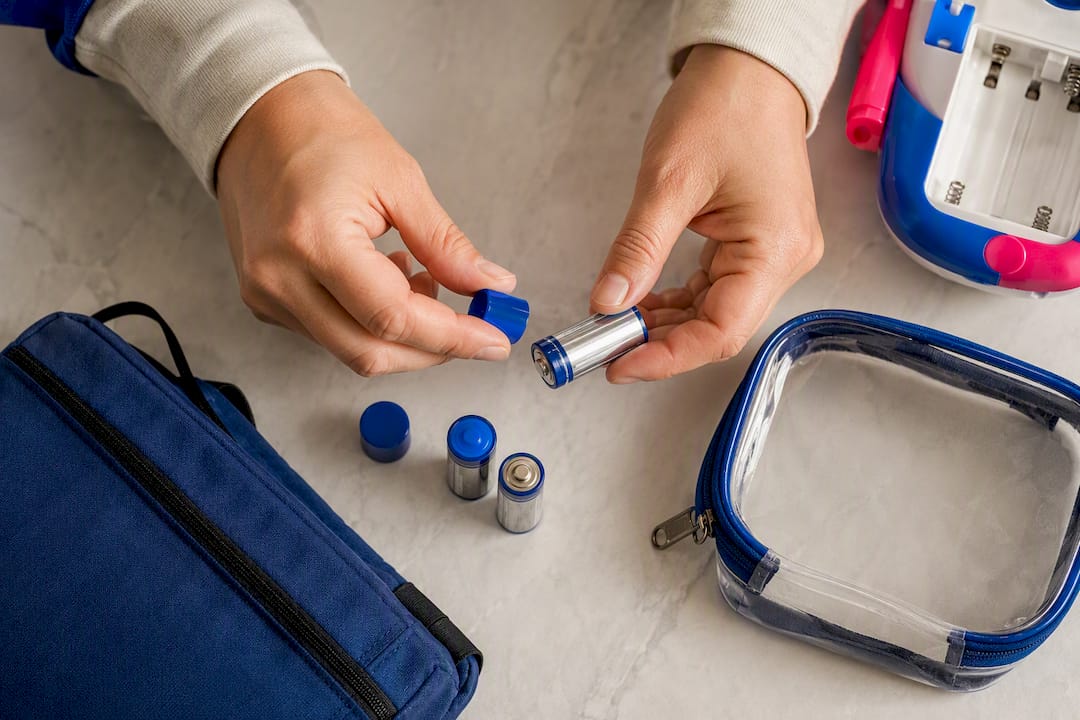
That rule exists because lithium batteries carry a small but real fire risk if the terminals contact metal or each other and short out. In the cargo hold, a battery fire can go undetected for critical minutes. In the cabin, a flight attendant or passenger can respond immediately.
Here’s how to handle batteries the right way when you’re packing toys for a flight:
- Keep spare lithium batteries and portable power banks in your carry-on bag only, never in checked luggage.
- Cover battery terminals with tape or store them in individual plastic sleeves to prevent accidental short-circuiting.
- Never pack damaged, swollen, or corroded batteries, in a toy or as spares. Replace them before you travel.
- Leave batteries installed inside the toy rather than loose whenever possible; installed batteries face fewer restrictions than loose spares.
- If a toy uses a built-in rechargeable battery pack (common in RC cars and drones), check the manufacturer’s watt-hour rating if it’s listed. Most consumer toy batteries fall well under airline limits, but larger hobby-grade batteries sometimes need special handling.
If you’re ever unsure whether a specific toy’s battery setup is fine to fly with, the simplest fix is to remove the battery entirely and pack the toy in checked baggage while the battery rides in your carry-on. It adds one extra step at your destination (popping the battery back in), but it eliminates the guesswork at security.
Parents shipping toys internationally or buying electronics-heavy gifts should also understand the broader shipping-side battery rules, which Toylandeu™ breaks down in its guide to shipping toys with lithium batteries. The packing principles overlap heavily with what you’ll do at airport security: isolate the battery, protect the terminals, and keep it out of the cargo hold when it’s a spare.
Do Gel and Liquid Toys Follow the 3-1-1 Rule?
Yes, without exception. Gel-filled toys and liquid-based sensory items have to comply with the same 3-1-1 liquids rule that governs shampoo and toothpaste in carry-on bags: each container maxes out at 3.4 ounces (100 ml), and everything has to fit inside one quart-sized clear bag. Anything bigger has to travel in checked luggage instead.
This catches a surprising number of families off guard, mostly because gel toys don’t feel like liquids. A squishy stress ball or a gel-filled teething toy seems solid enough sitting in your hand. On an X-ray and under TSA’s definitions, though, gel behaves exactly like a liquid, and it gets treated that way at the checkpoint every time.
Common toys that fall under this rule include:
- Gel-filled stress balls and squishy toys: Fine in carry-on under 3.4 ounces per container; larger ones need checked baggage.
- Slime and putty: Treated as a gel; container size limits apply the same way.
- Snow globes: The liquid inside almost always exceeds the 3.4-ounce limit, so these typically need to go in checked bags. Fragile glass globes should be wrapped well regardless of which bag they ride in.
- Liquid-filled bath toys: Small ones under the limit are fine in carry-on; larger novelty versions should be checked.
- Water-based sensory toys for kids with sensory needs: Same 3.4-ounce rule applies, though TSA officers tend to give some flexibility here, especially with a TSA Cares notification filed in advance.
For anything headed into checked luggage, leaks are the real enemy, not TSA rules. Seal gel and liquid toys inside a zip-top bag before nesting them in your suitcase, and surround glass items like snow globes with clothing on all sides rather than just underneath. A cracked snow globe soaking into a suitcase full of clothes ruins more than the toy.
If a gel toy is a must-have for a long flight, look for a smaller travel-size version rather than trying to sneak the full-size one through in carry-on. It’s a five-minute swap that avoids a checkpoint conversation entirely.
What About Toy Swords, Bats, and Musical Instruments?
Sporting and novelty toys occupy a middle ground that trips up a lot of families packing for vacations, weddings, or school events. The general rule: if it’s rigid, elongated, or could double as a blunt weapon, it’s safer in checked baggage, even when the toy version is clearly plastic.
Toy baseball bats, hard plastic swords, and rigid costume weapons often get flagged in carry-on, not because TSA thinks a child is dangerous, but because the shape and density mimic real sporting or bladed equipment on an X-ray. Foam versions usually pass without trouble since foam reads very differently than solid plastic or wood.
A quick guide to what typically needs checked baggage instead of carry-on:
- Hard plastic or wooden toy bats and bo staffs.
- Costume swords, axes, or knives made of rigid material rather than foam.
- Toy javelins, arrows, or anything with a pointed rigid tip.
- Projectile toys that launch hard objects (some toy crossbows and dart guns fall here).
Musical instruments sit in their own category. Small ones, recorders, ukuleles, harmonicas, travel through security in carry-on without any special process, and they’re screened just like any other item in your bag. Larger instruments, a full-size guitar, a cello, get into airline territory rather than TSA territory. Most airlines require oversized instruments to either fit in an overhead bin, get gate-checked, or occupy a purchased seat, and policies vary widely by carrier.
Call your airline directly if you’re traveling with anything larger than a small case instrument. TSA screening rules and airline size or fee policies are two separate systems, and clearing one doesn’t mean you’ve cleared the other. This applies just as much to oversized toy equipment, giant stuffed animals, inflatable pool toys, ride-on cars, where the real obstacle is airline baggage policy rather than airport toy regulations.
How Does TSA Screen Kids and Their Toys?
Traveling with young children changes the screening process in small but meaningful ways, and knowing them ahead of time saves everyone stress at the checkpoint.
During screening, all children’s items, including toys, bags, and strollers, need to go through the X-ray belt just like adult items. The good news is that TSA has built specific accommodations for families. Children 12 and under can keep their shoes and light jackets on during screening, and TSA keeps kids with their guardians throughout the process rather than separating them.
If your child has a disability, sensory sensitivity, or a medical device, TSA Cares is the program built for you. It’s a dedicated help line families can contact 72 hours before a flight to request a Passenger Support Specialist, ask about specific screening accommodations, or just get a heads-up on what to expect at a particular airport. It’s free, and it’s meant to be used, not saved for emergencies.
Here’s how to keep the checkpoint moving smoothly with kids and their toys in tow:
- Place toys, tablets, and any electronic items in a bin separate from clothing so the X-ray image stays clear and easy to read.
- Keep a favorite comfort toy easily accessible in an outer pocket rather than buried at the bottom of a backpack.
- Let your child carry their own small backpack if they’re old enough; it splits up the load and speeds up bin loading.
- Contact TSA Cares in advance if your child needs sensory accommodations, has a medical device, or gets anxious in crowded lines.
- Expect toys with a lot of wires or hidden compartments, big electronic playsets or robotics kits, to sometimes need a manual bag check, since complex internal components can be harder to interpret on X-ray, adding a little time to screening.
Pro Tip: Staying calm and cooperative during any secondary screening genuinely speeds things up. TSA’s own guidance emphasizes keeping kids with their guardians and minimizing stress, and officers tend to move faster through a bag check when the family isn’t visibly panicking about a missed flight.
What Happens If TSA Flags or Confiscates a Toy?
Getting pulled aside for a bag check isn’t the end of the world, and it’s more common than most parents expect, especially with electronics, gel toys, or anything shaped ambiguously on X-ray. Knowing your options in the moment keeps a minor delay from turning into a stressful scene.
- Stay put and stay calm. An officer will typically ask to open the bag or swab an item. Answer questions directly. Getting frustrated slows the process down, not up.
- Ask what specifically triggered the flag. Officers can usually tell you whether it’s the shape, a liquid limit, or a battery concern, which helps you avoid the same issue on your next trip.
- Decide fast if an item can’t fly in carry-on. You’ll generally get a choice: step out of the security line to check the item as luggage (if you haven’t already gone through baggage claim), mail it home, or surrender it voluntarily.
- Surrender prohibited items without argument. Replica explosives and other outright-banned items aren’t negotiable, and arguing only extends the delay.
- Know that civil penalties exist for serious cases. Most toy issues end in a simple confiscation or a redirect to checked baggage, but knowingly attempting to carry a genuinely prohibited or dangerous item can carry a civil penalty under TSA’s enforcement authority.
- Check TSA’s contact resources afterward if you believe an item was wrongly confiscated; TSA provides official channels for that kind of follow-up rather than resolving disputes at the checkpoint itself.
Most toy-related flags resolve in under five minutes once the officer sees the item isn’t a real threat. The bigger point: TSA officers retain final say on what passes through their checkpoint, and no guide, including this one, overrides that on any given day.
How Toylandeu™ Thinks About Travel-Friendly Toys
Selling toys internationally to families who travel constantly has taught Toylandeu™ which product features actually matter at security checkpoints, and which ones create headaches nobody warns you about until you’re standing in a TSA line.
The pattern is consistent: toys that are compact, non-liquid, and clearly non-realistic in shape move through security fastest. A soft plush character, a foldable art kit, a small clay set with dry or pre-measured components, none of these raise a single eyebrow at the X-ray belt. Compare that to a toy with a metallic finish shaped like a weapon, or a large jar of slime, and the difference in checkpoint friction is night and day.
For families shopping ahead of a trip, a few features are worth prioritizing:
- Low-mess, non-liquid materials that skip the 3-1-1 conversation entirely.
- Compact, foldable designs that fit in a carry-on without needing to argue about size.
- Bright colors and obviously non-realistic shapes for anything gun- or weapon-adjacent.
- Installed rather than loose batteries, with clear manufacturer labeling on battery type.
Toylandeu™ also covers the compliance side of toy shopping for U.S. families in more depth, including how CPSIA safety standards shape what ends up on store shelves and how to evaluate toy material safety before buying. The overlap with TSA rules isn’t a coincidence. Toys built to a safety standard tend to be the same toys that pack easily and screen cleanly, because both systems reward simple, well-labeled, non-hazardous design.
A Parent’s Real-World Take on Packing Toys for Flights
I’ve watched a family ahead of me in a security line get stopped over a toy walkie-talkie set, of all things, because the dense internal wiring created a cluttered X-ray image the officer wanted a second look at. Nothing was wrong with it. It just looked messy on the screen. The whole thing added maybe four minutes, but with a connecting flight and two overtired kids, four minutes felt like forty.
That’s the real lesson buried under all the official rules: TSA rules toys mostly by how they present at the checkpoint, not by how dangerous they actually are. A gel stress ball and a toy pistol have nothing in common except that both can slow you down if you don’t plan ahead.
If you remember nothing else, remember this: no realistic weapons or liquids over 3.4 ounces in carry-on, spare batteries stay with you, and pack loosely enough that nothing looks like a tangled mystery on the scanner.
— Thane Holland
Travel-Ready Toy Picks That Skip the Checkpoint Hassle
Packing smart starts with buying smart, and Toylandeu™ stocks plenty of options built for exactly the kind of trip this guide is about. Instead of gambling on whether a toy will raise questions at security, you can choose gear that was never going to be a problem in the first place.
The Enchanting Kids Art Workbook Montessori Drawing Kit is about as carry-on-friendly as it gets: flat, dry, and mess-free, with zero liquid or battery concerns to think about. For younger kids who need something to unroll and doodle on during a delay, the Creative Kids’ Colorful Drawing Scroll folds down small and keeps hands busy without a single security flag. If your child prefers something hands-on, the Vibrant 24-Color Clay Modeling Kit works well in carry-on, just pack the clay tubs upright and sealed to avoid any mess if a bag gets jostled. And for kids who love remote-control toys, the RC Durable Mini Remote Control Off-Road SUV travels fine as long as you follow the spare-battery rules covered earlier in this guide, installed battery in the car, any spares in your carry-on with terminals protected.
Whatever you pack, run it past the liquid and battery rules one more time before zipping the bag shut. If you’re weighing space for a bulky comfort item alongside your toys, checking your carrier size and shape needs ahead of time avoids a similar last-minute scramble. Browse the full travel-friendly selection at Toylandeu™ and get your family’s carry-on sorted before the next trip.
Official TSA Resources Worth Bookmarking
Rules shift periodically, so it’s worth checking these directly before any trip rather than relying on secondhand summaries, including this one.
- Toy Guns and Weapons: Official guidance on carry-on restrictions for realistic replicas and toy firearms.
- Gel-filled Toys: Details on how gel and liquid toys fall under the 3-1-1 rule.
- Traveling with Children: TSA Cares information and screening accommodations for families.
- Complete List (Alphabetical): Searchable tool for checking any specific item before you pack.
- Toys (Adult): Guidance covering novelty adult toys and carry-on allowances.
Sources
- Toy Guns and Weapons | Transportation Security Administration
- Gel-filled Toys | Transportation Security Administration
- Traveling with Children | Transportation Security Administration
FAQ
What Toys Are Not Allowed on Planes?
Realistic-looking toy guns and weapon replicas are barred from carry-on bags, and replica explosives like toy grenades are banned from both carry-on and checked luggage entirely. Gel or liquid toys over 3.4 ounces and loose spare lithium batteries in checked bags also run into trouble.
Are Toy Guns Allowed on Planes at All?
Yes, but only in checked baggage. TSA guidance states that toy guns and weapon-style toys resembling realistic firearms are prohibited in carry-on bags and should travel in checked luggage instead.
What Are the Most Common Toy-Related Items TSA Flags?
Gel-filled toys over the 3.4-ounce limit, realistic toy weapons, and loose spare batteries account for most toy-related stops at security checkpoints. Cluttered electronic toys with dense wiring also frequently trigger a closer look on X-ray.
Can I Bring a Battery-Powered Toy in My Carry-On?
Yes, toys with installed batteries are fine in both carry-on and checked bags. Spare lithium batteries and power banks, however, must stay in your carry-on with the terminals protected against short-circuiting.
Do Slime and Gel Toys Count as Liquids Under TSA Rules?
Yes, slime and gel-filled toys are treated the same as liquids under the 3-1-1 rule. Containers over 3.4 ounces need to go in checked baggage rather than carry-on.
Does Toylandeu™ Sell Toys That Are Easy to Travel With?
Yes, Toylandeu™ carries several compact, low-mess, non-liquid options, including art kits and modeling sets, that are designed to move through airport security without the complications that come with liquid, gel, or weapon-shaped toys.