

How to Ship Toys With Lithium Batteries Legally
Yes, you can ship most consumer toys with lithium batteries, and the process is more straightforward than the warnings suggest. You need to classify the battery correctly (installed, packed, or standalone), confirm it falls under watt-hour and quantity limits, apply the right DOT lithium battery mark, and follow whichever carrier you’re using. Miss any one of those steps, and the package gets held, refused, or fined.
Before you tape a single box, run through this:
- Classify the shipment. Is the battery installed in the toy, packed alongside it, or shipped alone? Each has its own UN number and rules.
- Check the watt-hour or lithium content. Small toy batteries usually clear the limits, but drones, RC trucks, and larger ride-on toys sometimes don’t.
- Mark the package correctly. Apply the DOT-approved lithium battery mark under 49 CFR 173.185, and add carrier-required wording if the item is used, damaged, or returned.
Follow PHMSA, USPS Publication 52’s Packaging Instruction 9D, and IATA’s lithium battery guidance as your three reference points. Everything below breaks those rules down for toys specifically.
Key Takeaways
Compliant lithium battery toy shipping comes down to correct classification, accurate watt-hour and quantity checks, proper DOT/IATA marking, and following carrier-specific rules.
| Point | Details |
|---|---|
| Classify before packing | Determine whether the battery is installed, packed with the toy, or standalone to pick the right UN number. |
| Check the watt-hour math | Most toy cells stay under 20 Wh and batteries under 100 Wh, but verify before assuming. |
| Watch state of charge for air | Standalone lithium-ion batteries generally need to be at or below 30% charge for air transport. |
| Damaged batteries go ground-only | Defective or recalled batteries need “Restricted Electronic Device” marking and surface-only shipping. |
| Toylandeu™ handles classification | Toylandeu™ applies correct UN numbers and DOT marks automatically on every battery-powered toy it ships. |
Table of Contents
- Why Lithium Battery Rules Exist and Who’s on the Hook
- How Are Toys With Batteries Classified for Shipping?
- What Are the Watt-Hour and Quantity Limits?
- Can You Ship a Fully Charged Toy Battery by Air?
- What Marks, Labels, and Paperwork Do You Need?
- Step-by-Step Packing Checklist for Battery-Powered Toys
- What Happens With Damaged or Recalled Batteries?
- What Should You Check First With Each Carrier?
- How Do You Confirm a Toy’s Batteries Are Transport Legal?
- What Retailers Get Wrong Most Often
- Get Shipping Help From Toylandeu™
- Sources
- FAQ
Why Lithium Battery Rules Exist and Who’s on the Hook
Lithium batteries can short circuit and ignite, especially when crushed, punctured, or overcharged, which is why regulators classify them as dangerous goods rather than ordinary cargo.
The shipper, not the carrier, carries legal responsibility for correct classification, packaging, and labeling. Get it wrong and you’re looking at fines, refused shipments, or liability if a package causes a fire in transit. DOT/PHMSA under 49 CFR and IATA write the rules that govern nearly every shipment leaving the U.S.
How Are Toys With Batteries Classified for Shipping?
Every toy with a battery falls into one of three buckets, and the bucket determines your UN number.
- Installed in equipment: the battery lives inside the toy and stays there. An RC car with a built-in lithium-ion battery typically ships as UN3481.
- Packed with equipment: the battery ships in the same box as the toy but isn’t installed, like a spare pack bundled with a drone. This usually falls under UN3480 (lithium-ion) or UN3090 (lithium-metal).
- Standalone: loose batteries shipped with no device at all, which is also UN3480 or UN3090 depending on the chemistry.
A doll with a coin cell inside it counts as installed equipment. A replacement battery mailed separately to a customer counts as standalone. UN3091 applies to lithium-metal batteries packed with equipment. Getting the category right is the single most common point where sellers trip up, according to compliance guidance from Kite Compliance.
What Are the Watt-Hour and Quantity Limits?
Most toy batteries clear these thresholds easily, but it’s worth doing the math instead of assuming.
Lithium-ion cells generally top out at 20 Wh and full batteries at 100 Wh for standard shipping without special handling; anything above 100 Wh needs airline preapproval and often gets restricted to cargo-only aircraft, per Kite Compliance’s guidance on UN38.3 thresholds. Lithium-metal batteries are capped by grams of lithium content rather than watt-hours.
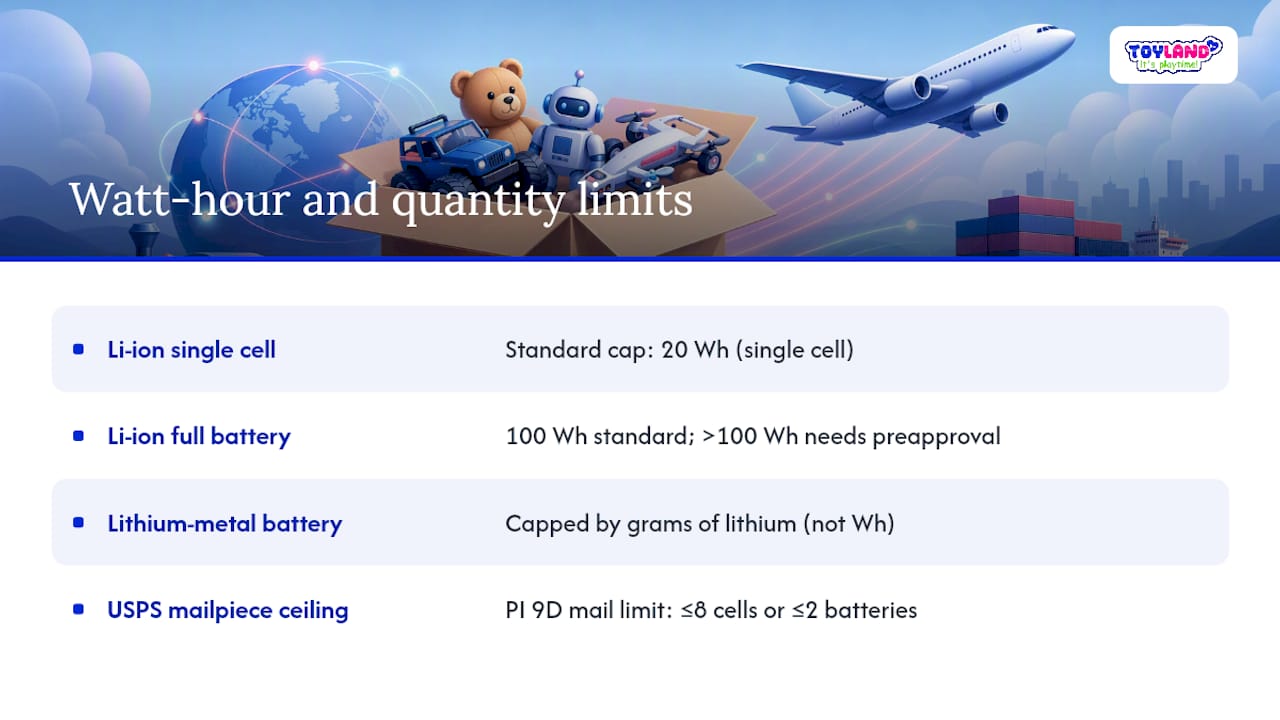
USPS layers on its own mailpiece ceilings. Packaging Instruction 9D limits some mail categories to no more than 8 cells or 2 batteries per package, regardless of how far under the watt-hour cap you are.
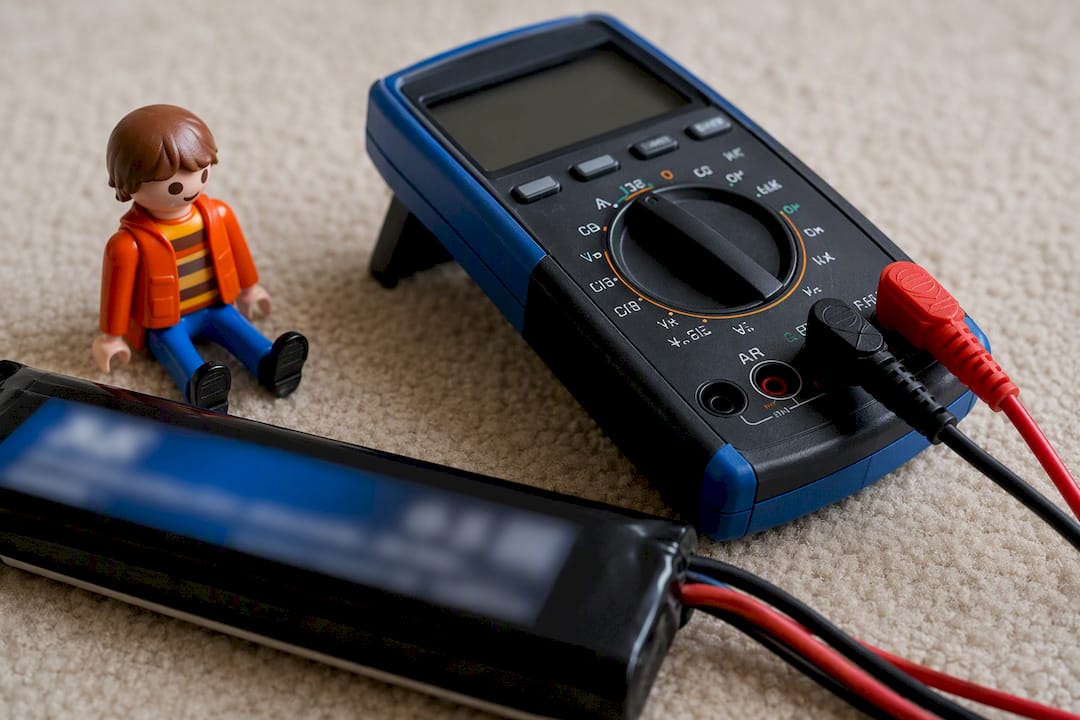
Here’s a quick way to check: watt-hours equal volts multiplied by amp-hours. A typical 7.4V RC car battery rated at 2,000 mAh (2 Ah) works out to about 14.8 Wh, comfortably under the 20 Wh single-cell threshold and well within most carrier limits.
Can You Ship a Fully Charged Toy Battery by Air?
Not always. IATA generally caps standalone lithium-ion batteries at a low state of charge for air transport, a rule aimed at reducing thermal runaway risk mid-flight. Batteries installed in the toy itself sometimes are exempt from strict state of charge limitations, but individual airlines can still impose it, so you check the specific carrier rather than assume.
Damaged, swollen, defective, or recalled batteries are essentially banned from passenger and cargo aircraft. They move by ground only, if they move at all.
Pro Tip: *Check the charge level before you box anything for air shipment.
What Marks, Labels, and Paperwork Do You Need?
Every lithium battery shipment needs the DOT-approved lithium battery mark specified in 49 CFR 173.185, plus the correct UN number printed on the outer box. If a box contains batteries with more than one UN classification, list all of them.
Used, damaged, or defective devices need extra wording. USPS requires “Restricted Electronic Device” and limits these packages to surface transportation only, per Packaging Instruction 9D.
Packing basics that actually prevent incidents:
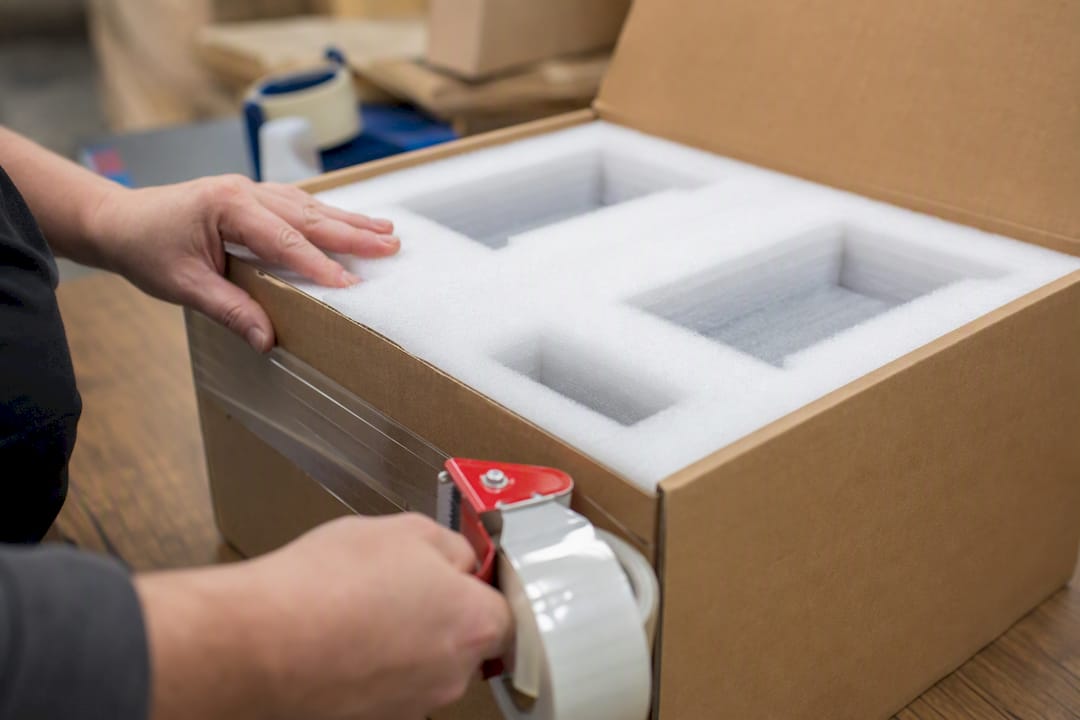
- Keep terminals covered with tape or caps so they can’t contact metal or each other.
- Use snug inner packaging so the battery and toy can’t shift during transit.
- Save the original manufacturer packaging when possible, since it’s usually designed around the battery’s exact dimensions.
- Hold onto UN38.3 test summaries for the battery in case a carrier or customs agent asks.
A shipper who can hand a carrier a UN38.3 test summary on request almost never gets a package held at a sorting facility. The paperwork trail matters as much as the tape and foam.
Most standard toy shipments don’t require a full Shipper’s Declaration of Dangerous Goods. Larger or bulk shipments, especially by air freight or international export, often do. When in doubt, check with the carrier’s dangerous goods desk before you ship, not after.
Step-by-Step Packing Checklist for Battery-Powered Toys
- Confirm the classification: installed, packed, or standalone.
- Check the battery’s watt-hour rating or lithium content against carrier limits.
- Confirm state of charge if shipping by air (aim for 30% on standalone cells).
- Insulate exposed terminals with tape, caps, or plastic sleeves.
- Secure the battery compartment so it can’t open in transit.
- Cushion the toy inside the box so nothing shifts or crushes the battery.
- Apply the DOT lithium battery mark and correct UN number.
- Add “Restricted Electronic Device” wording if the item is used or defective.
- Attach a UN38.3 test summary reference or keep one on file for the shipment.
- Confirm the carrier’s current battery policy before drop-off, especially for drones or larger RC vehicles.
An RC car with a built-in battery follows this exact flow. A spare battery shipped separately for a drone skips the “installed” steps but needs its own UN3480 marking. When a toy’s battery exceeds 100 Wh or you’re unsure about classification, stop and call the carrier’s dangerous goods desk instead of guessing.
What Happens With Damaged or Recalled Batteries?
Damaged, defective, or recalled lithium batteries almost always lose air eligibility and move to ground-only transport, and many carriers require preapproval before they’ll even accept the package, according to UPS’s battery shipping guidance.
- Mark the package “Restricted Electronic Device” and “Surface Transportation Only.”
- Contact the carrier before shipping. Some require a written preapproval on file.
- For recalls, ask the manufacturer about a dedicated battery-return program instead of shipping it yourself.
What Should You Check First With Each Carrier?
USPS, UPS, FedEx, and DHL each have their own quirks layered on top of federal rules.
- USPS: Packaging Instruction 9D governs mailability, mailpiece quantity limits, and required marks. Domestic mail has tighter caps than you’d expect for a “small” toy battery.
- UPS and FedEx: Ground-only restrictions typically apply to damaged batteries, and both offer dangerous goods training and preapproval programs for regular shippers.
- DHL: International shipments need UN38.3 documentation and correct SoC compliance up front, since customs delays are common when paperwork is incomplete, per DHL’s battery shipping guidance.
Call the specific carrier’s dangerous goods desk before your first shipment of a new toy line, and keep any written approval or instructions on file.
How Do You Confirm a Toy’s Batteries Are Transport Legal?
Ask the supplier for the documentation before the toy ever reaches your warehouse.
- Request the UN38.3 test summary and MSDS for every battery type you stock.
- Confirm the toy meets IEC 62115 safety standards for electric toys, which cover battery accessibility and warning labels.
- For toys with button or coin cells, verify compliance with CPSC’s Reese’s Law requirements under 16 CFR part 1263, including secure compartments and labeling.
- If a supplier can’t produce this paperwork, either refuse the shipment or route it through a logistics provider experienced in battery dangerous goods.
What Retailers Get Wrong Most Often
The mistakes that cause the most shipping headaches aren’t exotic. Missing UN38.3 paperwork, battery compartments that pop open in transit, and mislabeled boxes account for the bulk of holds and returns we’ve seen across battery-powered toy categories.
Build a standard check into your fulfillment process before a single battery-powered toy leaves the warehouse, and train staff to spot these issues before they seal a box. For some products, selling “batteries not included” simplifies everything without hurting the customer experience.
Get Shipping Help From Toylandeu™
Toylandeu™ ships thousands of battery-powered toys internationally every month, from RC cars to underwater robots, and every one of them follows the classification, labeling, and documentation rules covered above.
If you’re stocking or gifting something like the gesture-controlled stunt car, you’re dealing with an installed lithium-ion battery that ships under UN3481, and our team handles that classification on every order automatically. Questions about a specific product’s battery type, watt-hour rating, or documentation? Reach out to Toylandeu™'s support team before you buy, and get a straight answer instead of guessing at a spec sheet.
Sources
- USPS Publication 52 — Packaging Instruction 9D (Lithium batteries)
- PHMSA: Lithium battery shipping guide for shippers
- IATA: Lithium battery guidance document
- CPSC: Reese’s Law and button/coin battery safety standards
- UN38.3 & Lithium battery compliance guidance — Kite Compliance
- UPS: How to ship batteries
FAQ
Can I Mail a Toy That Has Batteries Installed?
Yes, most toys with installed lithium batteries are mailable through USPS if they meet the watt-hour limits and carry the correct DOT lithium battery mark under Packaging Instruction 9D.
Can You Get in Trouble for Shipping Lithium Batteries Incorrectly?
Yes. The shipper is legally responsible for classification and labeling under 49 CFR, and violations can result in fines, refused shipments, or liability for damage caused in transit.
Are Lithium Batteries Safe in Toys?
They’re safe when the toy meets standards like IEC 62115 and, for button cells, CPSC’s Reese’s Law requirements for secure compartments and labeling.
Do Lithium Batteries Have to Be Shipped in a Box?
They need rigid outer packaging that prevents movement and short circuits, whether that’s a box or another container that meets the same protective standard; loose or soft packaging typically isn’t accepted for compliant shipments.
Does Toylandeu™ Ship Battery-Powered Toys Internationally?
Yes, Toylandeu™ ships battery-powered toys like RC vehicles worldwide and applies the correct UN classification and DOT marking to each shipment.