

The Role of Toys for Gift Buyers: A Smart Guide
TL;DR:
- Choosing toys as gifts requires considering their developmental fit, safety, and ability to foster skills beyond mere entertainment. Toys that match a child’s interests and encourage social play create more meaningful and lasting engagement. Limiting the number of toys, rotating them regularly, and pairing them with experiences enhances their value and supports deeper development.
Picking a toy as a gift sounds simple until you’re standing in an aisle with 200 options and zero clarity. The role of toys for gift buyers goes far beyond grabbing something colorful off a shelf. The right toy can sharpen a child’s problem-solving skills, spark creative thinking, and give them hours of meaningful play. The wrong one collects dust by January. This guide cuts through the noise and shows you exactly how to choose toys that deliver real value, whether you’re shopping for a toddler, a grade-schooler, or a teenager.
Table of Contents
- Key takeaways
- The role of toys for gift buyers: why it matters more than you think
- Choosing the right toy: safety, age fit, and development stage
- Smart strategies: quantity, rotation, and pairing with experiences
- Selecting toys that match interests and invite social play
- My honest take on toy gifting
- Find the right toy gift at Toylandeu
- FAQ
Key takeaways
| Point | Details |
|---|---|
| Toys serve dual purposes | The best gifts combine educational development with genuine recreational enjoyment. |
| Age fit prevents safety risks | Choosing the wrong developmental stage creates choking or suffocation hazards, not just boredom. |
| Less toys, more engagement | Rotating one-third of toys every few weeks produces deeper, more creative play. |
| Match toys to interests | A gift aligned with the child’s actual passions lands harder than any trending product. |
| Pair toys with experiences | Combining a toy with shared time or an activity multiplies the gift’s emotional impact. |
The role of toys for gift buyers: why it matters more than you think
Toys are not just entertainment. They are tools. Play supports development of cognitive, social, and emotional skills, and research shows that creativity especially benefits from guided peer play during the elementary years. That means the toy you choose as a gift can actively shape how a child thinks, connects with others, and solves problems.
Here is what thoughtful toys as gifts actually do for children:
- Build creativity and imagination. Open-ended toys like building blocks, art kits, and clay sets invite children to invent rather than follow a script.
- Develop fine and gross motor skills. Puzzles strengthen hand coordination. Bikes and scooters build balance and physical confidence.
- Sharpen cognitive skills. Strategy games and STEM kits push kids to reason, sequence, and experiment.
- Encourage social interaction. Board games, puppets, and group building toys teach turn-taking, communication, and cooperation.
The importance of toys for buyers lies in recognizing this dual role. A toy that only entertains is fine. A toy that entertains and builds a real skill is a gift that keeps working long after the birthday cake is gone.
Pro Tip: Before buying, ask yourself: does this toy ask something of the child? Toys that require effort, even a little, tend to generate longer and richer play than passive ones.
Choosing the right toy: safety, age fit, and development stage
The biggest mistake gift buyers make is assuming age labels on packaging are just suggestions. They are not. Gift buying is shaped by balancing appropriateness, safety, and fit to the child and household context. A toy that is perfect for a six-year-old can be genuinely dangerous for a two-year-old in the same house.
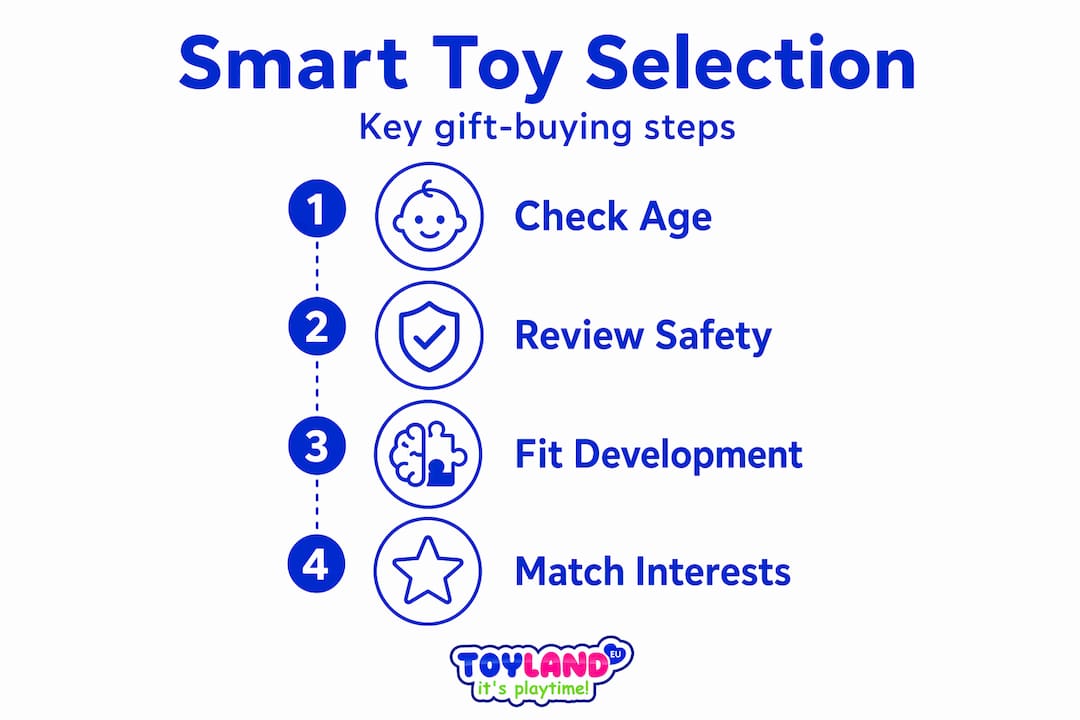
Here is a quick reference to help you match toys to developmental stages:
| Age range | Developmental focus | Toy examples |
|---|---|---|
| 0 to 12 months | Sensory stimulation, motor control | Soft rattles, fabric books, teethers |
| 1 to 3 years | Language, coordination, imagination | Shape sorters, stacking rings, simple puzzles |
| 4 to 6 years | Creativity, independence, active play | Craft kits, building blocks, bikes, magnet sets |
| 7 to 12 years | Logic, social skills, sustained attention | STEM kits, board games, remote control vehicles |
| 13 and up | Identity, challenge, self-expression | Art sets, complex builds, skill-based RC toys |
Safety goes beyond age labels, though. The American Academy of Pediatrics warns that soft toys near sleep areas like pillows, pillow-like toys, and quilts increase the risk of entrapment and suffocation in infants. Pediatric safety experts consider the whole environment, not just the toy itself. If you are buying for a home with a baby, think about how the toy interacts with that space.
You should also check current recall lists before purchasing. The U.S. Consumer Product Safety Commission updates these regularly. A quick search takes two minutes and can prevent a serious problem.
Pro Tip: When in doubt about safety standards for a specific toy, the 2025 toy safety standards overview at Toylandeu is a solid resource that explains exactly what certifications to look for.
Smart strategies: quantity, rotation, and pairing with experiences
One of the most counterintuitive toy gift buying tips is this: giving fewer toys often creates a better outcome than giving more. Rotating one-third of toys every few weeks leads to more creative play and easier tidying. When children have fewer options in front of them, they invest more deeply in what is there.
Here is a practical framework for gift buyers who want to maximize impact:
- Choose one high-quality, developmentally rich toy rather than three or four cheaper ones. Quality beats volume every time.
- Suggest toy rotation to parents. If you are a grandparent or family friend buying alongside others, let parents know the toy can be rotated into play every few weeks to keep it fresh.
- Pair the toy with an experience. Research shows 73% of parents prefer experiential gifts that create lasting memories over traditional physical gifts. Combine a craft kit with an afternoon of making art together. Give a board game alongside a promise to play it that evening.
- Coordinate with other gift givers. Ask parents or siblings what is already in the home. Doubling up wastes money and floods the household.
A few more ways to stretch the value of your toy gift:
- Include a card with ideas on how to use or extend the toy’s play.
- Think about whether the toy can grow with the child over multiple years.
- Personalized gifting approaches can transform a good toy into a memorable one.
Accessible toy storage also matters here. Toys that are easy to reach get played with. Toys buried in bins get forgotten, regardless of how thoughtful the purchase was.
Selecting toys that match interests and invite social play
The best toys for gift giving are the ones that reflect who the child actually is. A toy that aligns with a real interest, whether that is dinosaurs, building, art, or movement, will be played with far more than a generic trending item.
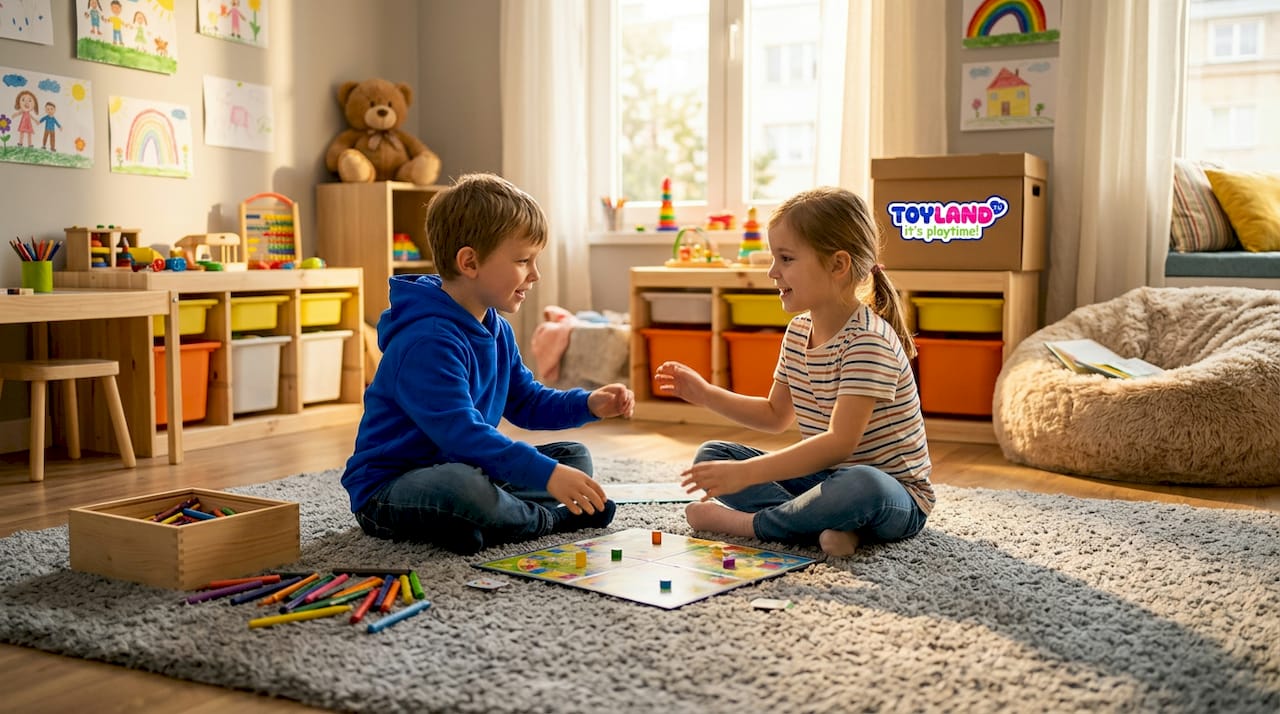
Start by observing or asking. What does the child talk about? What do they gravitate toward when given free time? A few questions to the parents or a quick look at what the child already owns tells you more than any bestseller list.
Beyond individual interests, consider toys that open up social play. These options work especially well:
- Puzzles and cooperative board games. They invite siblings, cousins, or friends to join in and build problem-solving skills at the same time.
- Building and construction toys. Blocks and building sets scale beautifully for group play and encourage collaborative creativity.
- Active outdoor toys. Scooters, kites, and sport sets pull kids outside and naturally involve others.
- Art and craft kits. These work as solo or group activities and produce something the child can show off proudly.
The social dimension of toys matters beyond just fun. When children play together, they practice negotiation, empathy, and communication. Those are skills that follow them into adulthood. A gift that creates that kind of interaction is one the whole family benefits from.
My honest take on toy gifting
I’ve watched gift buyers spend real money on toys that get abandoned within a week, and it’s almost never about the toy’s quality. It’s about the mismatch between the gift and the child’s current world.
What I’ve learned is that impulse buying in the toy aisle almost always loses to five minutes of research. Knowing a child’s developmental stage, current obsessions, and the household context changes every decision. A $20 craft kit chosen with intention will outperform a $60 gadget bought in a hurry.
The other thing most gift buyers miss is the power of presence. A toy paired with your time, even once, becomes a memory. The toy is the prop. The experience is the actual gift. Parents increasingly model gratitude by choosing experiences over physical items, and there is real wisdom in that shift.
My advice: use the toy gift checklist at Toylandeu before you buy anything. It takes two minutes and saves you from a decision you will regret.
— Thane
Find the right toy gift at Toylandeu
Toylandeu carries over 30,000 toys designed for children at every developmental stage, with free worldwide shipping and a catalog built for gift buyers who want both quality and variety. For younger children focused on creative development, the Montessori drawing kit and the 24-color clay modeling kit are standout choices that support fine motor skills and imaginative thinking. For older kids who want a physical challenge, the gesture-controlled stunt car delivers real engagement. Every product meets current safety standards, so you can buy with confidence.
FAQ
What is the role of toys for gift buyers?
Toys serve as gifts that support child development while providing genuine enjoyment. The best choices align with the child’s age, interests, and developmental stage to deliver lasting value beyond a single play session.
How many toys should you give as a gift?
One thoughtfully chosen toy outperforms multiple generic ones. Research shows that fewer toys lead to deeper engagement, and parents can extend the value further by rotating toys every few weeks.
What makes a toy age-appropriate and safe?
Age-appropriate toys match the child’s developmental milestones and avoid hazards like small parts for young children. Safety also depends on the household context, including whether the toy will be used near infants or in sleep areas.
Should you pair a toy gift with an experience?
Yes. Combining a toy with shared time or an activity significantly increases the gift’s emotional impact. Studies show a growing number of parents favor experiential elements alongside physical gifts for this exact reason.
How do you choose a toy that matches a child’s interests?
Observe what the child talks about, watch what they gravitate toward in free play, or ask a parent directly. A toy tied to a real interest will be played with far more than any bestselling product chosen without context.