

Plush Size Guide for Collectors and Gift Buyers
If you’re buying a gift, pick a plush in the Medium size band. That’s the size range that reads as generous without costing a fortune to ship, and it’s the sweet spot most e-commerce buyers gravitate toward. Infants and toddlers do best with something small and lightweight, within the Small size band, with no detachable parts. Collectors building a display shelf usually want 36 centimeters and up (14.5 inches plus), where detail and presence actually show. Keychain and bag-clip plush stay under 10 centimeters (4 inches), full stop.
Here’s the short version if you’re in a hurry:
- Infants and toddlers: 11–18 cm (4.5–7 in), no small parts, no loose trims
- Gift buyers and general e-commerce: 21–35 cm (8.5–14 in), the size that photographs well and ships affordably
- Collectors and display pieces: 36 cm+ (14.5 in+), where fabric detail and proportion actually register
- Keychains and mini clip-ons: under 10 cm (4 in)
Before you buy anything based on a number in a product listing, know this: that number could mean standing height, sitting height, or nose-to-tail length depending on who wrote it. Standing height, measured top of head to bottom of feet, is the convention worth trusting most.
Key Takeaways
Matching plush size to purpose, gift, play, or display, matters more than chasing the biggest or cutest option on a page.
| Point | Details |
|---|---|
| Pick by audience | Infants need Small (11–20 cm), gift buyers do best with Medium (21–35 cm), collectors want Large/Jumbo (36 cm+). |
| Verify the pose | Confirm whether a listed size is standing height, sitting height, or nose-to-tail before buying. |
| Trust standing height | Standing height, top of head to feet, is the most reliable figure to compare across listings. |
| Watch freight impact | Large and Jumbo sizes cost far more to ship per unit, which drives their higher retail price. |
| Shop Toylandeu™ for clarity | Toylandeu™ lists standing height on plush pages and offers free worldwide shipping across its catalog. |
Table of Contents
- What Is the Standard Plush Size Chart?
- How Do I Measure My Plush for the Right Size?
- Which Plush Size Should You Choose for Your Use Case?
- What Do Common Plush Sizes Look Like in Real Life?
- How Does Manufacturing Affect Plush Size and Price?
- What Belongs on a Plush Spec Sheet?
- What Safety Rules Affect Plush Size Choices?
- What Actually Sells: A Market Perspective
- Which Toylandeu™ Plush Sizes Should You Buy?
- Sources
- FAQ
What Is the Standard Plush Size Chart?
Plush toys sort into six recognized size bands, and knowing them turns a vague product description into something you can actually compare across listings. The industry generally uses Micro, Mini, Small, Medium, Large, and Jumbo as the working categories, each tied to a fairly consistent centimeter and inch range.
Standing height, not sitting height and not “nose to tail,” is the measurement that should anchor the label on any listing. A plush measured while seated can read 20% to 30% shorter than the same item standing, so a “12 inch” bear could be either depending on how the seller measured it. This ambiguity is exactly why serious retailers publish both numbers.
| Size Band | Standing Height (cm) | Standing Height (in) | Typical Weight | Best Use |
|---|---|---|---|---|
| Micro | Up to 5 cm | Up to 2 in | Under 10 g | Charm attachments, capsule toys |
| Mini | 6–10 cm | 4–7 in | 10–30 g | Keychains, bag clips, gashapon |
| Small | 11–20 cm | 4.5–8 in | 30–100 g | Toddler-safe toys, party favors |
| Medium | 21–35 cm | 8.5–14 in | 100 g | Gift-buying, e-commerce hero products |
| Large | 36–55 cm | 14.5–18 in | 100 g–1 kg | Display pieces, premium gifts |
| Jumbo | 56 cm and up | 14.5 in and up | 1 kg+ | Statement décor, collector centerpieces |
Pro Tip: When you’re comparing listings, look for both a standing height and a sitting height in the description, plus a note on whether ears, tails, or antennae are counted in the total. If a listing only gives one number with no context, treat it as a rough estimate, not a spec.
How Do I Measure My Plush for the Right Size?
Always measure a physical sample when you have one in hand. If you’re shopping online and can’t touch the product, lean on a seller’s spec sheet over a marketing description, since spec sheets tend to follow consistent conventions while ad copy often rounds up.
- Choose the pose first. Decide whether you’re recording standing height, sitting height, or both. Standing height (top of head to bottom of feet) is the industry default and the number most manufacturers use for the primary listing figure.
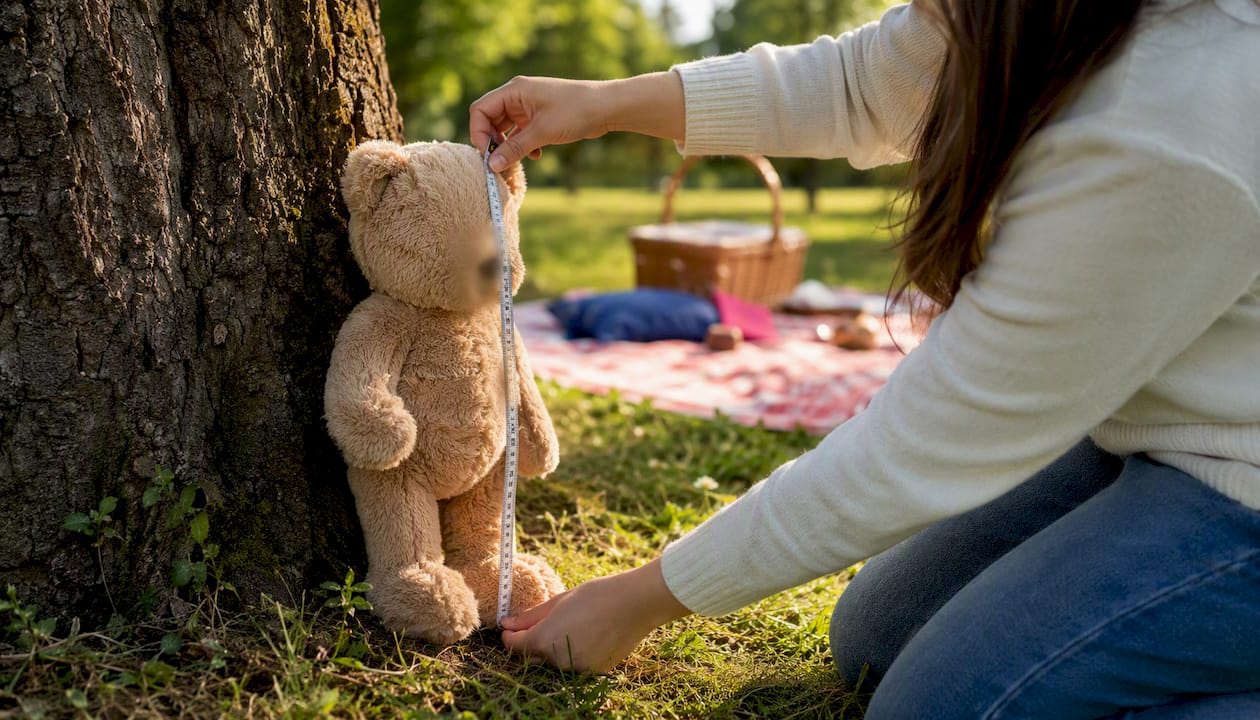
- Measure standing height. Set the plush upright against a flat wall, run the tape from the crown of the head straight down to the base of the feet, and keep the tape perpendicular to the floor.
- Measure sitting height separately. Seat the plush naturally, then measure from the top of the head to the surface it’s resting on. Publish this alongside standing height, not instead of it.
- Record width and depth. Measure width at the widest stable point, usually across the shoulders or hips, and depth from chest to back at the thickest point.
- Measure appendages on their own. Ears, tails, wings, and antennae get their own measurements. State clearly whether these are included in the “overall” figure or listed separately.
- Document tolerances. Note how much variance is acceptable, typically plus or minus 5 to 10 millimeters depending on the dimension. This matters more for production runs than for a single collectible you’re buying once.
- Photograph the measurement. Take three reference photos: front-on with a ruler against the centerline, a side profile, and a top-down shot if the item has volume that matters (like a rounded belly or a wide tail).
A basic measurement diagram, one showing standing height, sitting height, width, and depth on a single labeled illustration, is worth more than a paragraph of description. If a seller’s page has one, trust it more than the bullet points around it.
Pro Tip: Always specify whether ears and tails count toward the stated size. A “30 cm” fox plush with a 6 cm tail included reads very differently from one where the tail is extra. Sellers who spell this out are the ones worth buying from repeatedly.
Which Plush Size Should You Choose for Your Use Case?
Match the size to the job the plush needs to do, not just to what looks impressive in a photo. Different buyers, different channels, different right answers.
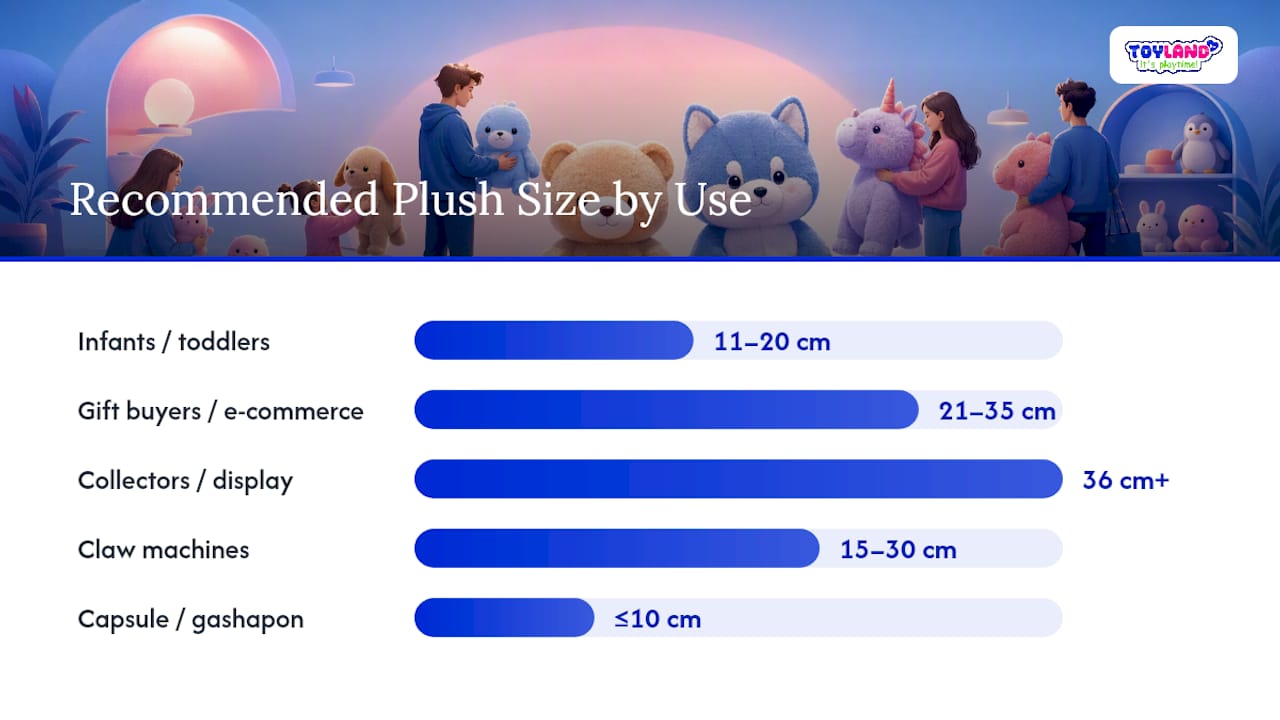
For infants and toddlers, stick to Small (11–20 cm). Anything under about 6 inches faces stricter small-parts scrutiny under most safety frameworks, so smaller pieces need embroidered eyes and noses rather than plastic parts that could detach. Skip loose trims, buttons, or bows entirely at this size.
For general gift-giving and e-commerce, Medium (21–35 cm) wins almost every time. It photographs well, fits in a gift bag without modification, and keeps shipping costs reasonable. This is the size band most retail sales cluster around for exactly those reasons.
For collectors and display pieces, Large to Jumbo (36 cm+) makes sense because detail and proportion actually register at that scale. A collector isn’t paying for cuteness alone. They’re paying for fabric texture, stitched detailing, and presence on a shelf, and none of that reads clearly under 30 centimeters.
For claw machines and carnival prizes, operators favor Small to Medium (roughly 15–30 cm) because the weight has to balance against the claw’s grip strength. Too light and the plush slides out; too heavy and the claw can’t lift it consistently.
For capsule toys and gashapon, Micro to Mini (under 10 cm) is the only real option, dictated by the size of the capsule itself, not by design preference.
| Audience/Channel | Recommended Band | Primary Reason |
|---|---|---|
| Infants/toddlers | Small (11–20 cm) | Safety, small-parts risk, easy grip |
| Gift buyers/e-commerce | Medium (21–35 cm) | Value perception, shipping cost, photo appeal |
| Collectors/display | Large/Jumbo (36 cm+) | Tactile detail, shelf presence |
| Claw machine operators | Small/Medium (15–30 cm) | Weight-to-grip balance |
| Capsule/gashapon | Micro/Mini (≤10 cm) | Fixed by capsule dimensions |
Pro Tip: If you’re buying for a toddler who’s also a plush collector’s kid, don’t split the difference. Buy the Small size for the child’s actual play use and let a Large piece stay on the parent’s shelf, out of reach.
What Do Common Plush Sizes Look Like in Real Life?
Numbers on a screen don’t mean much until you attach them to something familiar. Here’s how the size bands translate:
- 10 cm (4 in): about the height of a standard soda can. This is squarely in Mini territory, right for a keychain or bag charm.
- 15 cm (6 in): roughly a smartphone standing on end. Small band, appropriate for a toddler’s first plush.
- 25 cm (10 in): close to a standard notebook’s long edge. Solidly Medium, the classic gift-shop size.
- 40 cm (16 in): about the width of a couch cushion. Large band, the point where a plush starts commanding real shelf space.
- 60 cm (24 in): taller than most toddlers sitting down. Jumbo, and genuinely a piece of furniture-adjacent décor at that point.
When you’re shopping online and can’t hold the item, lean on photo context rather than the number alone. A plush photographed alone against white background tells you almost nothing about scale. Look for listings with a hand resting on the plush, a person holding it, or a ruler laid alongside it. If a listing shows a child’s approximate arm or hand proportions next to the item, that’s a genuinely useful scale reference, especially for gift buyers shopping for a specific age.
Pro Tip: Ask sitting-versus-standing directly if a listing only gives one number and no photo context. A seller who can’t answer that question in one sentence probably didn’t measure carefully in the first place.
How Does Manufacturing Affect Plush Size and Price?
Larger plush toys cost more to make and dramatically more to ship, which is the real reason Medium sizes dominate retail catalogs. It isn’t aesthetic preference. It’s math.
Pattern scaling isn’t linear. Doubling the height of a plush roughly quadruples the fabric surface area, which means fabric waste, seam length, and stuffing volume all climb faster than the size number suggests. Stitching also gets harder to control at scale: a 10 cm plush tolerates minor seam variance that would look sloppy on a 50 cm piece, so larger sizes typically need stronger seams and sometimes internal reinforcement to hold their shape under the added stuffing weight.
Freight is where the real cost jump happens. Carton density drops off a cliff as size increases: a standard 60x40x50 cm carton might hold around 150 units of a 15 cm plush but only about 8 units of a 50 cm plush. That’s nearly a twentyfold difference in units per shipment, which explains why Jumbo pieces carry a price premium that has almost nothing to do with materials and everything to do with cubic freight cost.
For designers deciding where to set a size ladder, Medium remains the safest default for volume sales. Reserve Large and Jumbo for premium SKUs where the higher price point already accounts for the shipping math, rather than trying to sell oversized plush at gift-shop margins.
What Belongs on a Plush Spec Sheet?
Every professional spec sheet needs these measurement points at minimum: overall standing height, sitting height, width at the widest point, depth at the thickest point, head circumference, limb lengths, and tail or appendage dimensions listed separately from the body.
Beyond measurements, a complete tech pack covers product identification, technical drawings with dimension callouts, fabric and trim specifications, stuffing density and type, packaging requirements, and compliance fields for the target market’s safety standards. Retail-grade spec sheets typically run 4 to 12 pages depending on complexity. A simple keychain might need three pages; a detailed character plush with multiple fabric types can run past 15.
The tolerance rule of thumb: about ±5 millimeters for measurements under 100 mm and ±10 millimeters for anything larger. Tighter tolerances than that drive up rejection rates during quality control and add cost, since factories need more careful pattern cutting and more frequent sample checks to hit them.
Pro Tip: Ask for a photo-annotated tech pack, not just a text spec sheet. A single image with arrows pointing to each measurement point resolves more disputes with a manufacturer than three paragraphs of written description ever will.
What Safety Rules Affect Plush Size Choices?
Younger age grades demand stricter small-parts screening, and that requirement should shape your size decision before anything else does. This isn’t a footnote. It changes what features a plush can even have.
- Plush under roughly 6 inches for infant or toddler use should stick to embroidered eyes, noses, and mouths rather than any glued or sewn-on plastic pieces that could detach.
- Avoid buttons, bows, bells, or other add-ons on anything intended for a child under three, regardless of how securely they’re attached.
- Very large plush (Jumbo and up) carries its own weight-related concern: heavier pieces need reinforced seams and should be checked for tip-over risk if a young child might climb on or lean against them.
- Check for an age-grade label and, where available, a test report reference before buying, especially for smaller sizes marketed toward babies.
- When shopping online, ask sellers for photos of the safety label and any compliance documentation rather than relying on the listing description alone.
Toylandeu™ covers this in more depth in a parent’s guide to toy safety and a breakdown of current toy safety regulations, both worth a read before buying for a child under three.
Pro Tip: If a listing photo doesn’t show a legible age-grade label, message the seller and ask directly. A retailer with nothing to hide will send you a clear photo within minutes.
What Actually Sells: A Market Perspective
The Medium size band dominates retail plush sales for a reason that has nothing to do with what looks best in a product photo. It’s the point where perceived value peaks relative to shipping cost. Go smaller and the item feels like an afterthought gift. Go larger and the shipping math eats the margin before the product even reaches a warehouse.
Collectors think about scale differently than gift buyers do, and that difference gets underestimated constantly. A collector isn’t comparing a plush to “what fits in a gift bag.” They’re comparing it to the last three pieces on their shelf, and tactile scale, how the fabric drapes, how the proportions read at arm’s length, matters more to them than any number in a listing. This is why Large and Jumbo pieces can command premium pricing that would look absurd applied to a Medium gift-shop item: the buyer isn’t paying for cubic centimeters, they’re paying for shelf presence.
The trade-off that gets discussed least is the one between size ladders and inventory density. A retailer launching three SKUs of the same character almost always does better spreading them across Mini, Medium, and Large rather than clustering two sizes close together. It captures the keychain buyer, the gift buyer, and the collector in one product line instead of competing with your own inventory for the same customer.
If you’re designing or stocking a size ladder and only have budget for three SKUs, the pattern that tends to work is one Mini (under 10 cm) for impulse buys, one Medium (25 to 30 cm) as the volume seller, and one Large (40 cm+) as the aspirational piece that makes the other two look reasonably priced by comparison.
Which Toylandeu™ Plush Sizes Should You Buy?
Once you know your size band, buying the right plush becomes a lot less guesswork and a lot more matching a number to a need. If you’re picking up a gift, the Medium range (21 to 35 cm) is where Toylandeu™'s plush catalog is strongest, sized for exactly the balance of presence and price that makes a good gift-shop purchase. Shopping for a toddler’s first stuffed animal, look toward the Small band, pieces with embroidered features and no detachable trims. Building out a display shelf or buying for a serious collector, the Large and Jumbo listings are where the fabric detail and proportion actually justify the higher price tag.
Toylandeu™ ships internationally with free worldwide shipping across its full catalog, and every plush listing states standing height clearly so you’re not guessing which measurement mode you’re looking at. If a plush’s size still isn’t clear from the product page, reach out to customer service and ask for a measurement photo with a ruler in frame, or request the sitting height if only standing height is listed. And if you’re building out a gift bundle rather than buying a single item, pair a plush with something hands-on, a Montessori-style drawing kit rounds out a kid’s gift nicely without adding much to shipping weight. Browse the current plush selection and check the standing-height figure on any listing before you add it to your cart.
Sources
- Plush Size Chart Guide In 6 Steps – Expert Sizing Made Easy — LeelineToys Blog
- How to Read a Plush Toy Spec Sheet | With Real Examples
- Plushies Size Chart Guide: How to Pick the Right Size — szoneier
- Size Customization for Plush Toys: How to Choose the Right Size - customimplemente
- Teddy Bear Size Guide & Measurement Chart | MS Teddy Bear
For safety-specific reading before buying for a young child, Toylandeu™'s guides on toy material safety and plush safety and collector appeal go deeper into materials and trims.
FAQ
How do I measure my plush for the right size?
Stand the plush upright against a flat surface and measure from the top of the head straight down to the bottom of the feet using a tape measure held perpendicular to the floor. Record sitting height separately, and note whether ears or tails are included in the total.
What are the different sizes of plushies?
The standard bands run Micro (up to 5 cm), Mini (6 to 10 cm), Small (11 to 20 cm), Medium (21 to 35 cm), Large (36 to 55 cm), and Jumbo (56 cm and up). Each band lines up with a different use, from keychains to display centerpieces.
Is a 12 inch plush big?
A 12 inch (about 30 cm) plush sits in the Medium band, which is the most common size for gift-giving and general retail plush. It’s noticeably larger than a toddler-safe Small plush but well short of a collector-grade Large or Jumbo display piece.
How big is a 7 in plush?
A 7 inch plush measures roughly 18 centimeters, placing it at the upper end of the Small size band. That size works well for toddlers and young children as long as it has embroidered features rather than detachable trims.