

Multi-language toys: boosting kids' language skills and fun
TL;DR:
- Research indicates that play with multi-language toys is an effective, natural way to enhance young children’s vocabulary, pronunciation, and confidence. These toys actively respond, repeat phrases, and provide repeated exposure, supporting cognitive flexibility and problem-solving skills beyond language alone. Parental involvement during use significantly amplifies these benefits, emphasizing that mindful interaction matters most in early language development.
Most parents assume that language learning happens in classrooms, through flashcards, or structured lessons. But research is flipping that idea on its head. Play, especially with toys that respond in multiple languages, may be one of the most effective and natural ways to build a child’s vocabulary, pronunciation, and confidence from as early as age two. Multi-language toys are changing how families think about early education, and the evidence behind them is surprisingly strong.
Table of Contents
- What are multi-language toys?
- How multi-language toys support child development
- Types of multi-language toys and how to choose the best
- Challenges, limitations, and privacy considerations
- Why intentional use, and not just tech, matters most
- Explore creative, educational toys for your child
- Frequently asked questions
Key Takeaways
| Point | Details |
|---|---|
| Supports early language | Multi-language toys improve vocabulary and pronunciation, especially for young children. |
| Boosts cognitive skills | They enhance memory, problem-solving, and cognitive flexibility through engaging play. |
| Choose wisely | Match toys to your child’s age, interests, and your comfort with technology and privacy. |
| Not a replacement | Toys are most effective when combined with real conversations and parental interaction. |
| Check privacy features | Review privacy settings and offline options to keep your child’s data protected. |
What are multi-language toys?
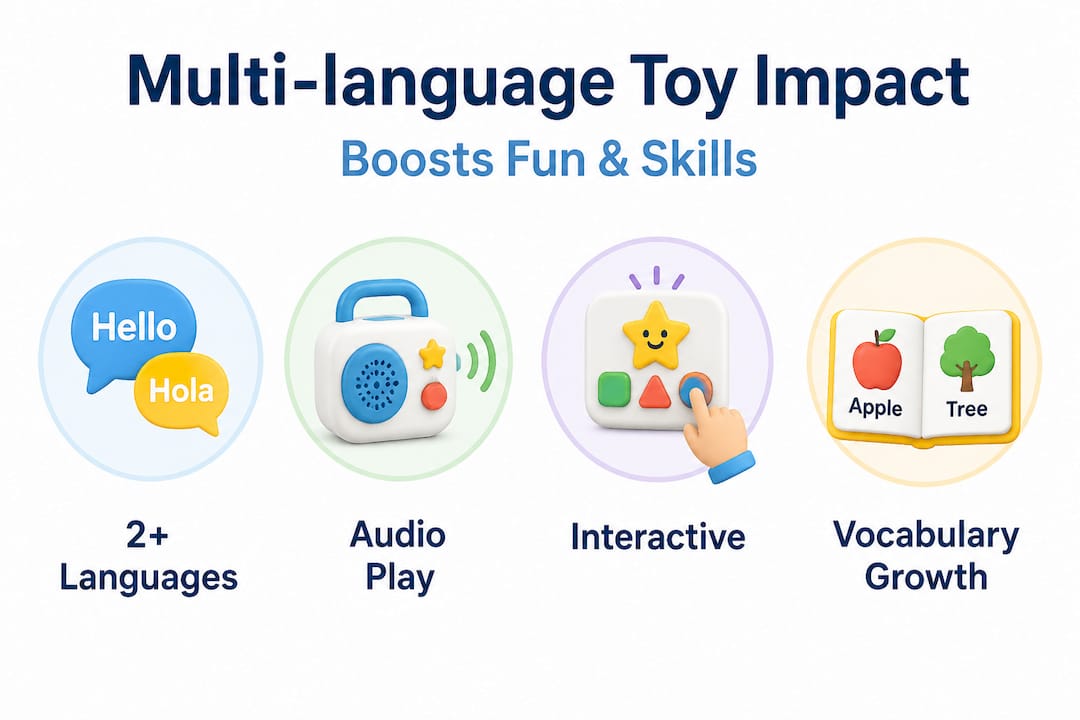
Multi-language toys are playthings specifically designed to expose children to two or more languages through interactive audio, visual, or tactile features. Unlike a standard storybook or a basic puzzle, these toys actively respond to a child’s input, repeat words and phrases, and create repeated exposure in a playful context. That repeated exposure is exactly what early language acquisition research points to as critical.
The core components vary by product type, but most include some combination of recorded audio in multiple languages, colorful visual prompts such as illustrated cards or screens, and tactile elements like buttons, levers, or touch-sensitive pads. More advanced versions now incorporate AI-driven voice recognition. Think of them as language labs that fit in a backpack.
Here’s a quick look at how the multi-language toy market has grown:
| Year | Global educational toy market size | Notable trend |
|---|---|---|
| 2020 | $61.6 billion | Rising bilingual household demand |
| 2022 | $67.4 billion | Surge in electronic learning toys |
| 2024 | AI toy market in China alone reached 24.6 billion yuan | AI-powered language toys mainstream |
| 2026 | Continued double-digit growth projected | Offline AI toys entering homes globally |
Popular multi-language toy types for children aged 2 to 10 include:
- Talking picture books that read aloud in two or more languages when a child presses illustrated pages
- Electronic learning tablets designed for toddlers with switchable language settings
- Bilingual puzzles featuring vocabulary words printed in two scripts side by side
- Interactive plush toys that respond with phrases in the selected language
- Alphabet and number boards with audio buttons supporting multiple languages
- Card-based flashcard systems using printed codes scanned by a reader pen
- AI-powered language companions (ages 5 and up) that hold simple conversations in a target language
What separates these from standard toys is intentional language scaffolding. A normal toy might label itself “educational,” but a true multi-language toy systematically introduces vocabulary, models pronunciation, and rewards engagement across at least two distinct language systems. Learning more about interactive toys and child development shows just how much this structural difference matters.
How multi-language toys support child development
Understanding what these toys are, the next question is what they actually do for your child’s growth. The short answer: quite a lot, and across more areas than most parents expect.
Bilingual or multi-language exposure during the early years strengthens vocabulary at an impressive rate. Children who regularly hear words in two languages develop stronger mental networks around concepts because each word in a second language reinforces the idea it represents in the first. This leads to deeper, more flexible understanding rather than simple rote memorization.
Research consistently shows that bilingual exposure via toys boosts vocabulary, pronunciation, memory retention, cognitive flexibility, and problem-solving skills in young children.
The cognitive gains go well beyond language itself. Studies on bilingual children reveal they often outperform their monolingual peers on tasks requiring attention switching and filtering out distractions, a skill researchers call cognitive flexibility. This ability to toggle between systems trains the young brain in a way that has lasting benefits for math, reading comprehension, and even emotional regulation.
Here are the standout developmental benefits, supported by current research:
- Improved vocabulary breadth. Children exposed to two languages through play learn more words faster and retain them longer because they encounter each concept through multiple linguistic lenses.
- Better pronunciation accuracy. Early exposure during the critical window (roughly ages 2 to 7) trains the ear and mouth to distinguish and produce sounds that older learners struggle to master.
- Stronger memory retention. The repetition built into multi-language toys mimics the spaced repetition method, one of the most effective memory-building techniques known to educators.
- Enhanced problem-solving. Managing two language systems simultaneously strengthens executive function, the mental toolkit children use to plan, focus, and adapt.
- Greater engagement. The novelty and responsiveness of interactive multi-language toys hold children’s attention longer than passive materials, increasing total learning time without any extra effort from parents.
- Boosted confidence. Successfully communicating even simple phrases in a second language gives children a visible win that motivates further exploration.
The link between interactive play and development is well-documented, and multi-language toys are a particularly powerful subset of that connection because they combine the stimulation of play with structured language input.
Pro Tip: The biggest gains happen when you play alongside your child, not just hand them the toy. Even five minutes of responding to what the toy says, repeating phrases together, or asking “what did it just say?” multiplies the learning effect significantly compared to solo play.
Types of multi-language toys and how to choose the best
With benefits established, let’s turn to practical advice on choosing the right multi-language toy for your child.
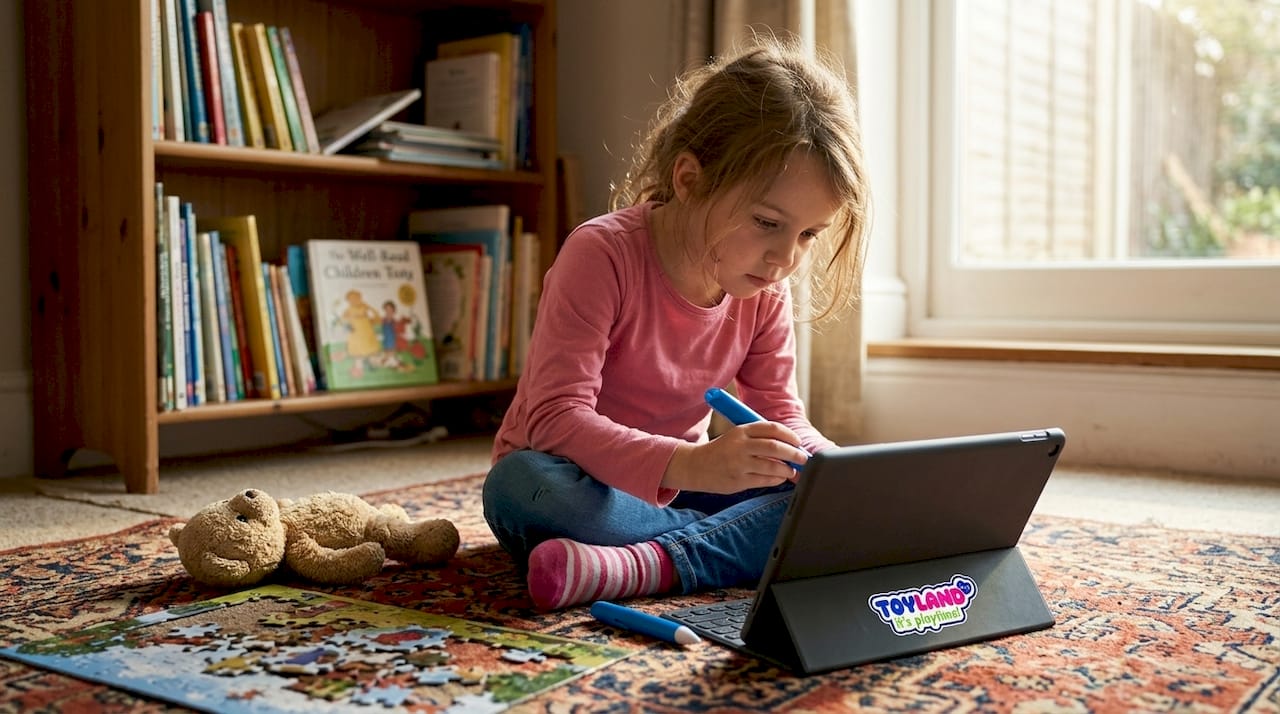
The market splits into several clear categories. Electronic toys are the most familiar and cover tablets, reader pens, and interactive boards. Analog options include bilingual puzzles, dual-language books, and multilingual card games that need no batteries. Voice-powered toys respond to a child’s speech and prompt them to try new words. AI-enabled toys represent the newest frontier, using natural language processing to hold simple back-and-forth conversations with children in a target language.
Here’s a side-by-side comparison of the major types:
| Toy type | Languages supported | Best age range | Special features |
|---|---|---|---|
| Electronic learning tablet | 2 to 4 | Ages 2 to 6 | Audio, visual prompts, games |
| Bilingual picture book | 2 | Ages 2 to 5 | Touch-and-hear, illustrations |
| Reader pen with card sets | 2 to 6 | Ages 3 to 10 | Expandable, portable |
| Talking plush toy | 2 | Ages 2 to 4 | Soft, repetitive phrases |
| AI language companion | 2 to 3 | Ages 5 to 10 | Conversational, adaptive responses |
| Bilingual puzzle set | 2 | Ages 3 to 7 | Tactile, screen-free |
| Multilingual card game | 2 to 4 | Ages 5 to 10 | Social play, competitive |
Before buying, work through these questions as a parent:
- What is my child’s current language exposure at home and at school?
- Are we aiming for a second language foundation, or reinforcing a heritage language?
- Does my child prefer screen-based or hands-on, screen-free play?
- How much parental involvement can I realistically provide each week?
- Do I want a toy that grows with my child over several years, or a focused tool for a specific age?
- Is the toy designed for solo play, group play, or both?
It is also important to understand the real-world impact on cognitive growth before settling on a category. Some parents buy the most feature-packed toy available and then wonder why their child disengages. Complexity that exceeds a child’s current language level is discouraging, not motivating.
Pro Tip: Match the toy to where your child is, not where you hope they’ll be in six months. A four-year-old with zero exposure to Spanish will get far more from a simple bilingual puzzle than from an AI conversation companion designed for ages seven and up.
One important note: most bilingual toys are limited to two languages and tend to plateau in usefulness once a child moves past basic vocabulary. Plan for progression, and think of individual toys as one step in a larger journey rather than a complete solution.
Challenges, limitations, and privacy considerations
Before finishing, it’s important for parents to be aware of a few key limitations and safety considerations that do not always appear on the product packaging.
The most common limitation is language range. The vast majority of multi-language toys cover only two languages, typically English and one other. For multilingual families or parents hoping to introduce three or more languages, the current toy market offers limited options. Reader pen systems paired with expandable card sets come closest to solving this problem.
Age-appropriateness is another real concern. Electronic language toys are exceptionally effective for children aged 2 to 7, but their impact drops noticeably with older children who have moved past basic vocabulary acquisition and need more complex grammar, conversation practice, and cultural context to keep progressing.
There is also a subtle risk that parents sometimes overlook: over-reliance on electronic toys can actually reduce the quality of parent-child conversation. When a toy does all the talking, parents talk less. Research confirms that electronic toys reduce parent-child verbal interaction compared to simpler, analog toys. That trade-off matters because no toy replicates the responsiveness, warmth, and contextual richness of a real human conversation.
On the privacy front, AI-powered and connected language toys present genuine concerns. These devices often capture and process children’s voice data, which raises serious questions about storage, third-party sharing, and compliance with children’s data protection regulations. Reading more about toy safety technology and privacy is well worth your time before any connected toy enters your home.
When evaluating any multi-language toy for privacy and safety, look for:
- Offline operation. Toys that function entirely without an internet connection cannot transmit voice data to external servers.
- No mandatory account registration. Products that require creating accounts for a child to use introduce unnecessary data collection risks.
- Clear data deletion policies. Reputable manufacturers state explicitly how long voice or usage data is retained and how to delete it.
- Third-party security certifications. Look for compliance markers related to children’s online privacy where applicable.
- Physical microphone disable options. Some AI toys include a physical button or switch to turn off the microphone when not in use.
For families wanting the benefits of AI-enhanced language play without the privacy trade-offs, exploring advanced toy safety in 2026 gives a helpful framework for evaluating connected products before purchase.
Why intentional use, and not just tech, matters most
Here is the perspective that most product reviews skip entirely: the toy is never the most important variable in the room. You are.
The conventional wisdom around educational toys suggests that buying the right product is the hard part. Once you have it, the technology does the work. That belief is seductive and almost entirely wrong. A study of LLM-powered language agents for children found significant gains in comprehension, output, and engagement, but those gains were maximized when children had a guide, a teacher, a parent, or a caregiver who made the experience interactive rather than passive. The role of play in learning is fundamentally social at its core.
What does this mean practically? Ten minutes of engaged, focused play where you repeat what the toy says, ask your child questions in the second language, and celebrate small wins will outperform an hour of solo playtime every single time. It is not about the quantity of exposure. It is about the quality of interaction layered on top of that exposure.
Busy parents hear “engagement” and immediately feel guilt. That is not the intention here. The point is that even brief, intentional moments matter far more than extended passive use. You do not need a dedicated lesson plan. You just need to occasionally sit down, press the button, and react out loud.
The most effective multi-language toy in the world is a mediocre tool in the hands of a distracted adult and a genuinely powerful one in the hands of a curious, present parent. Technology enhances learning. Involvement turbocharges it.
Explore creative, educational toys for your child
Finding a toy that genuinely supports language growth and keeps children engaged is not always straightforward, but the right starting point makes a real difference.
At ToylandEU, we bring together thousands of carefully selected educational and creative toys designed to make learning feel like play. Whether you are looking for tools that support language development, creative expression, or hands-on problem-solving, there is something here for every child and every stage. The Montessori drawing kit pairs structured learning with creative freedom, while the 24-color clay modeling kit builds fine motor skills alongside imaginative play. Browse the full range, enjoy free worldwide shipping, and find the toy that sparks your child’s next big discovery.
Frequently asked questions
Do multi-language toys make children fluent in another language?
Multi-language toys build foundational vocabulary and pronunciation skills, but they work best as part of broader language exposure that includes conversation, books, and real-world practice. Research confirms that bilingual toy exposure boosts vocabulary and retention, but fluency requires much more.
Are electronic multi-language toys safe for my child’s privacy?
Offline toys present fewer risks, but connected and AI-powered options require careful review. Always check whether the toy processes voice data externally, and consider products with clear data deletion policies since AI toys raise privacy concerns even when marketed as offline-friendly.
What age is best for multi-language toys?
Ages 2 to 7 represent the strongest window for multi-language toy use because younger children acquire language more naturally and fluidly. Note that these toys are less effective for older kids once they move beyond basic vocabulary into grammar and conversational complexity.
Can multi-language toys replace parent-child language exposure?
No. These toys are supplements, not substitutes. Studies show that electronic toys reduce the amount of verbal interaction between parent and child compared to simpler toys, which means parental involvement remains the single most important factor in a child’s language development.
Recommended
- Interactive dolls: foster imagination, empathy & learning – ToylandEU
- Multisensory toys: boosting children’s learning in 5 ways – ToylandEU
- Top toys for toddlers: Boost learning and fun with expert picks – ToylandEU
- Why Interactive Toys Matter for Child Development – ToylandEU
- The Best Age for Young Children to Learn a New Language