

Multisensory toys: boosting children's learning in 5 ways
- Multisensory toys engage multiple senses to strengthen neural connections and improve learning.
- Effective toys prioritize open-ended, tactile, and child-controlled experiences to support development.
- Quality input is more important than quantity, avoiding overstimulation and passive electronic toys.
Children who struggle with traditional learning methods often respond remarkably well when multiple senses are engaged at once. Multisensory toys enhance visual memory and recall, particularly for children with processing difficulties, making them far more than just playthings. Yet most parents and educators pick toys based on looks or price, missing the deeper science behind how children actually absorb and retain information. This guide breaks down what multisensory toys are, why the evidence supports them, how to choose wisely, and how to build routines that genuinely support your child’s growth.
Table of Contents
- What are multisensory toys? Defining the essentials
- How multisensory toys accelerate learning and development
- Choosing safe and effective multisensory toys: Evidence and expert tips
- Practical strategies: Using multisensory toys for maximum benefit
- A fresh perspective: What most guides miss about multisensory toys
- Explore top multisensory toy solutions for your child
- Frequently asked questions
Key Takeaways
| Point | Details |
|---|---|
| Clear scientific benefits | Multisensory toys boost visual memory, motor skills, and attention, supporting all children especially those with learning challenges. |
| Choose open-ended toys | Experts recommend battery-free, open-ended multisensory toys for fostering creativity and self-regulation. |
| Avoid overstimulation | Limiting play to 2-3 targeted sensory activities prevents meltdowns and enhances regulation. |
| Tailor play for individual needs | Observation and adaptation maximize the learning impact of multisensory toys for each child. |
What are multisensory toys? Defining the essentials
A multisensory toy is any toy that deliberately engages two or more senses at the same time. Think of a textured puzzle that requires a child to feel the pieces, see the colors, and hear the satisfying click when parts fit together. That combination is the key. A single-sense toy, like a plain rubber ball, offers tactile input alone. A multisensory toy layers experiences to create richer neural connections.
The science behind this is grounded in three core mechanisms. First, cross-modal transfer allows information learned through one sense to reinforce understanding through another. Second, dual coding means the brain stores information in both verbal and visual formats simultaneously, making recall far easier. Third, neuroplasticity, the brain’s ability to reorganize and strengthen connections, is directly stimulated when multiple sensory pathways are activated together. Multisensory toys facilitate cross-modal transfer, dual coding, and neuroplasticity in ways that single-sense toys simply cannot match.
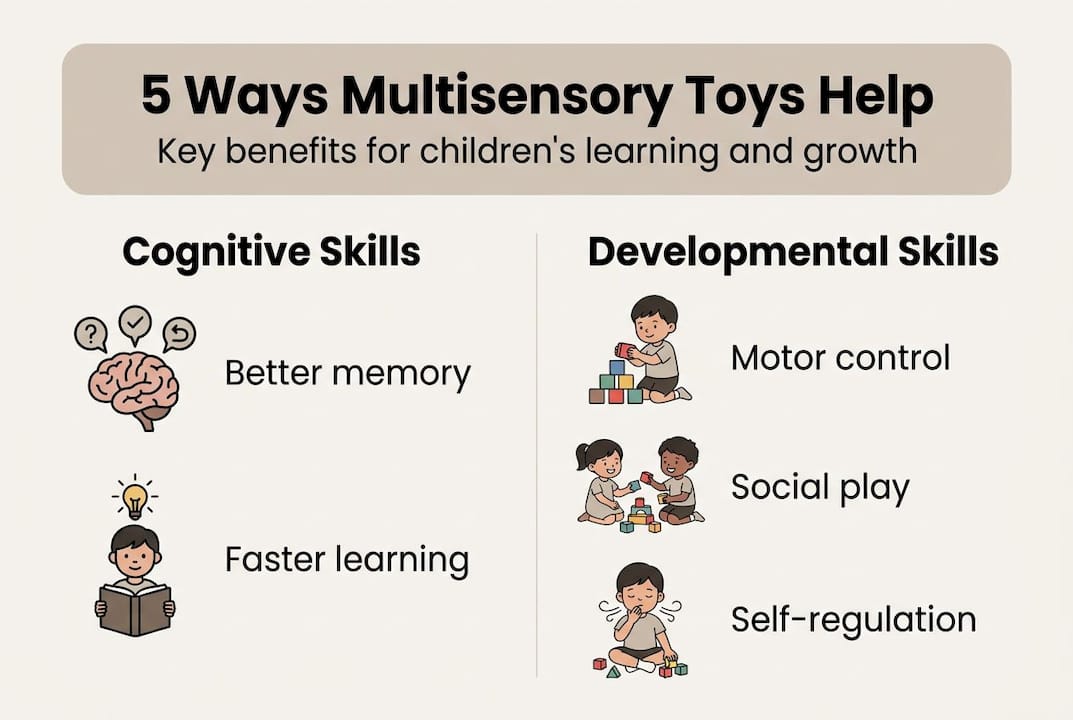
Here is a quick comparison to make the difference concrete:
| Feature | Unisensory toy | Multisensory toy |
|---|---|---|
| Senses engaged | 1 | 2 or more |
| Neural pathways activated | Limited | Multiple, interconnected |
| Memory encoding | Single format | Dual coded |
| Developmental range | Narrow | Broad |
| Best for | Isolated skill practice | Holistic development |
The main types of multisensory toys include:
- Tactile toys: Kinetic sand, textured blocks, sensory bins
- Visual and tactile combos: Montessori shape sorters, color-matching boards
- Auditory and motor toys: Musical instruments, rhythm drums
- Nature-based toys: Gardening kits, natural material craft sets
- Open-ended toys: Clay, drawing kits, building sets
You can explore the full range of sensory toy benefits and how they support different developmental needs. For children who thrive on imagination, open-ended toys are especially powerful because they allow children to direct their own sensory experience.
Pro Tip: When browsing toy aisles or online stores, skip anything that only lights up or only makes noise. The best multisensory toys require the child to do something physical while also seeing and hearing a result.
With multisensory toys defined, let’s explore how they directly impact child development.
How multisensory toys accelerate learning and development
The evidence here is genuinely compelling. Research shows that visuo-haptic integration improves recall scores significantly, with particular benefits for children who have dyslexia or visual processing challenges. When a child touches a letter block while saying its name and seeing its shape, three sensory channels encode the same information. That redundancy is not inefficiency. It is how the brain builds durable memories.
Functional outcomes extend beyond memory. Attention span, classroom participation, and fine motor control all show measurable gains. Nature-based multisensory play significantly improves fine motor skills in preschoolers, including those with developmental delays. Activities involving natural textures, digging, sorting, and molding build the hand strength and coordination that children need for writing and self-care.
Here is how multisensory input actually triggers meaningful brain changes:
- Sensory input arrives through touch, sight, or sound during play.
- Multiple brain regions activate simultaneously, strengthening neural pathways.
- Dual coding stores the experience in both visual and verbal memory formats.
- Retrieval becomes easier because the brain has more than one pathway to access the memory.
- Repeated play deepens these pathways, making skills more automatic over time.
The data across developmental outcomes is encouraging:
| Outcome | Evidence level | Example toy type |
|---|---|---|
| Visual memory and recall | Strong | Tactile letter/number sets |
| Fine motor skills | Strong | Clay, drawing kits, nature play |
| Attention and focus | Moderate | Rhythm instruments, sensory bins |
| Participation in learning | Moderate | Open-ended building sets |
| Emotional regulation | Emerging | Weighted or deep-pressure toys |
“Nature-based multisensory play improves fine motor skills in preschoolers with difficulties, supporting both physical and cognitive development.”
For children with motor delays or sensory processing challenges, sensory-based interventions show consistent improvements in daily function when used consistently. Browsing best toys for preschoolers can help you match developmental stage to toy type. A drawing toy set for skill building is a strong example of a product that layers color recognition, fine motor practice, and creative expression into one activity.

Once you understand the benefits, it is crucial to distinguish between toy options that truly deliver multisensory value.
Choosing safe and effective multisensory toys: Evidence and expert tips
Not every toy labeled “sensory” earns that title. Many electronic toys flood children with lights and sounds but require almost no active engagement. A developmental psychologist warns that overly stimulating electronics undermine creativity and self-regulation, two skills that matter enormously for long-term learning.
When evaluating any toy, look for these quality markers:
- Multiple input sources: The toy should engage at least two senses actively, not passively.
- Open-ended design: Children should be able to use it in more than one way.
- No battery dependency: The child’s actions, not a motor, should drive the experience.
- Age-appropriate complexity: Too simple causes boredom; too complex causes frustration.
- Safe materials: Non-toxic, durable, and free of small parts for younger children.
- Tactile variety: Different textures, weights, or temperatures add sensory richness.
The research is clear on effectiveness levels. Deep pressure tactile input shows strong evidence, while broader multi-sensory interventions show moderate improvements across attention and participation. This means tactile-heavy toys, things children squeeze, mold, or press, tend to deliver the most reliable developmental returns.
Signs that a toy may be causing overstimulation rather than supporting development include:
- The child becomes irritable or withdrawn during or after play
- Play sessions end in meltdowns more often than not
- The child cannot transition away from the toy without significant distress
- Attention actually decreases rather than builds over time
Pro Tip: Before buying, ask yourself whether the child controls the sensory experience or the toy does. Child-controlled input, like pressing clay or drawing on a scroll, builds agency and regulation. Passive input, like flashing lights, builds dependency.
For children with autism or sensory processing disorders, the selection process matters even more. Reading about benefits of open-ended toys and reviewing guidance on best sensory toys for autism can help you narrow choices with confidence.
With selection guidance in hand, the next consideration is how to use multisensory toys effectively to maximize learning.
Practical strategies: Using multisensory toys for maximum benefit
Having the right toy is only half the equation. How you structure play matters just as much. Research confirms that sensory-based interventions improve attention and participation when they are tailored to individual needs rather than applied generically.
Here is a simple structured routine that works for both home and classroom settings:
- Set a clear intention. Choose one developmental goal per session, such as fine motor practice or emotional regulation.
- Prepare the environment. Reduce background noise and visual clutter before introducing the toy.
- Introduce one toy at a time. Let the child explore freely for five to ten minutes before guiding the activity.
- Layer the senses gradually. Start with touch, then add a visual element, then sound if appropriate.
- Watch for engagement cues. Sustained focus, smiling, and repeated return to the toy signal productive stimulation.
- Close with a transition activity. A calm, familiar routine after play helps the nervous system settle.
Troubleshooting overstimulation is equally important. If a child shows signs of overload, excessive sensory input leads to meltdowns, and the solution is to simplify rather than push through. Limit sessions to two or three targeted activities rather than cycling through a full sensory diet.
Signs to watch for include:
- Meltdowns that begin during or shortly after play
- Very short regulation windows, meaning the child calms quickly but dysregulates again fast
- Avoidance of previously enjoyed toys
- Increased aggression or withdrawal
“When a child’s sensory diet becomes too full, the nervous system cannot process input efficiently. Fewer, well-chosen activities outperform a packed schedule every time.”
For children who need support with regulation specifically, exploring calming sensory toys can point you toward tools designed to soothe rather than stimulate. If you are still building your understanding of sensory needs, exploring sensory toys for autism offers a practical starting point for any caregiver.
With actionable strategies covered, it is time for an honest perspective on what most guides miss.
A fresh perspective: What most guides miss about multisensory toys
Most articles on multisensory toys push a simple message: more stimulation equals more development. That is not quite right, and it leads well-meaning parents to overfill their child’s play schedule with back-to-back sensory activities that ultimately exhaust rather than enrich.
The real insight is that quality of input beats quantity every time. Excessive or mismatched sensory input risks overstimulation, particularly in high-energy children who are already running close to their sensory threshold. Adding alerting activities to an already activated child is counterproductive.
There is also a quiet risk in the electronics trend. AI-driven and electronic toys may hinder social and emotional development when they replace child-led, open-ended interaction. The toy becomes the agent, and the child becomes the passive recipient. That flips the entire developmental model on its head.
What actually works is simpler than most guides admit: observe your child, choose open-ended creativity tools, and adjust the intensity of play based on what you see, not what a schedule says. Trust the child’s cues more than any product description.
Explore top multisensory toy solutions for your child
Finding toys that genuinely deliver on multisensory learning does not have to be complicated. At ToylandEU, we have curated options that combine tactile, visual, and creative input in one package, so your child gets real developmental value from every play session.
The Montessori drawing kit builds fine motor skills and visual creativity simultaneously. The kids drawing scroll adds a tactile, hands-on dimension to color learning. For texture-rich sensory exploration, the clay modeling kit engages touch, color recognition, and imaginative play all at once. Browse ToylandEU’s full catalog to find the right match for your child’s age, needs, and learning style, with free worldwide shipping on every order.
Frequently asked questions
What makes a toy ‘multisensory’ versus ‘sensory’?
Multisensory toys engage two or more senses at the same time, while sensory toys often focus on just one. Cross-modal integration and dual coding are what set multisensory toys apart developmentally.
Are electronic multisensory toys harmful for children?
Overly stimulating electronics can undermine creativity and self-regulation. Open-ended, battery-free play is what developmental experts consistently recommend for healthy sensory development.
How do I recognize and prevent sensory overload?
Meltdowns after play, short regulation windows, or withdrawal are clear warning signs. Limit sessions to 2-3 targeted activities and watch your child’s cues closely rather than following a fixed schedule.
Are multisensory toys helpful for children with dyslexia or sensory processing disorders?
Yes. Children with processing difficulties showed improved recall scores in visuo-haptic learning studies, and multi-sensory interventions consistently improve attention and participation across a range of sensory and learning challenges.
Recommended
- Sensory toys: Boosting development for 7 key challenges – ToylandEU
- Toy Rotation for Lasting Learning: Build Low-Screen STEM Play – ToylandEU
- Interactive dolls: foster imagination, empathy & learning – ToylandEU
- Best toys for group learning: a practical guide – ToylandEU
- Fun Activities for Kids of All Ages