

What Chores Are OK for a 5 Year Old: 2026 Guide
TL;DR:
- Simple chores like making beds, feeding pets, and tidying toys help five-year-olds develop responsibility and independence through short, supervised tasks. Consistent routines with visual aids enhance habit formation, while safety considerations ensure chores stay appropriate and hazard-free. Focusing on participation and routine builds long-lasting skills, rather than emphasizing perfection or rewards.
Age-appropriate chores for a 5-year-old are simple, supervised tasks like making the bed, feeding pets, and setting the table that build responsibility and independence. Knowing what chores are ok for a 5 year old matters more than most parents realize. Child development research from 2026 confirms that children who do regular chores score higher on self-reliance and empathy. The key is keeping tasks short, safe, and consistent. A daily chore routine of 10–15 minutes total is all it takes to start building habits that last.
Quick Summary
Five-year-olds thrive with simple, single-step tasks lasting 2–5 minutes each. The best chores include making their bed, feeding pets with supervision, setting the table with non-breakable items, tidying toys, and putting clothes in the hamper. Start with 2–3 daily tasks, use visual aids like chore charts, and focus on consistency over perfection.
TL;DR
- Best chores: making bed, feeding pets, setting table, tidying toys, hamper duty
- Keep each task to 2–5 minutes; total daily time at 10–15 minutes
- Use chore charts and sticker charts for motivation
- Avoid chores with sharp objects, chemicals, or heavy lifting
- Focus on habit and participation, not perfect results
Table of Contents
- What simple chores can a 5-year-old reliably perform?
- How to create a consistent chore routine for a 5-year-old
- Safety considerations and supervision when assigning chores
- How to handle challenges and encourage positive attitudes
- Key Takeaways
- Perspective
- Toylandeu™ picks that support responsibility routines
- FAQ
What simple chores can a 5-year-old reliably perform?
Five-year-olds are ready for single-step household tasks that match their motor skills and short attention spans. These tasks do not require reading, complex instructions, or physical strength. They do require a parent to demonstrate the task first and do it alongside the child at the start.
The most reliable child-friendly chores for this age group include:
- Making their bed (imperfectly is fine and expected)
- Feeding pets with a pre-measured scoop and adult nearby
- Setting the table using only plastic plates, cups, and utensils
- Tidying toys into bins or designated spots
- Putting dirty clothes in the hamper
- Watering a plant using a small, lightweight container
Each of these tasks fits within the 2–5 minute window that matches a preschooler’s natural attention span. That time limit is not arbitrary. It prevents frustration and keeps the child engaged long enough to finish and feel proud.
Pro Tip: Demonstrate each chore three times before asking your child to try it alone. Do it together for the first week. Children learn chore routines through imitation, not instruction.

These best chores for preschoolers also build fine motor skills. Folding a washcloth, carrying a small watering can, and placing items on a table all develop hand coordination. The household benefit is secondary. The developmental gain is the real point.
How to create a consistent chore routine for a 5-year-old
Consistency is the engine behind habit formation. A child who does two chores every day for a month builds a stronger foundation than one who does ten chores once a week. Starting with 2–3 manageable daily chores before adding more is the most effective approach.
Visual tools make routines stick for young children. Options that work well include:
- Chore charts with pictures instead of words
- Sticker charts where each completed task earns a sticker
- Routine cards with photos of the child doing each task
- Magnetic boards with movable task tiles
Research from 2024 shows that children who perform regular chores score higher on self-reliance and empathy. That finding holds across income levels and household types. The chore itself matters less than the consistency of doing it.
Pro Tip: Treat chores like brushing teeth. Do not celebrate every single step with big praise. Normalizing chores as part of the daily routine builds stronger habits than reward-based systems alone.
Reliability matters more than the number of tasks assigned. A child who consistently feeds the pet and tidies toys is ahead of many peers. Add a third or fourth task only after the first two feel automatic.
Safety considerations and supervision when assigning chores
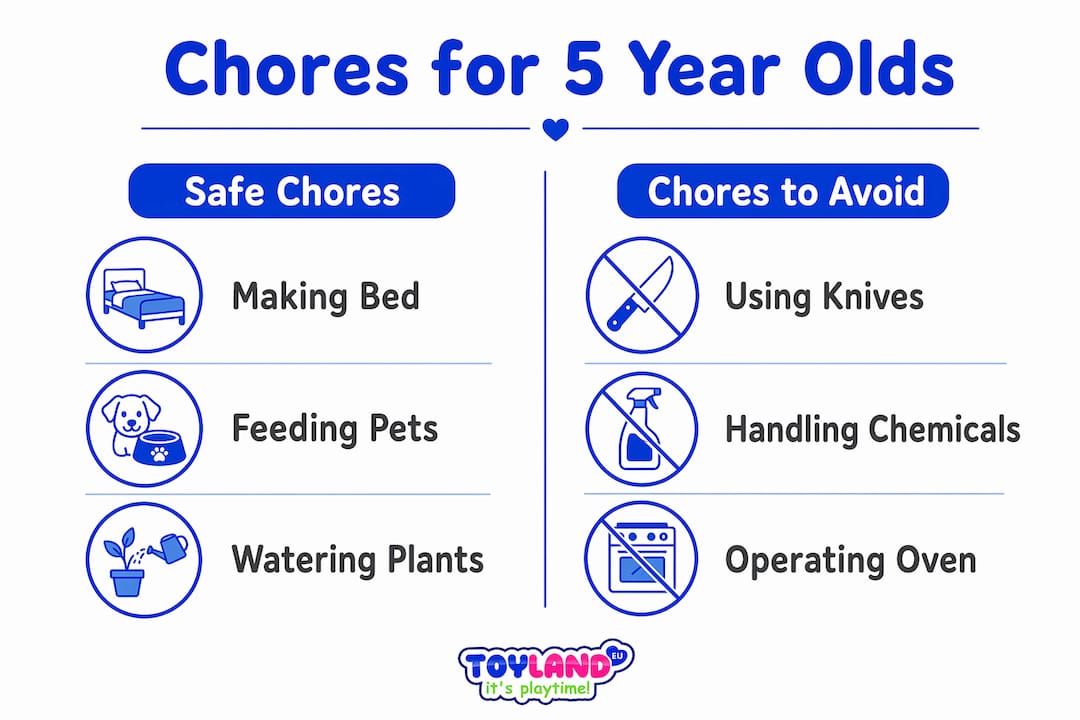
Not every household task is safe for a 5-year-old. Parents must screen chores for physical and chemical hazards before assigning them. Chores to avoid include anything involving sharp objects, cleaning chemicals, heavy lifting, or multi-step instructions the child cannot yet read.
The right supervision level is nearby with periodic check-ins, not constant hovering. Hovering signals distrust and reduces the child’s sense of ownership over the task.
| Safe chores for age 5 | Chores to avoid at age 5 |
|---|---|
| Making bed (with guidance) | Washing dishes with hot water |
| Feeding pets (pre-measured) | Using cleaning sprays or chemicals |
| Setting table with plastic items | Carrying heavy laundry baskets |
| Tidying toys into bins | Vacuuming stairs |
| Watering plants (small container) | Cooking on the stove |
| Putting clothes in hamper | Handling sharp kitchen tools |
Chore time exceeding 15 minutes leads to burnout and reduced motivation in this age group. That is a hard limit worth respecting. When a child hits that wall, they are not being difficult. They are simply out of capacity.
Developmental readiness also varies. Some 5-year-olds can water plants without spilling. Others need another month. Adjust the task to the child, not the other way around.
How to handle challenges and encourage positive attitudes
Resistance to chores is normal and expected. The way parents respond to that resistance shapes whether chores become a lasting habit or a daily battle. The most effective approach is to frame chores as family contributions, not as work-for-pay or punishment.
Practical strategies that reduce resistance include:
- Do chores together when first introducing a task
- Use “we” language: “We take care of our home together”
- Pause and simplify if a child pushes back hard, then reintroduce the task after a few days
- Focus on participation, not the quality of the result
- Avoid fixing the chore immediately after the child finishes. A lumpy bed is a completed chore.
Performing chores alongside parents builds a child’s identity as a “helper.” That identity is more powerful than any sticker chart. Children who see themselves as helpers are more likely to contribute without being asked as they get older.
The outcome matters less than the habit-forming process. A bed that is not perfectly made is still a made bed. Praising completion rather than perfection builds confidence and keeps the child coming back to the task tomorrow.
Toys that mimic household activities, like play kitchens or team-building playsets, also reinforce the “helper” identity during free play. Play and chores work together when the home environment supports both.
Key Takeaways
Five-year-olds build lasting responsibility through short, consistent, safe chores that prioritize habit and participation over perfect results.
| Point | Details |
|---|---|
| Best chores for age 5 | Single-step tasks like making the bed, feeding pets, and tidying toys fit motor skills and attention span. |
| Keep tasks short | Each chore should take 2–5 minutes; total daily chore time should not exceed 10–15 minutes. |
| Use visual aids | Chore charts and sticker charts with pictures help 5-year-olds track and complete daily tasks. |
| Safety first | Avoid chores with chemicals, sharp objects, heavy loads, or multi-step instructions. |
| Process over perfection | Praising completion rather than quality builds confidence and sustains long-term chore habits. |
Why I think parents underestimate the chore window at age 5
Most parents I talk to either wait too long to start chores or pile on too many tasks at once. Both mistakes come from the same place: overestimating what a 5-year-old needs to prove before being trusted with a task.
Here is what I have seen work. The parents who start small, stay consistent, and resist the urge to redo the chore after the child finishes raise kids who genuinely want to help. That is not a small thing. A child who identifies as a helper at five is a teenager who takes out the trash without being asked.
The research on chores and empathy surprised me when I first read it. Chores are not just about a clean house. They are about teaching a child that their actions affect other people. That lesson, learned at five through feeding a pet or setting a table, is one of the most transferable skills a parent can give.
My honest advice: start with one chore this week. Do it together. Do not fix it afterward. Come back to it tomorrow. That is the whole system.
— Thane Holland
Toylandeu™ picks that support responsibility routines
Building a sense of responsibility does not stop when chore time ends. Creative play reinforces the same skills: focus, follow-through, and pride in completing something.

Toylandeu™ carries the Enchanting Kids Art Workbook Montessori Drawing Kit, a structured creative kit that gives 5-year-olds a task to start, work through, and finish on their own. That sequence mirrors exactly what a good chore routine builds. The Creative Learning Set for Kids 3–12 pairs drawing with early math in a format that rewards completion. Both ship worldwide with free delivery through Toylandeu™, making them easy additions to any child’s daily routine.
FAQ
What chores are ok for a 5 year old to do alone?
Five-year-olds can do simple tasks like tidying toys, putting clothes in the hamper, and making their bed without direct help. A parent should be nearby for check-ins rather than constant supervision.
How long should chores take for a 5-year-old?
Each individual task should take 2–5 minutes, with total daily chore time capped at 10–15 minutes to prevent burnout.
Should I pay my 5-year-old for doing chores?
Child development guidance recommends framing chores as family contributions rather than paid work. Tying chores to money can undermine the habit-forming and empathy-building benefits.
What if my 5-year-old refuses to do chores?
Pause the task, simplify it, and reintroduce it after a few days. Adjusting based on resistance and doing the chore together initially reduces pushback and rebuilds confidence.
How many chores should a 5-year-old have?
Start with 2–3 daily chores and add more only after those feel routine. Reliability across a small number of tasks matters more than the total count assigned.