

Best Colors for Kids Bedrooms: 2026 Parent Guide
TL;DR:
- The best kids’ bedroom colors are calming, muted tones that support sleep and adapt as children grow. Bright colors should be used only as accents to prevent overstimulation and sleep disruption. A neutral wall palette with interchangeable accessories allows personalization without frequent repainting.
The best colors for kids bedrooms are muted, calming tones like sage green, dusty blue, and warm neutrals. These shades, known in interior design as low-saturation hues, support sleep, reduce overstimulation, and adapt as your child grows from toddler to teen. Bright primaries like fire-engine red and neon orange belong on accent pillows, not walls. This guide gives you the research-backed framework to choose bedroom color schemes that work today and still look right five years from now.
Quick summary
The single most important rule for children’s bedroom color: keep walls calm and muted, then layer personality through accessories. Soft blues and muted sage green support melatonin production and reduce distractions. Bright reds and neon oranges raise alertness and disrupt sleep. Neutral bases like warm white and cream let you update the room without repainting every two years.
Tl;dr
- Best wall colors: Sage green, dusty blue, warm white, soft terracotta
- Avoid on walls: Bright red, neon orange, electric yellow
- Best strategy: Neutral base + vibrant accents via textiles and toys
- Lighting matters: Test paint samples at home under morning and evening light
- Shared rooms: One unified neutral base, personalize with bedding
Table of contents
- Which Colors Promote Calm and Restful Sleep?
- Muted vs. Saturated Colors: Which Lasts Longer?
- Color Schemes for Every Age and Room Zone
- How to Personalize With Color Without Overwhelming the Space
- Key Takeaways
- Perspective
- Toylandeu™ Picks to Complete the Room
- FAQ
Which colors promote calm and restful sleep in kids bedrooms?
Soft blue and muted sage green support melatonin production and reduce visual distractions, making them the top scientifically supported choices for children’s bedroom walls. Melatonin is the hormone that triggers sleep onset. When a child’s environment reinforces that signal, falling asleep and staying asleep becomes easier.
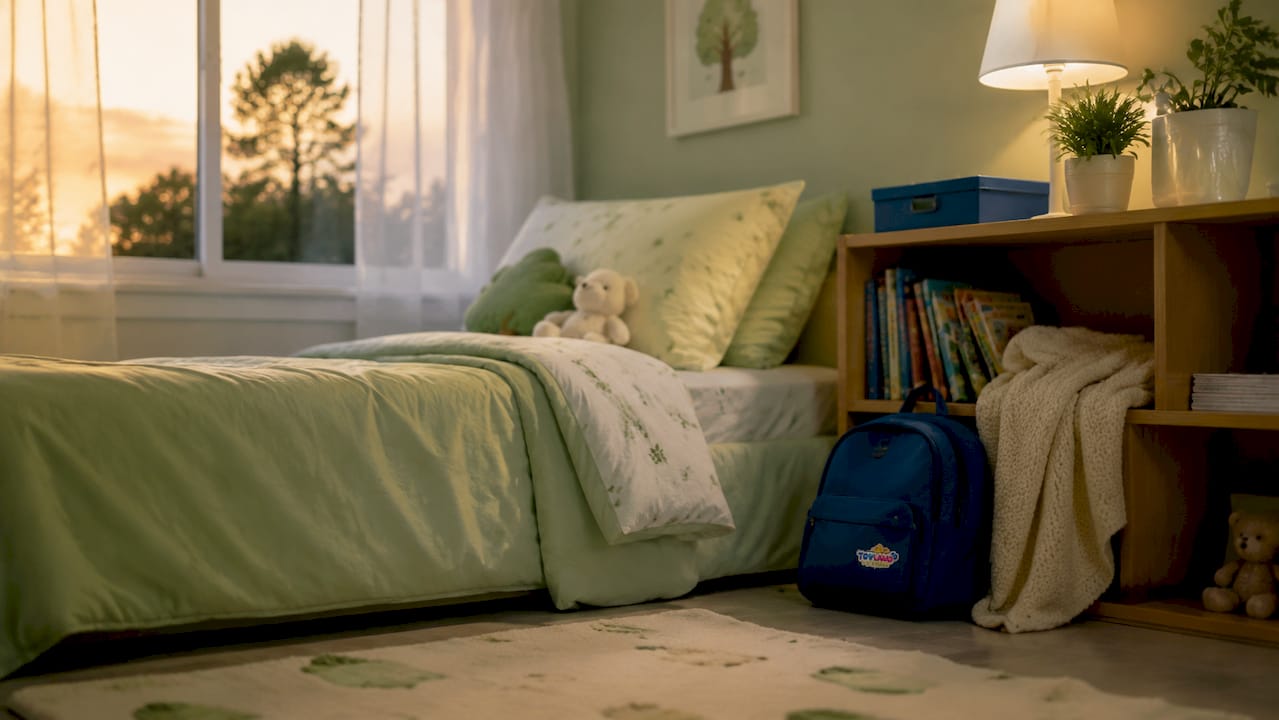
The colors to avoid are just as clear. Bright red and neon orange increase alertness and circulation, disrupting sleep patterns. These colors are processed by the brain as high-energy signals. That is exactly what you want on a soccer field and exactly what you do not want at 8 p.m. in a six-year-old’s bedroom.
Here is a practical breakdown of color choices by their effect:
- Soft blue (powder blue, sky blue): Lowers heart rate, reduces anxiety, supports sleep onset
- Muted sage green: Calming and grounding, works from nursery through teen years
- Lavender: Gentle and soothing, particularly effective for children who struggle to wind down
- Warm white and cream: Neutral and flexible, reflect light without feeling cold or clinical
- Dusty pink: Calming in its muted form, far more room-friendly than candy pink or hot pink
Pro Tip: Test paint samples on a large piece of cardboard and move it around the room at different times of day. Store lighting is nothing like your child’s bedroom at 7 a.m. versus 7 p.m.
Understanding color psychology for kids goes deeper than just picking a soothing shade. The finish matters too. Flat and eggshell finishes absorb light and feel softer. Satin and gloss finishes reflect light and can make a color feel more intense than the paint chip suggests.
Muted vs. saturated colors: which lasts longer?
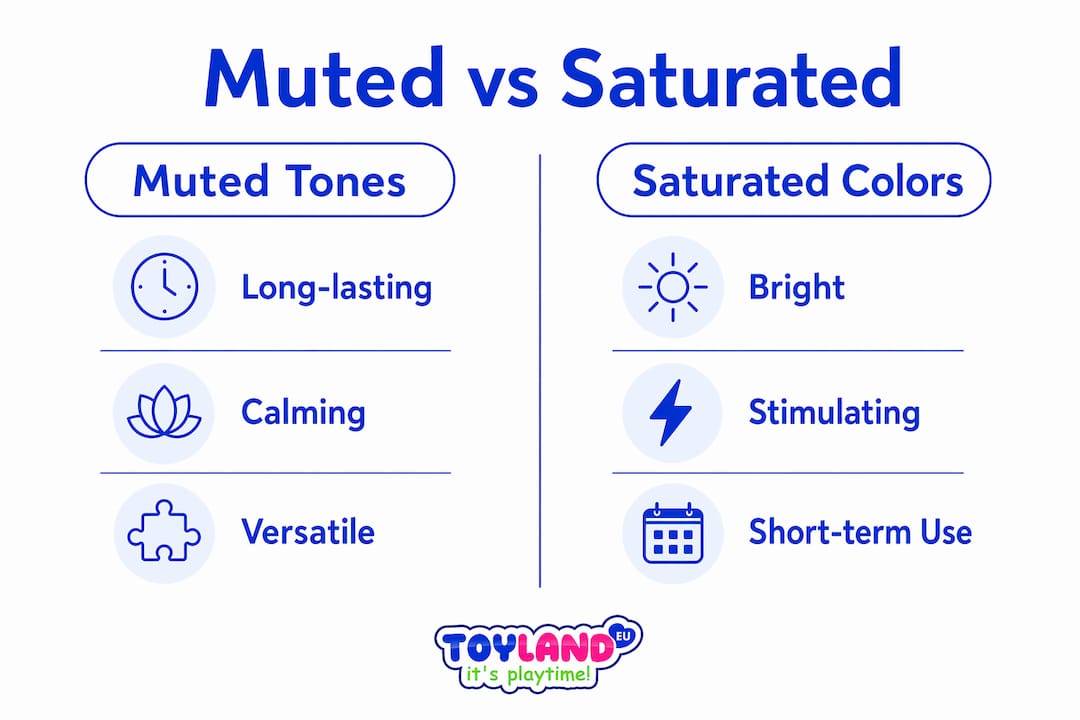
Muted and dusty shades have a longer aesthetic life than saturated primaries. They adapt as furniture changes, as the child’s interests shift, and as the room takes on new functions. A saturated cobalt blue that looks perfect in a five-year-old’s space can feel jarring by age nine.
The comparison below shows why most designers now favor muted tones as base colors for children’s rooms.
| Feature | Muted / Dusty Shades | Saturated Primaries |
|---|---|---|
| Longevity | Ages well across childhood stages | Often feels dated within 2–3 years |
| Sleep impact | Supports calm and melatonin production | Can raise alertness and disrupt sleep |
| Furniture flexibility | Pairs with wood, white, and most textiles | Clashes with many furniture finishes |
| Repainting frequency | Low, adapts to changing decor | High, requires updates as tastes evolve |
| Best use | Wall base color | Accent pillows, rugs, toys, art |
Sage green is the single most popular base color in 2026 designer children’s room projects. That is not a coincidence. It reads as nature-inspired and calm, works with both warm and cool lighting, and never feels babyish or overly juvenile.
Dusty pink follows the same logic. It is preferred over candy pink for room longevity because it reads as sophisticated rather than novelty-driven. A child who loved candy pink at age four will likely outgrow it by age seven. A child with dusty pink walls may keep them through middle school.
Pro Tip: Use saturated colors in items you can swap out easily. A bright yellow throw pillow costs $15 and takes 30 seconds to replace. Repainting a room costs time, money, and disruption.
What are the best bedroom color schemes by age and room zone?
The most effective children’s bedroom color schemes treat the room as three distinct zones: sleep, play, and study. Each zone has a different function, and color use should respect those zones to balance stimulation and calm. A single wall color applied uniformly ignores how children actually use their space.
Here is how to think about each zone:
- Sleep zone (bed area): Use your calmest, most muted shade here. Soft blue, sage green, or warm white on the wall behind the bed signals rest. Keep lighting warm and low in this area.
- Play zone (floor area or corner): This is where you can introduce more vibrant accents through a colorful rug, toy storage bins, or a feature wall in a slightly bolder tone. The color does not need to be loud to feel energetic.
- Study zone (desk area): Warm neutrals and soft greens work well here. They support focus without the drowsiness that very deep blues can cause. Warm whites are preferable to cool whites in children’s bedrooms because cool whites can feel clinical and harsh under artificial light.
Age also shapes the right palette:
- Toddlers (ages 1–4): Soft pastels and warm neutrals. Avoid anything too stimulating near the sleep area.
- School-age children (ages 5–11): Introduce slightly more saturated accents in the play and study zones. Sage green, dusty blue, and warm terracotta work well as base colors with brighter accents.
- Tweens and teens (ages 12+): Deeper, more sophisticated versions of the same palette. Charcoal blue, forest green, and warm taupe give the room a grown-up feel without a full repaint.
For shared rooms, Behr recommends a unified neutral base to avoid visual clash. Splitting walls by color to mark each child’s territory creates a small, disjointed space. Instead, use bedding, rugs, and accessories to personalize each child’s area within a cohesive color story.
How can you personalize a kids room with color without overwhelming it?
Neutral walls with warm undertones are a lasting investment. They let you update the room’s personality through textiles and decor without repainting every time your child’s interests shift from dinosaurs to space to soccer. Children’s favorite colors change quickly. Walls should not have to keep up.
The most practical approach is to treat the walls as a backdrop and the accessories as the color story. Here is what that looks like in practice:
- Bedding and pillows: The fastest, cheapest way to introduce bold color. A sage green wall with a bright orange duvet cover creates energy without overstimulation.
- Rugs: A colorful rug defines the play zone and adds warmth underfoot. It is easy to swap as tastes change.
- Toy storage: Brightly colored bins and shelves add visual interest while serving a functional purpose. A colorful Montessori pegboard toy doubles as wall decor and a play tool.
- Art and prints: Framed prints in your child’s favorite colors are removable and replaceable. They cost far less than a repaint.
- Curtains: A bold curtain color can anchor the whole room’s palette without touching the walls.
Bright primary colors overstimulate children when used on walls and disrupt sleep. Used in accents and textiles, those same colors become assets. The key is scale. A bright red wall is overwhelming. A bright red toy bin in the corner is cheerful.
Key takeaways
The best colors for kids bedrooms are muted, calming tones used on walls, with vibrant shades reserved for accessories that can be swapped as the child grows.
| Point | Details |
|---|---|
| Muted tones win on walls | Sage green, dusty blue, and warm neutrals age well and support sleep. |
| Avoid bright colors on walls | Red and neon orange raise alertness and disrupt melatonin production. |
| Zone the room by function | Use calm colors near the bed and slightly bolder accents in play and study areas. |
| Neutral bases save money | Warm white and cream walls reduce repainting frequency as tastes change. |
| Accessories carry the personality | Swap rugs, bedding, and toys to update the color story without touching the walls. |
Why i think most parents get kids room colors backwards
Most parents I talk to start with the child’s favorite color and paint the whole room that shade. I understand the instinct. It feels like you are honoring your kid’s personality. The problem is that a five-year-old’s favorite color changes roughly every 18 months, and walls do not.
The parents who get it right start with the room’s function, not the child’s preference. They ask: where does my child sleep, play, and study? Then they choose a calm base that serves all three zones and let the accessories carry the personality. That approach works at age four and still works at age twelve.
Lighting is the piece most people overlook entirely. I have seen parents choose a beautiful dusty blue at the store, paint the room, and end up with something that looks gray and cold by evening. Test samples under different lighting at home before you commit. Morning light, afternoon light, and lamp light all read differently on the same wall.
The other mistake is treating a shared room like two separate rooms. Splitting the wall down the middle with two different colors makes both halves feel smaller. A unified neutral base with personalized bedding and decor on each side is the smarter call, and Behr’s guidance on shared kids spaces backs that up.
My honest recommendation: paint the walls sage green or warm white, buy colorful toys and bedding, and revisit the accessories every couple of years. Your child gets a room that feels like theirs. You get a room that does not need repainting every time they discover a new obsession.
— Thane Holland
Complete the room with toylandeu™

A calm, well-zoned bedroom is only as good as what fills it. Toylandeu™ carries over 30,000 products that bring color, creativity, and learning into children’s spaces without overwhelming the walls. For the study and art zone, the colorful drawing scroll kit gives kids a hands-on creative outlet that pairs perfectly with a neutral backdrop. For the play zone, the LED art desk set adds warm, focused light alongside creative tools. Toylandeu™ ships worldwide with free delivery, so building out your child’s room is straightforward no matter where you are.
FAQ
What is the single best wall color for a child’s bedroom?
Sage green is the most versatile choice. It ages well from nursery to teen, pairs with most furniture finishes, and supports a calm, focused atmosphere.
Do bedroom colors actually affect how well kids sleep?
Yes. Soft blue and muted green support melatonin production, while bright red and neon orange raise alertness and make it harder for children to wind down.
How do i choose colors for a shared kids room?
Use one unified neutral base color on all walls and personalize each child’s zone through bedding, rugs, and accessories. Splitting walls by color makes small rooms feel even smaller.
Should i involve my child in choosing the bedroom color?
Yes, but with guardrails. Let your child pick accent colors for bedding, pillows, and toys. Keep the wall color decision in your hands, since children’s preferences shift quickly and walls are harder to change than a throw pillow.
How often should i repaint a kids bedroom?
With a neutral or muted base color, you rarely need to repaint more than once every five to seven years. Rotating accessories handles most of the personality updates between repaints.