

Toy Rotation System: The Parent's Practical Guide
A toy rotation system keeps a small, curated set of toys visible and accessible while the rest stay stored out of sight, with scheduled swaps every week or two to keep play fresh. Start today in under 15 minutes:
Quick-start checklist:
- Gather every toy in the house into one spot
- Pick a small number of toys your child is currently interested in
- Box or bin the rest and move them out of sight (a closet shelf works fine)
- Set a recurring calendar reminder for swap day — same day, every week or two
What success looks like this week: Your child plays with the same toy for longer stretches, cleanup takes five minutes instead of twenty, and you haven’t heard “I’m bored” once.
Key Takeaways
A toy rotation system works because fewer choices produce longer, more creative play — and a consistent swap schedule keeps the system running without adding significant effort.
| Point | Details |
|---|---|
| Keep the active set small | 4–10 toys depending on age; the 2018 Infant Behavior and Development study found 4 toys outperformed 16 for toddler engagement. |
| Store bins at adult-grab height | Low-friction storage is the primary reason systems survive past the first month. |
| Swap 3–4 items, not everything | Partial swaps maintain continuity and reduce child upset while still refreshing the shelf. |
| Use observation, not just the calendar | If a toy sits untouched for five or more days, it’s ready to rotate out regardless of schedule. |
| Toylandeu™ rotation picks | Open-ended art kits, STEM sets, and Montessori-style activities from Toylandeu™ stay engaging across multiple rotation cycles. |
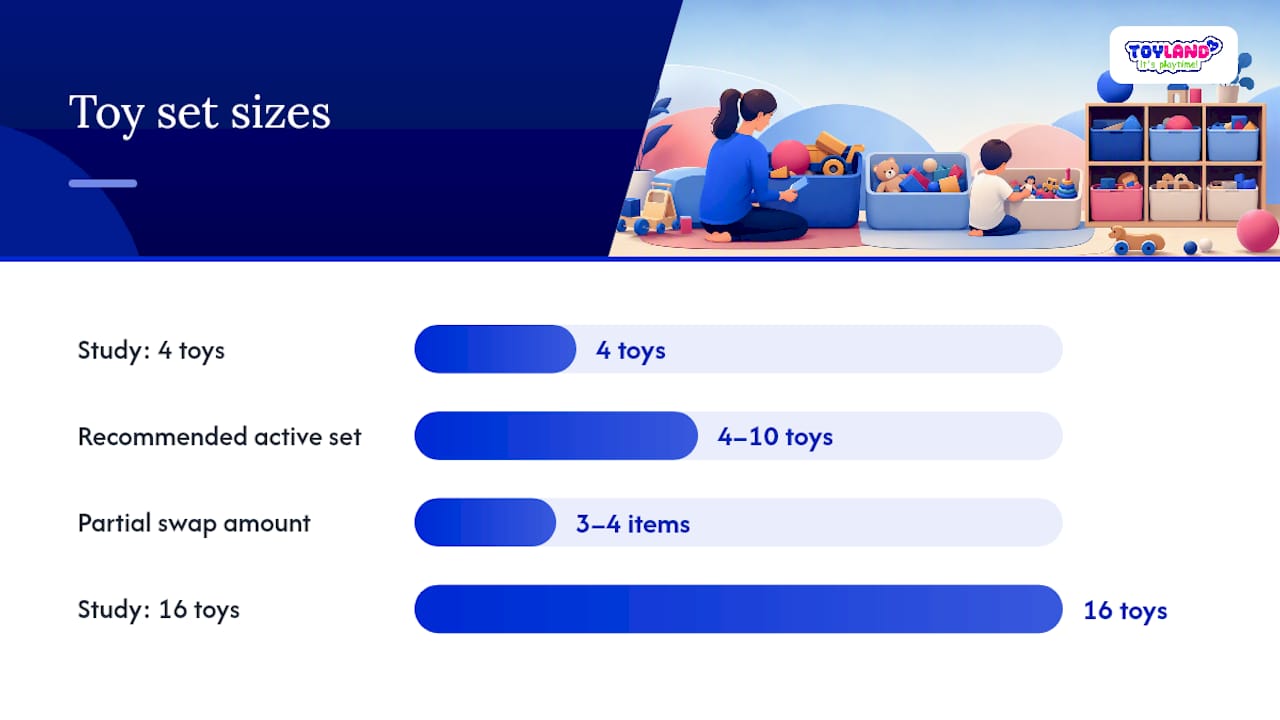
Table of Contents
- What is a toy rotation system and why do families use it?
- Why the research backs a smaller toy set
- What supplies do you actually need to get started?
- How to set up your toy rotation system this afternoon
- How many toys to keep out and how often to rotate
- How Montessori-style rotation works in a real home
- Signs it’s time to rotate and how to fix common problems
- What to do with outgrown, broken, or unwanted toys
- Using rotation intentionally to build specific skills
- What actually makes toy rotation stick in real homes
- Toylandeu™ picks that work well in a rotation
- Sources
- FAQ
What is a toy rotation system and why do families use it?
Keep a small active set of toys where your child can see and reach them. Store everything else out of sight. Swap a few items in and out on a regular schedule. That’s the whole system.
The core goals are straightforward: reduce choice overload, increase focused play, and make cleanup manageable. When a child faces a floor covered in 40 toys, the brain tends to flit from one to the next without settling. A smaller set removes that noise.
Pro Tip: Don’t buy a single new toy to start. Work entirely with what you already own and treat the first two weeks as an experiment. You can always adjust the count, the categories, and the swap frequency once you see how your child responds.
Why the research backs a smaller toy set
The most cited piece of evidence here is a 2018 study published in Infant Behavior and Development that compared toddlers given four toys versus toddlers given sixteen. The children with four toys played for significantly longer stretches and showed more creative engagement. Sixteen toys produced more surface-level, scattered play.
Study snapshot: Toddlers with 4 toys played longer and more creatively than those with 16 — a finding that directly supports keeping your active set small.
Practical benefits parents report once they start rotating, according to FirstCry Parenting’s overview of toy rotation:
- Longer, more focused play sessions — fewer options means deeper engagement with each toy
- More creative play — children invent new uses for familiar toys when novelty isn’t constantly supplied externally
- Easier cleanup — ten toys on a shelf take two minutes to tidy; forty toys on the floor do not
- Less pressure to buy new toys — stored toys feel new again when they come back out after a few weeks
- Reduced toy clutter — the playroom stays usable rather than overwhelming
What supplies do you actually need to get started?
Not much. The friction of starting is mostly psychological, not logistical.
Core supplies:
- Clear plastic bins or lidded boxes (so you can see contents without opening)
- A marker and masking tape or adhesive labels
- Low shelves, a bookcase, or a low coffee table for the active set
- One accessible closet shelf or under-bed space for stored bins
Low-cost alternatives that work just as well: shoeboxes, gift boxes with lids, reusable grocery bags grouped by category, or a spare laundry basket in a closet. A bin-based system using items you already own produces the same results as an expensive setup — the out-of-sight requirement is what matters, not the container brand.
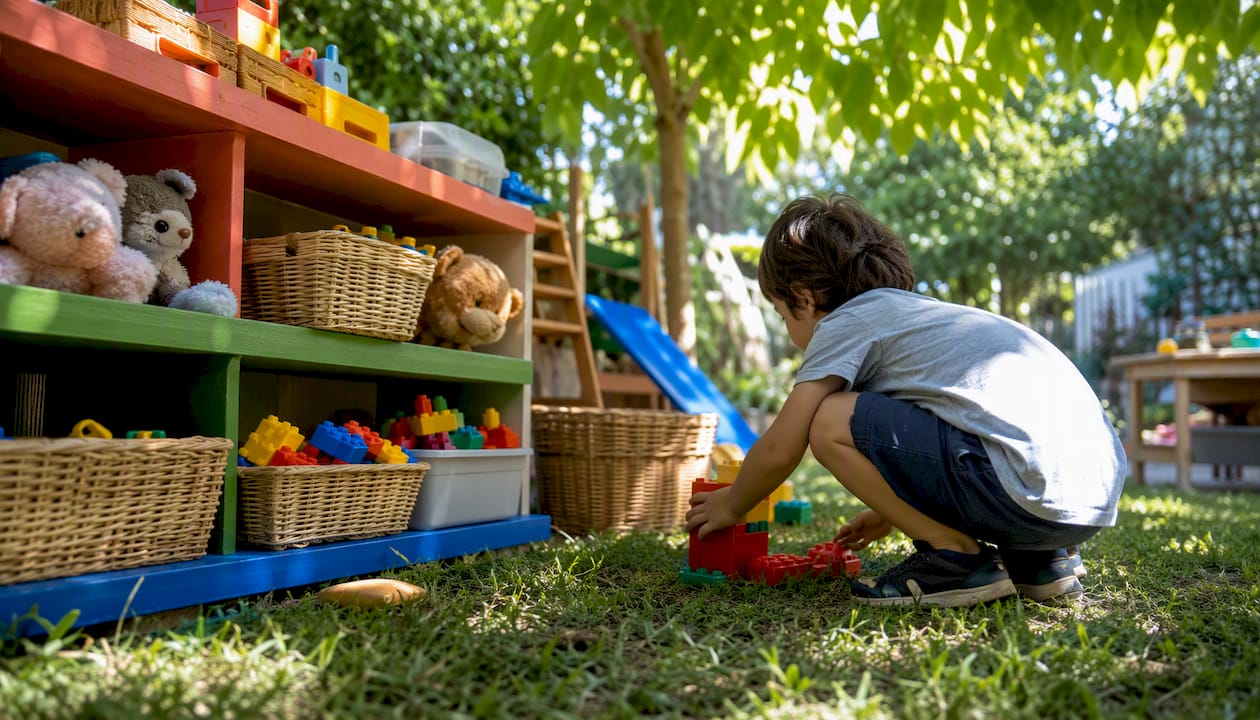
For the active set, low shelves work better than toy boxes. When toys are visible and individually placed, children are more likely to choose and engage with them independently. A tray on a low shelf, a basket at floor level, or a small bookcase turned sideways all work well.
Pro Tip: Photograph or write a quick list of what’s in each stored bin before you close it. A 30-second photo on your phone saves you from digging through every box on swap day.
How to set up your toy rotation system this afternoon
Follow these steps in order. The whole setup takes 30–60 minutes the first time; swaps after that run under 10 minutes.
-
Gather and triage. Pull every toy into one room. Sort into three piles: keep and rotate, donate or sell, and broken or needs repair. Be honest — if it hasn’t been touched in three months, it probably belongs in the donate pile.
-
Create 3–4 rotation groups. Aim for balance across categories: building and construction, imaginative play (figures, dolls, vehicles), fine motor (puzzles, art supplies, lacing cards), and books or art materials. Each group becomes one bin. Practical guides recommend starting with 4–8 visible items and adjusting from there.
-
Set up the active set. Choose a small number of toys from one or two groups. Display them on low shelves or in accessible baskets. Put everything else in labeled bins and move them to your storage spot — closet shelf, under the bed, or a garage shelf at adult-reach height.
-
Pick your swap day and set a reminder. Sunday evening and Friday afternoon are popular choices because they align with weekly rhythms. Set a recurring calendar event. On swap day: pull out one stored bin, swap 3–5 toys, return the swapped-out ones to storage. Keep favorites and comfort items on the shelf permanently.
-
Establish two simple rules. One-in-one-out: any new toy that enters the house means one goes into storage or the donate pile. Comfort items (a beloved stuffed animal, a favorite car) stay out always — the system works around them, not against them.
Pro Tip: Keep swaps under 10 minutes by storing bins at adult-grab height. If you need a step stool or have to move furniture, the system will quietly die within a month. Low-friction storage is the primary fix for systems that get abandoned.
How many toys to keep out and how often to rotate
Age changes both the count and the frequency. Here’s a practical starting point:
| Age range | Active toys to keep out | Suggested swap frequency |
|---|---|---|
| — | 3–5 | Every 1–2 weeks |
| 1–2 years (toddlers) | 4–8 | Weekly or every 2 weeks |
| 3–5 years (preschool) | 8–12 | Every 2–4 weeks |
| 6+ years (school-age) | 10–15 | Monthly or interest-led |
These ranges come from Montessori-aligned guidance on age-based toy counts, which recommends fewer items for infants and observation-led timing for older children.
Decision rule: If a toy sits untouched for five or more days, it’s a candidate for the next swap. Don’t wait for the calendar if engagement has already dropped.
The Montessori-aligned approach keeps roughly 6–8 items available and rotates a few every 1–2 weeks rather than swapping everything at once. Swapping 3–4 items while keeping favorites on the shelf maintains continuity and avoids the upset that comes from a complete overhaul.
For frequency, weekly works well for toddlers whose interests shift fast. Biweekly suits most preschoolers. Monthly is reasonable for school-age children who sustain interest in projects longer. An interest-led alternative: watch your child’s play rather than the calendar, and rotate when engagement visibly drops.
How Montessori-style rotation works in a real home
The Montessori approach to toy rotation adds two layers on top of the basic system: presentation and observation.
Presentation principles:
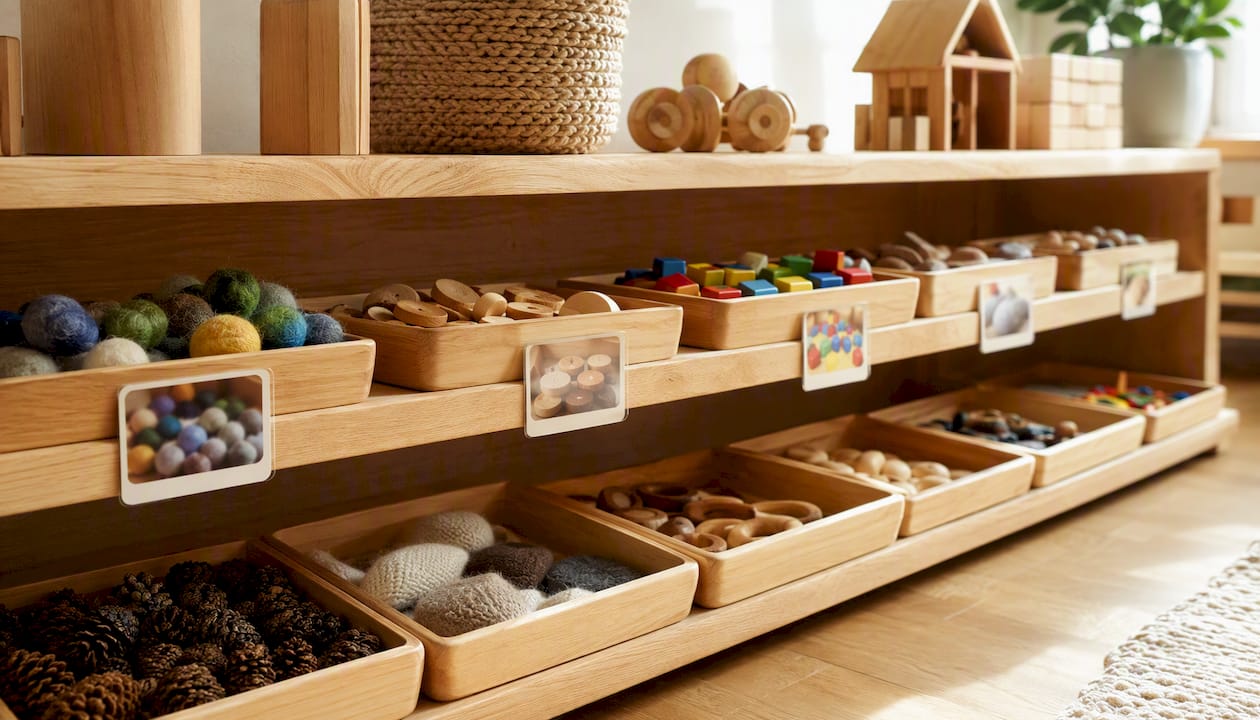
- Display toys at the child’s eye level, not on high shelves
- One complete activity per spot — a puzzle goes out with all its pieces, a lacing card with its lace
- Use trays to present activities as self-contained units the child can pick up, use, and return independently
- Order activities left-to-right by complexity so the shelf has a natural progression
- Include 1–2 practical-life items (a small pouring set, a folding cloth) alongside play toys
Observation-led rotation: Rather than swapping on a fixed calendar, watch for engagement patterns. Which activities get chosen first? Which sit untouched? Rotate out the ignored ones and introduce something new in that spot. Peggy O’Mara’s 8-step Montessori system demonstrates that this approach requires no new purchases and that families report increased independent play within two weeks of starting.
Keep a small number of permanent items — a comfort toy, a favorite building set — that never rotate out. The shelf refreshes around them.
Pro Tip: Label each tray spot with a small photo of the activity that belongs there. Children as young as 18 months can return items to the correct spot when the visual cue is clear, which builds independence and keeps the shelf organized between swaps.
For more ideas on Montessori-friendly toys that work well on a rotation shelf, Toylandeu™ has a practical guide worth bookmarking.
Signs it’s time to rotate and how to fix common problems
Behavioral signs the active set needs refreshing:
- Your child moves from toy to toy without settling into any one for more than a minute or two
- Toys that were favorites last week are now being ignored
- You’re hearing “I want the other toys” or “I’m bored” despite a full shelf
- Play is becoming repetitive and mechanical rather than inventive
Common failure points and quick fixes:
Storage is too hard to reach. If the bins require a step stool or moving furniture, swaps get skipped. Move storage to an adult-reachable shelf and the problem usually resolves immediately, as practical guides consistently note.
Active set has crept up in size. Toys accumulate back onto the shelf between swaps. Do a five-minute reset: anything that doesn’t belong in the current active group goes back in a bin.
Swap days keep getting skipped. Treat it like a standing appointment, not a chore. A 10-minute calendar block on a Sunday evening is easier to keep than an open-ended “sometime this week” intention.
Child is upset when toys disappear. Involve them. Let them help choose which toys go into the “sleeping box” and which stay out. Children who participate in packing accept the system far more readily than those who come home to a changed shelf.
What to do with outgrown, broken, or unwanted toys
Before every rotation cycle, run a quick triage on anything that’s been in storage for two or more cycles without being chosen:
- Repair: If it’s broken but loved, fix it or set a deadline. If it’s still broken in 30 days, move on.
- Keep for sentimental reasons: One small box of genuinely meaningful items is fine. Don’t let sentiment become a reason to keep everything.
- Donate: Remove batteries, check for missing small parts, and confirm the toy meets current U.S. Consumer Product Safety Commission safety standards before donating. Local shelters, libraries with toy-lending programs, and Buy Nothing groups are all good options.
- Sell: Facebook Marketplace and local consignment sales work well for toys in good condition. Photograph before cleaning; clean before listing.
- Recycle: Broken plastic toys with no resale or donation value can go through TerraCycle’s toy recycling program, which accepts mixed plastic toys.
The one-in-one-out rule keeps total volume stable as new toys arrive — for every toy that enters the house, one leaves the active set or goes to donation. Apply it consistently and the storage problem never returns.
Using rotation intentionally to build specific skills
Tidying the playroom is a side effect. The real payoff is using rotation to target developmental skills deliberately.
The 2018 Infant Behavior and Development study showed that fewer options don’t just produce longer play — they produce more creative problem-solving. Children with four toys invented more uses for each one. That finding suggests rotation works best when the active set is curated around a skill theme, not just assembled randomly.
Observation prompt: During a 15-minute free play session, note which toy your child returns to after interruptions. That’s the one generating the deepest engagement — keep it in the next rotation.
A simple 3-prompt observation template for swap day:
- Which toy did they choose first, and how long did they stay with it?
- Which toy went untouched the entire rotation period?
- Did they combine any toys in unexpected ways?
Play suggestions by developmental target:
- Fine motor: Lacing cards, clay modeling kits, threading beads, small building bricks
- Language and narrative: Puppets, small-world figures, picture books, felt boards
- Problem-solving: Puzzles, simple STEM kits, shape sorters, building sets
For evidence-based tips on connecting toys to learning outcomes, Toylandeu™'s blog covers this in practical detail.
What actually makes toy rotation stick in real homes
Most parents who try rotation and quit do so within the first three weeks — not because the system doesn’t work, but because swap day feels like one more task on an already full plate.
The fix is treating swap day like a recurring appointment rather than a chore you’ll get to eventually. Put it on the calendar with a 10-minute block. When it becomes a standing event, it runs on autopilot.
Expect these things in the first two weeks:
- Initial resistance from children who notice the missing toys (normal — it passes)
- A few swap days where you only move two or three items instead of a full group (still counts)
- One or two toys that come back out of storage and immediately get ignored again (that’s data — they’re ready to donate)
A micro-challenge worth trying: Run one two-week rotation with 6–8 toys. On day 10, sit nearby for 15 minutes and just watch. Don’t redirect, don’t suggest. Notice which toy holds attention longest. That observation will tell you more about your child’s current interests than any age-based chart.
Start small. Iterate. The system gets easier every cycle.
Toylandeu™ picks that work well in a rotation
This section highlights product types available at Toylandeu™ that pair particularly well with a rotation shelf. No hard sell — just practical suggestions.
Open-ended, low-screen toys earn their place in rotation because they stay engaging across multiple cycles. A few product types worth considering:
- Art and drawing kits (like the Montessori Drawing Kit or the clay modeling set) fit neatly into a rotation tray and support fine motor development across repeated sessions
- Montessori-style matching and drawing games (like the Montessori Drawing Adventure) work as self-contained activities a child can pick up and return independently
- STEM and building kits rotate well because each session can go in a different direction — children rarely exhaust the possibilities in one cycle
- RC vehicles make strong rotation candidates for school-age children; a gesture-controlled stunt car or off-road SUV brings high engagement when it comes back out after a few weeks away
Toylandeu™ carries over 30,000 products across these categories with free worldwide shipping. Browse the full catalog to find rotation-ready picks that match your child’s current developmental stage.
Sources
- Infant Behavior and Development (2018)
- Toy Rotation: The Montessori Hack That Changed Our Mornings | Tovi
- Toy Rotation: What It Is, Benefits, and Tips | FirstCry Parenting
- How to Rotate Toys Like a Montessori Teacher (Peggy O’Mara)
- How to Implement a Toy Rotation System That Actually Works | MinimalistRig
FAQ
Does toy rotation actually work?
Yes. A 2018 Infant Behavior and Development study found toddlers with four toys played longer and more creatively than those with sixteen, which is the core mechanism rotation exploits. Parents who maintain a consistent schedule consistently report longer play sessions and easier cleanup.
How does the Montessori method of toy rotation work?
Montessori rotation keeps roughly 6–8 items on low, child-height shelves, presented as complete activities on trays. Swaps are observation-led rather than calendar-driven: when a child stops engaging with an activity, it rotates out and something new takes its spot.
What age should you start toy rotation?
You can start from birth. Infants benefit from 3–5 toys rotated every 1–2 weeks. Toddlers do well with 4–8 toys on a weekly or biweekly schedule. The system scales up in item count and spacing as children get older and sustain interest for longer periods.
How many toys should you keep out for toy rotation?
The research-backed starting point is 4–8 toys for toddlers, scaling to 8–12 for preschoolers and 10–15 for school-age children. When in doubt, start at the lower end of the range and add one or two items if your child seems under-stimulated after a few days.