

Examples of Montessori Toys: Inspire Learning and Independence
TL;DR:
- Montessori-inspired toys focus on natural materials, self-correcting design, and open-ended play, not labels.
- Parents should evaluate toys based on their ability to promote independent problem-solving and development.
Walk into any toy store or scroll through any online marketplace and you’ll spot dozens of products stamped with the word “Montessori.” But as Good Housekeeping clearly explains, there is no single “true Montessori” toy, and Montessori does not manufacture or sell its own products. This creates real confusion for parents who want toys that genuinely support independent thinking, fine motor growth, and self-directed learning. This article cuts through the noise by identifying the core principles behind Montessori-inspired toys, offering concrete examples across developmental areas, and giving you a practical framework for making smarter choices.
Table of Contents
- What makes a toy Montessori-inspired?
- Top examples of Montessori toys by developmental area
- How Montessori-inspired toys compare to conventional toys
- Tips for selecting the best Montessori-inspired toy for your child
- A new perspective: What truly matters (and what doesn’t) when choosing Montessori-inspired toys
- Explore Montessori-inspired toys at ToylandEU
- Frequently asked questions
Key Takeaways
| Point | Details |
|---|---|
| Authenticity over labeling | Prioritize toys based on Montessori principles, not just branding. |
| Focus on simplicity | Choose toys that isolate skills, use natural materials, and allow self-correcting play. |
| Developmental alignment | Select toys matched to your child’s current abilities and needs for optimal growth. |
| Montessori outperforms conventional toys | Research shows Montessori-aligned options support multiple learning domains better than standard toys. |
| Child-led play is key | Look for toys that promote independence and exploration over entertainment. |
What makes a toy Montessori-inspired?
Understanding these foundational principles will help you confidently assess whether a toy genuinely supports your child’s development.
The word “Montessori” on a box is a marketing term, not a certification. No licensing board reviews toy designs and grants official approval. That means the responsibility falls entirely on you as a parent to look past the label and evaluate the actual design. This is empowering once you know what to look for.
The core hallmarks of a Montessori-inspired toy include:
- Isolation of a single concept: Each toy should focus on one skill or idea at a time, such as color matching, pouring, or stacking sequence. When a toy tries to teach five things at once, it dilutes the learning and overwhelms young children.
- Natural materials: Wood, cotton, metal, and other natural textures offer richer sensory feedback than plastic. Children feel the weight and grain of a wooden puzzle piece in a way that a plastic one can’t replicate.
- Self-correcting design: The toy tells the child when something is wrong without an adult intervening. A shape sorter that only accepts the correct shape in each slot is a classic example. The child learns through trial and error, not through praise or reprimand.
- Open-ended possibility: The best Montessori-inspired toys invite repetition and exploration. A simple set of wooden rings can be stacked a hundred different ways, keeping a toddler engaged across many play sessions.
- No batteries required: As Good Housekeeping highlights, Montessori-aligned shopping means avoiding toys designed mainly to entertain through lights, sounds, or talking, because those features shift control away from the child and reduce opportunities for independent problem-solving.
“The goal of early childhood education should be to activate the child’s own natural desire to learn.” This idea sits at the heart of why Montessori-inspired toys look so different from conventional options on most shelves.
Pro Tip: Before buying any toy labeled “Montessori,” ask yourself: does this toy respond to the child, or does the child respond to the toy? If a button press triggers a light show, the toy is doing the work. If a child must figure out how to fit a lid onto a jar, the child is doing the work. That distinction is everything.
Top examples of Montessori toys by developmental area
With these core principles in mind, exploring actual toy options across developmental stages will clarify the potential Montessori-inspired choices available to you.
Montessori-inspired practical life activities include pouring, spooning, using tongs, and dressing practice through items like frames with buttons, zippers, and laces. These are not just play activities but genuine skill-building exercises that connect directly to daily independence.
Here’s how Montessori-inspired toys map across key developmental areas:
Fine motor and practical life skills
Small pitchers for pouring water, tongs for transferring objects between bowls, and dressing frames for practicing buttons and zippers are cornerstones of this category. A wooden toddler tool set extends this idea by letting children manipulate real-feeling tools in safe, scaled-down form, building grip strength and hand-eye coordination simultaneously.
Object permanence and early problem-solving
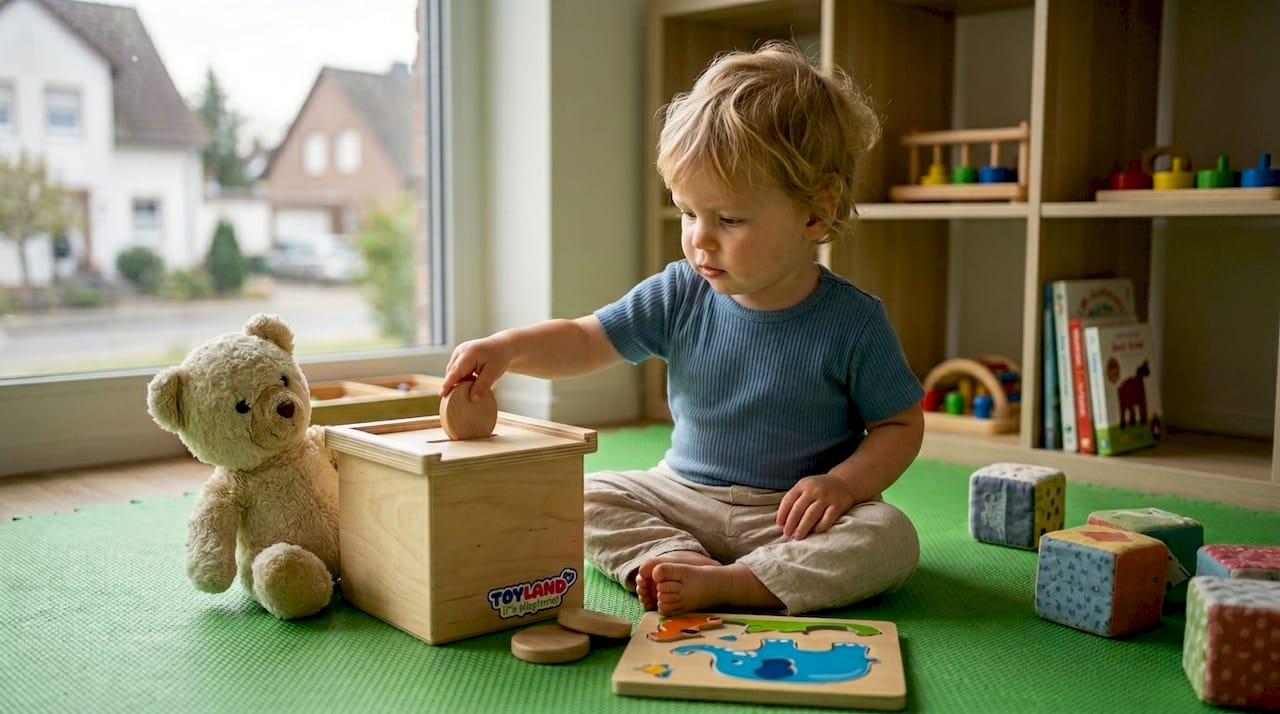
Simple wooden puzzles and interlocking discs teach children that objects have a fixed form and that fitting pieces together requires focused effort. Interlocking disc sets made from beech wood are especially effective because the natural texture gives tactile feedback as the child connects each piece.
Sensory exploration for infants
For babies, texture and safe materials are the priority. A natural baby teething tie made from food-safe materials allows infants to explore through mouthing, which is their primary mode of learning in the earliest months. High-quality materials matter here more than anywhere else because babies put everything in their mouths.
Logical reasoning and sequencing
Stacking and nesting sets push children to figure out order, size relationships, and spatial logic. A colorful pegboard mushroom toy introduces children to color sorting and pattern-making at the same time, reinforcing early math thinking without any screen or battery.
Early math and visual discrimination
Shape and color sorters, bead mazes, and simple counting boards fall here. As research on Montessori-inspired play explains, these toys rely on child-controlled repetition rather than battery-powered interactivity, which gives children the space to self-correct and build genuine understanding over time.
| Developmental area | Example toy type | Key benefit |
|---|---|---|
| Fine motor and practical life | Pouring pitchers, dressing frames, tool sets | Hand strength, coordination, independence |
| Object permanence | Wooden puzzles, interlocking discs | Spatial reasoning, problem-solving |
| Sensory exploration | Textured teethers, fabric books | Tactile awareness, safe mouthing |
| Logical sequencing | Stacking rings, nesting cups | Size relationships, order thinking |
| Early math and sorting | Color sorters, pegboards, bead mazes | Pattern recognition, visual discrimination |
Pro Tip: Rotate toys every two to three weeks instead of leaving everything out at once. A smaller selection creates focus and makes each toy feel new again when it reappears, which keeps your child’s engagement level consistently high.
How Montessori-inspired toys compare to conventional toys
Now that you’ve seen specific examples, it’s useful to compare what makes these Montessori-inspired options stand out versus conventional toys available on the market.
The difference between a Montessori-inspired toy and a conventional toy isn’t always obvious from the outside. Both might look like puzzles or stacking games. The real gap shows up in how they support or replace the child’s thinking.
A 2025 meta-analysis on Montessori education reports positive effects across multiple development and learning domains, with outcomes described as moderate to high depending on the specific dimension measured. That’s meaningful evidence for parents who want more than just entertainment from a toy.
Key differences at a glance:
- Montessori-inspired toys encourage exploration, accept mistakes as part of the process, and reward persistence with a clear “aha” moment when the design clicks into place.
- Conventional toys often direct play through scripts, sounds, and flashing rewards, reducing the amount of thinking a child has to do independently.
- A stacking puzzle made from natural wood invites open-ended use across age groups, while a battery-powered toy typically has one correct way to play and loses appeal once a child has seen that outcome a few times.
- Toys with lights and sounds, as Good Housekeeping notes, shift the child’s role from explorer to spectator.
- A rainbow pebbles set can become a sorting game, a stacking challenge, a counting exercise, or a color-matching activity depending on what the child decides to explore that day.
| Feature | Montessori-inspired toy | Conventional toy |
|---|---|---|
| Materials | Natural wood, cotton, metal | Plastic, electronic components |
| Play direction | Child-led, open-ended | Scripted, toy-directed |
| Feedback method | Self-correcting design | Sounds, lights, adult praise |
| Skill focus | One concept at a time | Often multiple or unclear |
| Longevity | Years of use across stages | Often outgrown quickly |
| Evidence base | Linked to positive developmental outcomes | Varies widely by product |
The longevity point deserves extra attention. A well-made wooden stacking set can serve a child from 12 months through age 5 because the challenge evolves as the child grows. That’s a practical and financial advantage most parents don’t factor in when comparing price tags at the store.
Tips for selecting the best Montessori-inspired toy for your child
With key differences clear, parents can make more empowered decisions using these tips for thoughtful selection.
Choosing well isn’t complicated once you have a framework. The biggest mistake most parents make is focusing on the label rather than the design, and as the Good Housekeeping Montessori toy guide emphasizes, design principles matter far more than branding or marketing language.
-
Match the toy to a specific developmental skill. Instead of buying “a Montessori toy,” identify what your child is currently working toward. Are they struggling with grip? Look for practical life tools. Are they ready for early counting? Try a bead maze or color sorter. Targeted choices lead to much better outcomes than general purchases.
-
Look for self-correcting features. Put the toy down and ask: how will my child know they made a mistake? If the answer is “I’ll tell them,” the toy isn’t doing its job. Good design builds feedback into the object itself.
-
Prioritize natural materials. Wood, cotton, and untreated metal age well, feel better in small hands, and carry far less risk of chemical exposure than soft plastics. They also hold up to years of use without cracking or fading.
-
Test for open-ended play potential. Can the toy be used in at least three different ways? A drawing toy set that supports free drawing, tracing, and color recognition offers far more value than a coloring book with fixed outlines.
-
Skip anything with a screen or a battery. This rule will immediately eliminate most misleadingly labeled products and keep your focus on toys that truly support hands-on discovery.
-
Observe your child, not the packaging. Bring your child into the selection process when possible. A toy that catches their genuine curiosity will get far more use than one that looks impressive on a shelf. A color and number maze might look simple to an adult but fascinate a toddler for weeks because of the tactile satisfaction of moving beads through tracks.
-
Plan for rotation, not accumulation. Research consistently supports fewer, well-chosen toys over a large, overwhelming collection. Rotate options every few weeks to maintain novelty and deepen focus on each item.
Pro Tip: Take a photo of your child’s current toy shelf and ask yourself how many items are child-driven versus toy-driven. If most toys make noise, light up, or follow a script, a simple swap toward natural, open-ended options can shift your child’s play quality dramatically within days.
A new perspective: What truly matters (and what doesn’t) when choosing Montessori-inspired toys
The most honest thing we can tell you is this: the “Montessori” label is almost irrelevant to your actual decision. Parents sometimes spend weeks researching which specific product has the most authentic Montessori credentials, when the real question is far simpler. Does this object give my child a genuine problem to solve? Does it invite them back again and again? Does it step aside and let them lead?
Some important nuance exists in the research, too. While the evidence overall is encouraging, some studies suggest that Montessori advantages on certain academic outcomes can fade over time, even when short-term gains are clear. That’s not a reason to dismiss Montessori principles. It’s a reason to focus on what genuinely lasts, which is the mindset of curiosity, patience, and self-trust that good play builds in a child.
A child who learns to sit with a puzzle until they solve it, who pours water carefully from one container to another without giving up, who figures out that the red peg only fits in the red hole through repeated exploration — that child is practicing something that lasts decades. They’re building tolerance for challenge and confidence in their own ability to figure things out. No single toy delivers all of that. But consistent access to well-designed, child-centered objects, combined with your calm encouragement, does.
Stop worrying about whether a toy has the right certification. Start asking whether it gives your child something worth discovering.
Explore Montessori-inspired toys at ToylandEU
If you’re ready to put these ideas into action, ToylandEU offers a wide range of Montessori-inspired toys designed to support independent learning, creative thinking, and hands-on exploration.
Whether you’re looking for early art activities like the art workbook Montessori kit, a playful introduction to visual matching with the drawing adventure game, or a sensory-rich creative outlet through the color clay modeling kit, you’ll find thoughtfully selected options across every developmental stage. ToylandEU ships worldwide with free delivery, making it straightforward to bring quality, principle-driven toys to your child wherever you are.
Frequently asked questions
Are there any official Montessori toys?
There are no official Montessori toys or certified brands. Montessori does not manufacture or sell products, so evaluate toys based on their design principles rather than their labels.
What materials are best for Montessori-inspired toys?
Natural materials like wood, cotton, and metal are preferred because they offer authentic sensory qualities and align with the Montessori focus on simplicity and self-correcting design.
How many Montessori-style toys do I need for my child?
A small, carefully chosen collection works best. Rotating five to eight items every few weeks keeps play purposeful and maintains your child’s genuine interest over time.
Do Montessori-inspired toys improve learning outcomes?
A 2025 meta-analysis found that Montessori education produces moderate to high positive effects across cognitive, social, and creative domains, though individual results vary depending on the child and context.
Can electronic or battery-powered toys be Montessori?
Battery-powered toys are generally not aligned with Montessori principles because they replace child-led discovery with passive entertainment. Montessori emphasizes hands-on, child-driven play without lights, sounds, or external rewards.
Recommended
- How toys can supercharge learning: 10 evidence-based tips – ToylandEU
- Montessori Inspired Wooden Toddler Tool Set 16 Piece For Creative Play And Imaginative Building ToylandEU
- Master Math Playfully: The Best Montessori Math Toys Revealed – ToylandEU
- Montessori Pegboard Colorful Mushroom Toy ToylandEU