

Toy Magnet Safety: The 50 kG²mm² Rule US Parents Must Know
Some magnetic toys are safe for kids. Loose high-powered magnets and adult desk sets are not, and they should never sit in a home with children. If you have any magnetic ball or cube set, a novelty desk toy, or a set with many small pieces, remove it from reach today, check every magnetic toy your kids own for cracked or loose housings, and call the poison control line or go to the emergency room immediately if you suspect a child swallowed one.
TL;DR:
- Only magnetic toys with a flux index below 50 kG²mm² and proper encasing are safe for children, while loose high-powered magnets pose a severe risk.
- Swallowing multiple magnets can cause tissue trapping, perforation, or infection even if they pass through the digestive system, demanding immediate medical attention.
- US safety standards require small magnets in children’s toys to meet specific strength and testing criteria, but many adult desk and novelty products bypass these regulations.
- The most dangerous products include magnetic sculpture sets, loose magnets in craft kits, and magnetic fake piercings, especially if they can separate into small, swallowable pieces.
- Inspect magnetic toys regularly, keep loose magnets out of children’s reach, and report any incidents or recalls to prevent long-term health consequences.
Table of Contents
- How Toy Magnet Safety Failures Injure Children
- What US Rules Actually Require of Magnet Toys
- Which Magnet Products Pose the Highest Risk?
- How to Choose, Inspect, and Store Magnetic Toys Safely
- What to Do If a Child Swallows or Inhales a Magnet
- How to Check for Recalls and Report a Magnet Hazard
- Long-Term Health Consequences of Magnet Ingestion
- Preventive Measures for Childcare Facilities and Schools
- Guidance on Educating Children About Magnet Safety
- Where Toylandeu™ Stands on Magnetic Toy Safety
- Shop Encased, Age-Appropriate Magnetic Toys at Toylandeu™
- Where to Verify Magnet Safety Rules and Guidance
- Sources
- FAQ
How Toy Magnet Safety Failures Injure Children
The danger isn’t the magnet itself. It’s what happens when a child swallows more than one. A single magnet usually passes through the digestive tract without incident, the same way a coin might. Two or more magnets, swallowed separately or together, can find each other through the walls of the intestine. They clamp together across tissue, and that tissue gets trapped between them.
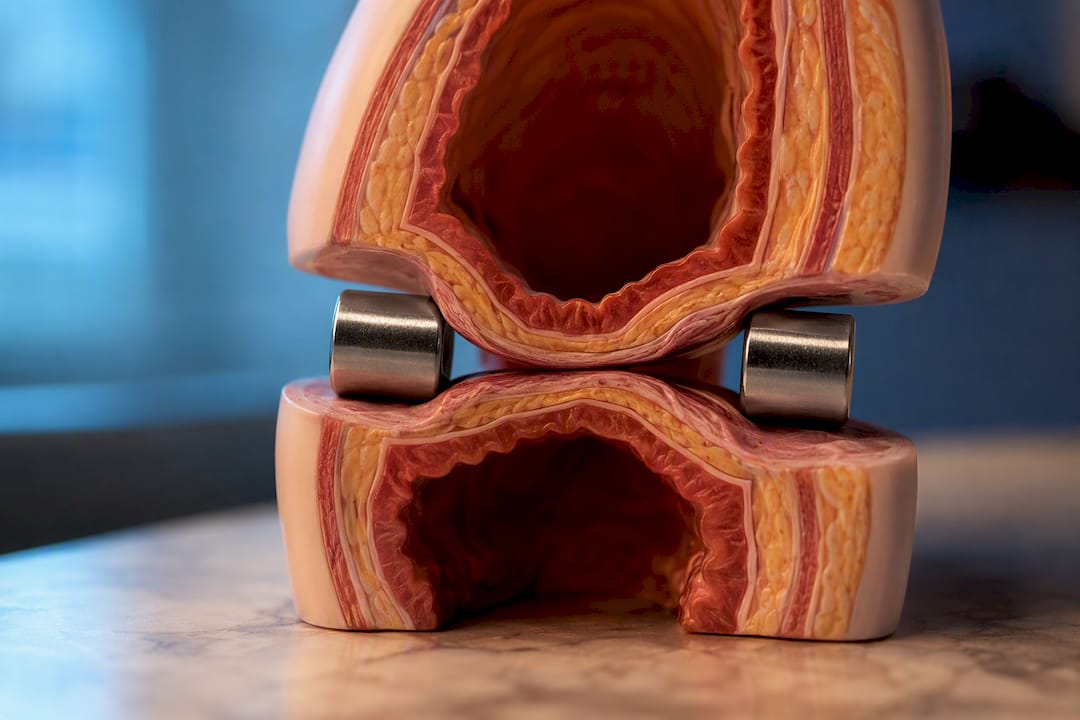
The result is often perforation, blockage, infection, or in severe cases, sepsis. This is what makes toy magnet safety fundamentally different from general choking prevention: the object doesn’t need to be lodged anywhere to cause damage, it just needs a friend on the other side of a tissue wall. The American Academy of Pediatrics warns that this attraction-through-tissue mechanism makes magnets far more dangerous than comparable small objects a child might swallow.
Watch for these warning signs after any suspected exposure:
- Abdominal pain, cramping, or a swollen belly
- Vomiting, especially if it’s repeated or worsening
- Fever, which can signal infection has already set in
- Refusal to eat or unusual lethargy
- Difficulty breathing, drooling, or gagging if a magnet may be stuck in the nose or throat
Here’s a detail most parents don’t know: a single X-ray often can’t confirm how many magnets are in a child’s gut. Multiple pieces can overlap and read as one object on the film. That’s why you need to tell the treating doctor you suspect more than one magnet was swallowed, even if the X-ray looks like a single small shadow.
What US Rules Actually Require of Magnet Toys
Toy magnet safety in the United States isn’t guesswork. It’s governed by a specific federal rule with a measurable number behind it. In 2022, the Consumer Product Safety Commission approved a mandatory federal safety standard requiring that small, loose, or separable magnets meet a flux index below 50 kG²mm².
Flux index is essentially a measure of magnetic strength adjusted for size. The smaller and more powerful a magnet is, the higher its flux index, and the more force it exerts once inside a body. Capping it at 50 kG²mm² is meant to keep any magnet small enough to swallow well below the strength needed to pull together through tissue. The full test methodology, which references ASTM F963 procedures, is spelled out in the federal rule text on govinfo.
A few things to know as you shop:
- Toys made for children under 14 fall under the toy safety standard (16 CFR Part 1250, built on ASTM F963), which layers on top of the magnet-specific rule.
- Products marketed as “adult desk toys,” “stress relief,” or “sculpture sets” are often built to skip the toy-specific testing entirely, even if a child could easily get hold of one.
- A label claiming “CPSC compliant” or “ASTM tested” is worth more than marketing language like “safe for all ages” with no standard cited.
If a listing doesn’t mention any standard by name, treat that silence as a red flag rather than an oversight.
Which Magnet Products Pose the Highest Risk?
Not every magnetic toy carries the same danger. A handful of product categories account for most of the serious incidents, and they share a structural flaw: pieces that separate.
- Magnetic ball and cube sculpture sets. Often sold as boxes containing many tiny rare-earth spheres, these are designed for adults to stack, twist, and fidget with, and they’re precisely the profile the 2022 CPSC rule was written to address.
- Loose or separable magnets inside novelty items. Building sets, jewelry kits, and craft supplies sometimes include small magnets that were never meant to be handled by a child under 14.
- Magnetic fake piercings and lip/tongue jewelry. These sit in pairs on either side of skin, and kids swap and share them, which multiplies the chance one gets swallowed or inhaled.
Watch shopping listings for language like “hundreds of pieces,” “adult desk toy,” or “stress relief” paired with no age rating at all. That combination almost always means the product was never tested against a children’s toy standard.
How to Choose, Inspect, and Store Magnetic Toys Safely
Toy magnet safety comes down to three habits: check before you buy, check after you buy, and check regularly once the toy is in the house.
Before you buy:
- Look for an explicit age label and a claim that magnets are “encased” or “fully sealed,” not just glued.
- Skip any set with dozens or hundreds of small loose pieces, regardless of the age range printed on the box.
- Favor listings that reference ASTM or CPSC compliance by name rather than vague safety language.
At home, check regularly:
- Run the small-parts test: if a piece fits inside a cylinder roughly the width of a toilet paper tube, treat it as a choking and ingestion risk for children under 3.
- Do a light drop or squeeze test on plastic housings every few months to catch early cracks.
- Count pieces before and after every play session, and sweep the play area for stray magnets the moment you notice one missing.
For storage and supervision:
- Keep loose magnet sets locked away or out of reach of children under 14.
- Talk to tweens and teens specifically about magnetic fake piercings and the habit of holding small magnets in the mouth.
Pro Tip: Prioritize toys where the magnet is ultrasonically welded or molded into the housing rather than glued in place. Glue weakens over time and heat, welded seams generally don’t, and that difference is exactly what separates a toy that survives years of play from one that fails quietly on the shelf.
If you want a broader rundown of small-parts risks beyond magnets, ToylandEU’s guide to toy choking hazards walks through the same 1.25-inch test in more detail.
What to Do If a Child Swallows or Inhales a Magnet
Act immediately. Do not wait to see if symptoms appear.
- Call your local poison control center or go straight to the emergency room, even if the child seems fine.
- Tell the clinician you suspect more than one magnet may be involved. A standard X-ray can undercount overlapping magnets, so ask specifically whether further imaging or a surgical evaluation is warranted.
- If you have the packaging, bring it or photograph it. Piece count and magnet strength both change how doctors approach treatment.
The CPSC notes that swallowed magnets attracting through intestinal walls often require surgery to separate, and delay is what turns a manageable case into a dangerous one. The longer magnets sit pinched against tissue, the higher the risk of bowel necrosis, infection, and, in the worst outcomes, death. If you’re ever unsure whether a swallowing incident is serious enough for the ER, treat it as serious. A partner resource on infant choking first aid covers the immediate steps for a related but distinct emergency: airway obstruction rather than ingestion.
How to Check for Recalls and Report a Magnet Hazard
Before assuming a toy is safe, check whether it’s already been flagged. The CPSC publishes recall notices and Notices of Violation specifically for magnet products, and you can search by product name or sign up for email alerts on cpsc.gov.
- Search current recalls at CPSC’s magnet safety page before letting a new toy into rotation.
- If you experience a near-miss or an actual injury, file a report at SaferProducts.gov. These reports feed directly into future recall decisions.
- Found a recalled item in your house? Stop using it immediately, keep the packaging and receipt as evidence, and follow the manufacturer’s specific recall instructions rather than just tossing it in the trash.
ToylandEU’s breakdown of 2025’s toy safety recalls covers how these reports have shifted what parents look for before buying.
Long-Term Health Consequences of Magnet Ingestion
Surviving the initial emergency doesn’t always mean a child walks away unscathed. Magnet ingestions that require surgery can leave lasting effects, and the severity usually tracks how long the magnets sat inside before treatment.
Bowel perforation, if it happens, can lead to sections of intestine dying off from lost blood flow, sometimes requiring surgical removal of that segment. Children who lose a significant length of intestine can develop short bowel syndrome, a condition that affects how well the body absorbs nutrients for months or years afterward. Scar tissue from surgery or from the original perforation can also cause intestinal strictures, narrow points that create recurring blockages long after the magnets themselves are gone.
Infections that spread from a perforation site, particularly ones that progress to sepsis, carry their own recovery timeline and can affect organ function well beyond the initial hospital stay. Even children who avoid surgery because the magnets pass on their own can experience lingering abdominal pain or scarring detected only on later imaging.
This is the core argument for prevention over treatment. Every safety habit covered in this guide, from checking flux index claims to counting pieces after playtime, exists because the downstream consequences of a missed magnet are measured in months of recovery, not a single bad afternoon. A toy that looks harmless on the shelf can carry consequences that outlast the toy itself by years.
Preventive Measures for Childcare Facilities and Schools
Group care settings face a version of this risk that individual households don’t: more children, more toy turnover, and less consistent oversight of what’s in every bin. A few practical measures matter more in these settings than at home.
Facilities should maintain an explicit policy against high-powered loose magnet sets, the same magnetic ball and cube sculptures flagged earlier, regardless of whether a parent donated them or a teacher brought them in for a science lesson. Science and STEM activities involving magnets should use classroom-grade, larger-format magnets that can’t fit inside the 1.25-inch small-parts cylinder, rather than small rare-earth sets.
Staff should build a piece count into daily routines for any magnetic toy bin, checking totals at the start and end of each activity block the same way they’d count scissors or other small supplies. Any toy with a cracked housing or a magnet that has worked loose from its casing needs to come out of circulation immediately, not get set aside for “later” repair.
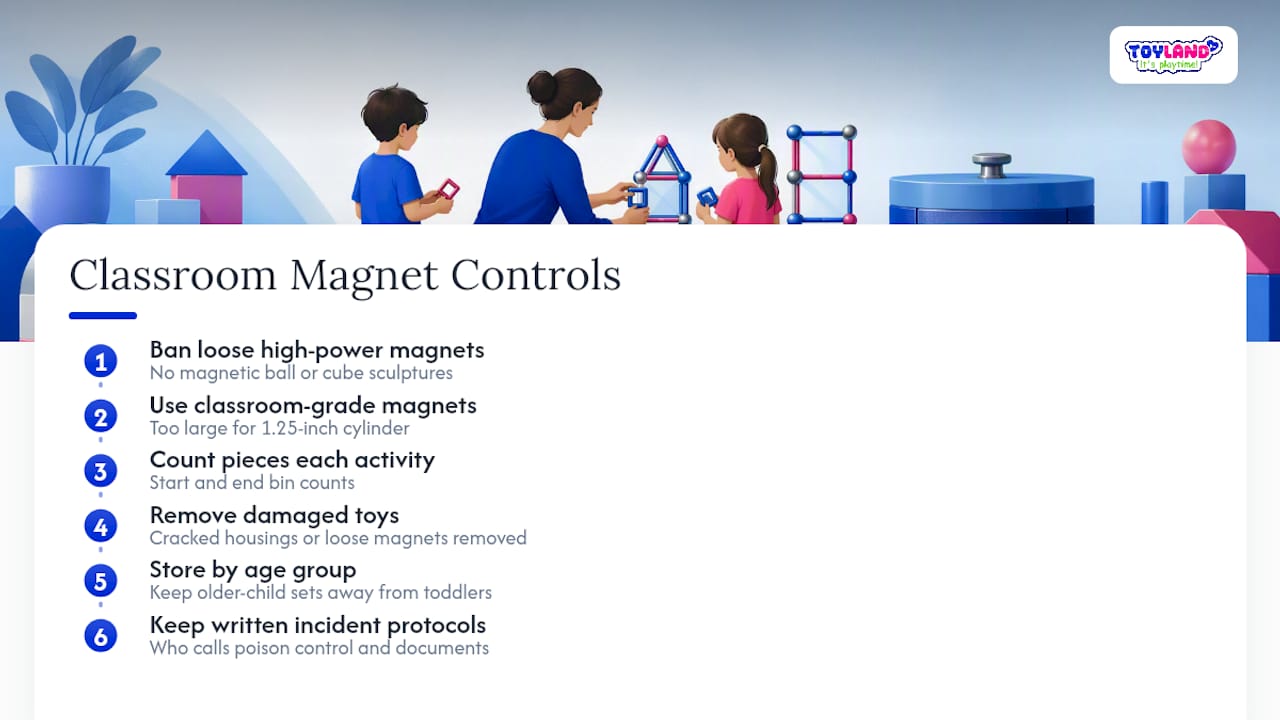
Because turnover between age groups is common in childcare settings, magnetic toys rated for older children should be stored separately from bins accessible to toddlers and infants. A set that’s genuinely fine for a supervised 10 year old’s STEM kit is a serious hazard in a mixed-age play area where a 2 year old can reach it unsupervised. Written incident protocols, including who calls poison control and who documents the exposure, should exist before an incident happens, not get improvised in the moment.
Guidance on Educating Children About Magnet Safety
Rules stick better when kids understand the reason behind them, and magnets offer a rare chance to make an abstract safety rule concrete. Young children respond well to simple, literal language: magnets are not food, they don’t go in the mouth, and if one gets lost, an adult needs to know right away, not later.
For school-age kids old enough to use magnetic building sets or STEM kits under supervision, it helps to explain the actual mechanism in age-appropriate terms: two magnets can pinch together on either side of the stomach or intestine the same way they pinch together on either side of a piece of paper. That visual, two magnets clamping through a thin material, tends to land better than an abstract warning about danger.
Tweens and teens need a different conversation, mostly around fake magnetic piercings and jewelry. These get shared, tried on, and sometimes held in the mouth or nose while being adjusted, which is exactly how accidental swallowing or inhalation happens in this age group. A direct conversation about why these specific items carry risk, paired with the same “tell an adult immediately if one goes missing” message younger kids get, closes a gap that generic toy safety talks tend to miss.
The habit of counting pieces before and after play works as well for teaching kids responsibility as it does for parental peace of mind. Involving a child in the count, rather than just doing it for them, reinforces that magnets require a level of care other toys don’t.
Where Toylandeu™ Stands on Magnetic Toy Safety
Prevention here is simple: keep loose, high-powered magnets out of children’s reach, and choose toys where magnets are encased, tested, and matched to the child’s actual age, not just the age printed for marketing purposes. That’s the standard we hold Toylandeu™'s catalog to when we curate magnetic toy listings for families. If you have a specific safety question about an item you’re considering, our customer service team can help, and our toy safety primer is a good next stop for background reading.
— Thane Holland
Shop Encased, Age-Appropriate Magnetic Toys at Toylandeu™
If you’ve just cleared out a risky magnet set, you don’t have to swear off magnetic play entirely. Toylandeu™ curates magnetic toy listings toward encased designs with clear age guidance, rather than the loose desk-sculpture sets that prompted the 2022 federal rule in the first place. Our magnetic wooden maze toy is a good example: the magnets are sealed into the wood pieces, built for toddlers and preschoolers, not adult desks.
Beyond magnetic toys, ToylandEU’s catalog runs well past 30,000 items across STEM kits, remote control vehicles, dolls, and creative play sets, all shipped worldwide, so if you decide a magnet-free option is the safer call for now, a pick like our gesture-controlled stunt car gives you the same hands-on fun without any of the ingestion risk. Check the product page for current age recommendations, and review our returns policy before checkout if you’re buying as a gift and want flexibility.
Where to Verify Magnet Safety Rules and Guidance
For primary rule text and updates, go straight to the source rather than a summary. The CPSC’s magnet safety center covers recalls and reporting, HealthyChildren.org from the American Academy of Pediatrics covers clinical guidance for parents, and the federal rule text on govinfo spells out the exact legal standard manufacturers must meet.
This article is general information, not a substitute for advice from a qualified doctor. Consult a qualified healthcare professional about your own circumstances before acting on anything here.
Sources
FAQ
Is It Safe for Kids to Play With Magnetic Toys?
Yes, if the toy is designed and tested for children, with magnets that are encased or too weak to meet the federal flux index threshold of 50 kG²mm². Loose, high-powered magnet sets are a different category and should stay out of homes with children.
What Are the Safety Standards for Toys in the United States?
Toys for children under 14 must meet the toy safety standard under 16 CFR Part 1250, built on ASTM F963 testing methods, and any magnets involved must also satisfy the separate federal magnet rule (Part 1262).
What Are the Safety Rules for Using Magnets Around Kids?
Keep loose or separable magnets locked away from children under 14, inspect magnetic toys regularly for cracked housings, count pieces before and after play, and never assume an adult-marketed desk toy is safe just because a child can reach it.
Is It Safe to Touch Neodymium Magnets?
Touching a single neodymium magnet briefly is not dangerous, but these rare-earth magnets are strong enough to pinch skin between two pieces and cause serious internal injury if more than one is swallowed, which is why the CPSC regulates them specifically by strength.
What Should I Do If My Child Swallowed a Magnet?
Seek emergency care immediately, tell the clinician you suspect multiple magnets since a single X-ray can undercount overlapping pieces, and don’t wait for symptoms like abdominal pain or vomiting to appear before going to the ER.