

Pick One in 60 Seconds: Quick Family Games for Busy Parents
Quick family games that run 5 to 15 minutes and need zero setup are one of the easiest wins in a busy household, and dozens of them work with nothing but a deck of cards, a timer, or two people willing to talk. Below is a shortlist sorted by exactly how much time you have tonight, plus a one-minute framework for picking the right one.
TL;DR:
- Most quick family games last between 5 and 15 minutes, making them suitable for last-minute moments and short breaks.
- No-prep verbal and active games like I Spy, Twenty Questions, and Freeze Dance are ideal for situations with no materials and limited space.
- Card games such as Go Fish and Uno work well within 10 to 15 minutes and require minimal setup or cleanup.
- For slightly longer sessions or special occasions, light strategy or cooperative tabletop games can comfortably fill 30 minutes.
- Adjusting game complexity and rules helps include mixed-age groups, ensuring both young children and teens stay engaged.
Table of Contents
- Quick Family Games by Playtime: 5, 10, 15, and 30 Minutes
- No-Prep, No-Equipment Games for Whenever You’re Stuck
- Playing Across Ages: From Toddlers to Teens in One Game
- Indoor vs. Outdoor: Matching the Game to Your Space
- How to Choose a Quick Family Game in Under a Minute
- Why Quick Games Matter More Than Long Ones
- A Five-Minute Game Saved One Very Bad Evening
- Want a Game That’s Always Ready to Go?
- Sources
- FAQ
Quick Family Games by Playtime: 5, 10, 15, and 30 Minutes
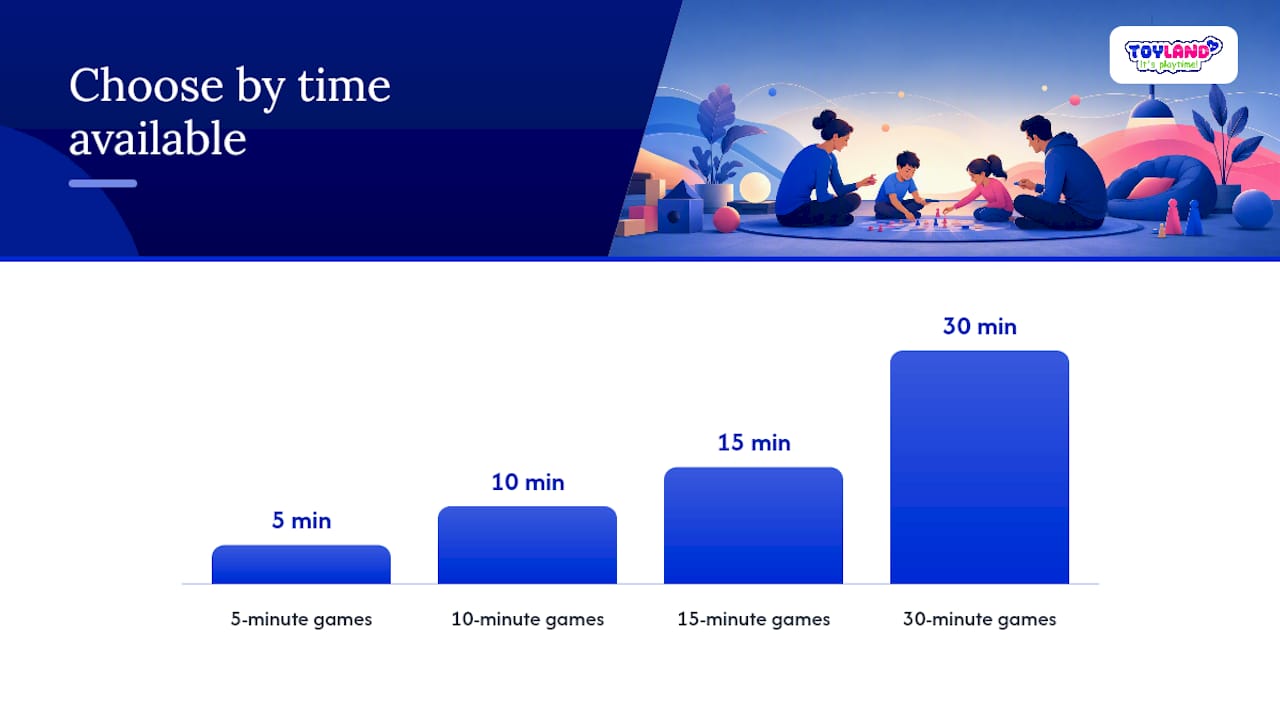
Choosing by time available, not by game type, is the fastest way to actually get playing instead of scrolling through options. Here’s a working list sorted into buckets, with the details you need to start immediately.
5-minute games work for those in-between moments: waiting for dinner, killing time before bed, or filling a car-line wait.
- Story Switch — One person starts a story with one sentence, then each player adds a single line. Playtime: 5 minutes. Players: 2 or more. Ages: 4 and up. Setup: none; just a rule that each turn is one sentence. This zero-cost format adapts well across ages when each turn stays short and low-pressure.
- Twenty Questions — One player thinks of an object; everyone else asks yes-or-no questions to guess it. Playtime: 5 minutes. Players: 2 to 6. Ages: 5 and up. Setup: none.
- Rock Paper Scissors Tournament — Best of three, single elimination bracket. Playtime: 5 minutes. Players: 4 or more. Ages: 3 and up. Setup: none.
- Categories — Pick a category (animals, foods, countries) and take turns naming items until someone repeats or hesitates. Playtime: 5 minutes. Players: 2 or more. Ages: 6 and up. Setup: none.
- Would You Rather — Take turns posing two absurd options; everyone votes. Playtime: 5 minutes. Players: 2 or more. Ages: 5 and up. Setup: none.
10-minute games fit after-school gaps, pre-bath windows, or a short break between chores.
- Go Fish — Classic matching card game where players ask each other for cards to build pairs. Playtime: 10 minutes. Players: 2 to 4. Ages: 4 and up. Setup: one standard deck. Simple card games like Go Fish remain a reliable pick because the rules take under a minute to explain.
- Memory (Concentration) — Lay cards face down and flip two at a time hunting for pairs. Playtime: 10 minutes. Players: 2 to 4. Ages: 3 and up. Setup: one deck of cards spread on a table.
- Hand-Clapping Games — Patty-cake style routines with a partner, building speed as you go. Playtime: 10 minutes. Players: 2. Ages: 4 and up. Setup: none; hand-clapping games are a staple short activity that works indoors or out.
- Charades — Act out a word or phrase without speaking while others guess. Playtime: 10 minutes. Players: 4 or more. Ages: 5 and up. Setup: none, or a hat of pre-written prompts.
- Slapjack — Deal cards evenly; players flip one at a time and slap the pile when a jack appears. Playtime: 10 minutes. Players: 2 to 4. Ages: 6 and up. Setup: one deck of cards.
15-minute games suit a full activity block after dinner or a rainy-afternoon filler.
- Uno or a similar quick-play card game — Match colors and numbers, race to empty your hand. Playtime: 15 minutes. Players: 2 to 6. Ages: 5 and up. Setup: one deck, five minutes to learn.
- Scattergories-style word rounds — Pick a letter, then race to fill categories with words starting with it. Playtime: 15 minutes. Players: 2 or more. Ages: 8 and up. Setup: paper and pencils.
- Simon Says — One player calls out actions, only following commands prefaced with “Simon says.” Playtime: 15 minutes. Players: 3 or more. Ages: 3 and up. Setup: none.
- Compact cooperative card games — Short, teamwork-based titles built for repeat rounds in a single sitting. Playtime: 15 minutes. Players: 2 to 5. Ages: 6 and up. Setup: one small box. Modern micro-games are designed specifically for these short sessions, which makes them easy to squeeze into a weeknight.
30-minute games work when you have a real block of time, like a Sunday afternoon or a family game night kickoff.
- A light strategy board game — Fast-turn titles with simple rules that still offer real decisions. Playtime: 30 minutes. Players: 2 to 4. Ages: 8 and up. Setup: five minutes to lay out pieces.
- A trivia card game — Draw cards, answer questions, keep score. Playtime: 30 minutes. Players: 2 or more. Ages: 8 and up (junior versions for younger kids). Setup: one box of cards.
- A tabletop soccer or sports game — Flick or shoot pieces toward a goal in quick head-to-head rounds. Playtime: 30 minutes. Players: 2. Ages: 5 and up. Setup: unfold the board and go, like the tabletop soccer set built for parent-child matches.
- A cooperative building challenge — Race against a timer to build something specific out of blocks or craft supplies. Playtime: 30 minutes. Players: 2 or more. Ages: 4 and up. Setup: dump the bin on the table.
No-Prep, No-Equipment Games for Whenever You’re Stuck
Sometimes the best family game is the one that requires exactly nothing: no cards, no board, no app. These are the games that save a waiting room, a car ride, or the ten minutes before bed when everyone’s too tired to dig out a box.
- I Spy — Describe something you see; others guess. Works from a car seat or a dinner table.
- 20 Questions — Already covered above, but worth repeating here because it travels anywhere.
- The Alphabet Game — Find something starting with each letter, in order, as you drive or walk.
- Freeze Dance (no music needed, just humming) — One person hums, everyone dances, silence means freeze.
- Story Switch — The one-sentence-at-a-time story from the section above works especially well here.
- Would You Rather — Bottomless supply of new rounds, zero materials.
- Tongue Twister Relay — Everyone tries the same twister three times fast; laughter is basically guaranteed.
- Silent Ball Toss (mimed) — Pretend to toss and catch an invisible ball, adding sound effects.
- Guess the Song — Hum a tune, everyone guesses the title.
For younger kids, simplify any of these by dropping the “loser is out” mechanic entirely and just rotating turns. For big groups, split into teams of two or three so nobody waits too long between turns.
Pro Tip: Keep a one-line rule ready before you start: “no teasing, one turn each.” Agreeing to it up front avoids the five minutes of arguing that usually eats into your actual playtime.
No-prep games earn their keep in three specific situations: stuck in traffic, waiting for a table at a restaurant, or filling the twenty minutes between bath and bedtime when nobody wants to start something new.
Playing Across Ages: From Toddlers to Teens in One Game
The trick to a mixed-age game night isn’t finding one game everyone likes equally. It’s adjusting the same game so a 4-year-old and a 14-year-old both have a real reason to keep playing.
- Team up instead of going solo. Pair a younger child with an older sibling or parent so the team’s overall skill balances out.
- Simplify scoring for younger players. Turn a points system into a checklist of small wins, like “found a hint” or “took a turn,” rather than a strict win/lose count.
- Give handicaps where they make sense. A teen might need three correct answers to win a round; a preschooler might need just one.
- Rotate who goes first. Nobody feels stuck always going last, which cuts down on complaints before they start.
For preschoolers, keep any of the card or word games above cooperative rather than competitive: everyone wins together if the group reaches a goal. For school-age kids, straightforward win conditions work fine, since they usually understand fairness and can handle losing a round. For teens, add a light strategic layer, like scoring bonuses for creativity in Story Switch or speed bonuses in word games, so the game doesn’t feel babyish.
Pro Tip: When a competitive game starts causing hurt feelings, switch the goal from “beat each other” to “beat the clock together.” It changes the entire mood in about ten seconds.
Indoor vs. Outdoor: Matching the Game to Your Space
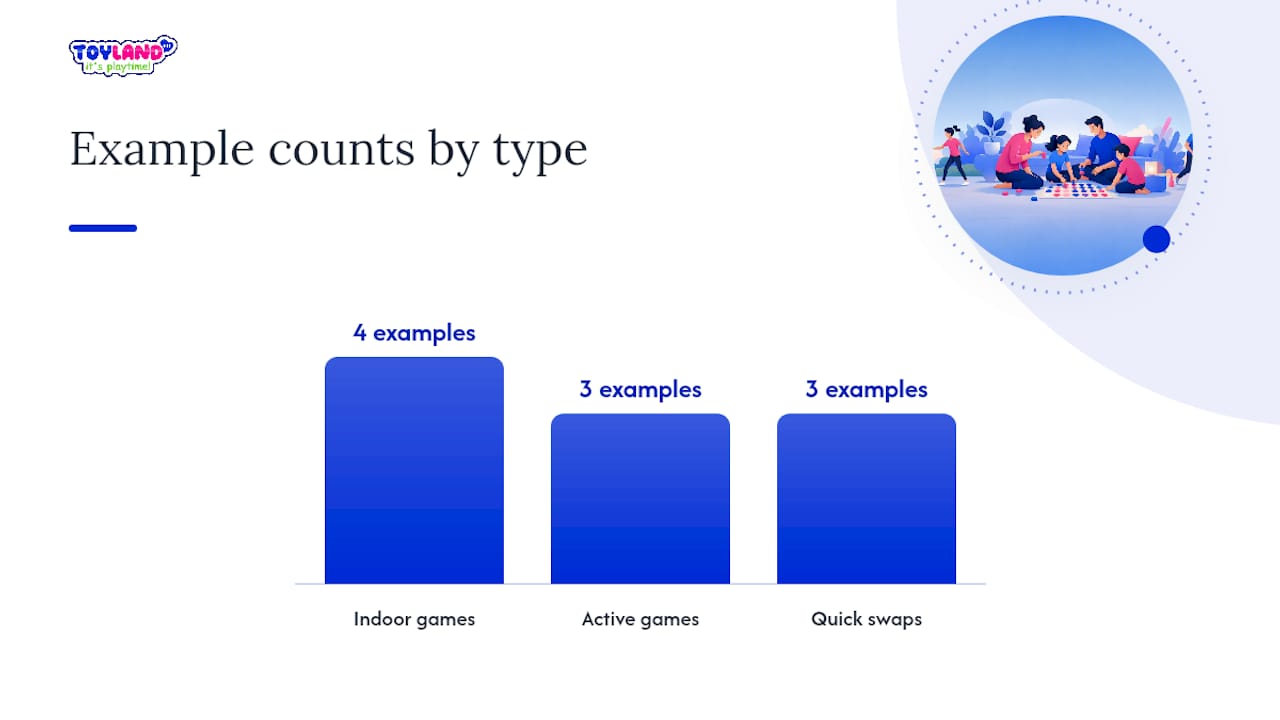
Card games, story games, and word games travel indoors without any adjustment: Go Fish, Story Switch, Categories, and Would You Rather all work at a kitchen table or on a couch. Active games like Freeze Dance, Simon Says, and hand-clapping routines do better outdoors or in a room with cleared floor space, since short active games are effective family activities whether they happen on a patio or a porch.
A short safety checklist before active play: clear breakable items from the immediate area, check the floor for rugs that slide, and set a boundary line if you’re playing somewhere with stairs or a pool nearby.
Quick swaps when the weather or the room won’t cooperate:
- Rain canceled the yard game? Switch to Charades or Story Switch indoors.
- Small apartment, no floor space? Swap Freeze Dance for a seated clapping game.
- Too loud for a shared space? Move to a quiet word game like Categories.
Rainy-day stretches are exactly when a stocked list of indoor activities and games pays off, since you’re not scrambling for ideas mid-afternoon.
How to Choose a Quick Family Game in Under a Minute
Five questions get you to a decision faster than scrolling through another list:
- How much time do you actually have? Pick from the 5, 10, 15, or 30-minute buckets above and stop looking once you’ve matched the window.
- How many players are joining? Some games (Go Fish) cap out at four; others (Charades, Twenty Questions) scale to a crowd.
- What’s everyone’s energy level? Tired kids do better with seated games; wound-up kids need something active like Simon Says.
- What materials do you have on hand? No cards or paper nearby means default to the no-prep list.
- How much cleanup are you willing to do afterward? Card games and verbal games leave nothing to put away; building challenges do.
A repeatable micro-plan makes this automatic after a few tries: pick the game in under a minute using the five criteria, agree to a 3-minute rule for settling any disagreement before playing, run the game for 5 to 15 minutes, then spend one minute afterward asking what everyone liked. Sorting options by available time rather than by game type is the single biggest reason busy families actually finish a round instead of abandoning it halfway.
Two examples: a Tuesday with 10 minutes before bed becomes Go Fish, no debate, no setup. A Saturday afternoon with 30 minutes open becomes the tabletop soccer set, since it holds attention longer without needing a rules refresher every round.
Why Quick Games Matter More Than Long Ones
Short shared play does real work for a family, even at 10 or 15 minutes a session. Brief bursts of shared activity build connection and count toward a kid’s daily movement goals when the game involves any physical component. The bonding effect doesn’t require an hour. It requires showing up consistently.
A few resources worth bookmarking for when you want more variety:
- Creative outdoor games for yard and driveway play that builds physical skills alongside fun.
- Winter indoor activities for stretches when outdoor play isn’t an option.
- Guidance on handling rule disputes when competitive games get a little too competitive.
- Notes on why interactive play supports development, useful if you want the reasoning behind why these games are worth prioritizing.
Toylandeu™ stocks compact, ready-to-play options built for exactly these short windows, which is worth knowing before your next 15-minute gap shows up.
A Five-Minute Game Saved One Very Bad Evening
There was an evening a few years back where dinner ran late, homework wasn’t done, and everyone’s patience was gone by 6:30. Instead of pushing through the tension, the fix was one round of Story Switch at the table, five minutes, no materials. It didn’t solve the homework problem. It did reset the mood enough that the rest of the evening went smoothly.
Two habits worth building from that: keep a small “ready kit” (a deck of cards, a couple of dice) in a drawer everyone knows about, and agree on a family signal, a specific phrase or gesture, that means “let’s play something right now” without needing a big announcement. Neither takes more effort than remembering where you put the kit.
If tonight feels like it’s heading sideways, pick one game from the 5-minute list above and just start. The game matters less than the fact that you stopped and played.
— Thane Holland
Want a Game That’s Always Ready to Go?
Some of the games above need nothing but your voice and a few minutes. Others benefit from having something physical on hand, and that’s where a stocked toy shelf earns its keep. Toylandeu™ carries compact, ready-to-play sets built for exactly the 5-to-15-minute window this guide is about, so you’re never stuck improvising when everyone wants to play right now.

The tabletop soccer game is a solid example: unfold it, flick the ball, and you’ve got a real head-to-head match in under ten minutes, with cleanup that takes about thirty seconds. For quieter evenings, a compact kit like the Montessori drawing set turns “draw something” into a structured five-minute activity with almost no mess.
| Option | Best for | Approx. playtime |
|---|---|---|
| Tabletop soccer set | Active, competitive matchups | 10 to 15 minutes |
| Montessori drawing kit | Calm, creative sessions | 5 to 10 minutes |
Picture this: dinner’s done, dishes are soaking, and instead of everyone drifting to separate screens, you’ve got a ten-minute soccer match at the table. That’s the whole pitch. Check out the tabletop soccer set on Toylandeu™ and see if it fits your evening routine.
Sources
- 50 fun family activities to do when you’ve only got 15 minutes – Active For Life
- The five-minute family story switch (2026) · Neodrop
- Quick Games for Busy Families - The Tabletop Family
- Parents
FAQ
What are some simple games I can play with my family?
Go Fish, Twenty Questions, Story Switch, and Charades all work with little to no setup and fit most age groups.
What are the top family games for a quick game night?
Card games like Go Fish and Uno, verbal games like Categories and Would You Rather, and compact tabletop games like a flick-to-score soccer set all deliver a full round in 10 to 15 minutes.
What is a good fun family game for mixed ages?
Story Switch works especially well across ages because each turn only requires one sentence, keeping younger and older kids on equal footing.
What games can we play with absolutely nothing on hand?
I Spy, Twenty Questions, the Alphabet Game, and Story Switch all require zero materials and work in a car, a waiting room, or a living room.
How long should a quick family game actually take?
Most quick family games run 5 to 15 minutes, though a few options like light strategy games or tabletop sports games can stretch to 30 minutes if everyone’s engaged.