

Rules for Playing Teatime Games With Kids and Teens
TL;DR:
- Teatime games provide children with structured, engaging social activities through card games, quizzes, scavenger hunts, and digital options. Clear rules, short sessions, and age-appropriate difficulty keep children involved and build social skills effectively. Simplifying mechanics and using visual aids significantly improve game engagement in mixed-age groups.
Rules for playing teatime games give children and teens a clear structure that turns a simple tea party into an engaging, social experience. The most popular formats include card games like Elevenses and Kmakici, printable etiquette quizzes, scavenger hunts, and digital tea simulations. Each format has its own teatime game rules, turn sequences, and scoring systems. Parents who understand these mechanics can run sessions that hold attention, build social skills, and keep every child involved from start to finish.
Quick Summary
The best teatime games for kids use short play sessions, clear turn rules, and thematic scoring tokens. Elevenses suits ages 8 and up with 30-minute rounds. Kmakici adds strategy through a pass-and-chip mechanic. Etiquette quizzes work as icebreakers for any group size. Scavenger hunts scale by age through clue difficulty. Digital options like Tea Time offer calm, no-fail play.
TL;DR
- Elevenses: 2–4 players, ages 8+, 30 minutes, silver spoon scoring
- Kmakici: play 1–3 cards or pass and take a steak chip (negative points)
- Etiquette True or False: printable, any group size, great icebreaker
- Scavenger hunts: adjust clue difficulty by age group
- Tea Time digital game: no scoring, no fail, calming and educational
Table of Contents
- Core rules of popular teatime card and board games
- Etiquette-themed games and icebreakers
- How to run a teatime scavenger hunt
- Digital teatime games and adapting rules for mixed ages
- Key Takeaways
- Perspective
- Toylandeu™ picks for teatime play
- FAQ
What are the core rules for playing teatime card games?
Teatime games are structured play activities built around tea party themes. They use cards, tokens, printed sheets, or digital screens to create turn-based or group play. The two most recognized card game examples are Elevenses and Kmakici, both available through platforms like Board Game Arena.
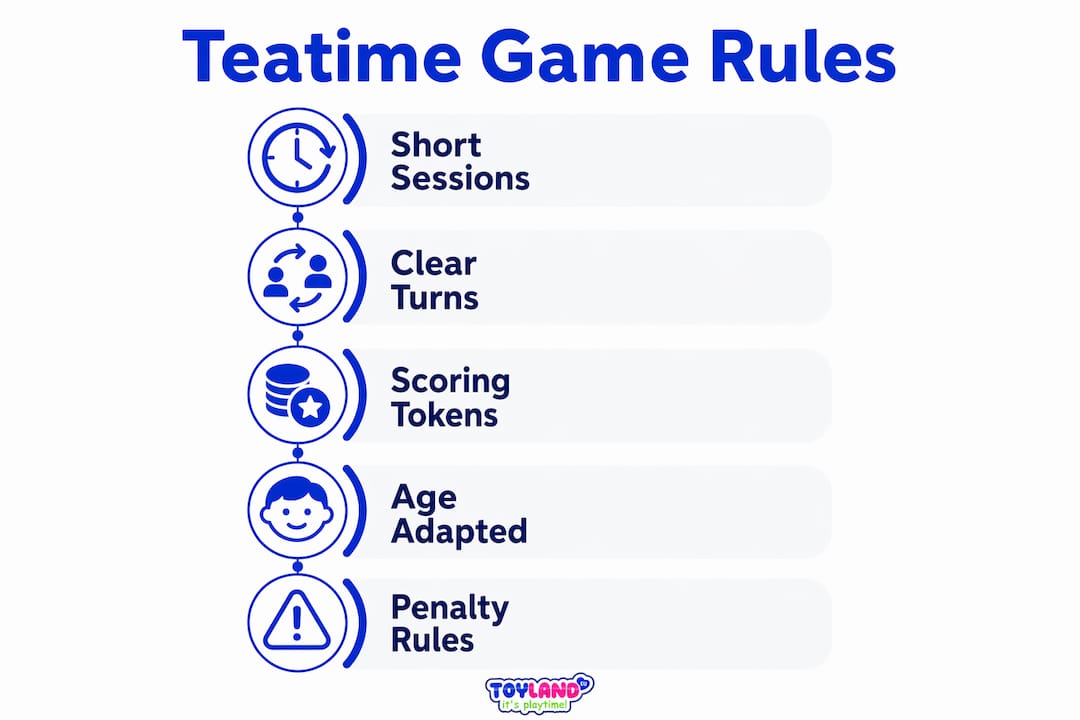
Elevenses is a card game for 2–4 players aged 8 and up, lasting about 30 minutes. The deck contains four identical sets of 11 cards each, numbered and themed around tea party actions. On each turn, a player plays one card from their hand, triggers its action (such as flipping another player’s card or swapping spreads), and arranges their tableau. The goal is to collect the most victory points, called silver spoons, by the end of the game.
Special Guest cards trigger extra scoring opportunities. That mechanic rewards players who track the board state rather than just playing cards randomly. Short 30-minute sessions keep children focused and reduce the downtime that causes younger players to disengage.
Kmakici runs on a different mechanic. Each turn, a player plays one to three cards or passes. Passing forces that player to take the leftmost steak chip from the Sweets Path. Steak chips count as negative points, so passing has a real cost. A key mini-rule prevents consecutive passes, which stops players from stalling and keeps the game moving.
- Play 1–3 cards from your hand to advance your position
- Pass only when you cannot make a useful move
- Take the leftmost steak chip when you pass
- You cannot pass twice in a row
- Win by finishing with the fewest negative chips and the most positive card points
Pro Tip: Explain the steak chip penalty to kids before the first round. When children understand that passing changes game state, they stay engaged even on turns when their hand feels weak.
What are the best etiquette-themed teatime games for groups?
Etiquette quiz games are the most underused format at children’s tea parties. The Tea Party Etiquette True or False game is a printable activity where each guest reads a statement about tea party manners and decides if it is true or false. Players write down their answers, then the group reviews them together.
The group discussion format lowers social pressure because no one is singled out for a wrong answer. That makes it a strong icebreaker for mixed-age groups or parties where children do not all know each other. The game works for any group size and can be printed at home or at a local print shop.
Here is how to run it smoothly:
- Print one sheet per guest before the party starts
- Read each statement aloud so younger children can follow along
- Give players 10–15 seconds to mark their answer
- Reveal the correct answer and invite one or two guests to share their reasoning
- Award a small prize, such as a sticker or a wrapped candy, to the player with the most correct answers
Pro Tip: Prepare a tiebreaker question in advance. When two children finish with the same score, a sudden-death bonus round keeps the energy high and avoids any awkward shared-prize situations.
Small prizes matter more than parents expect. They give children a concrete reason to stay focused through all the questions, especially in groups where attention drifts after the first few rounds.
How do you organize a teatime scavenger hunt?
Scavenger hunts are the most physically active format in the teatime game toolkit. They work for ages 4–12 and scale well by adjusting how hard the clues are to find. Three main formats suit tea party settings: an indoor item checklist, an outdoor search, and a rhyming clue hunt.
- Indoor checklist: Players check off tea-themed items they spot around the room (a teacup, a floral napkin, a sugar bowl). Best for ages 4–6.
- Outdoor search: Children find physical items hidden in a garden or yard. Works well for ages 6–9.
- Rhyming clue hunt: Each clue is a short rhyme that points to the next location. Ideal for ages 9–12 who enjoy a puzzle challenge.
Clue placement controls difficulty more than any other factor. Items placed in plain sight make the hunt fast and frustration-free for younger children. Items tucked behind objects or under cushions add challenge for older kids without making the hunt feel unfair.
Timing matters too. Run the scavenger hunt between the tea service and the dessert course. That gap gives children a physical activity break and builds appetite for the snacks that follow.
Pro Tip: Give every child a small “finder’s ribbon” at the end, regardless of finishing order. That single gesture prevents the tears and arguments that can follow competitive hunts in mixed-age groups.
How do digital teatime games and rule adaptations help mixed-age groups?
The digital game Tea Time simulates the full brewing process. Players select tea varieties, measure leaves, heat water, steep, and add optional extras. The game has no fail state and no scoring. That design makes it ideal for calm moments during a party, or as a wind-down activity before children head home.
Tea Time also teaches real facts about steeping times and water temperatures for different tea types. That educational layer gives parents a reason to include it beyond pure entertainment.
For mixed-age groups playing card or board games, rule adaptation is the most practical skill a parent can develop. These adjustments work well:
- Remove Special Guest cards from Elevenses for players under age 8 to simplify scoring
- Allow younger children to play with an open hand so an adult can quietly guide their choices
- Shorten Kmakici rounds by reducing the number of steak chips in play
- Use a visual turn-order card so every child knows when their turn arrives
Clear turn economy prevents the two most common problems in children’s game sessions: players who act out of turn and players who disengage while waiting. A simple numbered card placed in front of each child solves both issues without interrupting play. Parents can find ideas for screen-minimized tactile play that complement these game formats and keep children hands-on throughout the party.
Key Takeaways
The most effective teatime game sessions combine short play windows, clear pass rules, and age-scaled clue difficulty to keep every child engaged from the first card to the final prize.
| Point | Details |
|---|---|
| Start with scoring tokens | Teach children silver spoons or chip values before explaining theme story to speed up game comprehension. |
| Enforce the pass rule | In Kmakici, no consecutive passes keeps the game dynamic and prevents stalling from younger players. |
| Scale scavenger hunt difficulty | Use visible checklists for ages 4–6 and rhyming clues for ages 9–12 to match challenge to ability. |
| Use etiquette quizzes as icebreakers | True or False games work for any group size and reduce social pressure by reviewing answers together. |
| Cap sessions at 30 minutes | Short, focused play sessions hold children’s attention and reduce the downtime that causes disengagement. |
Why simple rules beat clever rules every time
I have run teatime game sessions with groups ranging from five-year-olds to teenagers, and the single biggest mistake I see parents make is front-loading the theme before the mechanics. Elevenses has a charming tea party story, but children do not need it to play well. They need to know what a silver spoon is worth. Once they understand the score, the theme becomes a bonus rather than a barrier.
The pass rule in Kmakici is the other place where sessions fall apart. Parents often skip it because it feels minor. It is not minor. Explaining that passing costs a steak chip changes how children approach the game entirely. They stop treating a pass as a free rest and start treating it as a real decision. That shift alone doubles engagement in my experience.
My honest advice: alternate one seated card game with one active format like a scavenger hunt. The physical break resets attention spans and makes the return to the table feel fresh. Inclusive games that build social skills are worth more than any single clever mechanic. The goal is not to run the perfect game. The goal is for every child to leave wanting to play again.
— Thane Holland
Toylandeu™ picks for teatime play

Teatime game sessions work best when creative activity extends beyond the card table. Toylandeu™ carries a range of hands-on kits that pair naturally with tea party themes and keep children engaged between game rounds. The Montessori Drawing Kit gives children a structured creative outlet that complements the focused, turn-based play of games like Elevenses. For groups that enjoy making things together, the colorful drawing scroll kit works as a shared activity that encourages conversation without competition. Toylandeu™ offers free worldwide shipping on all orders, making it easy to stock up on party-ready play kits for any gathering size.
FAQ
What is Elevenses and how do you play it?
Elevenses is a hand management card game for 2–4 players aged 8 and up, lasting about 30 minutes. Players take turns playing cards from their hand, triggering themed actions, and collecting silver spoon victory points.
What happens when you pass in Kmakici?
Passing in Kmakici forces you to take the leftmost steak chip, which counts as negative points. A player cannot pass twice in a row, which prevents stalling and keeps the game moving.
How does the Tea Party Etiquette True or False game work?
Each guest reads a statement about tea party manners and marks it true or false. The group then reviews answers together, making it a low-pressure icebreaker that sparks conversation for any group size.
What scavenger hunt format works best for young children?
An indoor item checklist suits ages 4–6 best. Clue placement controls difficulty, so keeping items visible prevents frustration and keeps younger children engaged throughout the hunt.
How do you adapt teatime card game rules for mixed-age groups?
Remove complex scoring cards for players under age 8 and allow younger children to play with an open hand. A visual turn-order card placed in front of each player prevents out-of-turn play and keeps everyone focused.