

Check Lead Free Toys in Minutes: 8 Step CPSIA Checklist for U.S. Parents
Most toys sold new in the United States today are effectively lead-free, because federal law caps lead in paint, coatings, and accessible plastic parts at levels the CPSIA and ASTM F963 standards enforce through mandatory testing. The real risk sits with older toys made before these rules tightened, unverified imports, and secondhand finds with no paper trail. Checking manufacturer documentation, scanning recall databases, and favoring simple, undecorated materials covers most of the gap standards alone don’t close.
TL;DR:
- Most new toys sold in the United States comply with lead limits through mandatory third-party testing and certification, but older and unverified imports may pose higher risks.
- Lead content is regulated by ceilings in paint and accessible materials, not by promising zero lead, which means damaged or aged toys can become hazardous even if originally compliant.
- Certified lab tests are the most accurate way to detect low-level lead, while XRF devices are faster but less reliable at low concentrations, especially on textured surfaces.
- Low-risk materials include unfinished wood, food-grade silicone, natural rubber, and certain tested plastics, whereas vintage painted toys and cheap imported painted items pose higher risks.
- Conducting quick checks like verifying documentation, inspecting for damage, and cross-referencing recalls can significantly reduce exposure risks during toy shopping.
Table of Contents
- What “Lead-Free Toys” Actually Means Under U.S. Rules
- How Reliable Is Lead Testing for Toys?
- Which Toy Materials Carry the Lowest Lead Risk?
- What’s a Practical Checklist for Buying Safer Toys?
- How Do You Reduce Lead Exposure at Home?
- Toylandeu™'s 8 Step U.S. Toy Safety Checklist
- How Does the EU Toy Safety Directive Compare to U.S. Rules?
- Why Standards Plus Practical Checks Beat Fear-Based Lists
- Shop Safer With Toylandeu™'s Curated Toy Categories
- Sources
- FAQ
What “Lead-Free Toys” Actually Means Under U.S. Rules
“Lead-free” is a shorthand, not a legal category. No federal statute promises zero lead atoms in a toy. What the law actually sets are ceilings: how much lead can sit in surface paint, and how much can be present in accessible substrate materials like plastic, metal, or vinyl.
The Consumer Product Safety Improvement Act, which incorporates ASTM F963 testing requirements, requires third-party lab testing for many children’s products before they reach store shelves. Manufacturers must issue a Children’s Product Certificate (CPC) confirming the item passed. That certificate is the paper proof a toy cleared federal lead and phthalate limits, and reputable sellers can produce one on request.
Phthalates get bundled into this same conversation because they’re regulated the same way. U.S. law bans certain phthalates in accessible plasticized parts of children’s toys above 0.1%, or 1,000 parts per million. That’s why you’ll see “phthalate-free” printed next to “non-toxic” on packaging. It’s a related but separate certification, covering softeners in vinyl and rubber rather than lead in paint or metal.
A few things to keep in mind when you’re reading labels or product pages:
- Federal limits apply to new products manufactured for U.S. sale. Toys made before 2008, when the CPSIA passed, were held to far looser standards, if any.
- Imported toys sold through third-party online marketplaces don’t always go through the same verification chain as items stocked by established retailers.
- A “non-toxic” claim on packaging is marketing language. A CPC or a lab test summary is documentation.
- Certification covers the product as manufactured, not the product after years of wear, chipping, or repainting.
That last point matters more than most parents realize. A toy made in 2015 that legally passed every test can still become a hazard once paint starts flaking, because damaged coatings expose layers that weren’t tested the same way loose paint chips would be tested at a lab.
How Reliable Is Lead Testing for Toys?
Two testing methods dominate this space, and they are not interchangeable. Certified laboratory testing is destructive: a small sample of paint, plastic, or metal gets dissolved and analyzed for exact lead content, reported in parts per million. It’s the gold standard, and it’s what manufacturers use to earn their CPC.
X-ray fluorescence, or XRF, works differently. It’s non-destructive, portable, and gives a reading in seconds by bouncing X-rays off a surface. The trade-off is accuracy at low concentrations — XRF screening is genuinely useful for catching obviously contaminated items, but it can miss lead that’s present at lower, still-relevant levels, especially on curved or textured surfaces where the reading angle throws off results.
Consumer color-change swab kits sit at the bottom of the reliability ladder. Health agencies advise against relying on them for anything beyond a rough first pass, because certified lab testing remains the only precise method for low-level detection. A swab that stays negative doesn’t mean a toy is clean. It often means the lead concentration was below what the chemistry in that swab can detect.
Quick fact: XRF devices report results in mg/cm² or ppm, and their accuracy depends heavily on the specific device’s Performance Characteristics Sheet for the material being tested. Always ask an inspector which standard their device is calibrated against before trusting the number.
If you want a real answer on a specific toy, here’s the practical path:
- Contact an EPA or state-certified lead inspector rather than buying a consumer swab kit.
- Ask for results reported in ppm, not a pass/fail color code.
- Send a small sample (paint scraping or material chip) to a certified lab if the item is valuable or suspected vintage.
- If a test comes back elevated, remove the toy immediately and report it to the CPSC.
- If a child has mouthed a suspect item repeatedly, mention it to your pediatrician, who can order a blood lead level test if warranted.
None of this means every parent needs a lab on speed dial. For the overwhelming majority of toys bought new from established retailers, the certification chain already did this work before the item shipped.
Which Toy Materials Carry the Lowest Lead Risk?
Material choice is the single easiest lever parents actually control at the point of purchase. You don’t need to memorize regulatory codes to shop smart. You need to know which categories tend to be low-risk and which ones warrant a second look.
- Unfinished solid wood carries minimal risk because there’s no paint or coating to test. Look for wood toys with a clear, food-safe finish or no finish at all.
- Food-grade silicone is inert, doesn’t require pigments that historically used lead compounds, and is a common choice for teething toys and infant items specifically because of that safety profile.
- Natural rubber items, when labeled as such, avoid the plasticizers that raise phthalate questions in synthetic vinyl.
- Tested BPA-free, phthalate-free plastics from brands that publish or provide CPC documentation on request offer a documented risk profile, not just a marketing label.
- Painted or decorated vintage and antique toys sit at the opposite end. Older toys manufactured before modern lead rules are more likely to exceed today’s safety limits, and that risk climbs with age and wear.
- Costume and metal jewelry items marketed to children have shown up in CPSC recalls repeatedly over the years because metal alloys and cheap enamel coatings are an easy place for lead to hide.
- Very low-cost imported painted toys sold with no visible age grading, no manufacturer contact information, and no safety documentation deserve the most skepticism of any category on this list.
A label reading “PVC-free” or “phthalate-free” is a genuinely useful signal, but treat it the way you’d treat any health claim on packaging: worth asking about, not worth assuming. A seller who can produce a CPC or a lab summary when you ask is telling you something a sticker can’t. One that gets vague or defensive when asked is telling you something too.
For everyday shopping, this translates to favoring board books, wooden blocks, plush characters, silicone teethers, and tested plastic building sets over antique dolls, painted tin toys, or metal charm bracelets marketed for toddlers.
What’s a Practical Checklist for Buying Safer Toys?
You don’t need a chemistry degree to shop confidently. You need a short sequence you run every time, whether you’re standing in a store aisle, scrolling a marketplace listing, or picking through a thrift store bin.
- Check for documentation first. Look for a Children’s Product Certificate reference, ASTM F963 compliance statement, or manufacturer safety page. Established retailers post this information on the product page or provide it on request. If a seller can’t answer a direct question about testing, treat that as information in itself.
- Search the recall database before you buy, not after. Cross-check the item against Recalls and the CPSC’s own recall listings, especially for anything secondhand, vintage, or bought at a yard sale or resale shop. Recalled toys frequently recirculate through thrift and online resale channels for years after the original recall, so a listing being available for sale is not proof it’s safe.
- Inspect the physical item. Look for flaking or chipped paint, missing age-grading labels, sharp mold seams, or any manufacturer information that seems absent or altered. A toy with no age rating printed anywhere is a toy you can’t verify was tested for the age group you’re buying it for.
- Know your red flags and act on them. Unusually heavy metal components, a strong chemical smell, peeling surface coating, or a seller who can’t name the country of manufacture are all reasons to request a lab report or simply choose a different product.
Pro Tip: Keep a simple folder, digital or physical, of CPC statements and receipts for toys you’re unsure about. If a recall notice ever comes out for that item, you’ll have proof of purchase and documentation ready instead of scrambling to remember where it came from.
Retailers and manufacturers are generally expected to make test summaries available on request, and asking for one is a completely normal question, not an accusatory one. A two-line email asking “Can you share the CPC or lab summary for this item?” takes thirty seconds and tells you more than any packaging claim.
How Do You Reduce Lead Exposure at Home?
Toy shopping is half the equation. What happens after the toy comes home matters just as much, particularly for infants and toddlers who explore everything by mouth.
Hand-to-mouth behavior is exactly why hygiene habits function as a real protective layer, not just a nice-to-have. Kids under three put objects in their mouths constantly, which means regular handwashing after play and periodically sanitizing toys that get mouthed reduces exposure even when a toy’s exact composition is uncertain.
A few household habits worth building into routine:
- Wash hands before meals and after floor play, especially with toddlers who crawl and grab.
- Wipe down or sanitize teething toys, bath toys, and anything that regularly ends up in a mouth, on a weekly schedule.
- Quarantine secondhand and hand-me-down toys in a separate bin until you’ve checked them against recall listings and inspected the paint and material condition.
- Keep older family toys, antiques, and inherited items away from children under six unless you’ve verified them.
- If you suspect a specific exposure, stop use immediately and call your pediatrician, who can order a blood lead test if the situation warrants it.
Here’s a detail that surprises a lot of parents: toys are rarely the dominant source of lead exposure in most households. Old paint in homes built before 1978 and contaminated soil around older buildings are typically bigger contributors than any single toy. That doesn’t make toy vigilance pointless. It means treating toys as one piece of a broader household safety picture, alongside things like safe play area setup that limits a toddler’s access to older, unverified surfaces and materials in the first place.
Toylandeu™'s 8 Step U.S. Toy Safety Checklist
Standards documents are dense. Most parents don’t have time to read the Code of Federal Regulations before buying a birthday gift, which is why Toylandeu™ built a shorter, shopping-floor version of the same logic regulators use.
The 8 Step U.S. Toy Safety Checklist walks through the same sequence covered above: checking CPC documentation, cross-referencing recalls, inspecting materials and finishes, and confirming age-appropriate labeling, condensed into a format you can actually run through in a few minutes while comparing two products.
A few resources worth bookmarking alongside it:
- The checklist itself breaks down what CPSIA rules mean for everyday shoppers in plain language, without requiring a legal background.
- A companion guide on non-toxic and eco-friendly toy choices goes deeper into material sourcing and finish types.
- A separate piece on toy material safety covers the wood, plastic, and fabric distinctions parents ask about most.
This article is written under Toylandeu™'s editorial byline, with Thane Holland providing the analysis and perspective in the closing section below. None of this replaces a pediatrician’s advice for a suspected exposure case, and it isn’t a substitute for checking the CPSC’s own recall tools directly. It’s meant to make that research faster, not to replace it.
How Does the EU Toy Safety Directive Compare to U.S. Rules?
Parents who shop internationally, or who receive gifts from family abroad, run into a second regulatory system: the European Union’s Toy Safety Directive. It’s worth understanding the broad shape of it, especially since so many toys manufactured overseas are designed to satisfy both markets at once.
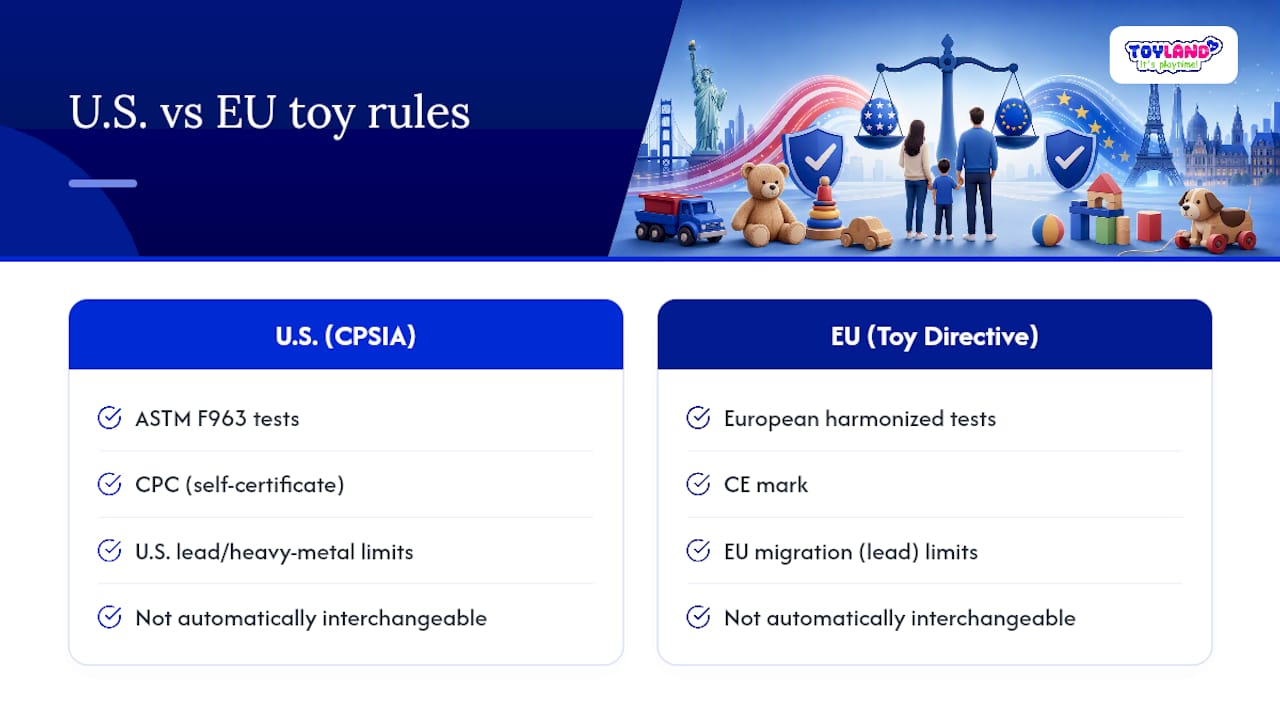
The EU framework sets its own migration limits for lead and other heavy elements in toy materials, tested under European harmonized standards rather than ASTM F963. Toys sold legally in the EU carry a CE mark, which functions similarly to a U.S. CPC in that it signals the manufacturer has certified compliance with the applicable safety directive.
The two systems aren’t identical in their testing methodology or exact numeric thresholds, and a toy compliant in one market isn’t automatically verified for the other, even though the manufacturing standards often overlap closely. If you’re buying from an international seller, a UK gift shop, or a marketplace listing that ships from overseas, don’t assume a CE mark and a CPSIA certification are the same document. Ask which standard the specific unit you’re buying was tested against, particularly for painted wood toys and metal components, where the two systems apply somewhat different accessible-limit rules. When in doubt, the safer assumption is to treat an imported toy without clear U.S. testing documentation the same way you’d treat an unverified vintage find: worth a closer look before it goes into a toddler’s hands.
Why Standards Plus Practical Checks Beat Fear-Based Lists
Alarmist “toys to avoid” lists get shared constantly, and most of them oversimplify a genuinely nuanced picture. The honest position is less dramatic: modern toys manufactured under CPSIA and ASTM F963 are overwhelmingly safe, and the real risk concentrates in older items, unverified imports, and damaged paint.
Vigilance works better as documentation than as anxiety. Keep receipts, check recalls, ask sellers direct questions. If you ever spot a product that concerns you, report it to the CPSC rather than just avoiding it quietly. That report protects the next family too.
— Thane Holland
Shop Safer With Toylandeu™'s Curated Toy Categories
Toylandeu™ offers a catalog of toys with worldwide shipping, aiming to simplify safety research compared to shopping from multiple marketplace sellers with no track record.
Browse categories built around the material logic covered above. The STEM educational toys collection favors durable, documented construction over painted decoration. The building block and MOC kit range gives you long-lasting, low-risk plastic pieces that hold up across siblings and years. And the plush toy selection covers fabric-based items for parents specifically avoiding painted or coated surfaces for younger kids.
Before you check out on anything, run it through the 8 Step U.S. Toy Safety Checklist Toylandeu™ built for exactly this purpose. It takes a few minutes and turns a vague “hope this is fine” purchase into one backed by an actual process.
This article is general information, not a substitute for advice from a qualified doctor. Consult a qualified healthcare professional about your own circumstances before acting on anything here.
Sources
- About Lead in Consumer Products | Childhood Lead Poisoning Prevention | CDC
- PART 1251—TOYS: Determinations regarding heavy elements limits for certain materials — CFR
- Cpsc
- Testing for Lead in Consumer Items for Children — National Center for Healthy Housing
FAQ
How can you tell if a toy has lead in it?
You can’t tell by looking, since lead paint doesn’t look different from safe paint. Check for flaking or chipped surfaces on older items, confirm the toy has a Children’s Product Certificate, and use certified lab or XRF testing if you have specific concerns about an item.
What are some lead-free baby toys?
Silicone teethers, unfinished or simply finished solid wood toys, and natural rubber items are generally low-risk choices for infants, since they avoid painted surfaces entirely. Toylandeu™'s STEM and building block collections include several tested plastic and wood options built for younger age groups.
What kids’ toys have lead in them?
Lead risk concentrates in painted or decorated vintage toys, low-cost imported items with painted finishes and no safety documentation, and metal toy jewelry, especially anything manufactured before the CPSIA tightened rules in 2008.
Do Fisher-Price toys contain lead?
Fisher-Price, like other major U.S. toy manufacturers, is required to meet CPSIA and ASTM F963 lead limits and provide third-party test certification for its products. Individual product safety records and any recall history can be checked directly through the CPSC recall database.
Are secondhand toys safe if they look undamaged?
Not automatically. A toy can look fine while still predating current lead limits or having been subject to a recall you’re unaware of, so checking recalls.gov before buying secondhand matters more than a visual inspection alone.