

Stop Risky Labels: U.S. Toy Age Rules and Toylandeu 8 Step Checklist
In the United States, age grading on a toy label is a safety and developmental judgment, not a marketing suggestion. It’s built on Consumer Product Safety Commission guidance and the ASTM F963 standard, and it exists because a toy that’s fine for a six-year-old can kill a toddler. Follow the label, check for small parts if a child under 3 is in the house, and if you manufacture or sell toys for kids 12 and under, expect mandatory testing and a Children’s Product Certificate.
TL;DR:
- Age labels are based on rigorous safety standards, not marketing, with strict testing and documentation required for products intended for children 12 and under.
- The CPSC uses independent developmental guidelines and third-party testing to determine appropriate age ranges, overriding manufacturer labels if discrepancies arise.
- Small parts regulations rely on the choke tube test, with a toilet paper roll used as a home check to prevent choking hazards under age 3.
- Compliance involves mandatory third-party testing, proper labeling, and recordkeeping, especially for toys with magnets, batteries, or mechanical components.
- Properly matching a toy’s intended age to a child’s actual development reduces injury risk and ensures legal compliance across manufacturing, importing, and retail.
Table of Contents
- What Age Grading Actually Means Under U.S. Law
- Small Parts, Choke Tubes, and the Mechanical Hazards That Trigger Warnings
- Age-by-Age Guidance: What to Watch for From Birth to 12
- Compliance Steps for Manufacturers, Importers, and Retailers
- How Toylandeu™ Approaches Age Grading and Safety
- Why Getting Age Labels Right Matters More Than Most Sellers Admit
- Find Age-Appropriate Toys Without the Guesswork
- Sources
- FAQ
What Age Grading Actually Means Under U.S. Law
Age grading in the USA isn’t one single rule. It’s a layered system built from a federal statute, an enforcement agency’s internal guidelines, and a voluntary industry standard that Congress made mandatory by reference. Understanding how those three pieces fit together tells you why a label says “3+” instead of “2+” or “4+,” and why getting that number wrong can shut down a product line.
The Consumer Product Safety Improvement Act (CPSIA), layered onto the older Consumer Product Safety Act (CPSA), defines a “children’s product” as anything designed or intended primarily for children age 12 or younger. That threshold matters more than most parents realize. Cross into it, and a toy stops being a general consumer product and becomes a children’s product subject to lead limits, phthalate restrictions, tracking labels, and third-party lab testing before it ever reaches a shelf, according to CPSC’s own business guidance.
Here’s where it gets specific. The CPSC doesn’t just take a manufacturer’s word for what age a toy suits. Agency staff use the Age Determination Guidelines, last revised in 2020, to independently evaluate whether a product’s design matches a child’s actual physical and cognitive abilities at a given age. The 2020 guidelines walk through developmental milestones, play patterns, and skill benchmarks, then match them against product features like part size, mechanical complexity, and required fine motor control. A rattle built for grip strength that a 4-month-old doesn’t have yet fails that match, regardless of what the box says.
Then there’s ASTM F963, the consumer safety specification that covers toys intended for children under 14. This is where a lot of confusion starts, because ASTM F963 includes its own age labeling guidance in Annex A1, and manufacturers sometimes treat that annex as the final word. It isn’t. CPSIA incorporated ASTM F963 as a mandatory federal standard, which means its mechanical and chemical hazard tests are legally binding. But when a real dispute arises over what age a toy is “intended primarily for,” CPSC staff apply their own Age Determination Guidelines as the controlling interpretive tool, not the manufacturer’s Annex A1 reasoning. If your label is ambiguous or your marketing contradicts your packaging, the agency can default to the stricter test tier.
That distinction drives the testing question. Once a toy is classified as a children’s product for kids 12 or under, federal law generally requires:
- Testing by a CPSC-accepted third-party laboratory before the product enters commerce
- A written Children’s Product Certificate (CPC) confirming the product meets every applicable rule, including lead content, phthalates, and mechanical hazard standards
- Permanent tracking labels identifying the manufacturer, production location, and batch or run number
Skip any of these, and you’re not just risking a recall. You’re operating outside the law the moment the product ships. Toylandeu™'s own CPSIA rules explainer breaks down how these obligations shift depending on whether you’re importing, private labeling, or manufacturing domestically, which matters because the compliance burden doesn’t disappear just because you didn’t make the toy yourself.
Small Parts, Choke Tubes, and the Mechanical Hazards That Trigger Warnings
Most age-grading disputes come down to one test: can a piece fit down a child’s throat? The CPSC’s small parts regulation answers that with a physical tool called a choke tube, a cylinder roughly the size of a child’s fully expanded throat under 3 years. If a toy component, or any piece that breaks off during reasonably foreseeable use or abuse, fits entirely inside that cylinder, it’s classified as a small part and the toy is restricted or must carry a specific cautionary label, according to CPSC’s small parts guidance.
Pro Tip: You don’t need a lab-grade choke tube to do a rough home check. An empty toilet paper roll has an inner diameter close enough to the CPSC test cylinder that if a toy piece slides through it easily, treat it as a choking risk for any child under 3, no matter what the box says.
The federal small parts rule doesn’t stop at outright bans. For toys and games marketed to children ages 3 to 6 that legitimately contain small parts, the law requires a specific cautionary statement on the packaging, and states are preempted from writing their own competing label language, according to the federal small parts statute. That preemption exists so a toy legally sold in Texas doesn’t need a different warning label to ship to California. One national standard, one warning format.
A few related thresholds show up constantly in age-grading disputes, and they’re worth knowing by number, not just by concept.
- Balls and marbles: Small balls under a certain diameter are banned outright for children under 3 because they lodge in the airway more easily than irregular shapes.
- Balloons: Uninflated and broken latex balloons are one of the most common choking causes in young children, which is why balloon-containing toys marketed to kids under 8 typically require an explicit choking warning.
- Cords and strings: Toys with cords longer than about 12-inch (30.5 centimeters) intended for cribs or playpens face strict restrictions, because strangulation risk climbs sharply once a cord can loop around a neck; pull toys have narrower exceptions tied to how the string is used during play.
- Magnets: Sets with small, high-powered magnets carry separate ingestion-injury warnings because two swallowed magnets can attract each other through intestinal walls, causing internal damage that a single swallowed object never would.
- Button batteries: These require distinct compartment-security and labeling rules because ingestion can cause chemical burns inside the esophagus within hours, a risk profile completely different from a standard choking hazard.
Magnets and batteries deserve their own mental category, separate from generic small parts. The CPSC’s toy safety education hub treats them that way for good reason: a swallowed marble is a choking emergency, but a swallowed battery or magnet pair is a chemical or internal-injury emergency that can take hours to become obvious. If a toy in your house uses either, check that battery compartments need a tool to open (not just a fingernail) and that magnetic building sets are labeled for the age they’re actually built for, not the age a sibling wants to believe.
For manufacturers, this is also where mislabeling gets expensive. If your product spans multiple age tiers in its marketing, say the box says “3+” but your Instagram ad calls it “great for toddlers,” CPSC staff can apply the stricter under-3 testing standard to the entire product line, per the same 2020 Age Determination Guidelines that govern age disputes generally. Consistency between packaging and marketing isn’t a legal nicety. It’s the difference between one testing tier and a much harsher one.
Age-by-Age Guidance: What to Watch for From Birth to 12
Regulations set the floor. What you actually check at the store, or in your kid’s toy bin at 9 p.m. on a Tuesday, is a different exercise. Here’s how the hazard profile shifts as a child grows, and what to actually look for at each stage.
Newborns to 6 months. Babies at this age explore almost everything by mouth, so material safety matters more than mechanical complexity. Favor toys made of solid wood or food-grade silicone over soft plastics, since pediatric safety experts flag some plastic softeners as a real concern for infants who chew constantly, a point Seattle Children’s Hospital makes directly in its safe-toy guidance. Avoid anything with loose felt eyes, sewn-on buttons, or fabric that isn’t machine washable, because at this age a toy gets washed nearly as often as it gets played with.
6 to 18 months. Teething strength and grip develop fast here, which means durability testing matters as much as size testing. A toy that survives gentle chewing at 7 months might crack at 14 months once molars come in, exposing sharp plastic edges. This is also the window where cord length becomes a live issue. Anything attached to a crib, stroller, or playpen needs to stay well under that 12 inch strangulation threshold, no exceptions for “it’s just a pull tab.”
18 to 36 months. Curiosity outpaces judgment badly at this stage, which is exactly why the choke tube test exists. Run every small component past the toilet paper roll check, twist and pull on attached pieces like wheels, eyes, and buttons to confirm they’re glued or sewn securely, and skip anything with pieces that fit in the 1.75 inch ball diameter category. Toylandeu™'s choking hazard guide walks through this exact inspection routine in more depth if you want a room-by-room version.
3 to 6 years. Small-part toys become appropriate here, but supervision still matters, especially with magnetic building sets and battery-powered toys with easily opened compartments. Check that any magnetic pieces are labeled for this age range specifically rather than a general “building toy” claim, and confirm battery doors need a screwdriver, not just fingers.
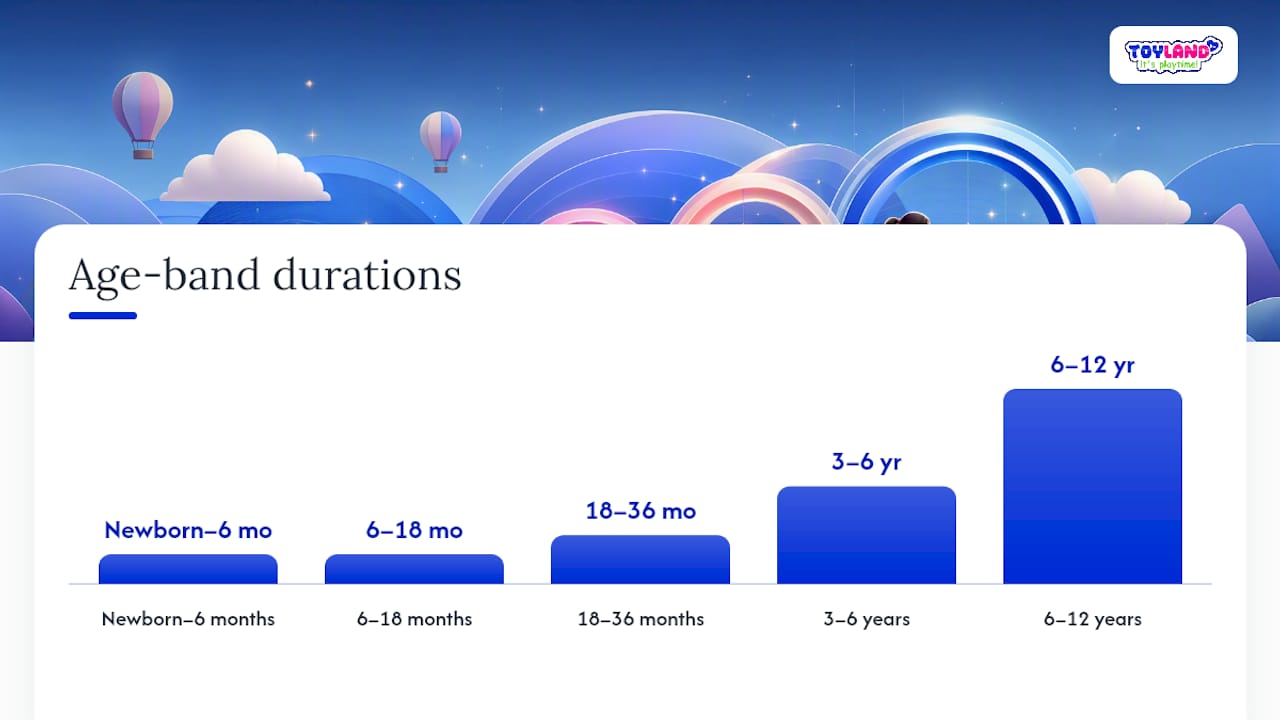
6 to 12 years and up. Mechanical complexity rises: remote control vehicles, model kits, and multi-piece building sets dominate this range. The main risks shift from ingestion to things like small rechargeable batteries, sharp edges on unfinished model parts, and choking risk from younger siblings getting into an older kid’s toy box. If you have kids spanning both sides of that age-3 line in one household, treat the whole collection by the youngest child’s rules, period.
A short checklist covers most of what matters across every age band:
- Read the age label and match it to the child’s actual current abilities, not their sibling’s, and not their age on paper if they’re developmentally behind or ahead.
- Run the toilet paper roll test on any loose or removable piece for kids under 3.
- Check every seam, button, eye, and wheel for secure attachment by tugging firmly, not just glancing at it.
- Confirm battery compartments require a tool to open, not fingernails.
- Count magnets if the toy includes any, and verify the packaging states an age range appropriate for magnetic sets specifically.
- Measure any attached cord or string against the 12 inch threshold if it’s near a crib or playpen.
- Wash soft and plush toys on the schedule the manufacturer recommends, more often for mouthing-stage infants.
- For hand-me-downs and secondhand toys, check the production date and skip anything that looks pre-1978, when lead paint rules changed.
Compliance Steps for Manufacturers, Importers, and Retailers
Age grading a product correctly is a legal obligation the moment your toy targets kids 12 or under, and the paperwork trail matters as much as the physical testing.
Once your product falls into the children’s product category, third-party laboratory testing isn’t optional and self-certification doesn’t satisfy federal law. You need an accredited, CPSC-accepted lab to run the applicable tests, mechanical hazards under ASTM F963, lead and phthalate limits under CPSIA, and any category-specific rules like small-parts or magnet standards, before you can issue a valid Children’s Product Certificate. That certificate has to accompany the product through distribution, and retailers can legally demand to see it before stocking anything.
Marketing claims carry more legal weight than most sellers assume. CPSC staff don’t just look at your box copy when determining intended age. They examine your advertising, your website product descriptions, your social media captions, and even your own internal emails about target demographics if a dispute reaches that stage, per the guidance embedded in the 2020 Age Determination Guidelines. A toy marketed inconsistently across those channels doesn’t get the benefit of the doubt. It gets tested under the strictest tier that any of your own marketing suggests.
Recordkeeping is the part manufacturers most often shortchange, right up until an enforcement action lands. Federal rules require permanent tracking labels on children’s products identifying the manufacturer, production date, and batch information, which means every unit needs to be traceable back to a specific production run if a recall ever becomes necessary. Keep the following on file, not just at production time but for the life of the product line:
- Third-party lab test reports for every applicable standard, with dates and lab accreditation numbers
- The signed Children’s Product Certificate itself, updated whenever a material or supplier changes
- Supplier certifications for raw materials, especially anything touching lead, phthalate, or magnet strength claims
- Marketing archive snapshots (packaging, web listings, ad copy) showing consistent age representation over time
Retailers carry real exposure here too, even when they didn’t manufacture the toy. Before adding a new supplier to your catalog, verify the CPC exists and matches the actual product being shipped, not a similar item from the same vendor. Toylandeu™'s 8 step U.S. toy safety checklist was built for exactly this vetting process, walking sellers through certificate verification, tracking label checks, and how to spot marketing inconsistencies before they become your problem instead of the manufacturer’s. Retail partners in the toy space, including resources like US Novelty’s sourcing guidance, echo the same principle: verify before you list, because the certificate chain is your legal cover if a product ever gets questioned.
How Toylandeu™ Approaches Age Grading and Safety
We built our safety approach around the same framework the CPSC uses, because there’s no better substitute for it. Every category on our site maps back to the CPSIA’s 12-and-under children’s product definition and the small parts thresholds that govern choking risk, and that mapping shapes how we write product descriptions, not just how we file paperwork.
Our internal 8 step checklist, detailed in full in our toy safety standards guide, covers the ground that matters most to both a parent scanning a listing and a vendor trying to get a product approved:
- Confirm the age label matches actual developmental capability, not just marketing convenience
- Verify small-parts compliance against the 1.25 inch choke tube standard for anything sold to households with kids under 3
- Check magnet and battery compartment security against current CPSC guidance
- Require documentation of third-party lab testing before a supplier’s product goes live
- Cross-check marketing copy against packaging to avoid the ambiguous-age problem that triggers stricter testing tiers
- Confirm tracking label presence for full recall traceability
- Flag material concerns for the 0 to 3 age range specifically, favoring wood and food-grade silicone claims we can verify
- Review secondhand and vintage listing dates against known safety rule changes, particularly pre-1978 lead paint risks
This article’s compliance analysis was developed by Thane Holland, drawing on CPSC’s published Age Determination Guidelines and current CPSIA/ASTM F963 standards. For deeper reading on how these rules affect everyday shopping decisions, our parent’s guide to toy safety and CPSIA rules explainer both expand on specific pieces of this framework in more detail.
Why Getting Age Labels Right Matters More Than Most Sellers Admit
The toy industry treats age grading as a compliance checkbox more often than it should. That’s the wrong instinct. An age label is a promise about a specific child’s developmental stage, not a rough suggestion, and the gap between those two framings is where most preventable injuries happen.
What surprises people once they dig into the CPSC’s Age Determination Guidelines is how much weight marketing carries in a legal dispute. Manufacturers assume the box label is the final word. It isn’t. If your ad copy, your product photography, or your own sales pitch suggests a younger user than your packaging states, the agency can and will use the broader picture. That should change how manufacturers write copy, not just how they design toys.
The other blind spot is secondhand toys, which almost nobody age-grades a second time. A vintage toy bin at a yard sale carries the same choking, lead, and mechanical risks as anything on a store shelf, minus any of the testing paperwork. Age grading doesn’t expire, but it also doesn’t travel automatically with hand-me-downs. If you didn’t buy it new with a visible label and traceable certificate, treat the age guidance as a starting estimate, not a guarantee, and inspect accordingly.
None of this is about fear. It’s about matching a toy to what a specific child can actually do safely, which is the entire point the regulation was written to solve.
— Thane Holland
Find Age-Appropriate Toys Without the Guesswork
An extensive toy catalog can be organized around clear age filters to help shoppers determine if something’s right for their child at different developmental stages.
Every product listing on our site states its intended age range plainly, and categories like our creative learning set for kids 3 to 12 show exactly how a properly age-labeled educational toy should be presented, no ambiguity between the packaging and the pitch. If you’re shopping for a toddler, our sensory and craft picks like the Montessori drawing kit and the 24-color clay modeling kit skip small, detachable pieces in favor of age-appropriate creative play. For older kids ready for more mechanical complexity, a remote control vehicle lineup can highlight age and skill level clearly in each listing rather than in fine print.
Start by checking our toy safety standards guide for the full compliance picture, then filter our catalog by age range to find something that actually matches where your child is developmentally, not just what’s trending. Free worldwide shipping applies across the catalog, so building out a properly age-graded toy collection doesn’t mean paying extra to get it right.
FAQ
What are the different age categories for toys?
U.S. toy labels commonly use bands like 0 to 3 months, 3 to 6 months, 6 to 12 months, 12 to 24 months, 2 to 4 years, 3 to 6 years, and 6 to 12 years, based on the developmental milestones outlined in CPSC’s Age Determination Guidelines.
What is the CPSC age determination process?
CPSC staff compare a toy’s design, complexity, and required skills against documented child development benchmarks in the 2020 Age Determination Guidelines, weighing marketing and packaging alongside the physical product to settle on an intended age.
What are the CPSC requirements for toys for children under 8 years old?
Toys marketed to children under 8 that contain small parts, cords, magnets, or button batteries face specific mandatory testing, cautionary labeling, and, for children 12 and under generally, third-party lab certification under a Children’s Product Certificate, per CPSC’s small parts guidance.
How old must a toy be to be considered vintage?
There’s no single legal definition, but safety-focused sources typically flag any toy made before 1978, when U.S. lead paint restrictions tightened significantly, as carrying meaningfully higher risk and worth extra inspection before letting a child play with it.
Does age grading apply to secondhand toys?
Yes in principle, though secondhand toys rarely carry updated certificates or current tracking labels, so the safest approach is treating the original age label as a rough estimate and manually checking for loose parts, battery compartment security, and cord length yourself.