

Start With 5 Minutes: Age by Age Daily Reading Targets for Parents
There’s no single hour count that applies to every child, but the ranges are specific: toddlers need several minutes of read-aloud time each day, kindergartners and first-graders require a moderate total reading time, and kids age 9 and up should spend a substantial amount of time on independent reading daily. The principle that matters more than any of those numbers is consistency. A child who reads daily, even for short periods, builds stronger literacy skills than one who reads for longer sessions less frequently, and kids still learning to sound out words need a short daily phonics block on top of whatever pleasure reading they do.
TL;DR:
- Consistency in daily reading habits matters more for literacy development than total time spent, with even five-minute sessions providing benefits.
- Bright illustrations, simple rhymes, and repetition are effective for toddlers, focusing on exposure and bonding rather than reading comprehension.
- For children aged 5 to 6, combining phonics practice with independent reading establishes decoding skills while maintaining motivation.
- Past age eight, the focus shifts predominantly to volume and variety in independent reading, with explicit phonics support usually no longer necessary.
- Using engaging toys and props can reinforce reading routines, transforming practice into play and encouraging longer-lasting habits.
Table of Contents
- How Many Minutes a Day Should Kids Read at Each Age?
- What Does the Research Actually Say About Daily Reading?
- How Do You Actually Build a Daily Reading Habit?
- When Should You Worry About Your Child’s Reading?
- Who Wrote This and How the Research Was Chosen
- Why the Standard Reading Advice Misses the Point
- Toys That Make Reading Time Stick
- Sources
- FAQ
How Many Minutes a Day Should Kids Read at Each Age?
The honest answer depends less on your child’s age and more on what “reading” actually means at that age. A two-year-old isn’t reading independently. An eleven-year-old shouldn’t need you to sit beside them the whole time. So the daily targets below break out three separate ingredients: read-aloud time (you reading to them), independent reading (them reading alone), and phonics practice (explicit decoding work for kids still cracking the code of written language).
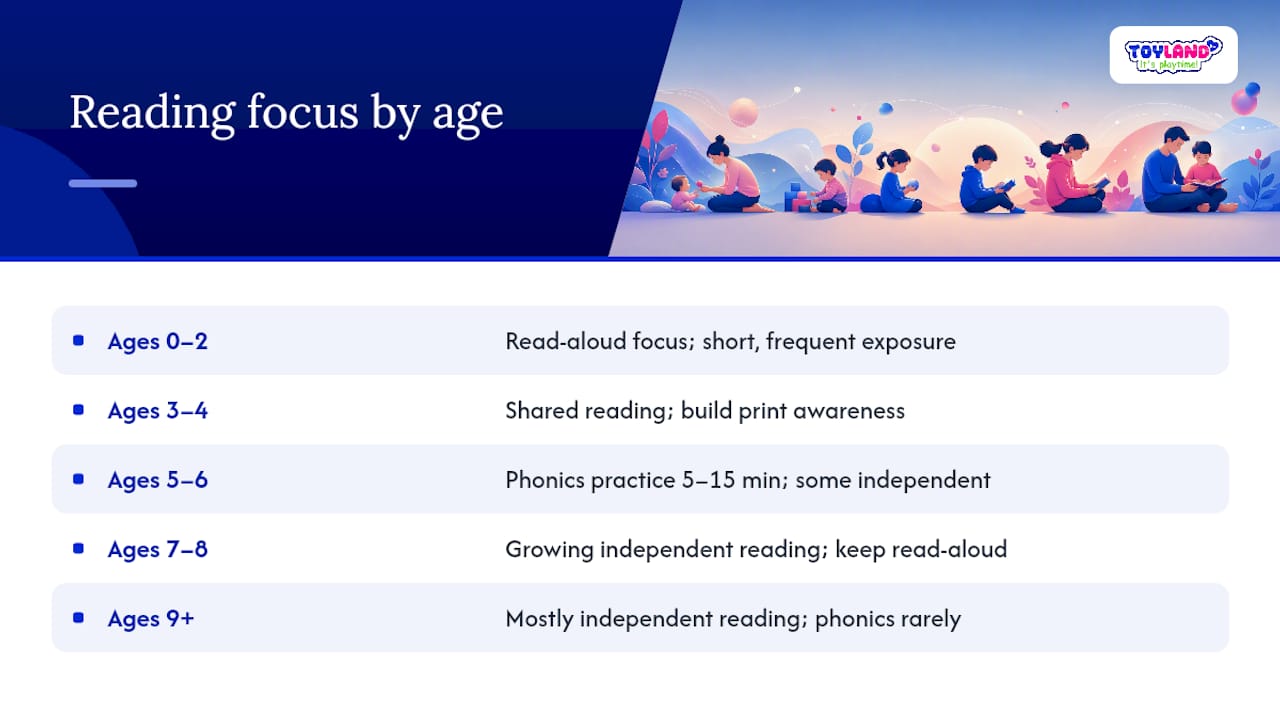
Here’s how Teach Your Kid to Read and related literacy guidance break the daily minutes down by age band:
Ages 0 to 2: build the habit before the skill. At this stage, reading is entirely about exposure and bonding, not comprehension checks. A toddler who hears the same board book fifteen times isn’t wasting time; repetition is how vocabulary sticks. Keep sessions short and frequent rather than one long story before bed. Board books with textures, simple rhymes, and bright illustrations work better than anything text-heavy.
Ages 3 to 4: shared reading does the heavy lifting. Kids this age can sit for longer stories, but they’re not decoding text yet. Point to words as you read to build print awareness, and let them “read” familiar books back to you from memory. That’s not cheating. It’s an early form of fluency.
Ages 5 to 6: this is where phonics enters the picture. Kindergarten and first-grade kids are learning letter-sound relationships, and that requires deliberate practice, separate from the fun of story time. A 5 to 15 minute phonics block using decodable readers, paired with 10 to 20 minutes of independent attempts and continued read-aloud time, covers both skill-building and motivation.
Ages 7 to 8: independent reading should be growing fast. Kids are transitioning from “learning to read” to “reading to learn.” Chapter books with occasional pictures, graphic novels, and short nonfiction all count. Keep some read-aloud time going even here. Books above a child’s independent reading level, read aloud, still build vocabulary they can’t access on their own yet.
Ages 9 and up: independent reading becomes the main event. By fourth grade and beyond, most kids no longer need explicit phonics instruction unless there’s an underlying difficulty. The focus shifts to volume, variety, and stamina, whether that’s a novel, a magazine, or a deep dive into a topic they’re obsessed with.
One rule holds across every band: these are floors, not ceilings. If your eight-year-old wants to read for ninety minutes because they’re stuck in a book series, let them. The targets exist to set a minimum worth protecting on busy days, not a maximum to enforce with a timer.
What Does the Research Actually Say About Daily Reading?
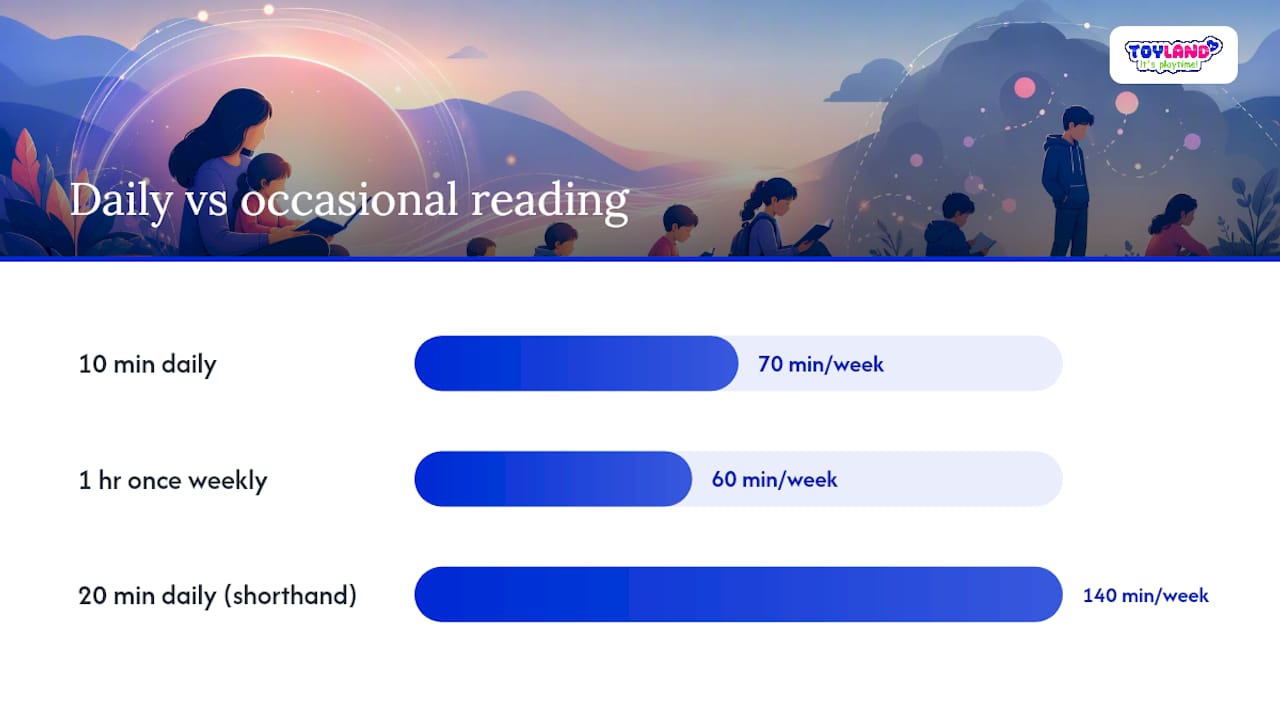
The strongest and most consistent finding in this space is almost boring in its simplicity: showing up daily beats showing up big. Michigan State University Extension summarizes decades of research showing that daily consistency in read-aloud time predicts stronger literacy growth than occasional marathon sessions. Ten minutes every day compounds. One hour on Sunday doesn’t.
Large-scale assessment data backs this up from a different angle. The National Assessment of Educational Progress tracks reading scores across American students, and students who report regular reading outside of school consistently score higher on average than those who don’t. That’s not proof that reading alone causes the score gap. Kids who read more at home often come from households with more books, more time, and more support in general. But the correlation is strong enough, and repeated across enough cohorts, that it’s a reasonable bet worth taking seriously.
Older literature reinforces the read-aloud piece specifically. An ERIC literature review documents long-term vocabulary and comprehension gains tied to sustained early read-aloud exposure, some of the research spans decades and still holds up.
What to take with a grain of salt:
- Most of these studies are correlational, not experimental. They show reading habits and reading outcomes moving together, not always which one is causing which.
- A lot of the underlying data relies on self-report from parents or students, and people tend to round up when asked how much their kid reads.
- “20 minutes a day” as a specific magic number is a useful shorthand, not a scientifically precise threshold. The real finding underneath it is that daily habits beat occasional ones, at almost any duration.
What’s well-established: consistency matters more than total volume, and read-aloud exposure builds vocabulary kids can’t yet access through their own decoding. What’s more tentative: the exact minute-by-minute breakdown, which varies by child, curriculum, and household.
How Do You Actually Build a Daily Reading Habit?
Don’t start at the target number. Start at whatever your family can actually sustain, then grow it.
- Begin with 5 to 10 minutes and add five more each week. Jumping straight to 40 minutes with a child who currently reads zero is a setup for resistance. Small, boring, repeatable wins.
- Attach reading to something that already happens every day. Bedtime is the classic anchor, but after-snack, right after a bath, or during a sibling’s practice session all work just as well. The goal is zero decision fatigue about when it happens.
- For kids still learning to decode, split the session into two parts. Do the explicit phonics block first, five to fifteen minutes of focused decoding practice, while attention is fresh. Follow it with shared read-aloud time, which builds vocabulary and keeps the whole experience enjoyable rather than purely instructional.
- Use micro-sessions on chaotic days. A five-minute picture book before school still counts. Audiobooks in the car during pickup lines count too, especially when paired with a physical copy of the same book so kids can follow along.
- Swap one screen slot for a book slot, rather than adding reading on top of an already full schedule. Trading fifteen minutes of a tablet for fifteen minutes of reading feels far less like punishment than bolting reading onto an already packed evening.
Pro Tip: Let your child pick the book, even if it’s the same one for the tenth night in a row, and skip the pop quiz about plot details afterward. Kids who get grilled on comprehension after every chapter start associating reading with testing, not pleasure, and that kills the habit faster than almost anything else.
Sibling read-alouds work surprisingly well too. An older child reading to a younger one builds fluency for the reader and listening comprehension for the listener, and it buys you ten free minutes.
When Should You Worry About Your Child’s Reading?
Most kids progress unevenly, and that’s normal. But a few patterns are worth flagging early rather than waiting to see if they resolve on their own.
- By age 6 or 7, a child who’s still guessing at words based on pictures or first letters, rather than sounding them out, may need targeted phonics support.
- Persistent avoidance of books, meltdowns before reading time, or physical complaints (headaches, stomachaches) tied specifically to reading tasks.
- A child who reads accurately but can’t answer basic questions about what they just read, which points to a comprehension gap rather than a decoding one.
- No progress over several months despite consistent daily practice at home.
If you notice any of these, start with the classroom teacher. Ask directly whether a literacy screening makes sense. Many schools can run one quickly, and it costs you nothing to ask. If the teacher shares your concern or the screening flags a gap, the next step is usually a referral to a reading specialist, a speech-language pathologist, or an educational psychologist for a fuller evaluation. Bring specific examples when you go into that conversation. “He mixes up b and d constantly” is more useful to a specialist than “he’s behind.”
Who Wrote This and How the Research Was Chosen
This guide was written by Thane Holland for the Toylandeu™ blog, where the editorial focus stays on parenting, child development, and how play supports learning at home. Sources here were chosen deliberately: national assessment data from NAEP, peer-reviewed and archival research through ERIC, university extension guidance from Michigan State, and practical age-band recommendations from literacy specialists at Teach Your Kid to Read.
For more on pairing hands-on activities with learning at home, see how toys can supercharge learning and tactile, screen-minimized STEM play for ideas that extend beyond the page.
Have a source you think should be added, or a question this article didn’t answer? Reach out through the Toylandeu™ blog and we’ll take a look.
Why the Standard Reading Advice Misses the Point
Most reading advice fixates on hitting a number, and that’s backward. The research doesn’t actually reward the parent who enforces 30 minutes with a timer. It rewards the parent who makes reading happen daily, even in five-minute bursts, without turning it into a fight.
Where conventional advice falls short is treating all reading minutes as equal. Ten minutes of a child sounding out words they’re excited about does more for long-term literacy than twenty minutes of a bored kid being read to from a book they didn’t choose. Choice and joy aren’t soft, feel-good extras here. They’re the mechanism that keeps a habit alive past age eight, when reading stops being novel and starts competing with everything else for a kid’s attention.
If you take one thing from this, prioritize protecting the daily floor over chasing a bigger number. A five-minute habit that survives a hectic Tuesday beats an ambitious hour that collapses by Thursday.
— Thane Holland
Toys That Make Reading Time Stick
A reading habit gets easier to protect when the environment around it supports the story instead of competing with it. Toylandeu™ isn’t a substitute for shared reading time, but the right props can turn a reluctant ten minutes into a request for more.

Pairing a nonfiction book about space or dinosaurs with a hands-on kit from our STEM Toys collection gives kids a reason to keep reading past the pictures, because the experiment at the end depends on understanding the instructions. A soft, huggable character from our Plush Toys selection can become a permanent “reading buddy” that sits through every bedtime story, which helps younger kids associate the whole routine with comfort rather than obligation. And for kids who’d rather build than sit still, a set from our Building Block Sets | Compatible Bricks & MOC Kits collection lets them recreate scenes from a story they just finished, turning comprehension into a project instead of a quiz. Toylandeu™ offers a wide selection of toys across a large catalog, so finding a companion piece for whatever your child is reading this month is a quick browse away. Check the STEM Toys and Plush Toys collections today and see which one earns a permanent spot on the nightstand.
Sources
- Reading aloud to kids has many benefits — Michigan State University Extension
- How much should a child read each day? Real guidelines by age — Teach Your Kid to Read
- NAEP reading report (2024) — NationsReportCard
- ERIC full-text review (historical literature summary)
FAQ
What is the 3-3-3 rule for children’s reading?
The 3-3-3 rule isn’t a formally established literacy standard, and definitions vary depending on where you encounter it. Some parenting resources use it to mean three short reading sessions of about three minutes each, spread across the day, aimed at building consistency for reluctant or very young readers rather than chasing one long block of time.
When should I worry about my child not reading?
Worry less about a slow start and more about a lack of progress over time. If your child is still guessing at words instead of sounding them out by age 6 or 7, avoids books consistently, or shows no improvement after months of daily practice, talk to their teacher and ask about a literacy screening.
What reading level should a 7-year-old be at?
Most seven-year-olds are moving from early readers into short chapter books, reading roughly 25 to 35 minutes independently each day according to age-based guidelines, often alongside a brief phonics block if they’re still solidifying decoding skills. Reading level varies widely between individual kids, so treat this as a general range rather than a strict benchmark.
Does reading 20 minutes a day actually make a difference?
Yes, largely because of consistency rather than the specific number 20. Research summarized by Michigan State University Extension shows that daily reading habits predict stronger literacy growth than occasional longer sessions, so a steady 20 minutes most days beats an inconsistent hour once a week.
Do educational toys actually help with reading skills?
They can support the habit indirectly, especially tools like phonics flash cards or storytelling props that make practice feel like play rather than drills. Toylandeu™'s Montessori talking flash cards are one example built specifically around early literacy and language development for younger kids.