

Chores for 7-Year-Olds: What's OK at This Age
TL;DR:
- Seven-year-olds can handle simple household tasks independently with occasional adult supervision.
- Building routine and praising effort help motivate children to complete chores willingly and develop responsibility.
Age-appropriate chores for 7-year-olds are defined as simple household and personal tasks a child can complete with independence but occasional adult check-ins. At this age, children are developmentally ready to take on real responsibility. Their motor coordination has improved, they can follow multi-step instructions, and they respond well to routine. Assigning the right household tasks for children builds confidence, life skills, and a sense of belonging in the family. This guide covers what chores are ok for a 7 year old, why they work at this stage, and how to make them stick.
What chores are ok for a 7 year old?
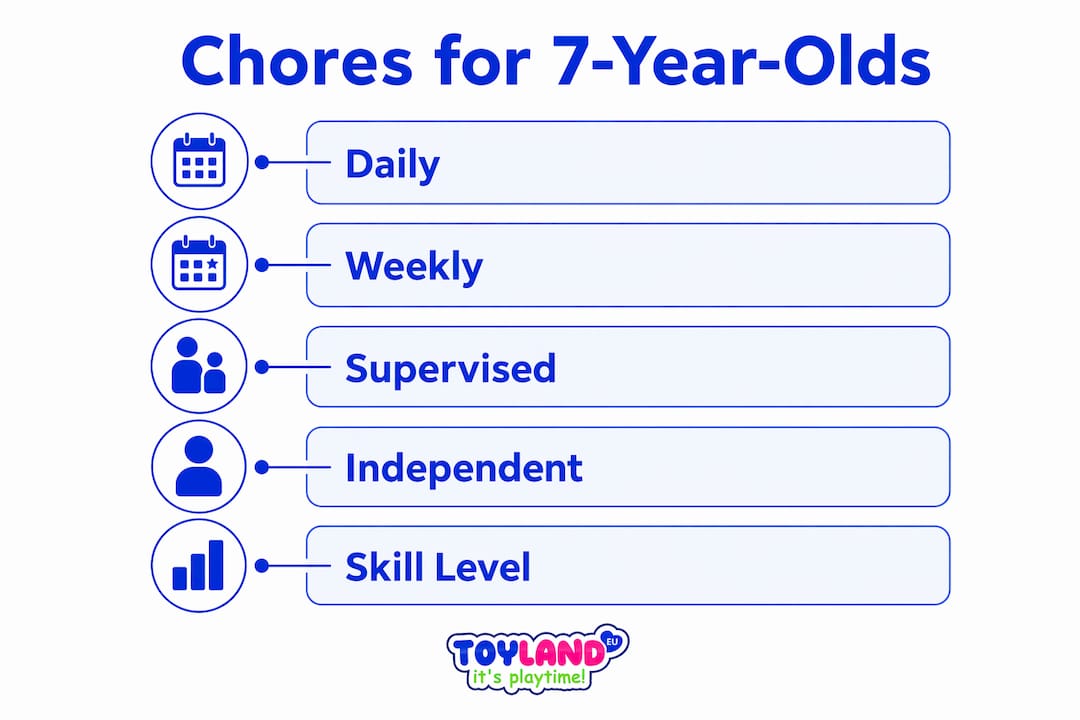
Seven-year-olds can independently handle a solid set of daily and weekly tasks. Daily chores typically take 15–20 minutes with only periodic supervision. That is a manageable commitment that builds habit without burning out a child.
Daily chores that work well at this age include:
- Making their bed each morning
- Setting and clearing the dinner table
- Packing their own school bag
- Tidying their bedroom before bed
- Feeding a family pet
Weekly chores add a bit more complexity and are well suited for 7-year-olds:
- Sorting laundry by color and folding clean clothes
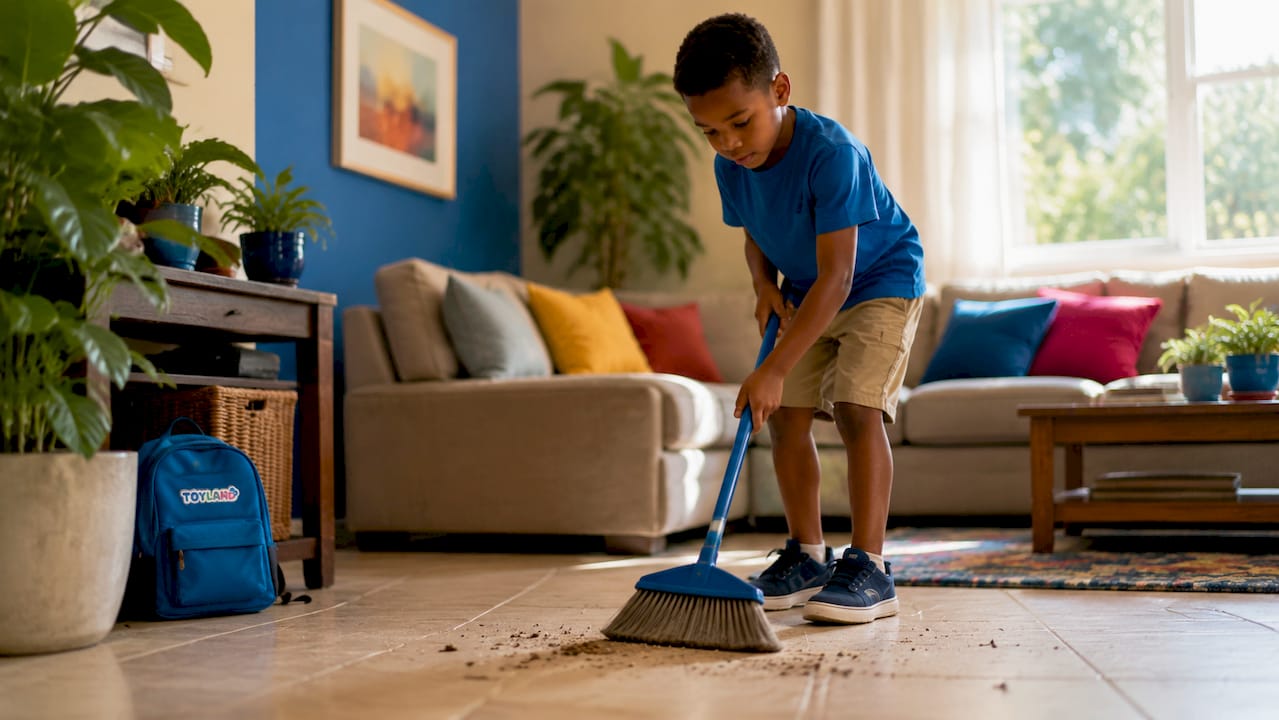
- Sweeping a kitchen or hallway floor
- Loading the dishwasher with light supervision
- Helping prepare simple snacks or meals
- Wiping down bathroom sinks
Here is a quick reference table to organize these by frequency and difficulty:
| Chore | Frequency | Difficulty | Supervision needed |
|---|---|---|---|
| Making bed | Daily | Low | None after training |
| Setting the table | Daily | Low | Minimal |
| Tidying bedroom | Daily | Low | Periodic check-in |
| Folding laundry | Weekly | Medium | Occasional guidance |
| Sweeping floors | Weekly | Medium | Minimal |
| Loading dishwasher | Weekly | Medium | Light supervision |
| Helping with snacks | Weekly | Medium | Present but hands-off |
Pro Tip: Start with one daily chore and one weekly chore. Add more only after the first two feel automatic. Piling on too many tasks at once creates resistance, not routine.
How do developmental factors influence chore suitability for 7-year-olds?
Age 7 is a genuine turning point for chore readiness. Children at this stage have the physical coordination to handle tasks like sweeping or folding without frustration. They can also follow a sequence of two or three steps without needing reminders at every turn.
Cognitive growth matters just as much as physical ability. A 7-year-old can understand cause and effect well enough to connect “I cleared the table” with “dinner runs smoothly.” That connection builds accountability, which is the real goal of chores at this age.
Emotional development plays a role too. Chores build confidence when the focus stays on effort and responsibility rather than perfection. A child who finishes a task, even imperfectly, feels capable. That feeling is more valuable than a spotless floor.
“Children develop at different paces. Treat any chore list as flexible, start small if you are beginning late, and do tasks together at first before stepping back.” — Children’s Mercy parenting guidance
Not every 7-year-old is at the same point. One child may sweep confidently while another still needs a demonstration. Adjust expectations to the individual child, not just the age.
What strategies encourage 7-year-olds to complete chores willingly?
Motivation is the part most parents underestimate. The chore itself is rarely the problem. The resistance usually comes from how the chore is introduced and managed.
- Build a consistent schedule. Chores done at the same time each day become automatic. Morning chores before school and an evening tidy before bed are two natural anchor points.
- Use a “first this, then that” structure. Linking chores to privileges like screen time or outdoor play frames the task as a normal step, not a punishment. “First tidy your room, then we watch a show” works better than threats.
- Give zone ownership. Assigning a fixed zone of the house, like the bathroom sink or the living room corner, creates a sense of personal responsibility. Rotating chores every week can feel arbitrary to a child. Owning one space feels meaningful.
- Praise effort, not results. Tell your child “You worked hard on that” rather than “Good job, it’s perfect.” Effort praise builds persistence. Result praise creates anxiety about getting it wrong.
- Resist the urge to redo the chore immediately. Redoing a task right after a child finishes it sends the message that their work does not count. Show the standard before the task, then accept their effort as valid learning.
Pro Tip: If your child resists a specific chore, try doing it together for a week before expecting independence. Side-by-side practice removes the intimidation factor.
How can parents balance chores and allowances for 7-year-olds?
The allowance question comes up quickly once chores are established. The clearest approach separates two categories: baseline chores and paid jobs. Baseline chores are unpaid contributions to the household, things every family member does because they live there. Paid jobs are extras, like washing the car or organizing a closet.
Average allowances for children ages 5–7 sit around $6.05 per week as of 2026. That figure gives you a realistic benchmark if you choose to introduce payment for extra tasks.
Experts caution against tying all chores to money at this age. When every task has a price tag, children start asking “what do I get?” before helping. The goal at 7 is to build the habit of contributing, not to create a transaction mindset.
- Keep baseline chores unpaid and frame them as family participation
- Offer small paid extras for above-and-beyond tasks
- If you introduce allowance, connect it to saving and spending decisions, not just chore completion
- Read more about structuring this in the allowance guide for parents at Toylandeu™
Involving children in meal preparation also supports vocabulary growth and reinforces their role as a household contributor, which is a benefit no allowance can replicate.
Key takeaways
The most effective approach to chores for 7-year-olds is starting with a small set of daily and weekly tasks, building routine through consistency, and praising effort over results.
| Point | Details |
|---|---|
| Daily chores are manageable | Tasks like making a bed and setting the table take 15–20 minutes and need only periodic supervision. |
| Weekly chores build real skills | Folding laundry and sweeping floors develop motor coordination and follow-through. |
| Zone ownership beats rotation | Giving a child one fixed area to manage creates accountability and reduces resistance. |
| Effort praise builds confidence | Praising the work, not the result, encourages persistence and reduces fear of failure. |
| Separate chores from payment | Baseline household tasks should be unpaid contributions; reserve payment for optional extras. |
Why I think most parents start chores the wrong way
Parents usually wait until a child is “ready” and then assign five chores at once. That approach almost always backfires. The child feels overwhelmed, the parent feels frustrated, and chores become a daily battle.
What actually works is starting with one task and doing it together until it feels normal. I have seen parents transform a resistant 7-year-old into a genuinely helpful kid in three weeks, just by sweeping the kitchen floor side by side every evening. The child was not learning to sweep. They were learning that contributing to the household is just what this family does.
The other mistake I see constantly is perfectionism. A parent watches their child fold a towel into a lumpy rectangle and immediately refolds it. The child notices. They learn that their effort is not good enough, and they stop trying. Accept the lumpy towel. The habit is worth more than the fold.
Chores at age 7 are not about a clean house. They are about a child who grows up knowing they are capable and that their contribution matters. That is a long game worth playing with patience.
— Thane Holland
Reward effort and creativity with the right tools
Chores teach responsibility, but children also need space to create, play, and recharge. Pairing a solid chore routine with hands-on creative time gives kids a healthy balance between contribution and fun.

Toylandeu™ carries a range of educational kits designed for exactly this kind of purposeful play. The Montessori Drawing Kit gives 7-year-olds a structured creative outlet that builds focus and fine motor skills, the same skills that make chores easier. The DIY Drawing Scroll kit turns downtime into a hands-on learning experience. Both ship free worldwide through Toylandeu™, making them easy additions to any parent’s toolkit. Explore how toys support learning alongside everyday responsibility.
FAQ
What chores can a 7-year-old do independently?
Seven-year-olds can independently make their bed, set and clear the table, tidy their room, pack their school bag, and feed a pet. These daily tasks take about 15–20 minutes and need only occasional check-ins.
Should a 7-year-old get paid for doing chores?
Baseline household chores should be unpaid contributions to family life. If you introduce allowance, the average for ages 5–7 is around $6.05 per week, best tied to optional extra tasks rather than everyday responsibilities.
How do I get my 7-year-old to do chores without a fight?
Use a “first this, then that” structure linking chore completion to a privilege like screen time. Consistent timing and zone ownership also reduce daily resistance significantly.
Is it too late to start chores if my child is already 7?
Starting at 7 is not late at all. Begin with one simple task, do it together for the first week, then step back. Children’s Mercy parenting guidance confirms that starting small and building gradually works at any point in early childhood.
How long should chores take for a 7-year-old?
A realistic daily chore commitment for a 7-year-old is 15–20 minutes. Weekly chores like folding laundry or sweeping may add another 10–15 minutes once or twice a week.