

How diverse dolls help kids develop empathy and inclusion
TL;DR:
- Early childhood toys influence racial biases and self-esteem through representation.
- Diverse dolls foster empathy, reduce bias, and build positive racial identity in children.
- Consistent adult involvement and ongoing play are essential for lasting impact.
When researchers gave children a choice between a white doll and a Black doll and asked which one was “nice” or “pretty,” most children, regardless of their own race, chose the white doll. That finding, first documented in the 1940s, still shapes how child development experts think about toys today. The Doll Test’s significance revealed that even very young children absorb society’s racial biases, and those biases show up in something as simple as which toy they reach for. If you’re raising a child and want them to grow up with genuine empathy and an open heart, the dolls on their shelf matter more than you might expect.
Table of Contents
- Dolls as mirrors: Representation, identity, and belonging
- Fostering empathy and reducing bias through diverse dolls
- Beyond the playroom: Challenges and real-world context
- Strategies for parents: Making diversity a daily part of play
- Why the impact of diverse dolls is bigger—and trickier—than most think
- Explore inclusive toys to spark empathy and creativity
- Frequently asked questions
Key Takeaways
| Point | Details |
|---|---|
| Representation shapes identity | Dolls that reflect diverse skin colors help children see themselves as valued and included. |
| Diverse play builds empathy | Exposure to dolls of different backgrounds increases children’s empathy and reduces bias. |
| Benefits depend on reinforcement | Adult conversation and routine play with diverse dolls are key for lasting impact. |
| Barriers can be overcome | Parents can find creative solutions to bring diverse dolls and inclusivity into everyday life. |
Dolls as mirrors: Representation, identity, and belonging
Building on why this topic matters, let’s look at how representation in play shapes identity from the ground up.
The Clark Doll Test, conducted by psychologists Kenneth and Mamie Clark in the 1940s, asked Black children to choose between identical dolls painted in different skin tones. Most children chose the white doll as the “good” one and the “pretty” one. The Clarks used this as evidence of internalized inferiority, the idea that Black children had absorbed society’s message that whiteness was more valuable. This research directly influenced the landmark Brown v. Board of Education ruling in 1954, making it one of the most consequential psychology studies in American history.
It’s worth noting that the test had critics. Doll Test methodological critiques pointed out that the painted dolls looked unnatural, that the race of the researcher could influence responses, and that results varied between integrated and segregated school settings. Still, the core finding held: children pick up on racial hierarchies early, and their toys are part of that learning environment.
Modern research builds on this foundation. Diverse skin color dolls boost self-esteem and positive racial identity in children of color, directly countering the internalized inferiority the Clarks documented. When a child sees a doll that looks like them, it sends a quiet but powerful message: you belong here, you are valued, you are beautiful.
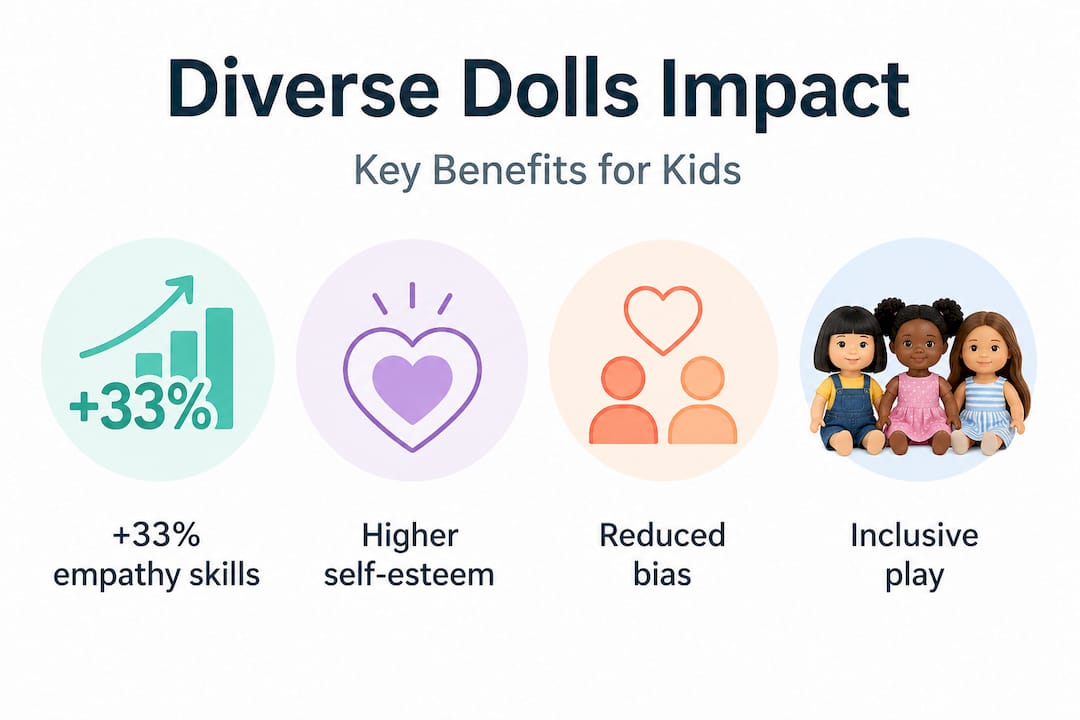
The effect isn’t limited to children of color. White children who grow up with only white dolls develop a skewed picture of the world, one where people who look like them are the default and everyone else is an exception. That narrow view can calcify into unconscious bias by the time they reach school age. Research on personalized books and involvement found that materials matching a child’s skin color increased both behavioral and verbal engagement, particularly for dark-skinned children, which underscores just how hungry kids are for representation.
Understanding toy color and child development more broadly helps parents see that the visual cues in a toy communicate values, not just aesthetics.
| Doll representation | Effect on children of color | Effect on white children |
|---|---|---|
| Only white dolls | Lower self-esteem, internalized bias | Reinforces narrow worldview |
| Only matching skin tone | Positive identity, stronger confidence | May limit exposure to diversity |
| Mixed skin tones | Strongest self-esteem outcomes | Normalizes diversity, reduces bias |
“When children see themselves reflected in their toys, they learn that they matter. When they see others reflected too, they learn that everyone does.”
Key effects of diverse doll representation in early childhood:
- Strengthens racial identity and self-worth in children of color
- Helps all children recognize and appreciate differences
- Reduces the automatic association of whiteness with “good” or “normal”
- Prepares children for diverse social environments like school and community settings
- Encourages imaginative play that mirrors the real world
Fostering empathy and reducing bias through diverse dolls
Representation goes hand in hand with social development. Next, let’s look at the evidence for empathy and bias reduction.
One of the most promising tools in early childhood education is the Persona Doll, a doll given a detailed backstory, a name, a family, and a cultural identity. Teachers introduce these dolls to children as if they were real friends visiting the classroom. The doll might “share” a story about experiencing discrimination or feeling left out. Children respond with remarkable empathy, problem-solving, and emotional engagement.
A recent study found that playing with diverse dolls fosters empathy, reduces bias, and increases children’s willingness to interact with peers from different backgrounds. In a controlled study, 39 preschoolers showed a statistically significant increase in empathy levels (p less than 0.05) after a migrant Persona Doll intervention. That’s a meaningful result from a relatively short classroom activity.
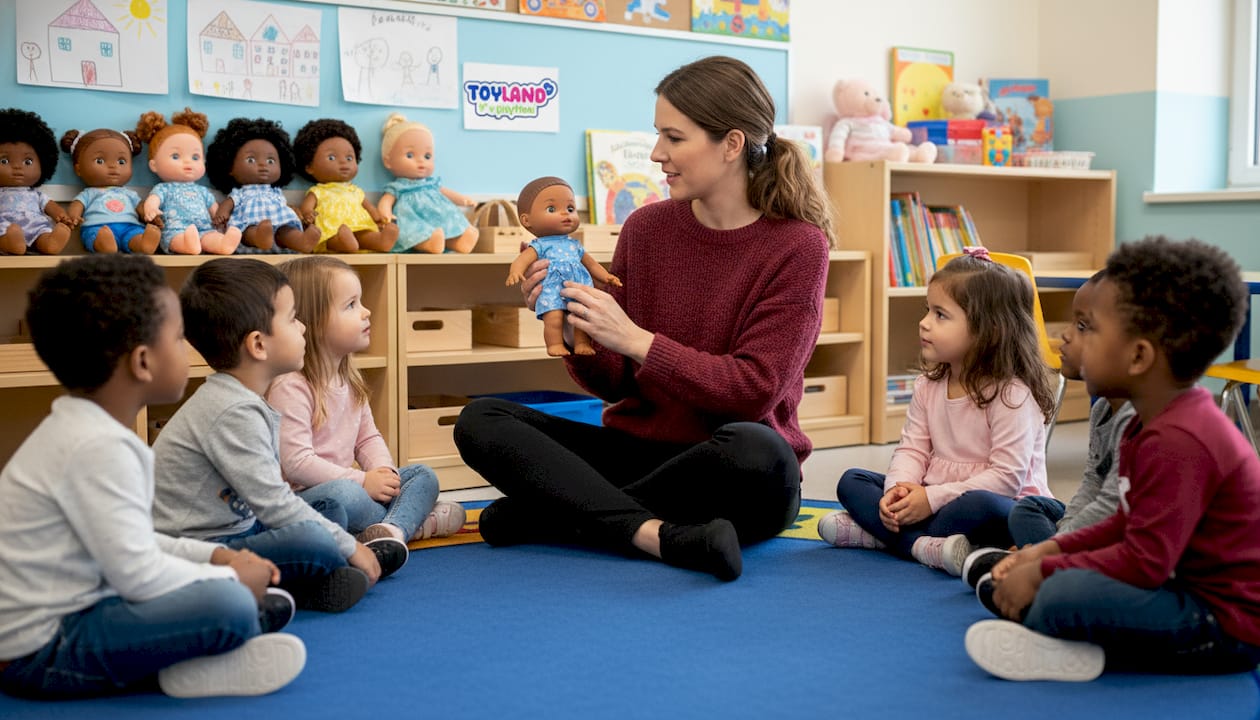
The mechanism makes intuitive sense. When a child hears a doll’s story about being new to a country or speaking a different language at home, they practice perspective-taking in a safe, low-stakes environment. They’re not being told to be kind; they’re being invited to feel what someone else feels. That’s a fundamentally different kind of learning.
Exploring interactive toys and social growth reveals that the most developmentally rich toys are ones that prompt children to imagine, respond, and connect. Diverse dolls fit squarely in that category. You can also read more about how dolls and empathy work together to build emotional intelligence in young children.
| Intervention type | Empathy gain | Duration of effect |
|---|---|---|
| Single Persona Doll session | Moderate | Short-term without follow-up |
| Repeated diverse doll play | Strong | Long-term with adult support |
| Books with diverse characters | Moderate | Varies by engagement level |
| Diverse dolls plus conversation | Strongest | Long-term with reinforcement |
Steps parents can take to use dolls for empathy building at home:
- Introduce the doll with a name and a simple backstory that reflects a different cultural or family background.
- Ask your child open-ended questions: “How do you think Maya feels when she can’t find anyone who speaks her language?”
- Let your child lead the play while you gently introduce scenarios that require empathy and problem-solving.
- Revisit the doll’s story regularly so the emotional connection deepens over time.
- Connect the doll’s experiences to real-world situations your child encounters, like meeting a new classmate.
Pro Tip: Don’t wait for a “teachable moment.” Build empathy into regular play by making diverse dolls a normal part of your child’s toy rotation, not a special occasion.
Beyond the playroom: Challenges and real-world context
While the benefits are clear, real-life application has its own hurdles. Here are the realities parents and teachers face.
Access is the first barrier. Diverse toys normalize inclusion in multicultural classrooms, but challenges include limited resources, parental attitudes that resist or question the need for diverse toys, and teachers who may lack confidence in facilitating conversations about race and identity. For many families, especially those in lower-income communities, simply finding and affording a good range of diverse dolls can be difficult.
Parental attitudes also play a significant role. Some parents worry that introducing dolls of different skin colors will prompt uncomfortable conversations they don’t feel equipped to handle. Others assume their child is “too young” to notice race. Research consistently shows the opposite: children notice racial differences as early as six months old and begin forming preferences and associations by age three. Waiting until children are “old enough” often means the window for shaping positive attitudes has already narrowed.
The second major challenge is sustainability. Empathy gains may fade without reinforcement, and retention can decline after a single intervention if adults don’t continue to facilitate meaningful engagement. A one-time activity with a diverse doll won’t undo years of narrow representation in media, books, and other toys. The gains are real, but they require ongoing effort.
Looking at innovative toys for development can help parents think about building a broader, richer play environment rather than relying on any single toy to do all the work.
Common obstacles parents and educators face:
- Limited availability of diverse dolls in mainstream toy stores
- Budget constraints, especially for schools in under-resourced communities
- Uncertainty about how to start conversations about race and identity with young children
- Resistance from other adults in the child’s environment who don’t see the value
- Inconsistency in follow-through after an initial introduction of diverse toys
Pro Tip: You don’t need a large collection to start. One or two dolls with different skin tones, introduced thoughtfully and consistently, can make a meaningful difference. Quality of engagement matters more than quantity of dolls.
Strategies for parents: Making diversity a daily part of play
Let’s move from challenges to simple, effective ways parents can take action every day.
The most important shift is moving from passive to intentional. Many parents buy a diverse doll, put it in the toy bin, and consider the job done. But the research is clear that APA-recognized doll studies have policy-level impact precisely because they show how deeply play shapes children’s worldviews. That means the toy itself is just the starting point. How you play with it, talk about it, and return to it over time is what drives real development.
Start by choosing dolls that represent a genuine range of skin tones, not just two extremes. A child who only sees “very light” and “very dark” dolls may still develop a binary view of race. Aim for variety that mirrors the actual diversity of your community and the wider world.
Steps for building inclusivity through play at home:
- Audit your current toy collection. Count how many dolls reflect different skin tones, hair textures, and cultural backgrounds. If the answer is “not many,” start there.
- Introduce new dolls with intention. Give each doll a name and a simple story. This makes the doll feel real and worthy of empathy.
- Model curiosity, not discomfort. When your child asks why one doll looks different from another, respond with genuine interest: “That’s a great question. People look different in lots of ways, and that’s one of the things that makes the world interesting.”
- Use books and media to reinforce the message. Diverse dolls work best when they’re part of a broader environment that reflects and celebrates difference.
- Check in regularly. Ask your child about their dolls, their stories, and their feelings. This keeps the conversation alive and shows your child that these topics are safe to explore.
Understanding open-ended toys and creativity can also help you see how diverse dolls fit into a larger philosophy of play that prioritizes imagination, flexibility, and emotional growth over scripted, single-use toys.
Pro Tip: Frame diversity conversations around curiosity and celebration rather than correction. Children respond better to “Isn’t it interesting that…” than to “You shouldn’t think that because…”
Why the impact of diverse dolls is bigger—and trickier—than most think
Here’s the part that most articles on this topic skip over: buying a diverse doll is the easy part. The harder part is sustaining the learning it’s meant to support.
We often assume that exposure equals understanding. Put a diverse doll in a child’s hands, and empathy follows. But empathy gains fade without reinforcement, and retention declines post-intervention if adults aren’t actively facilitating ongoing engagement. A doll sitting in a toy box isn’t doing developmental work. A doll that gets played with, talked about, and woven into a child’s imaginative life is.
This is where most well-meaning parents fall short, not because they don’t care, but because they underestimate how much adult involvement matters. Children don’t automatically extract lessons about empathy and inclusion from diverse toys. They need adults to model curiosity, ask questions, and create space for the conversations that make those lessons stick.
The importance of toy interaction isn’t just about the toy being interactive in a mechanical sense. It’s about the interaction between the child, the toy, and the adults in their life. That triangle is where real development happens.
Our take: don’t think of diverse dolls as a solution. Think of them as an ongoing invitation, one that you accept again every time you sit down to play, ask a question, or share a story. Consistency isn’t just helpful. It’s the whole point.
Explore inclusive toys to spark empathy and creativity
If you’re ready to build a more inclusive play environment at home, ToylandEU.com makes it easy to find toys that do exactly that.
Our diverse dolls collection includes beautifully crafted options that give children a rich, realistic play experience while reflecting the diversity of the world around them. Pair a new doll with one of our creative art kits to encourage children to draw and express the stories their dolls inspire. Our DIY art toys are another wonderful way to extend imaginative play into creative expression. With free worldwide shipping and over 30,000 products to explore, ToylandEU.com is your partner in raising curious, empathetic, and open-hearted kids.
Frequently asked questions
How do dolls of different skin colors affect my child’s self-esteem?
Dolls that reflect a child’s own skin color can significantly boost self-esteem and foster a positive sense of racial identity, as diverse dolls boost self-esteem in children of color by countering internalized negative associations. Children who see themselves represented in their toys feel valued and included.
Can diverse dolls actually reduce bias in young children?
Yes. Research shows that diverse dolls reduce bias and increase children’s willingness to interact with peers from different backgrounds, making them a practical tool for early social development.
What is the Clark Doll Test and why is it important?
The Clark Doll Test was a landmark study showing that children often preferred white dolls, revealing how early racial bias forms. Doll Test critiques have noted methodological limitations, but its core findings still influence child development policy and toy design today.
Are there challenges to finding diverse dolls?
Yes. Limited resources and attitudes remain real barriers for many families and schools, though more manufacturers and retailers are expanding their diverse toy offerings to meet growing demand.
What’s the most effective way for parents to reinforce empathy through play?
Ongoing parent involvement is essential because empathy gains require reinforcement to last. Regular play, open conversations, and consistent adult modeling are what turn a single toy into a lasting developmental tool.