

5–20 Minutes: Play First Conflict Resolution for Kids, Parents & Teachers
The most effective conflict resolution with kids follows one order: calm the body first, then mediate with a short script, then let kids practice the skill through play. Skipping straight to problem-solving while a child is still upset almost always fails, because a flooded nervous system cannot negotiate. Once emotions settle, a five-minute mediated conversation using I-statements and a brainstormed, mutually picked solution teaches the skill far better than an adult simply handing down a verdict.
TL;DR:
- Children need to be calm before attempting conflict resolution because strong emotions block reasoning and negotiation skills.
- Using visual tools like stoplight charts and calming strategies helps children identify their emotional state and self-regulate effectively.
- Mediation should involve neutral adult scripting, role reversal, and interest-based problem-solving rather than verdicts or blame assignments.
- Teaching core communication skills such as naming feelings, active listening, and turn-taking through play reinforces conflict resolution outside of disputes.
- Repeated low-stakes practice, especially through role-playing and cooperative games, builds children’s ability to resolve conflicts independently over time.
Table of Contents
- What Is the Fastest Way to Handle Conflict Resolution With Kids?
- Why Calming Down Has to Come Before Any Talking
- How Do You Mediate a Fight Between Two Kids?
- Which Communication Skills Should You Teach First?
- What Games Teach Kids to Resolve Their Own Conflicts?
- How Should the Approach Change by Age?
- What Mistakes Do Adults Make Most Often?
- Why Toylandeu™ Backs Play-First Conflict Skills
- An Editorial Take on Play-First Conflict Resolution
- Sources
- FAQ
What Is the Fastest Way to Handle Conflict Resolution With Kids?
Skip the lecture. Follow this sequence, and most everyday disputes between siblings, classmates, or playdate friends resolve quickly.
- Calm down. Separate the kids if needed, name the emotion, and use a breathing cue or stoplight visual before anyone talks about what happened.
- Listen to each side. Each child gets uninterrupted time to say what happened and how it felt, with the adult staying quiet.
- Paraphrase back. Have each child repeat what the other said in their own words, not just agree with it.
- Brainstorm solutions. Ask both kids for ideas before settling on anything.
- Test and agree on one solution. Pick the option both kids can live with, even if it is not perfect.
- Follow up later. Check back in an hour or the next day: “How did that solution work out?”
If either child is still too upset to speak in full sentences after the calm-down step, pause the whole process and offer a cool-off option (a quiet corner, water, a squeeze toy) before restarting at step one. Forcing the conversation before that point usually backfires and turns mediation into more arguing.
Why Calming Down Has to Come Before Any Talking
A child mid-tantrum or mid-meltdown physically cannot reason through a compromise. The Child Mind Institute recommends helping kids name their emotional state and use calming tools before any negotiation begins, because strong emotion shuts down the part of the brain that handles flexible thinking. Rushing this step is the single most common reason adult-led conflict resolution collapses into yelling.
Visual tools make this concrete for kids who cannot yet describe feelings in words. A stoplight chart (red for “too upset to talk,” yellow for “calming down,” green for “ready to solve it”) gives a child language before they have the vocabulary for it. A feelings chart with simple faces works the same way for younger children. Build a small calming toolbox: a breathing card, a soft squeeze ball, a favorite plush animal, or five minutes with a pet. Keep it somewhere both kids can reach without asking permission, so calming becomes routine rather than a special event.
Here is a script that works for kids as young as four:
- “I see you’re in the red zone. Let’s take three big breaths together before we talk about this.”
- “Your body looks like it needs a minute. Squeeze this ball ten times, then come find me.”
- “You don’t have to be calm yet, but we can’t solve this until you are. I’ll wait right here.”
Pro Tip: Never ask “what happened?” while a child is still crying or yelling. Wait until they can answer in a normal speaking voice, even if that means literally counting to ten out loud together first.
There is one exception to “always calm first.” If a rule has been broken (hitting, unsafe behavior, property destruction), enforce the limit immediately, separate the kids, and address safety before returning to the calming step. Mediation teaches negotiation skills; it is not a substitute for stopping harm.
How Do You Mediate a Fight Between Two Kids?
The adult’s job in mediation is to stay neutral, not to decide who is right. A randomized study of parents trained in formal mediation procedures found that kids ages 5 to 10 used more constructive negotiation strategies and understood their sibling’s perspective better than kids whose parents intervened the conventional way, by simply assigning blame. That single finding is the strongest argument for learning the script below instead of improvising.
- Set ground rules out loud. “No interrupting, no name-calling, and we’re looking for a solution, not a winner.”
- Child A states what happened and how they felt. “I felt frustrated when the tower got knocked over.”
- Child B paraphrases it back. “You’re saying you were frustrated because I knocked over your tower.”
- Switch roles. Child B states their side, Child A paraphrases.
- Dig for the interest behind the position. Ask “what did you actually need at that moment?”" rather than re-litigating who touched what first.
- Brainstorm together. Both kids offer at least one idea; the adult writes or repeats each one without judging it.
- Agree on a solution and set a check-in. “Let’s try this for the rest of the afternoon and see how it goes.”
A few notes on execution:
- Keep each step brief for younger kids; middle schoolers can handle longer exchanges.
- Avoid leading questions like “Don’t you think you should apologize?” — that turns mediation into a lecture in disguise.
- The Program on Negotiation at Harvard Law School frames this as separating interests from positions: the position is “I want the toy,” the interest underneath might be “I want to feel included.”
- Save arbitration (you simply decide) for safety issues or repeated harm, and schedule a mediated teach-back for later so the learning opportunity isn’t lost entirely.
Which Communication Skills Should You Teach First?
Four skills carry almost all the weight in kid-to-kid conflict: naming feelings with I-statements, listening without interrupting, taking turns, and reading tone and body language. Teach these outside of an actual fight, then reference them during one.
- I-statement templates by age. Preschoolers: “I feel [mad] when [you take my toy].” Elementary kids: “I feel [hurt] when [you leave me out] because [I want to play too].” Middle schoolers can handle a fourth clause: “…and what I need is [a turn next round].”
- Active listening drill. One child talks for 30 seconds about anything (a favorite show works fine), then the listener repeats back the main point before responding. Do this daily and it becomes automatic during real disputes.
- Turn-taking practice. Use a simple object, a talking stick or a small toy, that gets passed between speakers so only the holder talks. Board games with strict turn order double as unintentional turn-taking drills.
- Nonverbal coaching. Point out tone directly: “You said ‘sorry,’ but your voice sounded annoyed. Try it again like you mean it.” Kids often don’t realize their tone contradicts their words until an adult names the gap.
What Games Teach Kids to Resolve Their Own Conflicts?
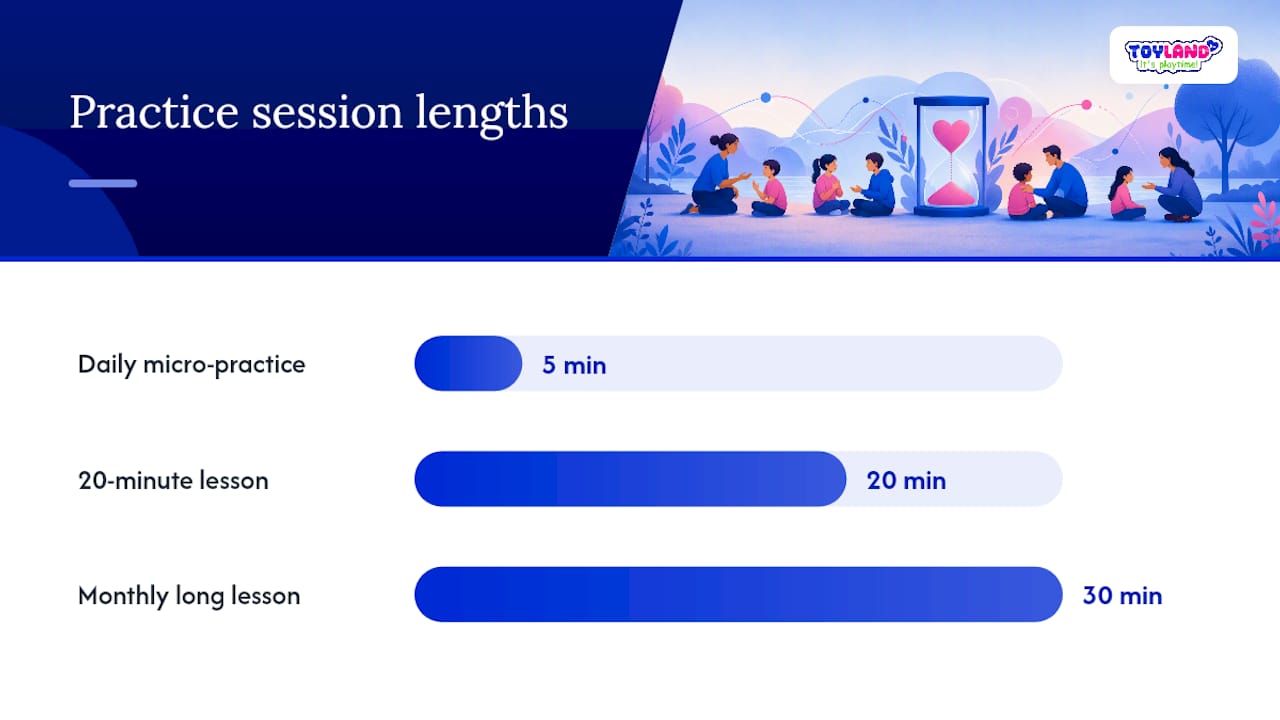
Low-prep activities let kids rehearse mediation skills when nothing is actually at stake, which makes the real thing easier later. Frequent short practice beats occasional long lessons, and a five-minute daily round genuinely builds the habit faster than a single 30-minute lesson once a month.
- Role-play scenarios. Act out a toy dispute, a playground line-cutting incident, or a group game where someone wants to change the rules mid-play. Swap roles so each kid plays both sides.
- Jar of solutions. Write common conflict triggers on slips of paper (someone cuts in line, two kids want the same seat), pull one out, and have kids brainstorm three fixes before picking one together.
- Cooperative building challenges. Give two kids one shared building set and a task that forces negotiation, like building one structure using both of their idea. A collaborative build with building block sets works well here because the shared pieces force turn-taking by design.
- Storytelling swaps. One child starts a story about two characters who disagree, the other continues it, and they take turns steering the plot toward a resolution.
For a five-minute micro-practice, pick one role-play scenario and run it once, no debrief needed. For a 20-minute lesson, run two scenarios, then talk through what worked and what felt awkward.
Pro Tip: Keep a small bin of shared-use toys, blocks, or figures set aside specifically for conflict practice. Kids treat “practice toys” differently than their personal favorites, which lowers the emotional stakes while they’re still learning the script.
How Should the Approach Change by Age?
A four-year-old and a twelve-year-old need very different versions of the same protocol.
- Preschool (ages 3 to 5): Use visuals over words, offer one clear solution rather than open brainstorming, and expect to scaffold nearly every step yourself.
- Elementary (ages 6 to 11): Teach the full mediation sequence explicitly and step back once kids show they can paraphrase and brainstorm without prompting.
- Middle school (ages 12 and up): Shift toward private, one-on-one negotiation rather than group mediation, and add safety planning as a standing topic, especially around social exclusion or online conflict.
What Mistakes Do Adults Make Most Often?
The single biggest error is arbitration disguised as mediation: an adult listens for thirty seconds, then announces a verdict. That skips every skill-building step and teaches kids to wait for a ruling instead of solving anything themselves.
- Avoid leading questions (“Don’t you think you owe her an apology?”) that push kids toward a predetermined outcome.
- Stay visibly neutral. Adults who play favorites, even unintentionally, cause kids to disengage from the whole process, according to extension research on mediation pitfalls.
- Frame disputes around interests, not positions. “What do you actually need right now?” surfaces more workable answers than “who had it first?”
Pro Tip: If a mediation session goes sideways, mid-argument, stop talking about the original conflict entirely and restart at the calming step. Trying to push through a stalled mediation almost always makes it worse.
Why Toylandeu™ Backs Play-First Conflict Skills
This piece was written for Toylandeu™ by Thane Holland, drawing on peer-reviewed mediation research, negotiation frameworks from Harvard’s Program on Negotiation, and classroom protocols used by educators nationwide.
Toylandeu™ approaches this topic from a practical angle: kids build negotiation skills faster through repeated, low-stakes play than through lectures. That is why cooperative sets, shared building kits, and turn-taking games show up so often in conflict-resolution guidance, not as a sales pitch, but because shared physical play naturally forces the turn-taking and compromise that mediation scripts describe on paper. If you’re stocking a classroom or home practice kit, building block sets and MOC kits hold up well to repeated group use and cost less to replace than most electronics-based options.
An Editorial Take on Play-First Conflict Resolution
The research on this topic points somewhere most parenting advice ignores: the goal isn’t a resolved conflict, it’s a child who resolved it mostly on their own. Conventional advice treats a quiet room as success. It isn’t. A quiet room where an adult picked the winner teaches kids to wait for a ruling next time, not to negotiate.
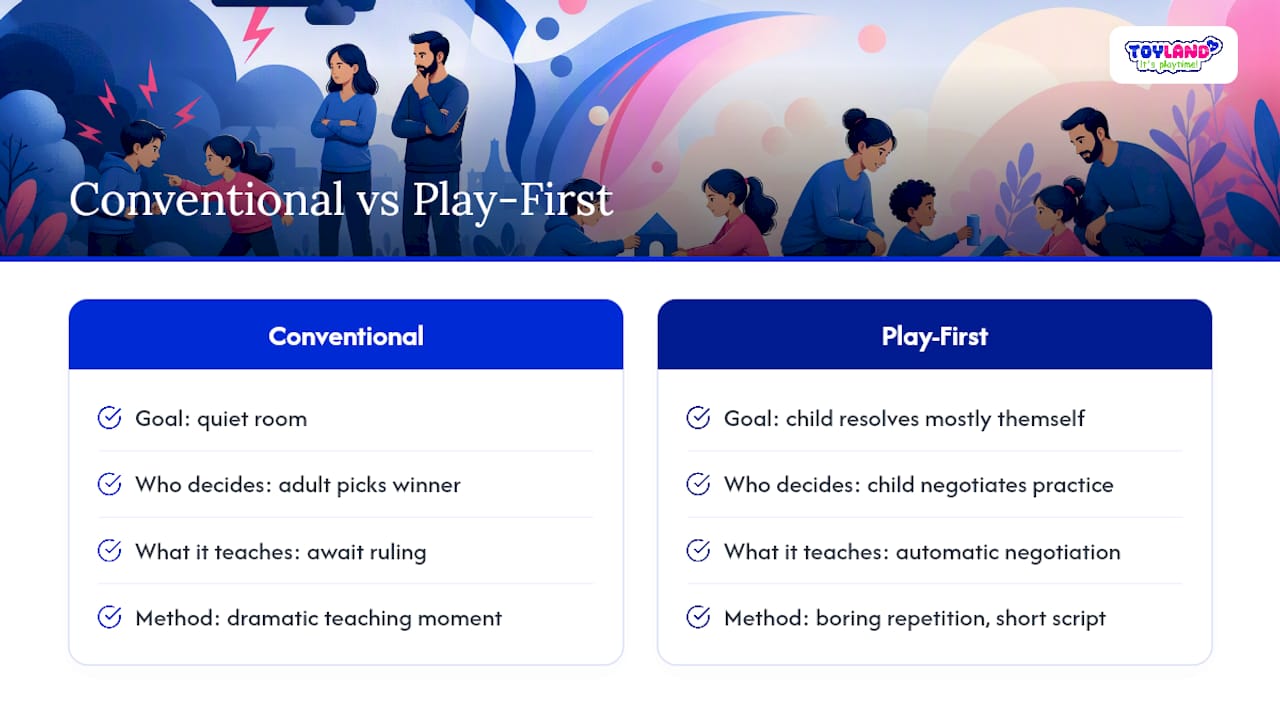
What’s overrated is the single dramatic “teaching moment” conversation. What actually works, based on how these skills are demonstrated in practice, is boring repetition: the same short script, the same paraphrase step, run dozens of times across small, low-stakes disputes until it’s automatic. A five-minute jar-of-solutions game on a calm Tuesday afternoon does more for a kid’s long-term conflict skills than a heartfelt hour-long talk after a blowup.
If you take one thing from this guide, prioritize the calm-down step over everything else. Every mediation script in this guide fails if you skip it, and it’s the step adults are most tempted to rush.
— Thane Holland
Sources
For deeper protocols and evidence behind this guide, consult the Program on Negotiation at Harvard Law School, Stopbullying, and Responsive Classroom’s coaching protocols for classroom-tested mediation sequences.
- Training Parents to Mediate Sibling Disputes Affects Children’s Negotiation and Conflict Understanding
- Program on Negotiation — Harvard Law School
- Teaching Kids How to Deal With Conflict — Child Mind Institute
FAQ
What Are the Six Steps of Conflict Resolution With Kids?
The core sequence is calm down, listen to each side, paraphrase what was heard, identify the real interest behind each position, brainstorm solutions together, and agree on one to test with a follow-up check-in. This mirrors the teachable-moment protocol used in classroom mediation programs and adapts easily to home use.
What Are Good Conflict Resolution Scenarios to Practice With Kids?
Common practice scenarios include two kids wanting the same toy, a disagreement over changing a game’s rules mid-play, and one child feeling left out of a group activity. Role-playing these low-stakes situations, alongside tools like the jar of solutions, lets kids rehearse the mediation script before a real conflict happens.
What’s the Most Effective Way to Resolve a Conflict With Kids?
Calming down first, then running a short mediated conversation with I-statements and a jointly picked solution, works better than an adult simply deciding who’s right. A study of parents trained in formal mediation found kids negotiated more constructively and understood each other’s perspective better than kids whose parents intervened conventionally.
When Should an Adult Step in Instead of Letting Kids Mediate?
Step in immediately for safety issues, hitting, or repeated harm, and use brief arbitration rather than full mediation in that moment. For anything involving bullying, follow StopBullying.gov’s guidance on direct conversation, safety planning, and reporting, since mediation skills alone aren’t designed to handle bullying dynamics.
How Do I Teach My Kid to Handle a Bully Without Just Fighting Back?
Focus on safety first: teach a clear, calm phrase to say (“Stop, I don’t like that”) and a plan for walking away and telling a trusted adult. StopBullying.gov’s prevention resources recommend pairing this with direct conversations about what bullying looks like, so kids can recognize it and know reporting isn’t the same as tattling.