

My Kid Cheats at Board Games: What to Do About It
TL;DR:
- Children cheat at board games mainly because they struggle to regulate their emotions, not out of dishonesty. Addressing this behavior with calm corrections, modeling fairness, and choosing age-appropriate games helps promote honesty and resilience.
Cheating during board games is a normal developmental phase in children, driven primarily by limited emotional regulation rather than deliberate dishonesty. When your kid cheats at board games, the behavior signals that they are struggling to manage frustration, fear of losing, or a mismatch between their skills and the game’s demands. Understanding this distinction changes everything about how you respond. Addressing cheating calmly and constructively, rather than with punishment or shame, produces better long-term results for your child’s honesty, resilience, and social skills.
Quick Summary
Children cheat at board games because of underdeveloped emotional regulation, fatigue, or game complexity mismatches. Parents get better results by modeling fair play, using procedural corrections, and choosing age-appropriate games. Punitive responses make the behavior worse.
TL;DR
- Cheating = emotional struggle, not a character flaw
- Keep games to 30–45 minutes for younger kids
- Model sportsmanship; skip the lecture
- Use handicaps instead of letting kids win on purpose
- Cooperative games reduce cheating opportunities naturally
Table of Contents
- What causes kids to cheat at board games?
- How can parents respond when their child cheats?
- Choosing games that minimize cheating opportunities
- Building long-term fairness and resilience through play
- Key Takeaways
- Perspective
- Toylandeu™ picks for fair-play family nights
- FAQ
What causes kids to cheat at board games?
Cheating in children is typically a phase linked to limited emotional regulation, not a moral failure. When a child moves a piece without permission or “forgets” a rule that costs them points, they are almost always reacting to an emotion they cannot yet manage. That is the starting point every parent needs.
Several factors push kids toward bending the rules:
- Underdeveloped emotional regulation. Young children lack the brain development to handle losing gracefully. The prefrontal cortex, which governs impulse control, is not fully developed until the mid-20s. A six-year-old who flips the board is not being manipulative. They are overwhelmed.
- Fatigue. Fatigue-induced rule breaking occurs most often in games running longer than 30–45 minutes for young kids. Tired children lose the capacity to self-regulate, and cheating becomes the path of least resistance.
- Skill and complexity mismatch. When a game is too hard, children feel incompetent. Frustration from lacking competence is one of the most consistent triggers for cheating. The child is not trying to deceive. They are trying to survive an experience that feels impossible.
- Parenting pressure. A 2026 study found that excessive strictness at age 4.5 predicts cheating behavior by age 6. Children raised in high-pressure environments learn that failure has painful consequences, so they avoid it by any means available.
- Confusion between cheating and lying. Cheating and lying are distinct behaviors. Cheating involves actions taken to gain an advantage. Lying involves verbal deception. Helping children understand this difference builds a clearer foundation for honesty.
Pro Tip: Before your next game night, ask yourself whether the game matches your child’s current skill level. A mismatch is often the real problem, not your child’s character.
How can parents respond when their child cheats during games?
The most effective parental response to a child cheating at games focuses on the action, not the child’s identity. Shaming a child for cheating teaches them to hide the behavior better. Correcting the action teaches them what to do instead.
- Model sportsmanship first. Children imitate adults’ behavior far more effectively than they absorb lectures about honesty. When you lose a game and say, “Good move, you got me,” your child files that away. When you win and say, “Nice try, want to play again?” you are teaching resilience in real time.
- Use procedural corrections, not shame. When you catch a rule violation, calmly reset the game state and explain what the correct move is. Say, “That piece goes back here. The rule is you draw two cards.” Keep your voice neutral. The goal is correction, not punishment.
- Set a clear, logical consequence. If cheating continues after a correction, end the game. Say, “We can try again tomorrow when we are both ready to follow the rules.” Do not negotiate. Do not extend the session hoping behavior improves. Consistency is the lesson.
- Skip intentional losing. Parents should avoid letting children win on purpose and instead use handicaps to balance gameplay. Give a younger child extra cards, a head start, or fewer obstacles. That way, when they win, the victory is real. Real wins build genuine confidence.
- Separate the conversation from the heat of the moment. Once emotions are calm, usually an hour or a day later, talk about what happened. Ask, “How did you feel when you were losing?” Listen before you explain. That conversation does more than any in-the-moment lecture.
Pro Tip: Use “I noticed” language instead of “You cheated.” Say, “I noticed the piece moved. Let’s put it back.” This keeps the conversation factual and avoids triggering defensiveness.
Choosing games that minimize cheating opportunities
Game selection is one of the most underused tools parents have for preventing cheating in kids. The right game removes the conditions that make cheating tempting in the first place.
Age-appropriate complexity matters most
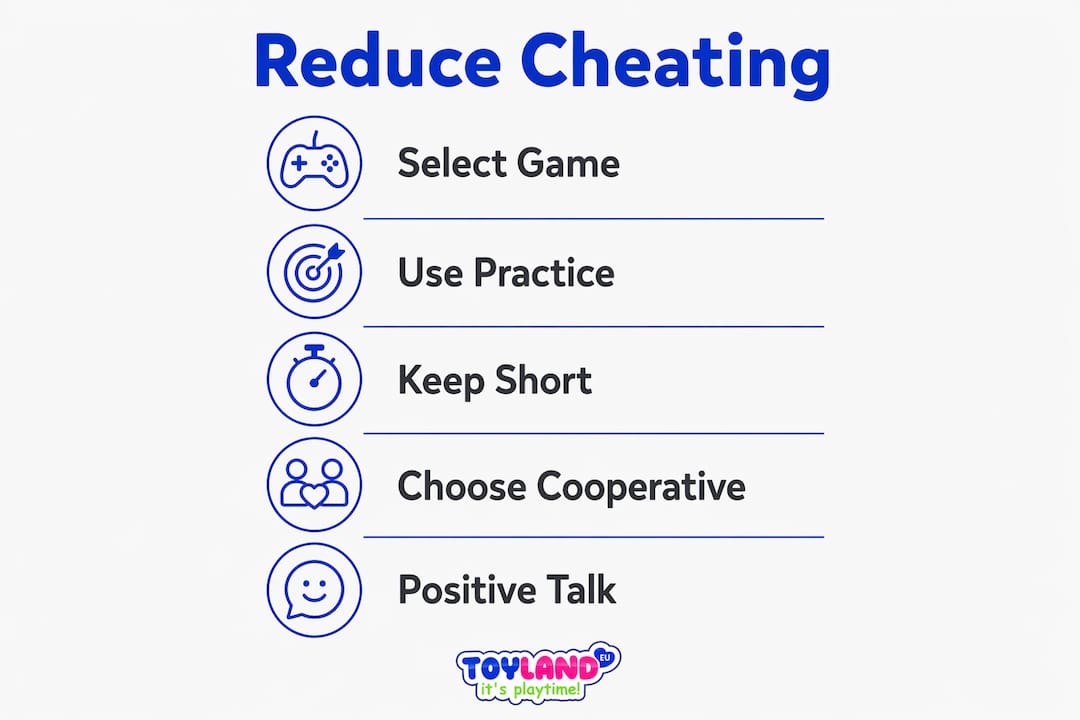
A game with too many rules overwhelms young players. When children cannot track the rules, they fill the gaps with whatever benefits them. Choose games rated for your child’s age or slightly below. The goal is confident participation, not a challenge.
Cooperative and simultaneous-action games change the dynamic
Cooperative games, where all players work toward a shared goal, eliminate the win-lose tension that triggers most cheating. Simultaneous-action games, where everyone acts at the same time, reduce waiting and boredom. Both formats are worth exploring for family camping games and indoor play alike.
| Game format | Cheating risk | Best for |
|---|---|---|
| Competitive, turn-based | High | Older kids with strong emotional regulation |
| Cooperative | Low | Ages 4–8, mixed-age groups |
| Simultaneous-action | Low to medium | Kids with short attention spans |
| Team-based competitive | Medium | Kids who handle peer accountability well |
Keep sessions to 30–45 minutes
Long game sessions fatigue children, and fatigue is a direct trigger for rule-breaking. Set a timer before you start. When it goes off, wrap up the round and stop. Younger children simply do not have the stamina for marathon game nights, and forcing it creates the exact conditions where cheating thrives.
Use practice rounds to teach rules without pressure
Practice rounds without stakes help children understand the rules before the pressure of winning or losing enters the picture. Play one round where no one keeps score. Let your child make mistakes and correct them without consequence. This reduces the incentive to cheat once real play begins.
Building long-term fairness and resilience through gameplay
Teaching fair play is not a single conversation. It is a skill built over hundreds of small moments at the game table.
- Define fairness in concrete terms. Fairness means turn-taking, rule consistency, and inclusiveness. These are social skills, not abstract values. When you name them specifically, children understand what you are asking for.
- Celebrate effort and sportsmanship, not just winning. After a game, say, “I loved how you waited your turn every time,” or “You handled that tough moment really well.” Recognizing the behavior you want reinforces it far more than punishing the behavior you do not want.
- Boost confidence outside of games. A child’s confidence in diverse tasks directly affects how they handle disappointment during play. When a child feels capable at drawing, building, or sports, losing a board game feels less catastrophic. Vary the activities your child engages with so they have multiple sources of competence.
- Use games as low-stakes practice for disappointment. A lost game is a safe place to feel frustrated. It costs nothing. Use those moments to ask, “What can we do when we feel like that?” and build a vocabulary for managing hard emotions. That skill transfers to school, friendships, and eventually work.
- Encourage communication during conflict. When a dispute arises over rules, pause and talk it through together. Ask each player to explain what they think the rule says. This builds conflict-resolution habits that go well beyond the game table. Toylandeu™ carries toys that build team skills and social trust, which complement these in-game lessons.
Key Takeaways
Children cheat at board games because of emotional regulation limits, fatigue, and skill mismatches. Procedural corrections, modeling, and age-appropriate game selection are the most effective responses.
| Point | Details |
|---|---|
| Cheating is developmental | It reflects emotional struggles, not a character flaw, and improves with age and guidance. |
| Game length matters | Keep sessions to 30–45 minutes for younger children to prevent fatigue-driven rule-breaking. |
| Model, don’t lecture | Children copy adult behavior at the table more reliably than they absorb verbal instructions. |
| Use handicaps, not fake losses | Letting kids win dishonestly undermines real confidence. Handicaps create genuine victories. |
| Define fairness concretely | Teach turn-taking, rule consistency, and inclusiveness as named, specific social skills. |
What I’ve learned from years of game nights gone sideways
The first time I watched a child slide a game piece two extra spaces and look me dead in the eye, I made the classic mistake. I turned it into a lecture about honesty. The game ended badly, the child felt ashamed, and nothing changed the next week.
What actually worked was far less dramatic. I started playing games where I visibly lost and said nothing except, “Good game.” I started using handicaps instead of throwing matches. I started ending sessions at 40 minutes, even when everyone wanted to keep going. The cheating dropped off. Not because I had cracked some parenting code, but because I had removed most of the conditions that made cheating feel necessary.
The harder insight is this: punitive responses to cheating teach children to cheat more carefully, not less. The child who gets shamed for moving a piece learns to move it when no one is looking. The child who gets a calm correction and a clear consequence learns that the rules are real and consistent. That is the environment where honesty grows.
Game selection also matters more than most parents realize. A game that is too complex for a child’s age is not a teaching opportunity. It is a frustration trap. Choosing games your child can actually play well, and then gradually increasing complexity, builds the confidence that makes cheating feel unnecessary. Toylandeu™ has a solid range of educational play options worth browsing when you are ready to refresh your game shelf.
— Thane Holland
Toylandeu™ picks for fair-play family nights
Family game nights work best when the toys and games match where your child actually is, not where you wish they were.

Toylandeu™ carries a wide selection of games and activity kits designed to build focus, patience, and social skills in children ages 3 and up. The Montessori Drawing Adventure matching game is a strong pick for younger kids who need low-pressure, rule-based play. For families who want a fast, physical game that keeps everyone engaged, the desktop football board game delivers competitive fun with simple rules and short sessions. Both are available with free worldwide shipping through Toylandeu™.
FAQ
Why does my kid cheat at board games?
Children cheat primarily because of underdeveloped emotional regulation, not dishonesty. They struggle to handle losing, and cheating is the fastest way to relieve that discomfort.
At what age do kids stop cheating at games?
Cheating typically decreases as emotional regulation improves, usually between ages 7 and 9. Consistent modeling and calm corrections speed up this process.
Should I let my child win to avoid cheating?
No. Parents should use handicaps instead of intentional losses. Fake wins do not build real confidence, and children often sense when a parent is throwing a game.
What types of games reduce cheating in young kids?
Cooperative games and simultaneous-action games reduce cheating because they remove the direct win-lose tension that triggers most rule-breaking in children under age 8.
How do I talk to my child about cheating without shaming them?
Focus on the action, not the child. Say, “That piece needs to go back,” rather than, “You cheated.” Wait until emotions are calm before having a longer conversation about fairness and honesty.