

Simple bouncy house safety rules every parent needs to know
TL;DR:
- Adult supervision is critical and can prevent 73-85% of bounce house injuries.
- Proper setup, anchoring, and weather awareness are essential for safe bouncy house use.
- Strict adherence to age, weight, and capacity limits, along with verified safety certifications, enhances safety.
Bouncy houses look harmless sitting in the backyard, but the setup and supervision around them matter far more than most parents realize. 73-85% of accidents are preventable with consistent adult oversight, yet injuries still happen at birthday parties and community events every weekend. The good news is that keeping kids safe does not require expensive gear or complicated checklists. It requires understanding a handful of clear, evidence-based rules and actually following them. This guide walks you through everything: supervision standards, setup requirements, age and weight limits, and what safety certifications actually mean.
Table of Contents
- Why supervision is the golden rule
- Set up for safety: Location, anchoring, and weather
- Understanding age, weight, and capacity limits
- Material safety and certifications: What parents should check
- The uncomfortable truth: Safety is more about people than products
- Fun and safety: Explore more ways to play smart
- Frequently asked questions
Key Takeaways
| Point | Details |
|---|---|
| Supervision is essential | Active, constant adult supervision prevents most bouncy house injuries. |
| Proper setup matters | Always anchor, check location, and monitor weather before use. |
| Follow capacity limits | Stick to manufacturer guidelines for age and number of kids to avoid accidents. |
| Check certifications | Only use units with third-party tested materials that meet ASTM or equivalent standards. |
Why supervision is the golden rule
Here is a fact that surprises most parents: the single biggest cause of bouncy house injuries is not a faulty product or a freak accident. It is a lapse in adult attention. Kids are unpredictable. A child who was bouncing safely thirty seconds ago can collide with another child, land awkwardly, or attempt a flip the moment no one is watching. Those seconds matter enormously.
Preventing 73-85% of accidents is achievable with constant adult supervision, and official guidance recommends one trained attendant for every 12 children. That ratio is not just a suggestion. It reflects real-world incident data showing that attention gets diluted when one adult tries to monitor too many kids at once. For home birthday parties, that might mean recruiting a second parent to help rather than assuming one person can watch the bouncer while also managing food and guests.
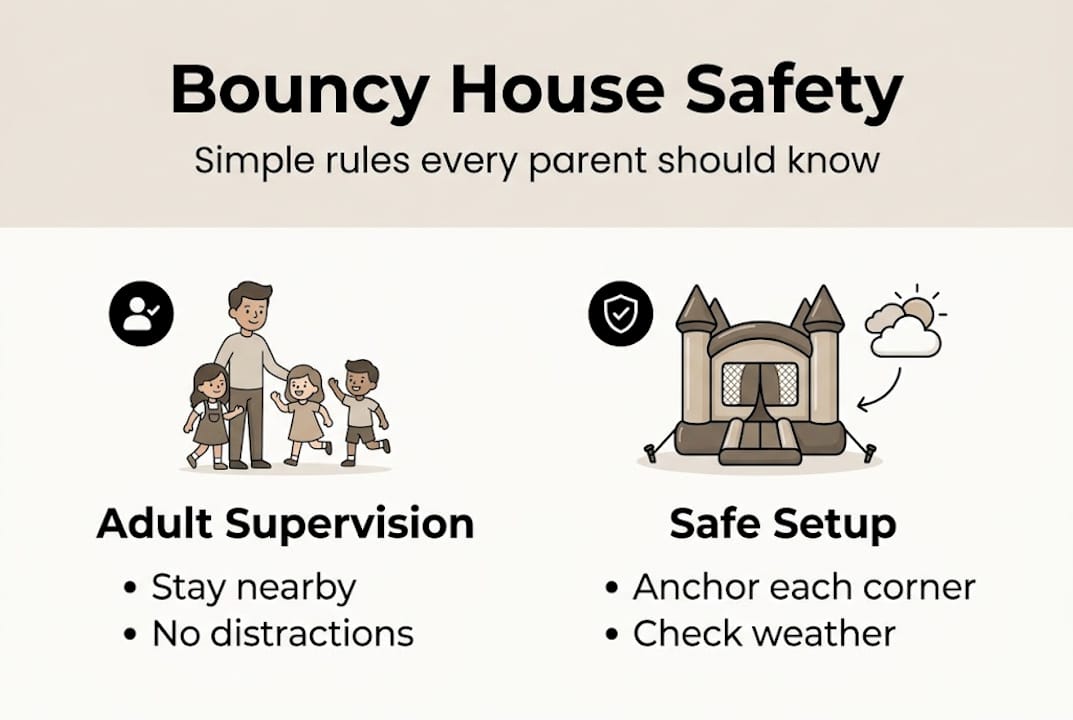
All official sources agree that supervision is non-negotiable, and active supervision means more than glancing over occasionally. It means positioning yourself where you can see every child inside the unit, intervening immediately when roughhousing starts, and enforcing rules consistently.
Here is what active supervision actually looks like in practice:
- Stand close enough to react quickly, not across the yard with a drink in hand
- Enforce a no-flipping and no-rough-play rule from the start, before kids enter
- Limit the number of children inside to what you can realistically monitor
- Rotate children in and out every 10 to 15 minutes to reduce fatigue-related accidents
- Never leave the unit unattended while children are playing, even briefly
One mistake parents make repeatedly is leaving the bouncy house inflated overnight or during breaks when kids might sneak back in unsupervised. This is a serious hazard. Deflate and secure the unit any time you step away.
Pro Tip: Assign one adult the sole job of bouncer supervision during parties. That person does nothing else: no phone, no food, no conversations. Rotate the role every 20 minutes to keep attention sharp.
For more practical guidance, check out these bouncy house safety tips or explore how emerging toy safety tech is changing how parents monitor playtime.
Set up for safety: Location, anchoring, and weather
Supervision alone cannot protect children if the unit is improperly set up. A bouncy house that shifts, tips, or deflates mid-session creates hazards no amount of watchfulness can fully prevent. Getting the physical setup right is just as important as having an adult present.
Start with location. Choose a flat, level surface with at least six feet of clearance on all sides. Avoid placing the unit near fences, trees, walls, or anything a child could hit if they exit unexpectedly. Hard surfaces like concrete or asphalt are not ideal. Grass or soft ground is preferable, though you should still check for hidden rocks, roots, or sprinkler heads underneath.
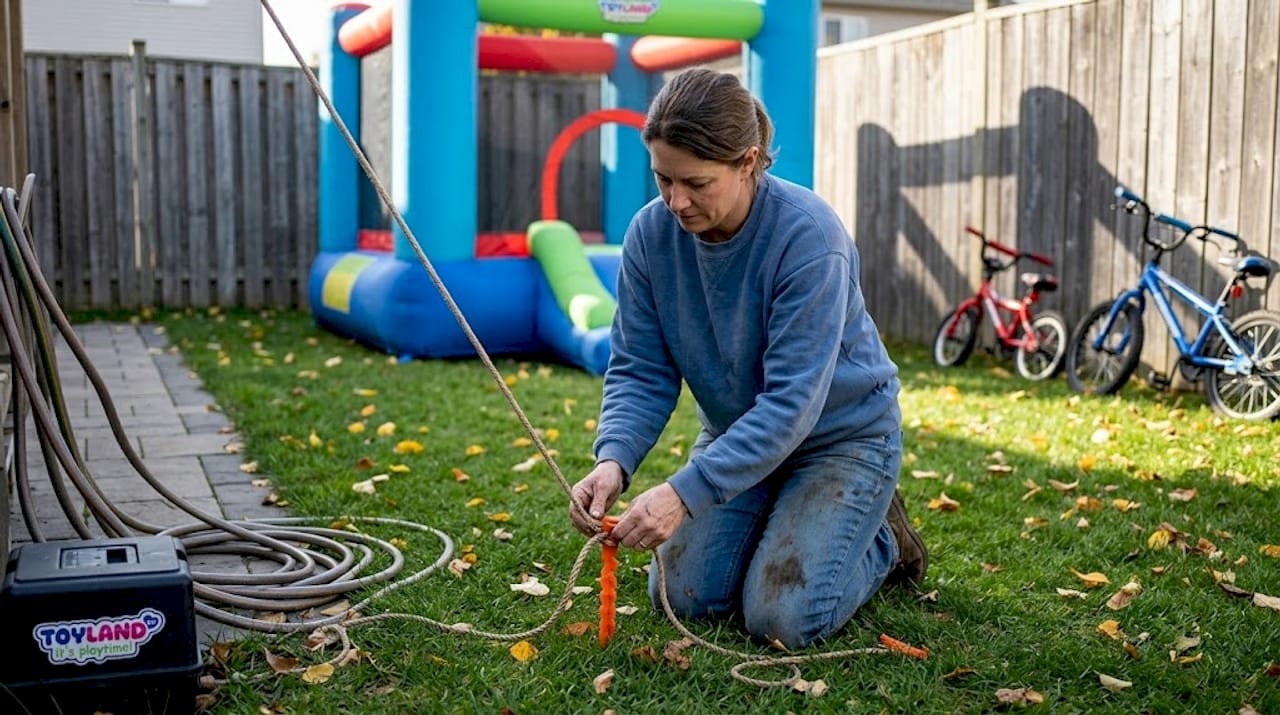
Anchoring is non-negotiable. Non-return valves, inflation tubes, and anchoring systems are engineered safety features, and skipping or rushing the anchoring step is one of the most common setup errors. Use all provided stakes or sandbags, and verify they are secure before any child enters.
Here is a simple setup sequence to follow every time:
- Clear the area of debris, sharp objects, and obstacles
- Lay out the unit on flat, soft ground
- Connect the blower and check that the inflation tube is properly sealed
- Anchor all corners using the provided stakes or sandbags
- Inflate fully and inspect seams, netting, and entry points before use
- Recheck anchors after the first 10 minutes of active use
Weather is a factor many parents underestimate. Wind is the biggest outdoor threat to inflatable units.
| Unit type | Max recommended wind speed | Additional weather notes |
|---|---|---|
| Residential home unit | 15 mph (24 km/h) | Deflate during any rain or gusts |
| Commercial event unit | 24 mph (39 km/h) | Requires professional anchoring setup |
| Toddler-specific unit | 12 mph (19 km/h) | Most sensitive to movement and tipping |
Pro Tip: Check the local weather forecast before setup, not just the morning of. If wind speeds are expected to rise during the afternoon, plan your bounce session for earlier in the day.
For broader guidance on keeping outdoor play safe, this resource on outdoor toy safety covers useful principles that apply beyond bouncy houses.
Understanding age, weight, and capacity limits
Proper setup is step one. Knowing who can play and how many at once is just as vital. Manufacturer guidelines on age, weight, and capacity are not conservative suggestions designed to limit fun. They are engineering thresholds. Exceeding them changes how the unit behaves structurally and dramatically increases the risk of collisions and tip-overs.
Here is a general overview of typical limits you will find on residential units:
| Unit size | Recommended age | Max weight per user | Max simultaneous users |
|---|---|---|---|
| Small (10x10 ft) | 3 to 8 years | 100 lbs (45 kg) | 3 to 4 children |
| Medium (13x13 ft) | 4 to 10 years | 120 lbs (54 kg) | 6 to 8 children |
| Large (15x15 ft) | 5 to 12 years | 150 lbs (68 kg) | 8 to 12 children |
| Toddler unit | 2 to 5 years | 60 lbs (27 kg) | 3 to 4 children |
The most common mistake at birthday parties is mixing age groups. Older, heavier kids create unpredictable bounce patterns that can knock toddlers off their feet. If you have a mixed-age group, schedule separate bounce sessions for different age ranges rather than letting everyone in at once.
Toddlers deserve special attention. 2-year-olds should only use dedicated low-height units with an adult within arm’s reach at all times. Standard bouncy houses are not designed for children that young, regardless of how carefully they are supervised.
Remember: Capacity limits are per session, not per hour. If a unit says maximum six children, that means six at one time, always, not six per rotation.
Key rules for managing capacity safely:
- Never allow older children and toddlers to bounce together in the same session
- Weigh children before entry if you are unsure whether they are within the unit’s limits
- Post the rules visibly near the entrance so older kids understand the boundaries
- Remove shoes, glasses, and sharp accessories before entry for every child
For more on how toy safety innovations are helping parents make better purchasing decisions, that resource is worth a read.
Material safety and certifications: What parents should check
Rules about capacity and age go hand-in-hand with buying or renting units made from safe materials. A bouncy house can meet every supervision and setup standard and still pose a chemical hazard if the materials were not properly tested.
Two standards matter most. ASTM F2374 applies to commercial inflatables used at public events, while F2729 covers residential units for home use. These are not interchangeable. A unit certified only to residential standards is not appropriate for a large community event, and vice versa. Residential and commercial standards differ significantly, and research has found that 50% of tested units exceeded safe lead limits, which is a startling figure that most parents never hear about.
The problem with self-certification is real. Manufacturers can print safety claims on packaging without independent verification. The only way to confirm a unit is genuinely safe is to ask for third-party lab reports, documents produced by an accredited testing facility that is not affiliated with the manufacturer.
Pro Tip: When renting a bouncy house, ask the rental company directly for their third-party certification documents. A reputable company will have them ready. If they cannot produce them, rent elsewhere.
Here is a quick checklist for evaluating any unit before use:
- Verify ASTM certification matches the intended use (residential or commercial)
- Request third-party lab reports, not just manufacturer claims
- Check for a visible safety tag sewn into the unit with certification details
- Look up the manufacturer to confirm they are a recognized brand with a complaint history you can check
- Inspect materials for strong chemical odors, which can indicate off-gassing from untested vinyl
For a deeper look at how advanced toy safety tech is reshaping what parents can expect from certified products in 2026, that article covers some genuinely useful developments.
The uncomfortable truth: Safety is more about people than products
After reviewing every technical standard, anchoring requirement, and certification checklist, the pattern that emerges from decades of incident reports is consistent: most bouncy house injuries happen not because the equipment failed, but because an adult made a preventable human error.
Parents often feel reassured once they have purchased a certified unit or hired a reputable rental company. That reassurance can breed complacency. A certified unit does not supervise itself. An ASTM-stamped label does not stop a 10-year-old from jumping on a 4-year-old. Government and ASTM guidance consistently emphasizes supervision and setup discipline above all else, not equipment quality alone.
The uncomfortable reality is that the most expensive, best-certified bouncy house on the market becomes dangerous the moment an adult walks away or lets the rules slide. Conversely, a modest residential unit used with strict supervision and proper setup is genuinely safe. Your attention and consistency are the most powerful safety tools you have. Invest your energy there first, and treat certifications as a baseline, not a guarantee. For a full refresher on the core rules, revisit these summer bouncy house rules before your next event.
Fun and safety: Explore more ways to play smart
Once you have bouncy house safety covered, it is natural to look for other ways to keep kids active, engaged, and safe. At ToylandEU, we believe the best play experiences are the ones where parents feel confident and kids feel free to explore.
Whether your child loves high-energy outdoor adventures or imaginative indoor play, our catalog has something for every personality. Check out the RC stunt car for kids for thrilling active play, or the princess reborn toddler doll for quieter creative moments. With free worldwide shipping and over 30,000 products, ToylandEU makes it easy to find toys that match your child’s energy and your standards for safety.
Frequently asked questions
Can 2-year-olds safely use an inflatable bouncy house?
Only if the unit is specifically designed for toddlers, low in height, and an adult remains within arm’s reach throughout the entire session. Standard bouncy houses are not appropriate for children this young.
How many kids can bounce at once?
Follow the manufacturer’s capacity label strictly. As a general benchmark, one child per square meter is a safe rule, and most medium residential units safely accommodate 6 to 8 same-age children at one time.
Should a bouncy house be left inflated overnight?
Never leave a bouncy house inflated and unattended overnight. Wind, weather changes, and the risk of unsupervised access all make overnight inflation a serious safety hazard.
What safety certifications matter for bouncy houses?
Look for ASTM F2374 or F2729 certification matched to the unit’s intended use, and always request independent third-party lab reports rather than accepting manufacturer self-claims.
Recommended
- Summer 2026 Bouncy House Safety Tips for Kids’ Fun & Security – ToylandEU
- Emerging Children’s Toy Safety Tech Innovations in 2026 – ToylandEU
- The Ultimate Guide to Outdoor Water Toys for Kids: Benefits, Safety Ti – ToylandEU
- Toy Safety Innovations in 2025: Protecting Kids with Smart Technologies – ToylandEU