

Are Trampolines Dangerous? What Parents Need to Know
TL;DR:
- Trampolines pose significant injury risks for children, especially when multiple kids jump simultaneously. The most effective safety rule is enforcing one-jumper-at-a-time to prevent collisions and serious injuries. Safety equipment alone cannot eliminate the danger, making strict behavior rules essential for safe trampoline use.
Trampolines are defined as a high-risk activity for children by the American Academy of Pediatrics, which strongly discourages recreational use for kids under 6. Over 11,000 children visit hospitals in the UK each year for trampoline-related injuries alone. That number reflects a consistent, well-documented pattern of pediatric trauma. The question parents ask is not just “are trampolines dangerous” but how dangerous, under what conditions, and what can actually be done about it. The answers are more specific, and more sobering, than most backyard conversations suggest.
Quick Summary
Trampolines cause thousands of serious pediatric injuries every year. The American Academy of Pediatrics advises against use for children under 6. Most injuries happen when multiple children jump at the same time. Safety nets reduce falls off the edge but do not prevent collisions on the mat. Strict rules, single-jumper policies, and regular equipment checks reduce risk but cannot eliminate it.
TL;DR
- Children under 6 should not use trampolines.
- 86% of injuries happen with multiple jumpers on the mat.
- Fractures, head injuries, and spinal trauma are the most common serious outcomes.
- Safety nets help with perimeter falls but not mid-mat collisions.
- One jumper at a time is the single most effective rule.
Table of Contents
- What types of injuries do trampolines cause in children?
- Why safety equipment does not eliminate trampoline risks
- How risk factors like age and multiple users increase danger
- What safety measures actually reduce trampoline injuries
- Are trampoline parks safer than backyard trampolines?
- Key Takeaways
- Perspective
- Safer play options for kids
- FAQ
What types of injuries do trampolines cause in children?
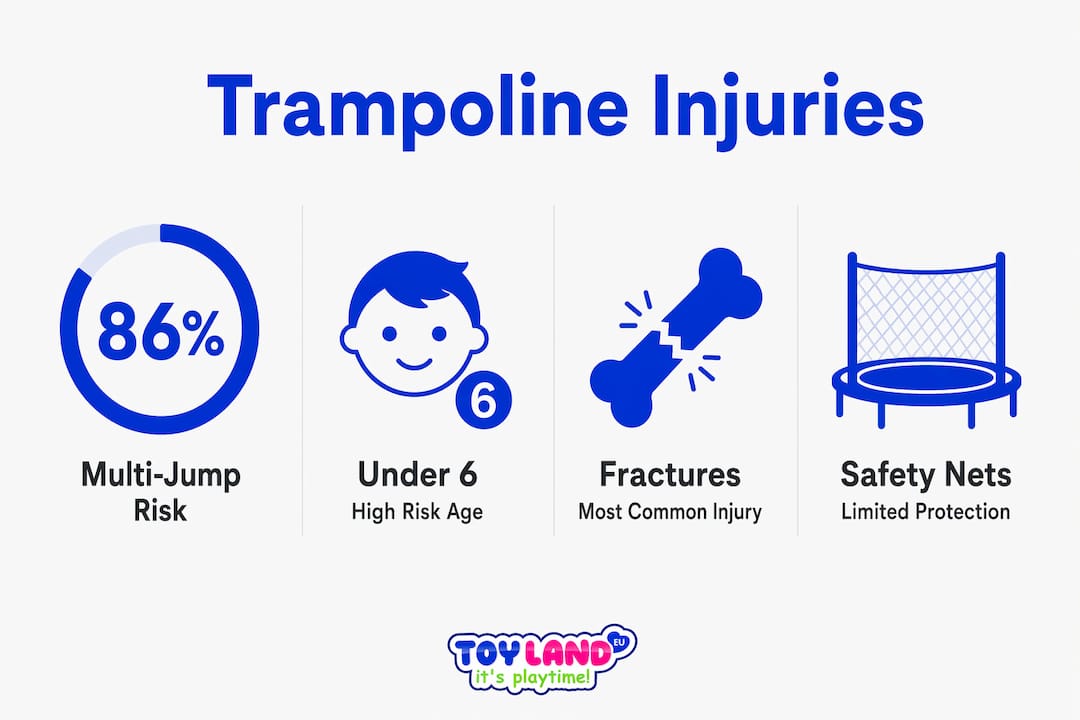
Fractures of the wrist, forearm, elbow, and collarbone are the most common trampoline injuries treated in children. These upper-limb breaks typically happen when a child lands awkwardly or reaches out to break a fall on the mat surface. They account for a large share of emergency room visits and often require casting or surgery.

Head and spinal injuries represent the more severe end of the injury spectrum. Pediatric trauma centers report that children under 5 more often sustain head injuries, while older children more commonly experience spinal injuries. That age-based pattern matters because it shapes which child in your household faces which type of risk.
The injury types parents most commonly see include:
- Fractures: Wrists, forearms, elbows, and collarbones from awkward landings
- Sprains and strains: Ankles and knees from uncontrolled bouncing
- Concussions: From collisions with other jumpers or the mat surface
- Head trauma: More common in children under 5
- Spinal injuries: More common in older children attempting flips or somersaults
| Injury Type | Most Affected Age Group | Common Cause |
|---|---|---|
| Upper-limb fractures | All ages | Awkward landings, reaching out to break falls |
| Concussion | Under 10 | Collisions with other jumpers |
| Head trauma | Under 5 | Falls and collision forces |
| Spinal injuries | Over 6 | Flips, somersaults, double-bounce dynamics |
| Sprains and strains | All ages | Uncontrolled bouncing, missteps |
Many of these injuries require more than a bandage. Hospital stays, surgical intervention, and weeks of recovery are documented outcomes. The severity is not rare or exceptional. It is a predictable result of the forces involved.
Why safety equipment does not eliminate trampoline risks
Safety nets and padding are the two features parents rely on most. Safety nets primarily prevent falls off the perimeter of the trampoline. They do not reduce collisions between jumpers on the mat surface, and they do not prevent awkward landings from flips or double-bounce dynamics.
The physics of trampolining create forces that no net can intercept. When a child bounces, they generate momentum that compounds with each jump. A collision mid-air or an off-center landing transfers that force directly to joints, bones, and the head. Severe injuries occur even when an adult is supervising because the collision happens faster than any adult can intervene.
Equipment also degrades. Weather and UV exposure break down trampoline mats, springs, and padding over time. A net that looked fine in spring may have weakened significantly by summer. Safety labels and certifications reflect the product when new, not after a season of outdoor use.
Key limitations of standard safety equipment:
- Enclosure nets: Stop perimeter falls but not on-mat collisions
- Spring covers and padding: Reduce spring-contact injuries but degrade with weather
- Adult supervision: Cannot physically prevent fast-moving collision injuries
- Helmets and pads: Not standard practice and not proven to prevent most trampoline injuries
Pro Tip: Inspect your trampoline’s mat, springs, and net every month during active use. Look for tears, rust, and stretched or missing padding. A degraded net gives parents a false sense of security while providing little real protection.
How risk factors like age and multiple users increase danger
86% of trampoline injuries happen when multiple children jump at the same time. That single statistic explains why the one-jumper rule is the most important safety guideline in existence. When children of different weights share a trampoline, the heavier child’s bounce sends the lighter child airborne unpredictably.
The lightest child in a multi-jumper session is five times more likely to be injured. That is not a marginal increase in risk. It is the difference between a controlled activity and a predictable accident. The mechanism is called double-bounce dynamics: the heavier jumper lands and compresses the mat just as the lighter child is coming down, launching them with far greater force than they generated themselves.
Age compounds the risk further. The American Academy of Pediatrics advises against any recreational trampoline use for children under 6. Their bones are still developing, their coordination is limited, and their ability to anticipate and react to collision forces is not yet mature. Placing a 4-year-old on a trampoline with older siblings is not a supervised activity. It is a high-probability injury scenario.
Risky behaviors multiply the danger further:
- Flips and somersaults are the leading cause of spinal injuries on trampolines
- Crowded trampoline parks increase collision frequency and severity
- Jumping near the edge raises the risk of perimeter falls even with nets
- Fatigue reduces a child’s ability to control landings after extended sessions
Statistic callout: The lightest child jumping with others is 5x more likely to be injured. One jumper at a time eliminates this risk entirely.
What safety measures actually reduce trampoline injuries
The most effective rule is one jumper at a time. No other measure comes close in terms of injury prevention. Awareness of safety guidelines alone does not significantly reduce injury severity. Rules must be enforced consistently, not just posted on a sign.
Parents who choose to keep a trampoline should follow these steps:
- Allow only one child on the mat at a time. This eliminates the multi-jumper collision risk that causes 86% of injuries.
- Ban flips and somersaults completely. These moves are the primary cause of spinal injuries and should not be attempted without professional gymnastics training.
- Separate children by age and size. Never allow a child under 6 to share jumping time with older children.
- Inspect the trampoline monthly. Check the mat for tears, the springs for rust or stretching, and the net for holes or loose attachments.
- Place the trampoline on level ground with a soft surface underneath. Grass or rubber matting reduces injury severity if a child does fall off.
- Remove the ladder when not in use. This prevents unsupervised access by young children.
Pro Tip: Set a visible timer for each child’s jumping session. Fatigue is a real injury factor, and children rarely self-regulate. A 10-minute limit per session keeps energy levels and coordination higher.
Knowing when to seek medical care is equally important. Seek urgent attention if a child complains of neck or back pain after a fall, loses consciousness even briefly, vomits after a head impact, or cannot bear weight on a limb. These are signs of injuries that cannot wait for a routine appointment. For more on child play safety standards, Toylandeu™ has a practical parent-focused guide worth reading.
Are trampoline parks safer than backyard trampolines?
Trampoline parks feel safer because they are staffed, regulated, and purpose-built. The reality is more complicated. Indoor parks may produce a higher rate of severe fractures and surgical interventions compared to backyard trampolines. The beds at commercial parks are often harder and more tightly sprung, which increases the force of each landing.
Crowding is the other major factor. A busy trampoline park on a weekend afternoon puts multiple children in close proximity across interconnected jumping surfaces. Collision risk rises with the number of bodies in motion. Staff supervision helps, but the same physics that make backyard multi-jumper sessions dangerous apply in parks.
| Setting | Key Risk Factors | Relative Severity |
|---|---|---|
| Backyard trampoline | Falls off edge, unsupervised access, equipment degradation | Moderate to high |
| Trampoline park | Harder beds, crowding, interconnected surfaces, peer pressure for risky moves | High, with more severe fractures |
Backyard trampolines carry their own specific risks. Falls onto surrounding ground, contact with nearby fences or structures, and unsupervised use by young children are the primary concerns. Neither setting is categorically safer. Both require the same core rules: one jumper at a time, no flips, and age-appropriate access. Regulated parks have progressively reduced injury rates through structured supervision, but the risks remain real and significant.
Key Takeaways
Trampolines carry unavoidable injury risks for children, and the single most effective protection is enforcing a strict one-jumper-at-a-time rule at all times.
| Point | Details |
|---|---|
| Multiple jumpers are the top risk | 86% of injuries occur with more than one child on the mat simultaneously. |
| Children under 6 should not jump | The American Academy of Pediatrics advises against trampoline use for this age group. |
| Safety nets have limits | Nets prevent perimeter falls but do not stop on-mat collisions or flip injuries. |
| Equipment degrades over time | Inspect mats, springs, and nets monthly to catch weather-related wear before it causes injury. |
| Parks are not automatically safer | Commercial trampoline parks may produce more severe fractures due to harder beds and crowding. |
The trampoline question parents actually need to answer
I have watched parents install safety nets and feel the job is done. That instinct is understandable. You bought the equipment, you followed the instructions, and the net looks solid. But the research is clear: the net is not the variable that determines whether your child gets hurt. The number of children on the mat at the same time is.
What I find most striking is how consistently the data points to behavior over equipment. You can buy the most expensive trampoline on the market, with every safety feature available, and still have a child in the emergency room by the end of the afternoon if two kids are jumping together. The physics do not care about the price tag.
My honest position is that trampolines are worth the risk only if parents are willing to enforce rules that feel socially awkward. Telling a group of kids that only one can jump at a time, while the others wait, is not a popular call. Most parents relax the rule after five minutes of protest. That relaxation is where the injuries happen.
If your child is under 6, the answer from pediatric medicine is unambiguous. Wait. If your child is older and you choose to allow trampoline use, the one-jumper rule is not a suggestion. It is the only meaningful protection you have. For parents who want to explore safer play equipment options that still deliver outdoor fun, there are good alternatives worth considering.
— Thane Holland
Safer play options worth exploring at Toylandeu™
Not every exciting activity for kids carries the fracture risk of a trampoline. Toylandeu™ carries over 30,000 toys designed for children across all age groups, including options that deliver genuine engagement without the injury profile of high-impact bouncing.

For parents looking for creative indoor alternatives, the Montessori Drawing Kit from Toylandeu™ gives kids a structured, hands-on activity that builds fine motor skills and focus. For outdoor excitement without the collision risk, the gesture-controlled stunt car delivers real thrills through remote control play. Free worldwide shipping is available on all orders, making it easy to find the right fit for your child’s interests and your family’s safety priorities.
FAQ
Are trampolines dangerous for kids under 6?
The American Academy of Pediatrics defines trampolines as too dangerous for children under 6 and advises against recreational use entirely for this age group. Developing bones and limited coordination make serious fractures and head injuries far more likely.
What is the most common trampoline injury in children?
Fractures of the wrist, forearm, elbow, and collarbone are the most frequently treated trampoline injuries in children. These typically result from awkward landings or attempts to break a fall on the mat surface.
Do safety nets prevent trampoline injuries?
Safety nets reduce falls off the perimeter of the trampoline but do not prevent the most common injuries, which occur from collisions and awkward landings on the mat itself.
Are trampoline parks safer than home trampolines?
Not necessarily. Studies indicate that trampoline parks may produce a higher rate of severe fractures due to harder jumping surfaces and crowded conditions. The same core safety rules apply in both settings.
What is the single most effective trampoline safety rule?
Allowing only one child to jump at a time eliminates the multi-jumper collision dynamic responsible for 86% of trampoline injuries. No other single measure reduces risk as significantly.