

Bouncy house safety: A parent's guide to safer play
TL;DR:
- Most bounce house injuries are preventable through proper setup, supervision, and safety measures.
- Certified models with key safety features reduce risks but do not eliminate the need for active adult supervision.
- Wind, overcrowding, and adult distraction are major factors contributing to bounce house accidents.
US emergency rooms treated 11,200 bounce house injuries in 2023 alone, with 75% of those children under 12. That number sounds alarming, but here’s the reassuring part: the vast majority of these injuries are preventable. Most accidents trace back to skipped setup steps, poor supervision, or the wrong product choice. This guide breaks down the real risks, the features worth paying for, and the practical habits that keep kids bouncing safely. Whether you’re renting for a birthday party or buying for the backyard, you’ll find actionable, research-backed steps here.
Table of Contents
- Understanding the risks: Injury trends and statistics
- Choosing a safer bouncy house: Key features and certifications
- Preparing for safe setup: Location, anchoring, and weather awareness
- Supervising play and emergency readiness
- Why most bouncy house accidents are still preventable: Hard truths for parents
- Explore safe and exciting play options for your children
- Frequently asked questions
Key Takeaways
| Point | Details |
|---|---|
| Injury risk is real | Bouncy houses cause thousands of injuries yearly, but most are preventable with the right steps. |
| Buy safety-certified | Choose models with ASTM certification, visible safety features, and reputable manufacturer standards. |
| Prepare and supervise | Safe setup, weather checks, anchoring, and active adult supervision are essential for injury prevention. |
| Emergency readiness | Have a plan for rapid evacuation, first aid, and immediate shutdown in case of trouble. |
Understanding the risks: Injury trends and statistics
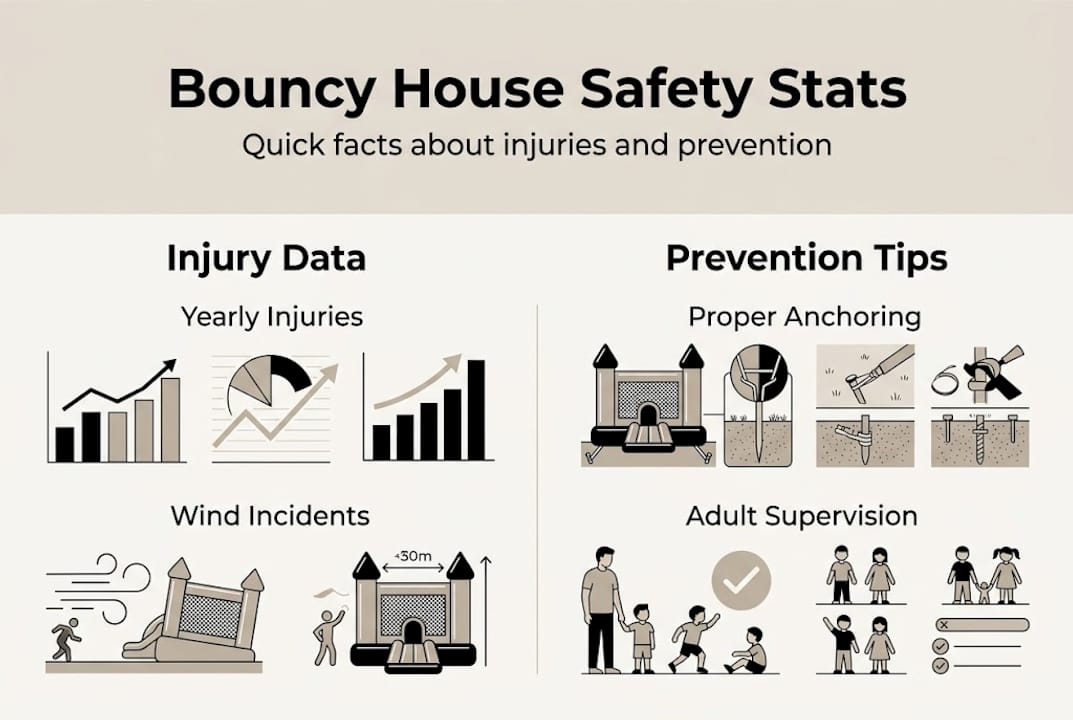
Before you inflate anything, it helps to understand what you’re actually dealing with. Bounce house injuries are not rare edge cases.
Key injury statistics at a glance
| Category | Data |
|---|---|
| Total injuries (2003–2013) | ~113,272 |
| Annual injuries (recent years) | ~17,500–21,000 |
| Deaths decrease since 2020 | 40% |
| Wind-related deaths (2000–2025) | 28 worldwide |
The injury data from 2003 to 2025 tells a story of both growing popularity and improving safety awareness. Deaths have dropped 40% since 2020, thanks largely to better product standards and wider public education. Still, tens of thousands of children are injured every year.
The most common injury types include:
- Fractures and broken bones, especially to arms and wrists from falls
- Soft tissue injuries like sprains and bruises from collisions
- Head and neck injuries from flips or tumbling into walls
- Lacerations from contact with zippers, seams, or hard surfaces
“Most injuries happen not because of freak accidents, but because of predictable, avoidable situations: too many kids at once, mixed age groups, or unsecured inflatables.”
Wind is a separate and serious category. Wind-related incidents caused over 503 injuries and 28 deaths worldwide between 2000 and 2025. These events tend to be sudden and severe. A gust can lift an entire inflatable off the ground in seconds.
The good news is that awareness is working. Checking out 2026 bouncy house safety tips before every use is becoming standard practice among informed parents. Understanding the data is step one. Acting on it is what actually protects your kids.
Choosing a safer bouncy house: Key features and certifications
Not all bouncy houses are built the same. A $99 discount inflatable and a properly certified model may look similar in photos, but the differences in safety features are significant.
Feature comparison: Budget vs. certified models
| Feature | Budget model | Certified model |
|---|---|---|
| Mesh safety walls | Sometimes | Always |
| Non-slip floor surface | Rarely | Standard |
| Non-return air valves | No | Yes |
| Deflation alert system | No | Yes (for heights over 8 ft) |
| ASTM certification | No | Yes |
| Clear weight/age limits | Vague | Clearly labeled |
When shopping, here’s what to look for in order of importance:
- ASTM F2374 certification: This is the industry standard for inflatable amusement devices. It covers design, materials, and performance requirements.
- Mesh side walls: These allow airflow and visibility while preventing kids from bouncing out.
- Non-slip interior surfaces: Critical for preventing falls, especially when kids are jumping near each other.
- Non-return valves and deflation alerts: Reputable manufacturers build in non-return valves and deflation alerts for units over 8 feet tall, which reduce the risk of sudden collapse.
- Clearly printed weight and age limits: Vague or missing limits are a red flag.
- Reinforced anchor points: At least 6 anchor loops around the base.
Pro Tip: Before buying, search the manufacturer’s name alongside “ASTM” or “safety recall” online. If nothing comes up to confirm certification, keep looking. Reputable brands are transparent about their compliance.
You can also explore toy safety tech innovations to understand how modern design is reducing risk across children’s products. The investment in a quality bouncy house pays off in peace of mind and fewer trips to the emergency room.
Preparing for safe setup: Location, anchoring, and weather awareness
You’ve chosen a quality product. Now comes the setup, and this is where many parents cut corners without realizing the consequences.
Choosing the right location
Pick a flat, grassy surface free of rocks, roots, and debris. Keep the inflatable:
- At least 6 feet away from fences, walls, and trees
- Away from driveways, pools, and hard surfaces
- Clear of overhead power lines or hanging branches
- On a surface that allows stakes or anchors to penetrate fully
Avoid concrete or asphalt entirely. If a child falls out, the landing surface matters enormously.
Anchoring properly
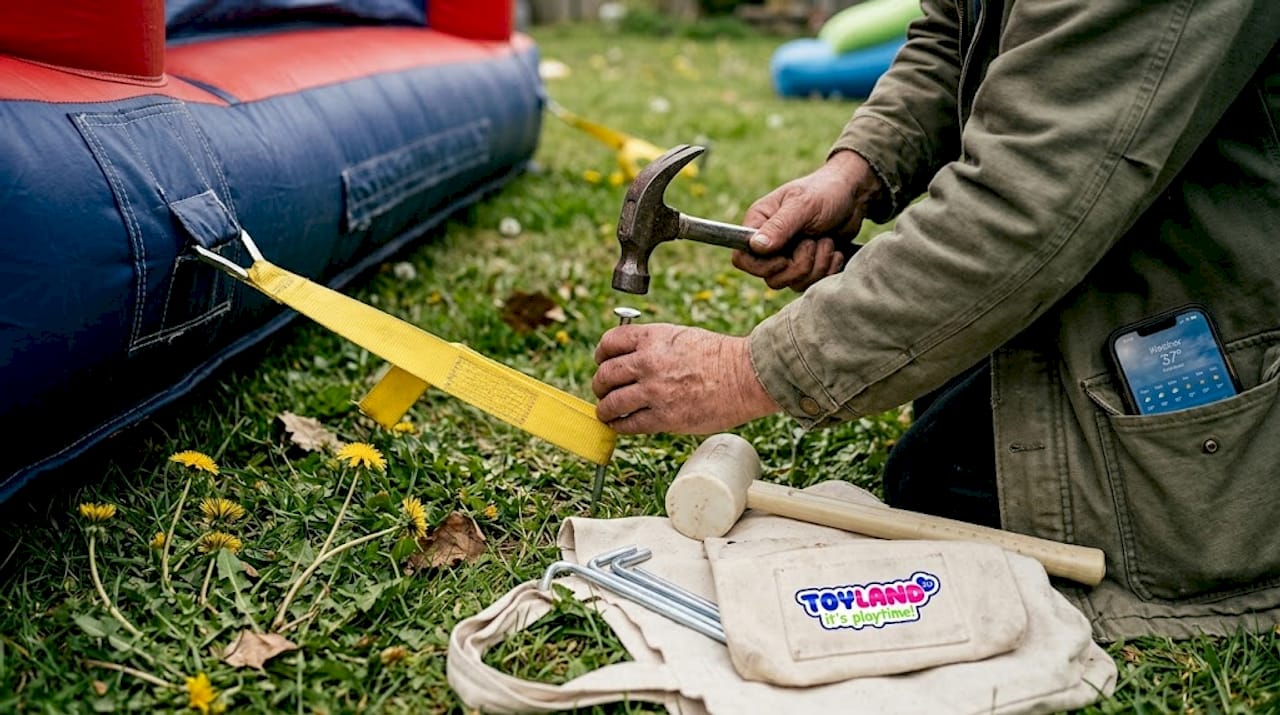
Every anchor point on the inflatable must be secured. Use the stakes that come with the unit and supplement with sandbags if the ground is too hard for deep staking. Never assume two or three anchors are enough. Innovative safety technologies in 2026 now include anchor tension sensors in commercial units, but for home use, a physical check of every point before kids enter is essential.
Weather is non-negotiable
“Wind is the single most dangerous environmental factor for bounce houses. It can turn a secured inflatable into a projectile in under 10 seconds.”
Check the forecast before setup. If wind speeds are expected to exceed 15 mph, do not inflate. Wind incidents globally have caused 503+ injuries and 28 deaths between 2000 and 2025. Most of those happened when conditions changed unexpectedly during use.
Pro Tip: Keep a weather app open during the event. Set an alert for wind speed changes. If conditions shift, evacuate the bouncy house immediately and deflate it before re-anchoring.
Supervising play and emergency readiness
Setup done, kids excited, and the blower is humming. This is exactly when adult attention needs to go up, not down.
Rules to set before anyone enters
- Age and size separation: Never mix toddlers with older kids. Larger children create unpredictable bounce patterns that can injure smaller ones.
- Maximum occupancy: Follow the manufacturer’s limit strictly. Overcrowding is one of the top causes of collisions and falls.
- No flips or roughhousing: Somersaults and wrestling are the fastest route to a neck or head injury.
- Shoes off, pockets empty: Hard objects and footwear increase injury risk significantly.
- One entrance and exit: Prevents collisions at the opening.
Active supervision strategies
- Assign one adult specifically to watch the bouncy house. Do not multitask.
- Stand close enough to intervene, not across the yard.
- Rotate supervision duties every 15 to 20 minutes to maintain focus.
- Call all kids out for a break every 30 minutes to reduce fatigue-related accidents.
Residential use lacks the operator training mandates that commercial operators must meet. That means you need to personally fill that gap with consistent rules and real attention.
Pro Tip: Print out your rules on a card and tape it near the entrance. Kids respond better to visible reminders than verbal-only instructions.
Emergency readiness
- Keep a first-aid kit within arm’s reach.
- Know how to cut power to the blower quickly.
- Practice a verbal evacuation signal with kids before play begins.
- Review safe bouncy play rules with every new group of children.
Why most bouncy house accidents are still preventable: Hard truths for parents
Here’s a perspective that most safety guides won’t say plainly: the biggest risk factor at any bounce house is not the inflatable itself. It’s the adult who walked away.
Improved ASTM standards and better manufacturing matter. But they are backstops, not substitutes for supervision. The data consistently shows that injuries spike when adults are distracted, when age groups are mixed carelessly, or when setup instructions are skimmed. These are not rare oversights. They are the norm at backyard parties.
There’s also a false comfort in thinking that buying an expensive, certified model covers your responsibility. It doesn’t. A $500 bouncy house with mesh walls and anchor points still becomes dangerous the moment you stop watching. The cutting-edge safety solutions entering the market are genuinely impressive, but they support attentive parents, they don’t replace them.
The overlooked risks are almost always the obvious ones: a sudden gust of wind, one too many kids inside, or a flip that “looked fine” until it wasn’t. Safety is not a feature you buy. It’s a habit you practice every single time.
Explore safe and exciting play options for your children
Knowing what to look for in a safe bouncy house puts you ahead of most parents. But safe play doesn’t stop at inflatables.
At ToylandEU, we curate toys with quality and safety in mind across every category. If you’re looking for high-energy outdoor fun that doesn’t require setup and anchoring, our gesture-controlled stunt car is a crowd favorite for kids who love action. For younger thrill-seekers, the kids stunt car with 4WD drift delivers serious excitement with simple controls. With free worldwide shipping and over 30,000 products, finding the right safe toy for your child has never been easier.
Frequently asked questions
Are bouncy houses safe for toddlers?
Most experts recommend bouncy houses for children aged 6 and older. Toddlers face a higher fracture risk due to their smaller size and underdeveloped coordination when mixed with older, larger children.
What should I do if the bouncy house starts to deflate while in use?
Evacuate all children immediately and cut power to the blower. Units with deflation alert systems for heights over 8 feet give you a warning window, but the safest response is always immediate evacuation first.
How can I tell if my backyard is suitable for a bouncy house?
Look for a flat, soft surface with no rocks, roots, or debris, and confirm you have enough clearance on all sides to anchor every point securely away from fences and trees.
What weather conditions are considered unsafe for bouncy house use?
Never use a bouncy house during rain, storms, or when winds exceed 15 to 20 mph. Wind-related incidents have caused over 503 injuries and 28 deaths worldwide, and conditions can change faster than most parents expect.